


The disappearance of the dinosaurs is probably the world’s most famous example of a mass extinction, but it’s certainly not the only one.
There have been at least four other mass extinctions on Earth over the past 500 million years.
A mass extinction refers to the die-off of a huge number of species in a relatively short period of time. In the past, mass extinctions have been caused by geological or climatic events, such as the asteroid strike that wiped out the dinosaurs.
But according to scientists, we are experiencing another mass extinction. And this time, it’s of our own making.
Biological Armageddon
A new study published in the journal Proceedings of the National Academy of Sciences says that there is a “biological annihilation” underway.
Researchers from Stanford University and the National Autonomous University of Mexico looked at 27,600 terrestrial vertebrate species (animals with a backbone that live on land), which represent around half of all vertebrate species, and found that 32% are decreasing in population.
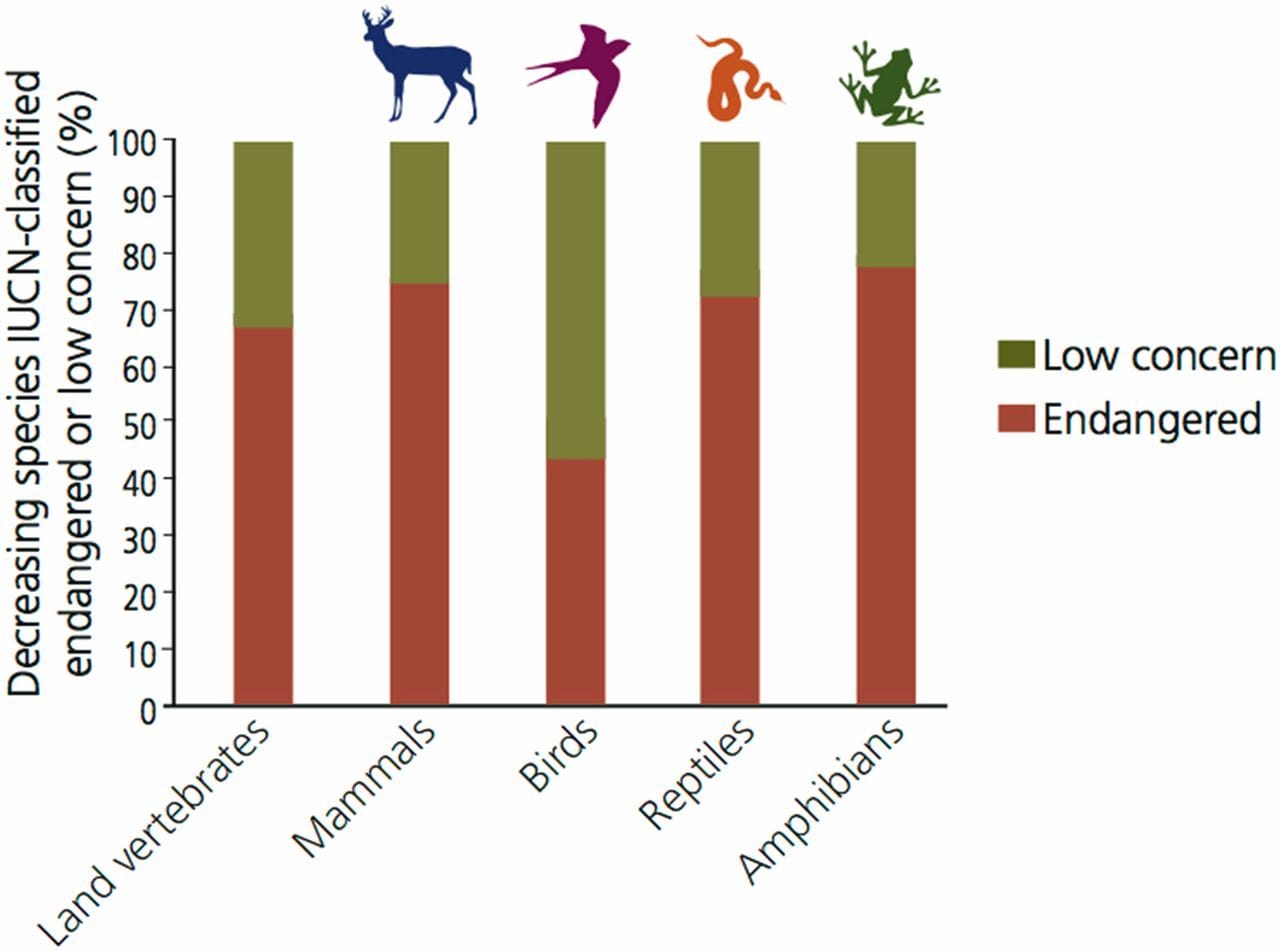
They also looked at 177 mammal species, and found that all have lost at least a third of their geographic ranges. In addition, nearly one in two of the species have experienced severe population declines.
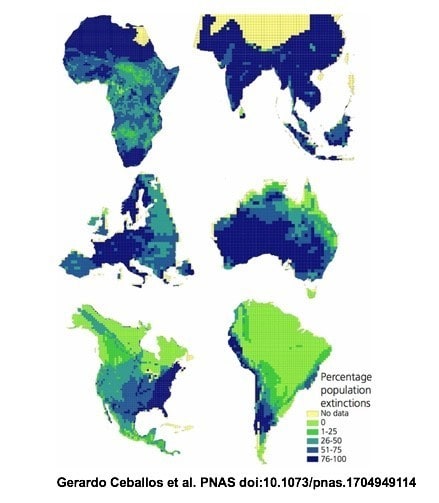
Several species of mammals that were relatively safe one or two decades ago are now endangered. For instance, the number of African lions has dropped by 43% since 1993.
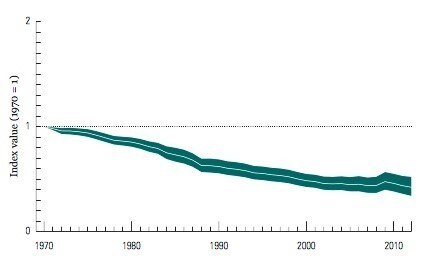
The study is not the only piece of research to come to the conclusion that certain species are declining rapidly. The Living Planet Index, which measures the number of 3706 vertebrate species, also shows a persistent downward trend.
This one is different
Although mass extinctions occurred before humans took over the planet, the scientists say that the rate of die-offs has speeded up considerably.
Even by their conservative estimates, almost 200 species of vertebrates have become extinct in the last 100 years. This is equivalent to around two species a year. In past extinctions, the loss of 200 species would have taken up to 10,000 years.
The problem, say the authors of the study, is that two extinctions a year do not attract enough global attention, especially if people have not heard of the creature in the first place. They use the examples of the Catarina pupfish and the Christmas Island pipistrelle, a small bat, which have both vanished in recent years.
They argue that the world should be paying attention, because the loss of biological diversity is one of the most severe human-caused global environmental problems.
In the last few decades, humans have taken over vast swathes of animal habitat and caused pollution and global warming. All of which, the authors say, have led to catastrophic declines in populations of both common and rare vertebrate species.
The problem with extinction is that it’s irreversible, and it has a profound effect on the planet’s ecosystem. Everything from the food we eat to the resources that we use are with us because of the Earth’s extraordinary biodiversity.
There’s not enough time, they say, to prevent the shrinking of biodiversity, and any notion that we can somehow bring extinct animals back to life is a “misimpression”.
But not everyone agrees with the scientists’ gloomy assessment.
Earth bouncing back?
Some argue that if we really were in the middle of a mass extinction, the world would already be over. Smithsonian paleontologist Doug Erwin told The Atlantic:
“People who claim we’re in the sixth mass extinction don’t understand enough about mass extinctions to understand the logical flaw in their argument.
“To a certain extent they’re claiming it as a way of frightening people into action, when in fact, if it’s actually true we’re in a sixth mass extinction, then there’s no point in conservation biology.”
Although he warns:
“I think that if we keep things up long enough, we’ll get to a mass extinction, but we’re not in a mass extinction yet, and I think that’s an optimistic discovery because that means we actually have time to avoid Armageddon.”
And there is another reason for a more optimistic outlook. New species are coming into existence faster than ever thanks to humans, according to Chris D Thomas, Professor of Evolutionary Biology at the University of York.
He argues that we underestimate just how far nature can adapt.
“Throughout the history of the Earth, species have survived by moving to new locations that permit them to flourish,” he says.
“A million or so years from now, the world could end up supporting more species, not fewer, as a consequence of the evolution of Homo sapiens.”
But the authors of the biological annihilation study have a stark warning: even our own days might be numbered.
“Earth’s sixth mass extinction episode has proceeded further than most assume,” they conclude.
“The window for effective action is very short, probably two or three decades at most.
“All signs point to ever more powerful assaults on biodiversity in the next two decades, painting a dismal picture of the future of life, including human life.”
Receive Daily Updates
Recent Posts
Petrol in India is cheaper than in countries like Hong Kong, Germany and the UK but costlier than in China, Brazil, Japan, the US, Russia, Pakistan and Sri Lanka, a Bank of Baroda Economics Research report showed.
Rising fuel prices in India have led to considerable debate on which government, state or central, should be lowering their taxes to keep prices under control.
The rise in fuel prices is mainly due to the global price of crude oil (raw material for making petrol and diesel) going up. Further, a stronger dollar has added to the cost of crude oil.
Amongst comparable countries (per capita wise), prices in India are higher than those in Vietnam, Kenya, Ukraine, Bangladesh, Nepal, Pakistan, Sri Lanka, and Venezuela. Countries that are major oil producers have much lower prices.
In the report, the Philippines has a comparable petrol price but has a per capita income higher than India by over 50 per cent.
Countries which have a lower per capita income like Kenya, Bangladesh, Nepal, Pakistan, and Venezuela have much lower prices of petrol and hence are impacted less than India.
“Therefore there is still a strong case for the government to consider lowering the taxes on fuel to protect the interest of the people,” the report argued.
India is the world’s third-biggest oil consuming and importing nation. It imports 85 per cent of its oil needs and so prices retail fuel at import parity rates.
With the global surge in energy prices, the cost of producing petrol, diesel and other petroleum products also went up for oil companies in India.
They raised petrol and diesel prices by Rs 10 a litre in just over a fortnight beginning March 22 but hit a pause button soon after as the move faced criticism and the opposition parties asked the government to cut taxes instead.
India imports most of its oil from a group of countries called the ‘OPEC +’ (i.e, Iran, Iraq, Saudi Arabia, Venezuela, Kuwait, United Arab Emirates, Russia, etc), which produces 40% of the world’s crude oil.
As they have the power to dictate fuel supply and prices, their decision of limiting the global supply reduces supply in India, thus raising prices
The government charges about 167% tax (excise) on petrol and 129% on diesel as compared to US (20%), UK (62%), Italy and Germany (65%).
The abominable excise duty is 2/3rd of the cost, and the base price, dealer commission and freight form the rest.
Here is an approximate break-up (in Rs):
a)Base Price | 39 |
b)Freight | 0.34 |
c) Price Charged to Dealers = (a+b) | 39.34 |
d) Excise Duty | 40.17 |
e) Dealer Commission | 4.68 |
f) VAT | 25.35 |
g) Retail Selling Price | 109.54 |
Looked closely, much of the cost of petrol and diesel is due to higher tax rate by govt, specifically excise duty.
So the question is why government is not reducing the prices ?
India, being a developing country, it does require gigantic amount of funding for its infrastructure projects as well as welfare schemes.
However, we as a society is yet to be tax-compliant. Many people evade the direct tax and that’s the reason why govt’s hands are tied. Govt. needs the money to fund various programs and at the same time it is not generating enough revenue from direct taxes.
That’s the reason why, govt is bumping up its revenue through higher indirect taxes such as GST or excise duty as in the case of petrol and diesel.
Direct taxes are progressive as it taxes according to an individuals’ income however indirect tax such as excise duty or GST are regressive in the sense that the poorest of the poor and richest of the rich have to pay the same amount.
Does not matter, if you are an auto-driver or owner of a Mercedes, end of the day both pay the same price for petrol/diesel-that’s why it is regressive in nature.
But unlike direct tax where tax evasion is rampant, indirect tax can not be evaded due to their very nature and as long as huge no of Indians keep evading direct taxes, indirect tax such as excise duty will be difficult for the govt to reduce, because it may reduce the revenue and hamper may programs of the govt.