


The Arctic could be free of sea ice by 2040, 30 years earlier than previously suggested
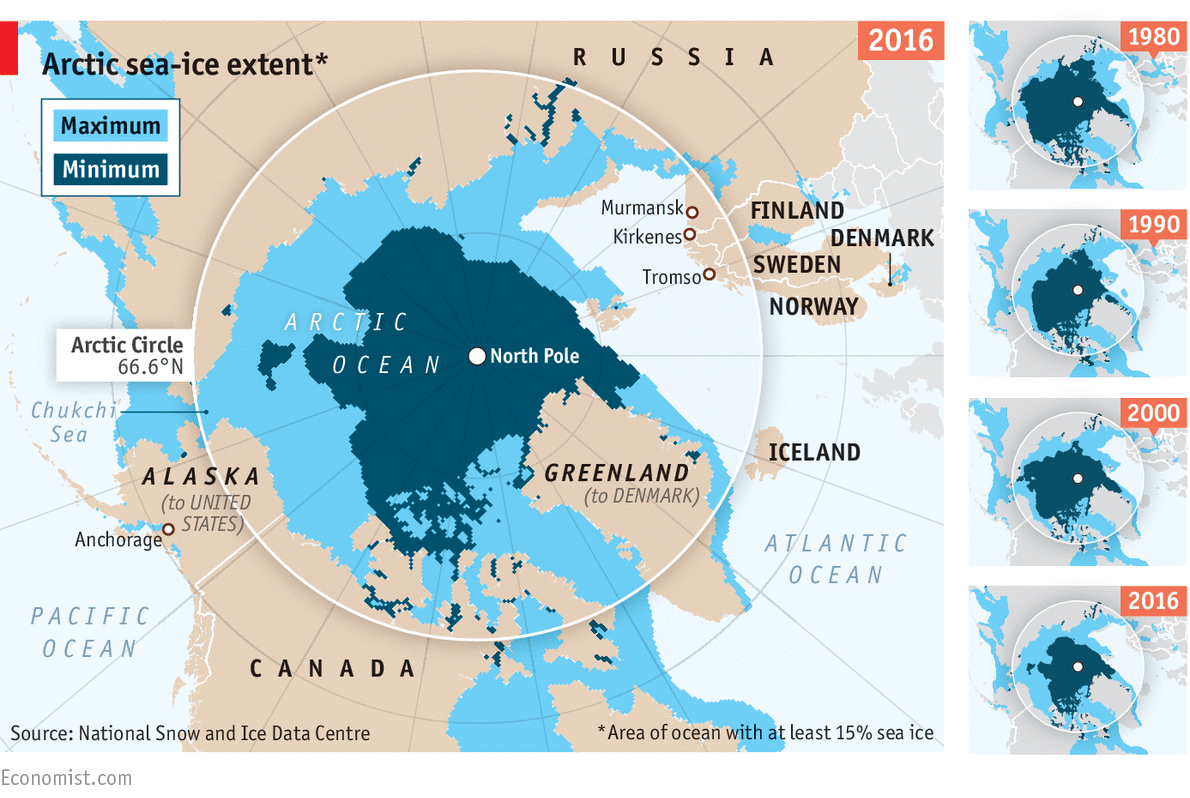
OVER the past three decades the area of sea ice in the Arctic has fallen by more than half and its volume has plummeted by three-quarters. So says a report “Snow, Water, Ice, Permafrost in the Arctic” (SWIPA), produced under the auspices of the Arctic Council (Prelims question in 2014), a scientific-policy club for the eight countries with territory in the Arctic Circle, as well as observers including China and India.
SWIPA estimates that the Arctic will be free of sea ice in the summer by 2040. Scientists previously suggested this would not occur until 2070. The thickness of ice in the central Arctic ocean declined by 65% between 1975 and 2012; record lows in the maximum extent of Arctic sea ice occurred in March.
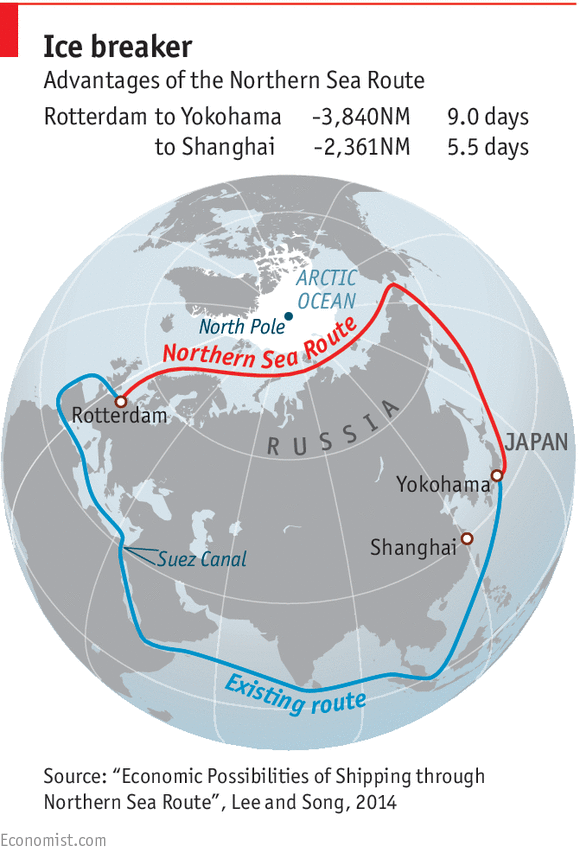
In theory shipping firms should benefit from access to a more open seaway. Using it to sail from northern Europe to north-east Asia can cut the length of voyages by two-fifths compared with travelling via the Suez Canal. But any Arctic promise has drifted away and the expected shipping boom has not materialised. In 2012 only 1m tonnes of goods were shipped through the northern passage, a paltry level of activity yet one not achieved since.
Even in the summer months the Arctic ocean is stormy, making timely delivery of goods impossible to guarantee. Drifting ice also poses a danger. Ships must be strengthened to withstand it, adding to construction costs. And a lack of coastal infrastructure, such as deepwater ports, means that spills of the heavy fuel oil that powers most vessels could wreak havoc on both ecosystems and reputations, because clean-up missions would have to set out from much farther away and would take much longer to be effective.
A new Polar Code from the International Maritime Organisation, which regulates shipping, came into force at the beginning of the year to try to address some of these concerns. It bans discharges of sewage and oily mixtures in polar waters. America and Canada, among others, want to go further. For one thing, they want a ban on heavy fuel-oil (as there is in the Antarctic, which has various special protections).
Nothing, however, looms larger than the potential for environmental calamity. The question of thawing is rising up the list of priorities both of countries with territory in the region and those farther afield. Sticking to the Paris agreement could, eventually, stabilise temperatures. But more radical measures may be needed given that countries are unlikely to keep within the limits set in Paris.
Polar Code
IMO has adopted the International Code for Ships Operating in Polar Waters (Polar Code) and related amendments to make it mandatory under both the International Convention for the Safety of Life at Sea (SOLAS) and the International Convention for the Prevention of Pollution from Ships (MARPOL).
The Polar Code entered into force on 1 January 2017. This marks an historic milestone in the Organization’s work to protect ships and people aboard them, both seafarers and passengers, in the harsh environment of the waters surrounding the two poles.
The Polar Code and SOLAS amendments were adopted during the 94th session of IMO’s Maritime Safety Committee (MSC), in November 2014; the environmental provisions and MARPOL amendments were adopted during the 68th session of the Marine Environment Protection Committee (MEPC) in May 2015.
The Polar Code covers the full range of design, construction, equipment, operational, training, search and rescue and environmental protection matters relevant to ships operating in the inhospitable waters surrounding the two poles.
The Polar Code includes mandatory measures covering safety part (part I-A) and pollution prevention (part II-A) and recommendatory provisions for both (parts I-B and II-B).
Whilst Arctic and Antarctic waters have a number of similarities, there are also significant differences. The Arctic is an ocean surrounded by continents while the Antarctic is a continent surrounded by an ocean. The Antarctic sea ice retreats significantly during the summer season or is dispersed by permanent gyres in the two major seas of the Antarctic: the Weddell and the Ross. Thus there is relatively little multi-year ice in the Antarctic. Conversely, Arctic sea ice survives many summer seasons and there is a significant amount of multi-year ice. Whilst the marine environments of both Polar seas are similarly vulnerable, response to such challenge should duly take into account specific features of the legal and political regimes applicable to their respective marine spaces.
Receive Daily Updates
Recent Posts
Petrol in India is cheaper than in countries like Hong Kong, Germany and the UK but costlier than in China, Brazil, Japan, the US, Russia, Pakistan and Sri Lanka, a Bank of Baroda Economics Research report showed.
Rising fuel prices in India have led to considerable debate on which government, state or central, should be lowering their taxes to keep prices under control.
The rise in fuel prices is mainly due to the global price of crude oil (raw material for making petrol and diesel) going up. Further, a stronger dollar has added to the cost of crude oil.
Amongst comparable countries (per capita wise), prices in India are higher than those in Vietnam, Kenya, Ukraine, Bangladesh, Nepal, Pakistan, Sri Lanka, and Venezuela. Countries that are major oil producers have much lower prices.
In the report, the Philippines has a comparable petrol price but has a per capita income higher than India by over 50 per cent.
Countries which have a lower per capita income like Kenya, Bangladesh, Nepal, Pakistan, and Venezuela have much lower prices of petrol and hence are impacted less than India.
“Therefore there is still a strong case for the government to consider lowering the taxes on fuel to protect the interest of the people,” the report argued.
India is the world’s third-biggest oil consuming and importing nation. It imports 85 per cent of its oil needs and so prices retail fuel at import parity rates.
With the global surge in energy prices, the cost of producing petrol, diesel and other petroleum products also went up for oil companies in India.
They raised petrol and diesel prices by Rs 10 a litre in just over a fortnight beginning March 22 but hit a pause button soon after as the move faced criticism and the opposition parties asked the government to cut taxes instead.
India imports most of its oil from a group of countries called the ‘OPEC +’ (i.e, Iran, Iraq, Saudi Arabia, Venezuela, Kuwait, United Arab Emirates, Russia, etc), which produces 40% of the world’s crude oil.
As they have the power to dictate fuel supply and prices, their decision of limiting the global supply reduces supply in India, thus raising prices
The government charges about 167% tax (excise) on petrol and 129% on diesel as compared to US (20%), UK (62%), Italy and Germany (65%).
The abominable excise duty is 2/3rd of the cost, and the base price, dealer commission and freight form the rest.
Here is an approximate break-up (in Rs):
a)Base Price | 39 |
b)Freight | 0.34 |
c) Price Charged to Dealers = (a+b) | 39.34 |
d) Excise Duty | 40.17 |
e) Dealer Commission | 4.68 |
f) VAT | 25.35 |
g) Retail Selling Price | 109.54 |
Looked closely, much of the cost of petrol and diesel is due to higher tax rate by govt, specifically excise duty.
So the question is why government is not reducing the prices ?
India, being a developing country, it does require gigantic amount of funding for its infrastructure projects as well as welfare schemes.
However, we as a society is yet to be tax-compliant. Many people evade the direct tax and that’s the reason why govt’s hands are tied. Govt. needs the money to fund various programs and at the same time it is not generating enough revenue from direct taxes.
That’s the reason why, govt is bumping up its revenue through higher indirect taxes such as GST or excise duty as in the case of petrol and diesel.
Direct taxes are progressive as it taxes according to an individuals’ income however indirect tax such as excise duty or GST are regressive in the sense that the poorest of the poor and richest of the rich have to pay the same amount.
Does not matter, if you are an auto-driver or owner of a Mercedes, end of the day both pay the same price for petrol/diesel-that’s why it is regressive in nature.
But unlike direct tax where tax evasion is rampant, indirect tax can not be evaded due to their very nature and as long as huge no of Indians keep evading direct taxes, indirect tax such as excise duty will be difficult for the govt to reduce, because it may reduce the revenue and hamper may programs of the govt.