


UPSC/STATE PSC
Curated by Experts For Civil Service Aspirants
The Hindu & Indian Express
News 1: ‘Adopt a TB patient’ drive mitras
Background:
- The Union Health Ministry’s “adopt a TB-patient” (Ni-kshay Mitra) initiative, and it was to fill the critical “community” element into India’s fight towards eliminating TB by 2025 under the Pradhan Mantri TB-Mukt Bharat Abhiyaan.
Burden of TB:
- India has the world’s highest tuberculosis (TB) burden, with 26 lakh people contracting the disease and approximately four lakh people dying from it every year.
- The economic burden of TB in terms of the loss of lives, income and workdays is also substantial.
- TB usually affects the most economically productive age group of society resulting in a significant loss of working days.
Ni-kshay Mitra:
- The support provided to the patient under this initiative is in addition to the free diagnostics, free drugs and the Ni-kshay Poshan Yojana provided by the National TB Elimination Programme (NTEP) to all the patients notified from both the public and the private sector.
Donors:
- Cooperative societies, corporates, elected representatives, individuals, institutions, non-governmental organizations, political parties and partners willing to adopt the health facilities (for individual donor) and urban wards, blocks, districts and States for accelerating the response against TB to complement the government’s efforts.
- Some donors would provide additional support to all the on-treatment TB patients who had given consent for support, in the selected health facilities, blocks, urban wards, districts and States. Others have to choose the entire geographical unit (blocks, urban wards, districts and States). The minimum period of commitment for providing the support to the TB patient will be one year.
News 2: ‘Mastermind’ behind Chinese shell firms held
Background:
- The Serious Fraud Investigation Office (SFIO) late on Saturday arrested a person said to be the mastermind behind a slew of Chinese shell companies operating in the country, from a remote part of Bihar while he was attempting to cross the border through the land route.
Serious Fraud Investigation Office:
- Established: 2003 as per Companies Act, 2013
- Headquarter: New Delhi
- Ministry: Ministry of Corporate Affairs
- Type: Statutory organization
- Objective: It is involved in detecting and prosecuting or recommending for prosecution white-collar crimes/frauds. The SFIO is mandated to conduct Multi-disciplinary investigations of major corporate frauds
Shell companies:
- A shell corporation is a corporation without active business operations or significant assets. These types of corporations are not all necessarily illegal, but they are sometimes used illegitimately, such as to disguise business ownership from law enforcement or the public.
News 3: Project 17A Taragiri
Background:
- Taragiri, the third stealth frigate of the Project 17A, was launched on Sunday by Mazagon Dock Shipbuilders Ltd. (MDL).
Taragiri:
- Indigenously designed Taragiri will have state-of-the-art weapons, sensors, an advanced action information system, an integrated platform management system, world class modular living spaces, a sophisticated power distribution system and a host of other advanced features.
- It will be fitted with a supersonic surface-to-surface missile system and the ship’s air defence capability is designed to counter the threat of the enemy aircraft and the anti-ship cruise missiles would revolve around the vertical launch and long-range surface to air missile system.
Project 17A:
- The programme involves the development of 7 advanced guided missile frigates, of which 4 will be built by Mazagaon Dock Shipbuilders and the remaining three ships by GRSE.
- The Nilgiri-class stealth frigates, are also known as Project 17A frigates and it is a follow-on of the Project 17 Shivalik –class frigates.
- The names of ships are based on the names of hill ranges in India i.e., INS Nilgiri, INS Himgiri, INS Udaygiri, INS Dunagiri, INS Taragiri, INS Vindhyagiri, INS Mahendragiri
Ships of Project 17A:
- It will generate employment opportunities for more than 2000 companies and MSMEs in the country.
- Approximately, 80% of the materials and equipment are being sourced from domestic vendors, thus giving a fillip to domestic manufacturers.
News 4: India stays out of ‘trade pillar’ at Indo-Pacific meet
Background:
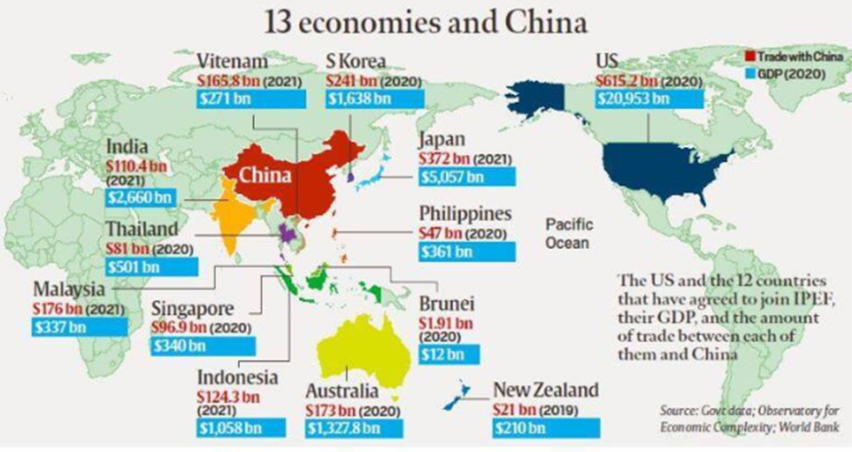
- India stayed out of the joint declaration on the trade pillar of the U.S.-led Indo-Pacific Economic Framework (IPEF) ministerial meet in Los Angeles, with Union Commerce Minister Piyush Goyal citing concerns over possible discrimination against developing economies.
- India was the only one of the 14 IPEF countries, which include Southeast Asian countries, Australia, New Zealand, South Korea and Japan, not to join the declaration on trade.
India’s position on IPEF:
- India was “comfortable” with the outcome statements on the other three pillars: supply chains, clean economy (clean energy) and fair economy (tax and anti-corruption).
- India will be staying out of the trade pillar as the “contours of the framework” had not emerged yet, particularly on the kind of commitment each country would have to make on “environment, labour, digital trade and public procurement.
Indo-Pacific Economic Framework
- The development of an Indo-Pacific economic framework that will define the shared objectives around trade facilitation, standards for the digital economy and technology, supply chain resiliency, decarbonization and clean energy, infrastructure, worker standards, and other areas of shared interest.
- Launched: US President Joe Biden launched it in 2022
- Members: Australia, Brunei, Fiji, India, Indonesia, Japan, South Korea, Malaysia, New Zealand, Philippines, Singapore, Thailand, United States, and Vietnam.
Four pillars:
- Fair and resilient trade
- Supply chain resilience
- Infrastructure, clean energy, and decarbonization
- Tax and anti-corruption
News 5: New adoption rules create confusion

Background:
- Parliament passed the Juvenile Justice (Care and Protection of Children) Amendment Bill, 2021, in July last year, which empowers DMs to give adoption orders. The intent of the amendment was to prevent court-related delays during adoptions because of a large number of pending cases. The amendments came into effect from September 1.
Central Adoption Resource Authority (CARA)
- Type: Statutory
- Ministry: Ministry of Women and Child Development
- Function and Mission: It functions as the nodal body for adoption of Indian children and is mandated to monitor and regulate in-country and inter-country adoptions.
- CARA is designated as the Central Authority to deal with inter-country adoptions in accordance with the provisions of the Hague Convention on Inter-country Adoption, 1993, ratified by Government of India in 2003.
- CARA primarily deals with adoption of orphan, abandoned and surrendered children through its associated /recognized adoption agencies.
News 6: Why Cloudburst forecast still remains elusive in India
Cloudbursts:
- Cloudbursts are violent and voluminous amounts of rain pouring down in a short duration over a small area.
- Cloudburst events are often associated with cumulonimbus clouds that cause thunderstorms and occasionally due to monsoon wind surges and other weather phenomena.
- Cumulonimbus clouds can grow up to 12-15 km in height through the entire troposphere (occasionally up to 21 km) and can hold huge amounts of water.
- According to the India Meteorological Department (IMD), 100 mm of rain in an hour is called a cloudburst.
- Usually, cloudbursts occur over a small geographical region of 20 to 30 sq. km.
Occurrence of Cloudbursts:
- In India, cloudbursts often occur during the monsoon season, when the southwesterly monsoon winds bring in copious amounts of moisture inland.
- The moist air that converges over land gets lifted as they encounter the hills. The moist air reaches an altitude and gets saturated, and the water starts condensing out of the air forming clouds.
- An orographic lifting together with a strong moisture convergence can lead to intense cumulonimbus clouds taking in huge volumes of moisture that is dumped during cloudbursts.
Areas affected by cloudbursts:
- Cloudbursts, hence, occur mostly over the rugged terrains over the Himalayas, the Western Ghats, and northeastern hill States of India.
- The heavy spells of rain on the fragile steep slopes trigger landslides, debris flows, and flash floods, causing large-scale destruction and loss of people and property.
Reasons behind difficult detection of cloudbursts:
- The change in monsoon extremes and cloudbursts we see now are in response to the 1-degree Celsius rise in global surface temperature.
- A 1-degree Celsius rise in temperature may correspond to a 7-10% increase in moisture and rainfall.
- The forecasting of rainfall in hilly regions remains challenging due to the uncertainties in the interaction between the moisture convergence and the hilly terrain, the cloud microphysics, and the heating-cooling mechanisms at different atmospheric levels.
- The resolution of the precipitation radars of the satellites can be much smaller than the area of individual cloudburst events, and hence they go undetected.
- Multiple doppler weather radars can be used to monitor moving cloud droplets and help to provide nowcasts (forecasts for the next three hours).
- As radars are expensive it is not practical to deploy them.
Way forward:
- A long-term measure would be mapping the cloudburst-prone regions using automatic rain gauges.
- People who are located in landslide risk areas and whose condition can be further worsened due to cloudbursts, need to be shifted so as to minimize the impacts of disaster.
- Action and policies to protect lives and property from extreme events are needed as the global temperature change doubles.

News 7: Why is the Kushiyara river treaty important?
Kushiyara agreement:
- The flow of the Barak river has changed in such a way that the bulk of the river’s water flows into Kushiyara while the rest goes into Surma.
- The agreement is aimed at addressing part of the problem that the changing nature of the river has posed before Bangladesh as it unleashes floods during the monsoon and goes dry during the winter when demand of water goes up because of a crop cycle in Sylhet.

Why is Kushiyara river water important for Bangladesh?
- Approximately 10,000 hectares of land and millions of people will benefit from the water that will flow through a network of canals in Sylhet benefiting the farmers involved in cultivation of Boro rice and horticulture crops.
- India initially objected to construction of Rahimpur canal as it interfered with border security but India has now withdrawn this objection.
- The Kushiyara agreement did not require a nod from any of the States like Assam from which the Barak emerges and branches into Kushiyara and Surma.
News 8: India-Saudi ties promise shared growth, security, stability, says Jaishankar
India and Saudi Arabia ties:
- Saudi Arabia is India’s fourth-largest trading partner.
- More than 18 per cent of India’s crude oil imports are sourced from Saudi Arabia.
- The 2.2-million-strong Indian community is the largest expatriate community in Saudi Arabia.
Gulf Cooperation Council:
- It is a regional, intergovernmental, political, and economic union.
- Members: Bahrain, Kuwait, Oman, Qatar, Saudi Arabia, UAE
- Headquarters: Riyadh, Saudi Arabia
News 9: Supreme Court to take up CAA challenge
Background:
- A three-judge Bench of the Supreme Court led by Chief Justice of India (CJI) U U Lalit will hear the challenge to the Citizenship (Amendment) Act on Monday.
Citizenship (Amendment) Act, 2019:
- It seeks to grant citizenship to a class of migrants belonging to Hindu, Sikh, Buddhist, Jain, Parsi or Christian communities from Afghanistan, Bangladesh or Pakistan.
- The legislation applies to those who were “forced or compelled to seek shelter in India due to persecution on the ground of religion”.
- It aims to protect such people from proceedings of illegal migration.
- The cut-off date for citizenship is December 31, 2014 which means the applicant should have entered India on or before that date.
- Indian citizenship, under present law, is given either to those born in India or if they have resided in the country for a minimum of 11 years.
- Exception: The Bill adds that the provisions on citizenship for illegal migrants will not apply to the tribal areas of Assam, Meghalaya, Mizoram, or Tripura, as included in the Sixth Schedule to the Constitution.
- These tribal areas include Karbi Anglong (in Assam), Garo Hills (in Meghalaya), Chakma District (in Mizoram), and Tripura Tribal Areas District.
- It will also not apply to the areas under the Inner Line” under the Bengal Eastern Frontier Regulation, 1873.
Who is an illegal migrant?
- An illegal migrant is a foreigner who: (i) enters the country without valid travel documents, like a passport and visa, or (ii) enters with valid documents, but stays beyond the permitted time period.
- Illegal migrants may be imprisoned or deported under the Foreigners Act, 1946 and the Passport (Entry into India) Act, 1920. The 1946 and the 1920 Acts empower the central government to regulate the entry, exit and residence of foreigners within India.
Criticisms against CAA:
- Some critics are of the view that the act is unconstitutional.
- Others are of the view that it violates Article 14 of the Constitution that guarantees that no person shall be denied the right to equality before law or the equal protection of law in the territory of India.
- Granting citizenship on the grounds of religion is seen to be against the secular nature of the Constitution which has been recognised as part of the basic structure that cannot be altered by Parliament
- Fears have risen in North east states as this will increase the number of illegal migrants which might threaten the linguistic and cultural identity of people.
News 10: ‘Discoms’ outstanding dues towards gencos to be eliminated by 2026
Background:
- Outstanding dues of electricity distribution companies (discoms) towards gencos, which remains over Rs 1 lakh crore at any point of time, eill be eliminated in next four years, Union Power Minister RK Singh said.
Reasons for losses:
- Power tariffs are not keeping in line with price rises
- Aggregate technical and commercial losses
- Pilferage
- Gap between average cost per unit and realised revenue
- Forcing discoms to reduce their power purchases and delay payments to power producers
Ujwal Discom Assurance Yojana:
- Launch: 2015
- Ministry: Ministry of Power
- Objective: UDAY provides for the financial turnaround and revival of Power Distribution companies (DISCOMs), and importantly also ensures a sustainable permanent solution to the financial mess that the power distribution.
- The scheme envisages: financial turnaround, Operational improvement, Reduction of cost of generation of power, Development of Renewable energy, and energy efficiency and conservation.
Benefits to participating states:

Impact of the scheme:

News 11: Switching lanes in EV race
Background:
- India’s first indigenously-developed hydrogen fuel cell (HFC) technology bus was unveiled late August, with the fuel cell — which uses hydrogen and air to generate electricity onboard to power the bus — being developed jointly by the Council of Scientific and Industrial Research (CSIR) and Pune-based automotive software company KPIT Ltd.
- India is finding it difficult to make inroads into the global lithium value chain
Problems of using Lithium batteries:
- Demand for Li-ion batteries from India is projected to grow at CAGR of over 30 per cent by volume up to 2030, translating into over 50,000 tonnes of lithium requirement for the country to manufacture only EV batteries.
- With over 90 per cent of global Lithium production concentrated in Chile, Argentina and Bolivia, alongside Australia and China, and other key inputs such as cobalt and nickel mined in the Congo and Indonesia, India would need to be almost entirely dependent on imports from a small pool of countries to cater to its demand.
India’s early stride towards tapping of hydrogen energy:
- National Hydrogen Mission and a roadmap for using hydrogen as an energy source has been promoted and established in India.
- Proposed end-use sectors include steel and chemicals, the major industry that hydrogen has the potential of transforming is transportation — which contributes a third of all greenhouse gas emissions, and where hydrogen is being viewed as a direct replacement of fossil fuels, with specific advantages over traditional EVs.
Hydrogen:
- The most common element in nature, however, is not found freely.
- Hydrogen exists only when combined with other elements and has to be extracted from naturally occurring compounds like water (which is a combination of two hydrogen atoms and one oxygen atom).
- Although hydrogen is a clean molecule, the process of extracting it is energy intensive. The two most common methods for producing hydrogen are natural gas reforming and electrolysis.
Processes involving production of Hydrogen:
- The thermal processes for hydrogen production typically involve steam reforming, a process in which steam reacts with a hydrocarbon fuel to produce hydrogen and accounts for about 95 per cent of all hydrogen produced. In electrolysis, water is split into oxygen and hydrogen through a process called electrolysis.
- Electrolytic processes take place in an electrolyser, which functions more like a fuel cell in reverse — instead of using the energy of a hydrogen molecule as a fuel cell does, an electrolyser creates hydrogen by splitting water molecules.
How hydrogen fuel cells work:
- Hydrogen fuel must therefore be transformed into electricity by a device called a fuel cell stack before it can be used to power a car or truck. A fuel cell converts chemical energy into electrical energy using oxidising agents through an oxidation-reduction reaction. Fuel cell-based vehicles most commonly combine hydrogen and oxygen to produce electricity to power the electric motor on board.
Benefits of using hydrogen fuel cell:
- Hydrogen fuel cell cars have a near-zero carbon footprint. Hydrogen is about 2-3 times as efficient as burning petrol, because an electric chemical reaction is much more efficient than combustion.
- The new HFC technology bus prototype unveiled in Pune used a fuel cell which is known as, “low temperature proton exchange membrane type fuel cell”, that operates at 65-75°C, which is suitable for vehicular applications. These cells operate at relatively low temperatures and are the best candidates for powering automobiles.
Issues regarding use of hydrogen:
- Lack of fuelling station infrastructure
- Safety issues as hydrogen is stored in a pressurized cryogenic tank.
- Scaling up the technology
News 12: United States Agency for International Development:
- USAID leads international development and humanitarian efforts to save lives, reduce poverty, strengthen democratic governance and help people progress beyond assistance.
- It is an independent agency of the U.S. federal government that is primarily responsible for administering civilian foreign aid and development assistance.
India and USAID
- USAID has partnered with India to alleviate food insecurity, fuel the Green Revolution; eradicate polio and strengthen health systems; promote biodiversity and preserve India’s food crops; develop industry and infrastructure; establish leading research universities; develop its economy; and reduce poverty.
- The US Agency for International Development (USAID) and India’s Ministry of Environment, Forest and Climate Change (MoEF&CC) officially launched Forest-PLUS 2.0 on September 25, 2019.
- It is a five-year programme initiated in December 2018 that focuses on developing tools and techniques to bolster ecosystem management and harnessing ecosystem services in forest landscape management.
- The programme’s first set focused on capacity building to help India participate in Reducing Emissions from Deforestation and forest Degradation (REDD+). It included four pilot projects in Sikkim, Rampur, Shivamogga and Hoshangabad.
About REDD+:
- It means “Reducing Emissions from Deforestation and forest Degradation”, conservation of forest carbon stocks, sustainable management of forests, and enhancement of forest carbon stocks in developing countries.
- REDD+ is a mechanism developed by Parties to the United Nations Framework Convention on Climate Change (UNFCCC).
News 13: M.P. first to draft suicide prevention strategy:
Understanding the sociological factors, suggesting preventive methods, devising ways to raise mass awareness and suggesting newer methods for the training of professionals and individuals. The committee will also look at how the laws can be strengthened or diluted to improve the situation and understand the inter-sectoral linkages in suicide prevention.
According to the National Crime Records Bureau’s Accidental Deaths & Suicides in India 2020, a total of 1,53,052 suicides were reported in the country with 14,578 reported from Madhya Pradesh, the third highest in the country.
News 14: Enforcement Directorate:
- Established: 1956
- Headquarters: New Delhi
- Ministry: Department of Revenue, Ministry of Finance
- Objective: The Directorate of Enforcement is a multi-disciplinary organization mandated with investigation of the offence of money laundering and violations of foreign exchange laws.
- Functions of Enforcement Directorate:
- The Prevention of Money Laundering Act, 2002 (PMLA): It is a criminal law enacted to prevent money laundering and to provide for confiscation of property derived from, or involved in, money-laundering and for matters connected therewith or incidental thereto.
- The Foreign Exchange Management Act, 1999 (FEMA): It is a civil law enacted to consolidate and amend the laws relating to facilitate external trade and payments and to promote the orderly development and maintenance of foreign exchange market in India. ED has been given the responsibility to conduct investigation into suspected contraventions of foreign exchange laws and regulations, to adjudicate and impose penalties on those adjudged to have contravened the law.
- The Fugitive Economic Offenders Act, 2018 (FEOA): This law was enacted to deter economic offenders from evading the process of Indian law by remaining outside the jurisdiction of Indian courts. It is a law whereby the Directorate is mandated to attach the properties of the fugitive economic offenders who have escaped from India warranting arrest and provide for the confiscation of their properties to the Central Government.
News 15: Snake boat race on Pampa

News 16: Red panda

Recent Posts
Steve Ovett, the famous British middle-distance athlete, won the 800-metres gold medal at the Moscow Olympics of 1980. Just a few days later, he was about to win a 5,000-metres race at London’s Crystal Palace. Known for his burst of acceleration on the home stretch, he had supreme confidence in his ability to out-sprint rivals. With the final 100 metres remaining,
[wptelegram-join-channel link=”https://t.me/s/upsctree” text=”Join @upsctree on Telegram”]Ovett waved to the crowd and raised a hand in triumph. But he had celebrated a bit too early. At the finishing line, Ireland’s John Treacy edged past Ovett. For those few moments, Ovett had lost his sense of reality and ignored the possibility of a negative event.
This analogy works well for the India story and our policy failures , including during the ongoing covid pandemic. While we have never been as well prepared or had significant successes in terms of growth stability as Ovett did in his illustrious running career, we tend to celebrate too early. Indeed, we have done so many times before.
It is as if we’re convinced that India is destined for greater heights, come what may, and so we never run through the finish line. Do we and our policymakers suffer from a collective optimism bias, which, as the Nobel Prize winner Daniel Kahneman once wrote, “may well be the most significant of the cognitive biases”? The optimism bias arises from mistaken beliefs which form expectations that are better than the reality. It makes us underestimate chances of a negative outcome and ignore warnings repeatedly.
The Indian economy had a dream run for five years from 2003-04 to 2007-08, with an average annual growth rate of around 9%. Many believed that India was on its way to clocking consistent double-digit growth and comparisons with China were rife. It was conveniently overlooked that this output expansion had come mainly came from a few sectors: automobiles, telecom and business services.
Indians were made to believe that we could sprint without high-quality education, healthcare, infrastructure or banking sectors, which form the backbone of any stable economy. The plan was to build them as we went along, but then in the euphoria of short-term success, it got lost.
India’s exports of goods grew from $20 billion in 1990-91 to over $310 billion in 2019-20. Looking at these absolute figures it would seem as if India has arrived on the world stage. However, India’s share of global trade has moved up only marginally. Even now, the country accounts for less than 2% of the world’s goods exports.
More importantly, hidden behind this performance was the role played by one sector that should have never made it to India’s list of exports—refined petroleum. The share of refined petroleum exports in India’s goods exports increased from 1.4% in 1996-97 to over 18% in 2011-12.
An import-intensive sector with low labour intensity, exports of refined petroleum zoomed because of the then policy regime of a retail price ceiling on petroleum products in the domestic market. While we have done well in the export of services, our share is still less than 4% of world exports.
India seemed to emerge from the 2008 global financial crisis relatively unscathed. But, a temporary demand push had played a role in the revival—the incomes of many households, both rural and urban, had shot up. Fiscal stimulus to the rural economy and implementation of the Sixth Pay Commission scales had led to the salaries of around 20% of organized-sector employees jumping up. We celebrated, but once again, neither did we resolve the crisis brewing elsewhere in India’s banking sector, nor did we improve our capacity for healthcare or quality education.
Employment saw little economy-wide growth in our boom years. Manufacturing jobs, if anything, shrank. But we continued to celebrate. Youth flocked to low-productivity service-sector jobs, such as those in hotels and restaurants, security and other services. The dependence on such jobs on one hand and high-skilled services on the other was bound to make Indian society more unequal.
And then, there is agriculture, an elephant in the room. If and when farm-sector reforms get implemented, celebrations would once again be premature. The vast majority of India’s farmers have small plots of land, and though these farms are at least as productive as larger ones, net absolute incomes from small plots can only be meagre.
A further rise in farm productivity and consequent increase in supply, if not matched by a demand rise, especially with access to export markets, would result in downward pressure on market prices for farm produce and a further decline in the net incomes of small farmers.
We should learn from what John Treacy did right. He didn’t give up, and pushed for the finish line like it was his only chance at winning. Treacy had years of long-distance practice. The same goes for our economy. A long grind is required to build up its base before we can win and celebrate. And Ovett did not blame anyone for his loss. We play the blame game. Everyone else, right from China and the US to ‘greedy corporates’, seems to be responsible for our failures.
We have lowered absolute poverty levels and had technology-based successes like Aadhaar and digital access to public services. But there are no short cuts to good quality and adequate healthcare and education services. We must remain optimistic but stay firmly away from the optimism bias.
In the end, it is not about how we start, but how we finish. The disastrous second wave of covid and our inability to manage it is a ghastly reminder of this fact.
On March 31, the World Economic Forum (WEF) released its annual Gender Gap Report 2021. The Global Gender Gap report is an annual report released by the WEF. The gender gap is the difference between women and men as reflected in social, political, intellectual, cultural, or economic attainments or attitudes. The gap between men and women across health, education, politics, and economics widened for the first time since records began in 2006.
[wptelegram-join-channel link=”https://t.me/s/upsctree” text=”Join @upsctree on Telegram”]No need to remember all the data, only pick out few important ones to use in your answers.
The Global gender gap index aims to measure this gap in four key areas : health, education, economics, and politics. It surveys economies to measure gender disparity by collating and analyzing data that fall under four indices : economic participation and opportunity, educational attainment, health and survival, and political empowerment.
The 2021 Global Gender Gap Index benchmarks 156 countries on their progress towards gender parity. The index aims to serve as a compass to track progress on relative gaps between women and men in health, education, economy, and politics.
Although no country has achieved full gender parity, the top two countries (Iceland and Finland) have closed at least 85% of their gap, and the remaining seven countries (Lithuania, Namibia, New Zealand, Norway, Sweden, Rwanda, and Ireland) have closed at least 80% of their gap. Geographically, the global top 10 continues to be dominated by Nordic countries, with —Iceland, Norway, Finland, and Sweden—in the top five.
The top 10 is completed by one country from Asia Pacific (New Zealand 4th), two Sub-Saharan countries (Namibia, 6th and Rwanda, 7th, one country from Eastern Europe (the new entrant to the top 10, Lithuania, 8th), and another two Western European countries (Ireland, 9th, and Switzerland, 10th, another country in the top-10 for the first time).There is a relatively equitable distribution of available income, resources, and opportunities for men and women in these countries. The tremendous gender gaps are identified primarily in the Middle East, Africa, and South Asia.
Here, we can discuss the overall global gender gap scores across the index’s four main components : Economic Participation and Opportunity, Educational Attainment, Health and Survival, and Political Empowerment.
The indicators of the four main components are
(1) Economic Participation and Opportunity:
o Labour force participation rate,
o wage equality for similar work,
o estimated earned income,
o Legislators, senior officials, and managers,
o Professional and technical workers.
(2) Educational Attainment:
o Literacy rate (%)
o Enrollment in primary education (%)
o Enrollment in secondary education (%)
o Enrollment in tertiary education (%).
(3) Health and Survival:
o Sex ratio at birth (%)
o Healthy life expectancy (years).
(4) Political Empowerment:
o Women in Parliament (%)
o Women in Ministerial positions (%)
o Years with a female head of State (last 50 years)
o The share of tenure years.
The objective is to shed light on which factors are driving the overall average decline in the global gender gap score. The analysis results show that this year’s decline is mainly caused by a reversal in performance on the Political Empowerment gap.
Global Trends and Outcomes:
– Globally, this year, i.e., 2021, the average distance completed to gender parity gap is 68% (This means that the remaining gender gap to close stands at 32%) a step back compared to 2020 (-0.6 percentage points). These figures are mainly driven by a decline in the performance of large countries. On its current trajectory, it will now take 135.6 years to close the gender gap worldwide.
– The gender gap in Political Empowerment remains the largest of the four gaps tracked, with only 22% closed to date, having further widened since the 2020 edition of the report by 2.4 percentage points. Across the 156 countries covered by the index, women represent only 26.1% of some 35,500 Parliament seats and 22.6% of over 3,400 Ministers worldwide. In 81 countries, there has never been a woman head of State as of January 15, 2021. At the current rate of progress, the World Economic Forum estimates that it will take 145.5 years to attain gender parity in politics.
– The gender gap in Economic Participation and Opportunity remains the second-largest of the four key gaps tracked by the index. According to this year’s index results, 58% of this gap has been closed so far. The gap has seen marginal improvement since the 2020 edition of the report, and as a result, we estimate that it will take another 267.6 years to close.
– Gender gaps in Educational Attainment and Health and Survival are nearly closed. In Educational Attainment, 95% of this gender gap has been closed globally, with 37 countries already attaining gender parity. However, the ‘last mile’ of progress is proceeding slowly. The index estimates that it will take another 14.2 years to close this gap on its current trajectory completely.
In Health and Survival, 96% of this gender gap has been closed, registering a marginal decline since last year (not due to COVID-19), and the time to close this gap remains undefined. For both education and health, while progress is higher than economy and politics in the global data, there are important future implications of disruptions due to the pandemic and continued variations in quality across income, geography, race, and ethnicity.
India-Specific Findings:
India had slipped 28 spots to rank 140 out of the 156 countries covered. The pandemic causing a disproportionate impact on women jeopardizes rolling back the little progress made in the last decades-forcing more women to drop off the workforce and leaving them vulnerable to domestic violence.
India’s poor performance on the Global Gender Gap report card hints at a serious wake-up call and learning lessons from the Nordic region for the Government and policy makers.
Within the 156 countries covered, women hold only 26 percent of Parliamentary seats and 22 percent of Ministerial positions. India, in some ways, reflects this widening gap, where the number of Ministers declined from 23.1 percent in 2019 to 9.1 percent in 2021. The number of women in Parliament stands low at 14.4 percent. In India, the gender gap has widened to 62.5 %, down from 66.8% the previous year.
It is mainly due to women’s inadequate representation in politics, technical and leadership roles, a decrease in women’s labor force participation rate, poor healthcare, lagging female to male literacy ratio, and income inequality.
The gap is the widest on the political empowerment dimension, with economic participation and opportunity being next in line. However, the gap on educational attainment and health and survival has been practically bridged.
India is the third-worst performer among South Asian countries, with Pakistan and Afghanistan trailing and Bangladesh being at the top. The report states that the country fared the worst in political empowerment, regressing from 23.9% to 9.1%.
Its ranking on the health and survival dimension is among the five worst performers. The economic participation and opportunity gap saw a decline of 3% compared to 2020, while India’s educational attainment front is in the 114th position.
India has deteriorated to 51st place from 18th place in 2020 on political empowerment. Still, it has slipped to 155th position from 150th position in 2020 on health and survival, 151st place in economic participation and opportunity from 149th place, and 114th place for educational attainment from 112th.
In 2020 reports, among the 153 countries studied, India is the only country where the economic gender gap of 64.6% is larger than the political gender gap of 58.9%. In 2021 report, among the 156 countries, the economic gender gap of India is 67.4%, 3.8% gender gap in education, 6.3% gap in health and survival, and 72.4% gender gap in political empowerment. In health and survival, the gender gap of the sex ratio at birth is above 9.1%, and healthy life expectancy is almost the same.
Discrimination against women has also been reflected in Health and Survival subindex statistics. With 93.7% of this gap closed to date, India ranks among the bottom five countries in this subindex. The wide sex ratio at birth gaps is due to the high incidence of gender-based sex-selective practices. Besides, more than one in four women has faced intimate violence in her lifetime.The gender gap in the literacy rate is above 20.1%.
Yet, gender gaps persist in literacy : one-third of women are illiterate (34.2%) than 17.6% of men. In political empowerment, globally, women in Parliament is at 128th position and gender gap of 83.2%, and 90% gap in a Ministerial position. The gap in wages equality for similar work is above 51.8%. On health and survival, four large countries Pakistan, India, Vietnam, and China, fare poorly, with millions of women there not getting the same access to health as men.
The pandemic has only slowed down in its tracks the progress India was making towards achieving gender parity. The country urgently needs to focus on “health and survival,” which points towards a skewed sex ratio because of the high incidence of gender-based sex-selective practices and women’s economic participation. Women’s labour force participation rate and the share of women in technical roles declined in 2020, reducing the estimated earned income of women, one-fifth of men.
Learning from the Nordic region, noteworthy participation of women in politics, institutions, and public life is the catalyst for transformational change. Women need to be equal participants in the labour force to pioneer the societal changes the world needs in this integral period of transition.
Every effort must be directed towards achieving gender parallelism by facilitating women in leadership and decision-making positions. Social protection programmes should be gender-responsive and account for the differential needs of women and girls. Research and scientific literature also provide unequivocal evidence that countries led by women are dealing with the pandemic more effectively than many others.
Gendered inequality, thereby, is a global concern. India should focus on targeted policies and earmarked public and private investments in care and equalized access. Women are not ready to wait for another century for equality. It’s time India accelerates its efforts and fight for an inclusive, equal, global recovery.
India will not fully develop unless both women and men are equally supported to reach their full potential. There are risks, violations, and vulnerabilities women face just because they are women. Most of these risks are directly linked to women’s economic, political, social, and cultural disadvantages in their daily lives. It becomes acute during crises and disasters.
With the prevalence of gender discrimination, and social norms and practices, women become exposed to the possibility of child marriage, teenage pregnancy, child domestic work, poor education and health, sexual abuse, exploitation, and violence. Many of these manifestations will not change unless women are valued more.
[wptelegram-join-channel link=”https://t.me/s/upsctree” text=”Join @upsctree on Telegram”]2021 WEF Global Gender Gap report, which confirmed its 2016 finding of a decline in worldwide progress towards gender parity.
Over 2.8 billion women are legally restricted from having the same choice of jobs as men. As many as 104 countries still have laws preventing women from working in specific jobs, 59 countries have no laws on sexual harassment in the workplace, and it is astonishing that a handful of countries still allow husbands to legally stop their wives from working.
Globally, women’s participation in the labour force is estimated at 63% (as against 94% of men who participate), but India’s is at a dismal 25% or so currently. Most women are in informal and vulnerable employment—domestic help, agriculture, etc—and are always paid less than men.
Recent reports from Assam suggest that women workers in plantations are paid much less than men and never promoted to supervisory roles. The gender wage gap is about 24% globally, and women have lost far more jobs than men during lockdowns.
The problem of gender disparity is compounded by hurdles put up by governments, society and businesses: unequal access to social security schemes, banking services, education, digital services and so on, even as a glass ceiling has kept leadership roles out of women’s reach.
Yes, many governments and businesses had been working on parity before the pandemic struck. But the global gender gap, defined by differences reflected in the social, political, intellectual, cultural and economic attainments or attitudes of men and women, will not narrow in the near future without all major stakeholders working together on a clear agenda—that of economic growth by inclusion.
The WEF report estimates 135 years to close the gap at our current rate of progress based on four pillars: educational attainment, health, economic participation and political empowerment.
India has slipped from rank 112 to 140 in a single year, confirming how hard women were hit by the pandemic. Pakistan and Afghanistan are the only two Asian countries that fared worse.
Here are a few things we must do:
One, frame policies for equal-opportunity employment. Use technology and artificial intelligence to eliminate biases of gender, caste, etc, and select candidates at all levels on merit. Numerous surveys indicate that women in general have a better chance of landing jobs if their gender is not known to recruiters.
Two, foster a culture of gender sensitivity. Take a review of current policies and move from gender-neutral to gender-sensitive. Encourage and insist on diversity and inclusion at all levels, and promote more women internally to leadership roles. Demolish silos to let women grab potential opportunities in hitherto male-dominant roles. Work-from-home has taught us how efficiently women can manage flex-timings and productivity.
Three, deploy corporate social responsibility (CSR) funds for the education and skilling of women and girls at the bottom of the pyramid. CSR allocations to toilet building, the PM-Cares fund and firms’ own trusts could be re-channelled for this.
Four, get more women into research and development (R&D) roles. A study of over 4,000 companies found that more women in R&D jobs resulted in radical innovation. It appears women score far higher than men in championing change. If you seek growth from affordable products and services for low-income groups, women often have the best ideas.
Five, break barriers to allow progress. Cultural and structural issues must be fixed. Unconscious biases and discrimination are rampant even in highly-esteemed organizations. Establish fair and transparent human resource policies.
Six, get involved in local communities to engage them. As Michael Porter said, it is not possible for businesses to sustain long-term shareholder value without ensuring the welfare of the communities they exist in. It is in the best interest of enterprises to engage with local communities to understand and work towards lowering cultural and other barriers in society. It will also help connect with potential customers, employees and special interest groups driving the gender-equity agenda and achieve better diversity.