


UPSC/STATE PSC
Curated by Experts For Civil Service Aspirants
The Hindu & Indian Express
News 1: Central Bureau of Investigation
- Central Government shall appoint the Director of CBI on the recommendation of a three-member committee consisting of the Prime Minister as Chairperson, the Leader of Opposition in the Lok Sabha and the Chief Justice of India or Judge of the Supreme Court nominated by him. (where there is no recognized leader of opposition in the Lok Sabha, then the leader of the single largest opposition party in the Lok Sabha would be a member of that committee)
4) The CBI is a multidisciplinary investigation agency of the Government of India and undertakes investigation of corruption related cases, economic offences and cases of conventional crime. It normally confines its activities in the anti-corruption field to offences committed by the employees of the Central Government and Union Territories and their public sector undertakings.
5) It takes up investigation of conventional crimes like murder, kidnapping, rape etc., on reference from the state governments or when directed by the Supreme Court/High Courts
News 2: Martand Sun Temple in Kashmir
Background: ASI had objected to the ‘Navgrah Ashtamangalam Puja’ on the premises of Martand Temple as it is a heritage site.
About Martand Sun Temple :
1) Built by the Karkota dynasty king Lalitaditya Muktapida, who ruled Kashmir from 725 AD to 753 AD. Kalhana in Rajatarangini mentions that the Martand Sun Temple was commissioned by Lalitaditya Muktapida in the eighth century AD.
2) According to Jonaraja, the temple was destroyed by Sikandar Shah Miri who is also known as Sikandar Butshikhan ( Butshikan is a title meant for ‘temple Destroyer’)
3) It is located near the city of Anantnag in the Kashmir Valley of Jammu and Kashmir.
4) It is the earliest known Sun temple in India.
Jonaraja:-He was a Kashmiri historian and Sanskrit poet. His Dvitīyā Rājataraṅginī is a continuation of Kalhana’s Rājataraṅginī and brings the chronicle of the kings of Kashmir down to the time of the author’s patron Zain-ul-Abidin (r. 1418-1419 and 1420-1470). Jonaraja, however, could not complete the history of the patron as he died in the 35th regnal year. His pupil, Śrīvara continued the history and his work, the Tritīyā Rājataraṅginī, covers the period 1459–86
News 3: India, Bangladesh ink first water sharing pact in 25 years
Background: India and Bangladesh recently signed an interim water sharing agreement for the Kushiyara river, the first such pact since the signing of the Ganga water treaty in 1996.
Details :
1) India and Bangladesh share 54 rivers.
2) Bangladesh Prime Minister Sheikh Hasina sought for an early conclusion of the Teesta water sharing agreement, which has been hanging for more than a decade due to opposition from West Bengal Chief Minister Mamata Banerjee.
3) Both leaders unveiled Unit-I of the Maitree Super Thermal Power Project. Being constructed under India’s concessional financing scheme, the Project will add 1320 MW to Bangladesh’s National Grid.
4) In total both the countries have signed 7 MoUs
Teesta River :

1) Initially it was part of Ganges system but after a flood, it has changed its course and joined the Brahmaputra river.
2) Tributaries
- Left bank:- Rangpo River, Lachung River, Ranikhola, Relli River, Talung River, Dik Chhu, Lang Lang Chu
- Right bank:- Rangeet River, Ringyong Chhu, Ranghap Chhu
Kushiyara River:
1) It is a distributary river in Bangladesh and Assam, India.
2) It forms on the India-Bangladesh border as a branch of the Barak River, when the Barak separates into the Kushiyara and Surma.
Barak River :-The Barak is the second largest river system in the North East India as well as in Assam. The Barak rises on the southern slope of the lofty Barail Range in Manipur and forms a part of the northern boundary of the Manipur State with Nagaland where it is known as Kirong. Near Karimganj, it bifurcates into the northern branh of Surma and the southern branch of Kushiyara

News 4: Shanghai Cooperation Organisation (SCO) summit in Uzbekistan
Background: China’s President Xi Jinping is likely to travel to Kazakhstan on September 14 and subsequently attend the Shanghai Cooperation Organisation (SCO) summit in Uzbekistan on September 15 16.
About SCO :
1) It is an intergovernmental organization which operates in Eurasian political, economic and military arena aiming to maintain peace, security and stability in the region.
2) Prior to the creation of SCO in 2001, Kazakhstan, China, Kyrgyzstan, Russia and Tajikistan were members of the Shanghai Five.
3) Following the accession of Uzbekistan to the organization in 2001, the Shanghai Five was renamed the SCO.
4) India and Pakistan became members in 2017.
5) Head Quarter:- Beijing
6) India, which would take over the SCO Presidency next year, would give the fullest support for the success of the Samarkand Summit in Uzbekistan in September 2022.
News 5: Purchasing Managers’ Index

1) The PMI is based on a monthly survey of supply chain managers across 19 industries, covering both upstream and downstream activity.
2) The questions are related to 5 key variables. The variables with their weights in the index are — new orders (30%), output (25%), employment (20%), suppliers’ delivery times (15%) and stock of items purchased (10%). The surveys are conducted on a monthly basis.
3) IHS Markit produces the PMI for India. The IHS Markit India Manufacturing Purchasing Managers’ Index measures the performance of India’s manufacturing sector.
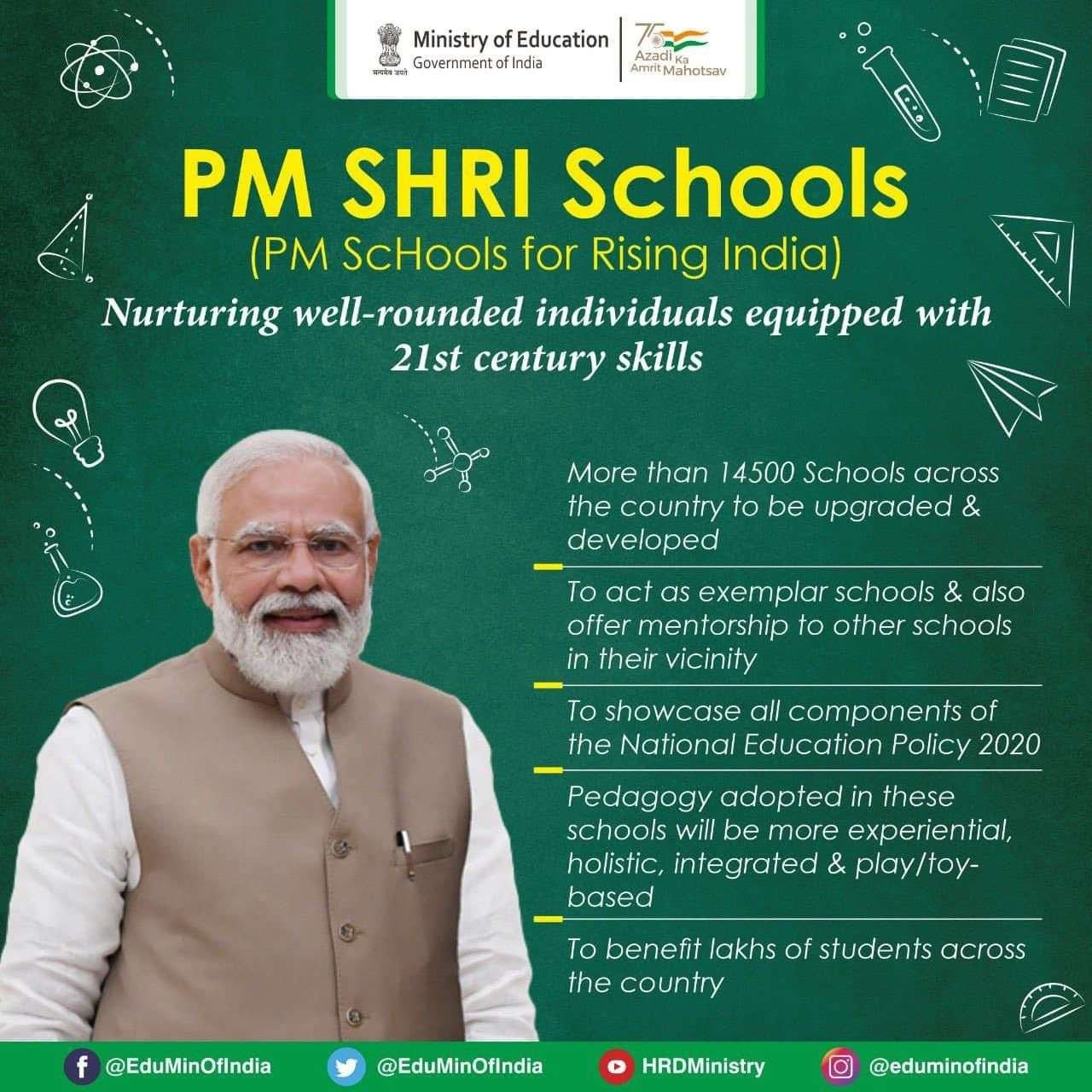
News 5: PM SHRI (PMSchools for Rising India)
1) Under it, as many as 14,500 schools across states and Union Territories will be redeveloped to reflect the key features of the NEP, 2020.
2) Kendriya Vidyalayas or Jawahar Navodaya Vidyalayas come entirely under the Centre’s Ministry of Education. They are fully-funded by the Union government under Central Sector Schemes.
3) While KVs largely cater to children of Union government employees posted in states and UTs, JNVs were set up to nurture talented students in rural parts of the country.
4) In contrast, PM SHRI schools will be an upgrade of existing schools run by the Centre, states, UTs and local bodies. This essentially means that PM SHRI schools can either be KVs, JNVs, state government schools or even those run by municipal corporations.
One Liners:-
1.

2.THE ICONIC Rajpath from RashtrapatiBhavan to IndiaGate is all set to be renamed as Kartavya Path (Path of Duty)
Receive Daily Updates
Recent Posts
Steve Ovett, the famous British middle-distance athlete, won the 800-metres gold medal at the Moscow Olympics of 1980. Just a few days later, he was about to win a 5,000-metres race at London’s Crystal Palace. Known for his burst of acceleration on the home stretch, he had supreme confidence in his ability to out-sprint rivals. With the final 100 metres remaining,
[wptelegram-join-channel link=”https://t.me/s/upsctree” text=”Join @upsctree on Telegram”]Ovett waved to the crowd and raised a hand in triumph. But he had celebrated a bit too early. At the finishing line, Ireland’s John Treacy edged past Ovett. For those few moments, Ovett had lost his sense of reality and ignored the possibility of a negative event.
This analogy works well for the India story and our policy failures , including during the ongoing covid pandemic. While we have never been as well prepared or had significant successes in terms of growth stability as Ovett did in his illustrious running career, we tend to celebrate too early. Indeed, we have done so many times before.
It is as if we’re convinced that India is destined for greater heights, come what may, and so we never run through the finish line. Do we and our policymakers suffer from a collective optimism bias, which, as the Nobel Prize winner Daniel Kahneman once wrote, “may well be the most significant of the cognitive biases”? The optimism bias arises from mistaken beliefs which form expectations that are better than the reality. It makes us underestimate chances of a negative outcome and ignore warnings repeatedly.
The Indian economy had a dream run for five years from 2003-04 to 2007-08, with an average annual growth rate of around 9%. Many believed that India was on its way to clocking consistent double-digit growth and comparisons with China were rife. It was conveniently overlooked that this output expansion had come mainly came from a few sectors: automobiles, telecom and business services.
Indians were made to believe that we could sprint without high-quality education, healthcare, infrastructure or banking sectors, which form the backbone of any stable economy. The plan was to build them as we went along, but then in the euphoria of short-term success, it got lost.
India’s exports of goods grew from $20 billion in 1990-91 to over $310 billion in 2019-20. Looking at these absolute figures it would seem as if India has arrived on the world stage. However, India’s share of global trade has moved up only marginally. Even now, the country accounts for less than 2% of the world’s goods exports.
More importantly, hidden behind this performance was the role played by one sector that should have never made it to India’s list of exports—refined petroleum. The share of refined petroleum exports in India’s goods exports increased from 1.4% in 1996-97 to over 18% in 2011-12.
An import-intensive sector with low labour intensity, exports of refined petroleum zoomed because of the then policy regime of a retail price ceiling on petroleum products in the domestic market. While we have done well in the export of services, our share is still less than 4% of world exports.
India seemed to emerge from the 2008 global financial crisis relatively unscathed. But, a temporary demand push had played a role in the revival—the incomes of many households, both rural and urban, had shot up. Fiscal stimulus to the rural economy and implementation of the Sixth Pay Commission scales had led to the salaries of around 20% of organized-sector employees jumping up. We celebrated, but once again, neither did we resolve the crisis brewing elsewhere in India’s banking sector, nor did we improve our capacity for healthcare or quality education.
Employment saw little economy-wide growth in our boom years. Manufacturing jobs, if anything, shrank. But we continued to celebrate. Youth flocked to low-productivity service-sector jobs, such as those in hotels and restaurants, security and other services. The dependence on such jobs on one hand and high-skilled services on the other was bound to make Indian society more unequal.
And then, there is agriculture, an elephant in the room. If and when farm-sector reforms get implemented, celebrations would once again be premature. The vast majority of India’s farmers have small plots of land, and though these farms are at least as productive as larger ones, net absolute incomes from small plots can only be meagre.
A further rise in farm productivity and consequent increase in supply, if not matched by a demand rise, especially with access to export markets, would result in downward pressure on market prices for farm produce and a further decline in the net incomes of small farmers.
We should learn from what John Treacy did right. He didn’t give up, and pushed for the finish line like it was his only chance at winning. Treacy had years of long-distance practice. The same goes for our economy. A long grind is required to build up its base before we can win and celebrate. And Ovett did not blame anyone for his loss. We play the blame game. Everyone else, right from China and the US to ‘greedy corporates’, seems to be responsible for our failures.
We have lowered absolute poverty levels and had technology-based successes like Aadhaar and digital access to public services. But there are no short cuts to good quality and adequate healthcare and education services. We must remain optimistic but stay firmly away from the optimism bias.
In the end, it is not about how we start, but how we finish. The disastrous second wave of covid and our inability to manage it is a ghastly reminder of this fact.