


The Priority Species and Critical regions of India
Asian Elephants

Habitat and distribution
In India, the Asian elephant was once widely distributed throughout the country, including in states like Punjab and Gujarat. Currently, they are found in four fragmented populations, in south, north, central and north-east India. Extreme habitat generalists, their habitat ranges from wet tropical evergreen forests to semi-arid thorn and scrub forests. However, highest densities of the elephant population are found in tropical deciduous forests. Elephants are ‘mega-herbivores’ that require vast tracts of forests, rich in food and water to survive.
Historically, Indians have through their long association with captive elephants that go back 4,000-5,000 years developed strong cultural and religious links with these mega herbivores. This makes elephants an excellent flagship species in generating public support for their conservation. Owing to their diverse range of habitats and large home ranges, elephants help protect the biodiversity within their range. Even their large dietary requirements enable elephants to have a significant impact on the trees and other vegetation, which results in a modification of their habitat. Thus their conservation could help maintain the biological diversity and ecological integrity of large forest tracts.
Bengal Tigers

At the turn of the 20th century, it is estimated that India probably had many thousands of tigers in the wild.The Wildlife Institute of India (WII) and the National Tiger Conservation Authority (NTCA), Government of India, have been conducting tiger estimation surveys in partnership with NGOs. WWF-India was the key NGO partner of the WII and NTCA in conducting the comprehensive country-wide tiger estimation exercise in 2010-11, which revealed a mean tiger population estimate of 1,706.
Based on a census using the pug mark technique, the number of tigers in 2002 stood at 3,642. As per the 2008 tiger estimation exercise conducted by WII in association with the NTCA using camera traps, there were only 1,411 tigers left in the wild in India.
The tiger is not just a charismatic species or just another wild animal living in some far away forest.
The tiger is a unique animal which plays a pivotal role in the health and diversity of an ecosystem. It is a top predator which is at the apex of the food chain and keeps the population of wild ungulates in check, thereby maintaining the balance between prey herbivores and the vegetation upon which they feed. Therefore, the presence of tigers in the forest is an indicator of the well being of the ecosystem. The extinction of this top predator is an indication that its ecosystem is not sufficiently protected, and neither would it exist for long thereafter.
If the tigers go extinct, the entire system would collapse.
For e.g. when the Dodos went extinct in Mauritius, one species of Acacia tree stopped regenerating completely. So when a species goes extinct, it leaves behind a scar, which affects the entire ecosystem. Another reason why we need to save the tiger is that our forests are water catchment areas.
Therefore, it’s not just about saving a beautiful animal. It is about making sure that we live a little longer as the forests are known to provide ecological services like clean air, water, pollination, temperature regulation etc.
What are white tigers?
A centennial event! Tiger numbers have finally increased!
The number of tigers in the wild is now 3,890! This updated minimum figure, compiled from IUCN data and the latest national tiger surveys, indicates an increase on the 2010 estimate of ‘as few as 3,200’, a first ever in the last 100 years.
With every tiger, we protect around 25,000 acres of forest.
When tigers are protected, we save so much more. As a large predator, the tiger shapes the ecosystem in which it lives.
One Horned Rhino
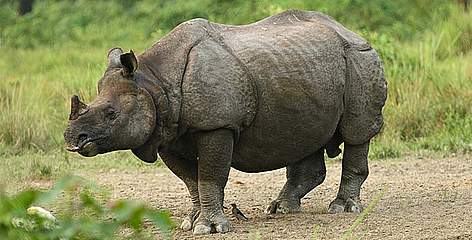
The Indian rhino has a single horn, which is present in both sexes. It is the largest of all the Asian rhinos. Considered to be the most amphibious of all the rhino species, the Indian rhino is an excellent swimmer. It can run at speeds of up to 55km/hr for short periods of time. Though it has an excellent sense of hearing and smell, its eyesight is relatively poor.The animal is solitary as a rule, though several may occupy the same patch of forest or water hole.
Habitat and distribution
The preferred habitat of an Indian rhinoceros is alluvial flood plains and areas containing tall grasslands along the foothills of the Himalayas. Formerly, extensively distributed in the Gangetic plains, today the species is restricted to small habitats in Indo-Nepal terai and northern West Bengal and Assam. In India, rhinos are mainly found in Kaziranga NP, Pobitara WLS, Orang NP, Manas NP in Assam, Jaldapara NP and Garumara NP in West Bengal and Dudhwa TR in Uttar Pradesh.
Indian Rhino Vision 2020
An ambitious plan to expand the distribution of Assam’s state animal, the greater one-horned rhinoceros, took yet another big leap, with the translocation of two rhinos from the Kaziranga National Park to the Burachopari Wildlife Sanctuary on 29 March 2016.
This operation was part of the Indian Rhino Vision 2020 (IRV 2020) programme launched by the Assam Forest Department in partnership with WWF-India, the International Rhino Foundation and US Fish & Wildlife Service in 2005.
The programme aims at increasing the number and range of rhinos in Assam through wild-to-wild translocations from Kaziranga National Park and Pobitora Wildlife Sanctuary to potential Protected Areas including Manas National Park, Burachapori Wildlife Sanctuary, Laokhowa Wildlife Sanctuary, and Dibru-Saikhowa National Park. The vision is to attain a population of 3000 wild rhinos in Assam, distributed over seven of its Protected Areas by 2020.
Snow Leopard

Habitat and distribution
Snow leopards live in the mountainous regions of central and southern Asia. In India, their geographical range encompasses a large part of the western Himalayas including the states of Jammu and Kashmir, Himachal Pradesh, Uttarakhand and Sikkim and Arunachal Pradesh in the eastern Himalayas. The last three states form part of the Eastern Himalayas – a priority global region of WWF and the Living Himalayas Network Initiative
Snow leopards prefer steep, rugged terrains with rocky outcrops and ravines. This type of habitat provides good cover and clear view to help them sneak up on their prey. They are found at elevations of 3,000-5,000 metres or higher in the Himalayas.
Status
The snow leopard is listed as Endangered on the IUCN-World Conservation Union’s Red List of the Threatened Species. In addition, the snow leopard, like all big cats, is listed on Appendix I of the Convention on International Trade of Endangered Species (CITES), which makes trading of animal body parts (i.e., fur, bones and meat) illegal in signatory countries. It is also protected by several national laws in its range countries.
Red Panda

Smooth-coated otter

Habitat and Distribution
Smooth-coated otter is distributed throughout the country from the Himalayas and to the south in India. It is sympatric with other otter species in the Western Ghats and the northeast India.
Smooth-coated otters are found in areas where freshwater is plentiful, preferring shallow and placid waters— wetlands and seasonal swamps, rivers, lakes, and rice paddies. Where they are the only species of otter, they may be found in almost any suitable habitat, but where they are sympatric with other species, they avoid smaller streams and canals in favour of larger bodies of water. Although they are often found in saltwater near the coast, especially on smaller islands, they require a nearby source of freshwater.
Major threats to Asian otter population are loss of wetland habitats due to construction of largescale hydroelectric projects, conversion of wetlands for settlements and agriculture, reduction in prey biomass, poaching and contamination of waterways by pesticides. Poaching for pelt and other body parts that are believed to possess therapeutic properties. Few nomadic hunting tribes eat otter flesh. Reductions in prey biomass (fish stocks) and infrastructural developments have led to disappearance of otters from the many streams and rivers which were once major otter habitats.
Ganges river dolphin

Habitat and Distribution
Ganges river dolphins prefer deep waters, in and around the confluence of rivers. The distribution range of the Ganges river dolphins in India covers seven states namely, Assam, Uttar Pradesh, Madhya Pradesh, Rajasthan, Bihar, Jharkhand and West Bengal. The upper Ganga River (in Uttar Pradesh), Chambal River (Madhya Pradesh and Uttar Pradesh), Ghaghra and Gandak Rivers (Bihar and Uttar Pradesh), Ganga River, from Varanasi to Patna (Uttar Pradesh and Bihar), Son and Kosi rivers (Bihar), Brahmaputra from Sadia (foothills of Arunachal Pradesh) upto Dhubri (on the Bangladesh border) and Kulsi River, a tributary of the Brahmaputra River, form ideal habitats for the Ganges river dolphin.
Once present in tens of thousands of numbers, the Ganges river dolphin has dwindled abysmally to less than 2000 during the last century owing to direct killing, habitat fragmentation by dams and barrages and indiscriminate fishing. It is for these reasons that despite high level of protection, its numbers continue to decline. The absence of a coordinated conservation plan, lack of awareness and continuing anthropogenic pressure, are posing incessant threats to the existing dolphin population.
Nilgiri tahr

Habitat and Distribution
The Nilgiri tahr inhabits the open montane grassland habitats at elevations from 1200 to 2600 m (generally above 2000 m) of the South Western Ghats. Their range extends over 400 km from north to south, and Eravikulam National Park is home to the largest population. The other significant concentration is in the Nilgiri Hills, with smaller populations in the Anamalai Hills, Periyar National Park, Palani Hills and other pockets in the Western Ghats south of Eravikulam, almost to India’s southern tip.
Nilgiri tahrs exist only in small, isolated populations due to extreme habitat fragmentation and illegal hunting. They are, as a result, vulnerable to local extinction. The reasons for the decline of tahr populations have not been fully understood. Despite several studies over the years, there are only rough estimations of Nilgiri tahr populations. The species has always been under severe stress on account of the construction of numerous hydroelectric projects, timber felling and monoculture plantation of eucalyptus and wattles. All these development activities, especially the plantation activities affect the heart of the tahr habitat, which are the grasslands – sholas.
Sarus Crane

The Sarus crane is the tallest flying bird in the world standing 152-156 cm tall with a wingspan of 240cm
Habitat and distribution
The Sarus crane has three disjunct populations in the Indian sub-continent, south-east Asia and northern Australia with an estimated global population of 25,000-37,000 individuals. In the Indian subcontinent, it is found in northern and central India, Terai Nepal and Pakistan. It was once a common site in the paddy fields of Uttar Pradesh, Bihar, Rajasthan, West Bengal, Gujarat, Madhya Pradesh and Assam. Their population is now on the decline with only 15,000-20,000 found in India, a majority of which are in Uttar Pradesh. The Sarus crane is known for its ability to live in association with humans, inhabiting open, cultivated, well watered plains, marshlands and jheels. These areas suit them well for foraging, roosting and nesting.
The main threat to the Sarus crane in India is habitat loss and degradation due to draining the wetland and conversion of land for agriculture. The landscape of its historic range is rapidly changing due to construction of highways, housing colonies, roads, and railway lines. More recently, many deaths have been recorded due to collision with power lines. Also, due to the increase in agricultural land, Sarus cranes are left with no choice but to forage in these fields, and as a result ingest pesticides, which lead to poisoning.
Black Necked Crane

Habitat and Distribution
The high altitude wetlands in the Tibetan plateau are the main breeding ground of the species. These wetlands with small mounds provide an excellent habitat to the birds for breeding. These birds winter at lower altitudes where they feed mainly on the leftovers in rice and potato fields. This species is found in India, China and Bhutan and breeds in high altitude wetlands in the Tibetan plateau at elevations of 2950-4900 m above mean sea level. High altitude marshes and lakes of Tibetan Plateau (Tibet, Qinghai, Xinjiang, Gansu), Sichuan (China), and eastern Ladakh (India) are the known breeding grounds of black-necked crane. The major wintering flocks are in Tibet, Yunnan and Guizhou (China) and Bhutan (Phobjika and Bomdaling Valleys). A small wintering population is also found in Sangti and Zimithang valleys of Arunachal Pradesh in India.
The major threat to the successful breeding of black-necked crane is the damage to the eggs and chicks, caused by feral dogs. These dogs are owned both by armed forces as well as by the local nomads. Another threat to the bird is the loss of habitat. The human pressure on the wetlands, the primary habitat of cranes, has increased tremendously over the last decade. The increased grazing pressure on the limited pastures near the wetlands is also leading to the degradation of the wetland habitat.
Sundarbans

Satpura Maikal landscape

Satpuda Maikal Landscape (SML) sprawls across 19 districts in the states of Madhya Pradesh, Maharashtra and Chhattisgarh covering a total area of 1,43,551km2. Of this, roughly 40,837km2 is under forest cover, with some of the country’s most famous tiger reserves and Protected Areas. This landscape supports 30 per cent of the world’s tiger population and 17 per cent of India’s tiger population with some of the largest contiguous forested tracks connected through wildlife corridors. Some of the tiger reserves critical from a conservation standpoint in this landscape are Kanha, Satpuda, Pench, Melghat, Tadoba and Achanakmar.
Terai Arc Landscape

Western Ghats


Nilgiris Eastern Ghats Landscape
The Nilgiris Eastern Ghats Landscape (NEG) is the foremost elephant country of the subcontinent. It has the single largest contiguous population of Asiatic elephants in its range and holds the key to the long term survival of the species. Over 6,000 elephants live in the Nilgiri and Eastern Ghats Landscape which spreads over an area of about 12,000km2. Other large mammals found in the area are the gaur, sambar and tiger. The terrain of the landscape is mostly undulating with low hills. The area extends from the south of the Brahmagiri hills in Karnataka through the Wayanad plateau into the northern Nilgiri hill slopes and the Mysore plateau which links up to the Sigur plateau and the Moyar river valley.
The Moyar valley rises up the slopes of the Eastern Ghats leading into the Thalamalai plateau going up to the east of the Biligirirangan range into Bargur, Sathyamangalam and Madeshwaramalai up to the Cauvery River.
Southern Western Ghats Landscape
The Southern Western Ghats (SWG) cover an area of 7000km2 through the states of Kerala and Tamil Nadu and harbour a very rich floral and faunal biodiversity. It forms one of the largest contiguous blocks of ‘good’ forest cover in the Southern Western Ghats. This region harbours high levels of endemism and over 15 per cent is under the Protected Area network. Some of the important and unique habitat types found here include wet evergreen forests and sholas in the higher elevations. The Southern Western Ghats is also a priority terrestrial and freshwater ecoregion of the world.
North Bank landscape

Kaziranga-Karbi Anglong landscape

The Kaziranga-Karbi Anglong Landscape (KKL) is a vital site situated within the Indo-Burma biodiversity hotspot. KKL is spread over 25,000 km2 south of the Brahmaputra River in Assam, touching the neighbouring states of Meghalaya and Nagaland in north-eastern India. The vision for this biodiversity-rich and culturally-diverselandscape is to ensure that large mammals, especially tigers, elephants and rhinos persist in connected ranges with minimal wildlife-human conflict.
Kaziranga National Park, the biggest protected area (PA) in this landscape is connected with the rest of the landscape through four corridors, namely Panbari, Haldhibari, Amguri and Kanchanjhuri, which are facing anthropogenic pressures. This landscape has a population of about 2500 elephants – about half of Assam’s elephant population and more than 70 per cent of Assam’s tigers. In addition, this landscape boasts of more than 2,000 rhinos, comprising close to 90 per cent of the rhino population of India. This makes the area critical for protection and conservation of wildlife and their habitats.
The region is also endowed with rich ethnic diversity. The diverse cultural and traditional practices among the ethnic tribes and other communities contribute to a complex demographic structure throughout the landscape.
Khangchendzonga landscape

Khangchendzonga Landscape lies at the heart of the eastern Himalayas. It includes the state of Sikkim as well as northern West Bengal. The area lies in the shadow of the towering 8,585-metre Khangchendzonga peak – the third highest mountain in the world. ‘Khangchendzonga’ literally means five repositories of God’s treasure, namely gold, silver, gems, grains and Holy Scriptures.
This landscape is nestled in the Himalayan biodiversity hotspot. A wide variety of endemic and threatened species thrive here because of the variations in elevation, climate, vegetation and habitat type. It is listed among the world’s ten most critical centres for biodiversity and endemism, with a vast array of floral and faunal species. Over 220 water bodies are found in Sikkim, fed mostly with glacial melt water, which also are the main sources for rivers in the state
The northern part of this landscape is comprised of the mountainous state of Sikkim, which has about 82 per cent of its geographical area under forest jurisdiction. Darjeeling district and parts of Jalpaiguri in northern West Bengal constitute the southern part of this landscape. The total area of this landscape is less than 10,000 km2. Due to a wide range of altitudes here, between 150 metres and 8500 metres, this landscape boasts of a great variety of plants that range from tropical and temperate to alpine and tundra. This is one of the few regions in the world to exhibit such diversity in a small area. A great variety of wild animals found in this area include the Bengal tiger, Asian elephant, clouded leopard and gaur in the lowland areas and the red panda – Sikkim’s state animal, Asiatic black bear, goral, serow, snow leopard, Himalayan tahr, Tibetan gazelle, Tibetan argali, and musk deer are found in the higher reaches. Sikkim is also renowned for orchids. It is home to an impressive 695 species of butterflies of the 1438 butterfly species found in India.
Western Arunachal landscape

Western Indian tiger landscape
The Western Indian Tiger Landscape (WITL) is spread over an area of 30,000km2 across the states of Rajasthan and Madhya Pradesh at the intersection of the Aravalli and Vindhya mountain ranges, the oldest hill ranges of India. It comprises two tiger reserves, two national parks and nine wildlife sanctuaries, all connected to each other through wildlife corridors in the form of territorial forests, reserve forests and tributaries of the river Chambal.This landscape supports the westernmost population of the Bengal tigers in India, and the world
The famous Ranthambore Tiger Reserve holds the source population of tigers, which disperse into adjoining national parks and wildlife sanctuaries through the wildlife corridors, in search of new territory, food and mate\
The landscape is a mix of dense forests comprising mostly dhak trees, a species known to withstand long periods of drought and heat, and grasslands on plateaus. Old ruins, palaces and forts form the backdrop of these forests, which were once the private hunting grounds of the Maharajas of Jaipur. While the tiger is the top predator here, other endangered wildlife include, the leopard, striped hyena, caracal, jungle cat and the black buck. The forests and wildlife here are threatened by habitat degradation, habitat fragmentation, encroachment, poaching of tigers and prey species and human-wildlife conflict.
Bharatpur

One of the most important waterfowl refuges of the world, a Ramsar site and a World Heritage site, Keoladeo National Park (KNP) is known for its rich biological diversity.
It is a man-made and managed wetland and was notified as a bird sanctuary in 1956 and elevated to the status of a national park in 1982. The reserve, primarily used as a waterfowl hunting reserve while protecting Bharatpur from frequent floods also provided grazing grounds for village cattle.
This 29 km2 reserve, locally known as Ghana, is a mosaic of dry grasslands, woodlands, woodland swamps, and wetlands. These diverse habitats are home to over 366 bird species, 379 floral species, 50 species of fish, 13 species of snakes, five species of lizards, seven amphibian species, seven turtle species and a variety of other invertebrates. Every year thousands of migratory waterfowl visit the park for wintering and breeding. By virtue of being one of the best bird areas of Asia, KNP attracts over 100,000 visitors every year.
Receive Daily Updates
Recent Posts
- India’s telecom market has seen monopoly as well as hyper-competition.
- Twenty-five years ago, the government alone could provide services.
- Ten years later, there were nearly a dozen competing operators.
- Most service areas now have four players.
- The erstwhile monopolies, BSNL and MTNL, are now bit players and often ignored.
- India is ranked second globally—after China—in the number of people connected to the internet. However, it is also first in the number of people unconnected.
- Over 50% of Indians are not connected to the internet, despite giant strides in network reach and capacity.
- India’s per capita or device data usage is low. It has an impressive 4G mobile network. However, its fixed network—wireline or optical fibre—is sparse and often poor.
- 5G deployment has yet to start and will be expensive.
Context
Sunil Mittal, the chairman of Bharti Airtel, said recently that it would be “tragic” if India’s telecom-access market was to be reduced to only two competing operators. He was probably referring to the possible exit of the financially-stressed Vodafone Idea and the increasing irrelevance of government-owned operators, BSNL and MTNL. This would essentially leave the market to Reliance Jio and Airtel. A looming duopoly, or the exit of a global telecommunications major, are both worrying. They deserve a careful and creative response.
[wptelegram-join-channel link=”https://t.me/s/upsctree” text=”Join @upsctree on Telegram”]Thus Far
The reduced competition is worrying. Competition has delivered relatively low prices, advanced technologies, and an acceptable quality of services. These gains are now at risk. There is a long way to go in expanding access as well as network capacity.
The Indian Telecom Irony
Vodafone Tragedy
Filling the gaps in infrastructure and access will require large investments and competition. The exit of Vodafone Idea will hurt both objectives. The company faces an existential crisis since it was hit hardest by the Supreme Court judgment on the AGR issue in 2019, with an estimated liability of Rs 58,000 crore.
The closure of Vodafone Idea is an arguably greater concern than the fading role of BSNL and MTNL. The government companies are yet to deploy 4G and have become progressively less competitive. Vodafone Idea, on the other hand, still accounts for about a quarter of subscriptions and revenues and can boast of a quality network.
It has been adjudged the fastest, for three consecutive quarters, by Ookla, a web-service that monitors internet metrics. India can ill-afford to waste such network capacity. The company’s liabilities will deter any potential buyer.
Vodafone+MTNL+BSNL ?
A possible way out could be to combine the resources of the MTNL and BSNL and Vodafone Idea through a strategic partnership. Creative government action can save Vodafone Idea as well as improve the competitiveness of BSNL and MTNL.
It could help secure government dues, investment, and jobs. It is worth recalling here that, about 30 years ago, the Australian government’s conditions for the entry of its first private operator, Optus, required the latter to take over the loss-making government satellite company, Aussat. Similar out-of-the-box thinking may well be key to escape the looming collateral damage.
It is not trivial to expand competition in India’s telecom market. Especially since there are no major regulatory barriers to entry anymore. Any new private player will be driven largely by commercial considerations. Global experience suggests that well-entrenched incumbents have massive advantages. New players are daunted by the large investments—and much patience!—needed to set up networks, lure existing customers and sign new ones.
However, regulators and policymakers have other options to expand choice for telecom consumers. Their counterparts in mature regulatory regimes—e.g., in the European Union—have helped develop extensive markets for resale. Recognising the limited influence of smaller players, regulators mandate that the incumbent offer wholesale prices to resellers who then expand choice for end-users.
This has been virtually impossible in India. There is a near absence of noteworthy virtual network operators (VNOs) and other resellers. A key barrier to resale is India’s licence fee regime which requires licence-holders to share a proportion of their revenues with the government. Thus, resale could hurt exchequer revenues unless resellers are subject to identical levies. Understandably, the levies—and consequently additional reporting and compliance—is a disincentive for smaller players. The disincentive flows from levies based on revenues which comes with considerable costs of compliance. It would almost vanish if the levies were replaced by say, a flat fee computed objectively.
The ball is in the court of the regulator and the government. They have options. But will they take decisive action to exercise them? It will be ‘tragic’ if they can’t.
INTRODUCTION
Since most of the early scholars, researchers and historians were men, many aspects of society did not find a place in history books. For example, child-birth, menstruation, women’s work, transgenders, households etc. did not find much mention.
[wptelegram-join-channel link=”https://t.me/s/upsctree” text=”Join @upsctree on Telegram”]Rather than building a holistic picture of the past, some select aspects such as polity and the different roles of men became the central focus of history writing. Women were confined to one corner of the chapter where a paragraph or two was devoted to the ‘status and position of women’.
Even the details of these paragraphs were hardly different from each other. This made it look like as if history (and thereby society, polity, economy and all culture) belonged to men while women were only a small static unit to be mentioned separately. Of course, there were some exceptions, but these were however rare. This practice is being corrected now and the roles and presence of women are being read into all parts of historical questions.
SOURCES FOR UNDERSTANDING GENDER HISTORY
Sources are the bases of history writing. From simple pre-historic tools to abstruse texts, everything can be utilized to understand life and roles of women in history. The presence as well as the absence of women from sources needs to be duly noticed, deliberated and argued upon and only then to be theorised upon.
Certain objects being directly related to the lives of women or depicting the ideas of the female principle are of central importance. These include but are not limited to female figurines, art objects, texts attributed to or authored or compiled by women, monuments created by or for women, various objects relating to their lifestyle, objects associated with women on account of their cultural roles and so on.
It has been rightly pointed out by Uma Chakravarti that much of the gender history written in early phase was a ‘partial view from above’. This referred to the utilization of select textual sources and focused only on relational identity of women. There were, however, a few exceptions.
GENDER HISTORIOGRAPHY
Amongst the many narratives propagated to denigrate Indian civilization and culture by the British colonial rulers, the condition of Indian women became a point of central reference. Various social evils that made the life of women miserable were pointed out and efforts were also made to introduce ‘reforms.’ Sati, child-marriages, imposed widowhood, polygamy, dowry, educational and economic inequality, purdah (ghoonghat) and many other practices prevailed during the colonial period that made the life of women difficult and pitiable.
Some practices affected women of higher social and economic households while others led to misery for poorer women. Many social reform movements were started in the 19th century to address these issues and contributions were made by Indian reformers as well as British officials and other Europeans.
Women in India came to be treated as a homogeneous category and over generalisation became the norm. While many communities in India practised widow remarriage and did not practise (much less forced) sati and while some practised divorces or separation, the image of the Indian woman who had been subjugated as woman, wife and widow became a dominant theme in history writing.
Secondly, a western vision was placed over the non-western societies and hence interpretations were far removed from the context. For example, notion of stridhan was equated with dowry and little regard was paid to the provisions regarding its use and ownership by women.
The huge social stigma that came along with the selling of jewellery of the household (one of the main components of stridhan) was paid no attention to. Similarly, penal provisions listed by ancient texts for misappropriation of women’s property were not even looked into.
During the Paleolithic age, hunting and gathering was norm. However much importance was given to Hunting than gathering in all literature of history. Studies, however, show that hunted prey formed only 35% of the diet while gathering fruits and other edible material supplied the major portion. Gathering of food resources was ordinarily done by women. Since gathering was an important activity, more than hunting for game, it could point to significant role playing by women.
The gendered understanding of Harappan civilization is being built upon and various archaeological remains have been studied in this respect. The female figurines, idols of pregnant women, the statue of the ‘dancing girl’, various pieces of jewellery and personal belongings that have been discovered at various sites and offer useful insights on the public and private lives of women and men.
The statue of a girl obtained from Mohanjodaro has been called a ‘dancing girl’ on grounds of familiarity with the institution of devadasis in the later times. Such backward looking explanations are problematic.
There is a wide variety of terracotta female figurines that have been found at different sites right from the pre-Harappan times. Women figures are found suckling a baby, holding utensils, kneading dough, nursing infants, carrying objects like drums, seated figures for board games, with steatopygia (fat deposition on the hips and elsewhere), with floral head-dresses and in many other forms.
Even figurines of pregnant women are quite common. However, most of these have been uncritically associated with fertility, religiosity and reproductive ideas, and have been passed off as representations of the Mother Goddesses. While some of them were votive objects, others are held to be toys or other utilities. The focus on female form has been so stereotypical that women have been seen as associated only with home, hearth, fertility, sexuality and divinity. So much so that sometimes even male figurines in assumed womanly roles were classified as female figurines.
POSITION OF WOMEN IN EARLY INDIA
The first literary tradition in the Indian subcontinent (and the oldest in the world) is that of the Vedic corpus. From the four Samhitas to the Upanishads, we find many interesting references to women in various roles. Some of these women have left their mark on the cultural heritage to this day and are remembered in various ritual and social contexts. Their names, stories, some highly revered hymns, and other interesting facets are mentioned in the Vedic corpus.
The Vedic literature has been classified as Early Vedic and Later Vedic. The Rigvedic society and polity seems to be teeming with life and agro-pastoral economy was enmeshed in close kinship ties. Women as well as men participated in society, economy and polity. Some of the most revered hymns including the gayatri mantra are ascribed to women.
Various natural phenomena are depicted as Goddesses and they are offered prayers. While quantitative analysis highlights the predominance of Indra, Agni, Varuna and other male gods, the power and stature of the goddesses is equally well established.
Women participated in all three Vedic socio-political assemblies viz. Sabha, Samiti and Vidhata. They had access to education and were even engaged in knowledge creation. They could choose to be brahmavadinis with or without matrimony.
Hence, there is no reason to believe that they were only confined to home and hearth. T. S. Rukmani attempts to understand if women had agency in early India. Her work has highlighted many interesting details. The author acknowledges the fact that though the patriarchal set up put women at a loss, there were instances where women found space to exercise their agency.
She points out that though the texts like the Kalpasutras (Srautasutras, Dharmasutras and Grhasutras) revolved around the ideology of Dharma and there was not much space to express alternative ideas, still these works also find some leeway to express ideas reflecting changed conditions.
For example, there is a statement in the Apastamba Dharmasutra that one should follow what women say in the funeral samskaras. Stephanie Jamison believes that in hospitality and exchange relations, women played an important role. She says that the approval of the wife was important in the successful completion of the soma sacrifice. In another study it has been shown that women enjoyed agency in deciding what was given in a sacrifice, bhiksha to a sanyasin. The men had no authority in telling her what to do in these circumstances.
Vedic society was the one which valued marriage immensely. In such contexts, Gender Perspectives if a woman chose not to marry, then it would point to her exercising choice in her decision to go against the grain and remain unmarried.
Mention may be made of Gargi. She was a composer of hymns and has been called a brahmavadini. This term applies to a woman who was a composer of hymns and chose to remain unmarried, devoting herself to the pursuit of learning.
Similarly, in the case of Maitreyi, she consciously opts to be educated in the Upanishadic lore and Yajnavalkya does not dissuade her from exercising her choice.
The statement in the Rigveda that learned daughters should marry learned bridegrooms indicates that women had a say in marriage. Though male offspring is desired, there is a mantra in the Rigveda, recitation of which ensures the birth of a learned daughter.
Altekar refers to the yajnas like seethayagna, rudrayajna etc. that were to be performed exclusively by women. Some of the women were known for their exceptional calibre, for example, from the Rigveda Samhita we find mention of women like Apala, Ghosha, Lopamudra, Gargi, Maitreyi, Shachi, Vishwavara Atri, Sulabha and others.
Women have not only been praised as independent individuals but also with reference to their contributions towards their natal or marital families.
The Later Vedic literature shows the progression towards a State society with a change in the organization of the society and polity. The chief comes to be referred to as bhupati instead of gopati. However, within the twelve important positions (ratnis) mentioned, the chief queen retains a special position under the title mahisi.
The importance of the chief queen continued as gleaned from several references to them in the Epics, Arthashastra and even in coins and epigraphs from early historical times.
The other Samhitas also refer to women sages such as Rishikas. The wife is referred to as sahadharmini. Brahmanas or the texts dealing with the performance of the yajna (Vedic ritual), requires a man to be accompanied by his wife to be able to carry out rituals.
For example, Aitareya Brahmana looks upon the wife as essential to spiritual wholesomeness of the husband. However, there is a mention of some problematic institutions as well.
Uma Chakravarti has pointed towards the condition of Vedic Dasis (female servant/slave) who are referred to in numerous instances. They were the objects of dana (donation/gift) and dakshina (fee).
It is generally believed that from the post Vedic period the condition of the women steadily deteriorated. However, Panini’s Ashtadhyayi and subsequent grammatical literature speak highly of women acharyas and Upadhyayas.
Thus, the memory and practice of a brahmavadini continued even after the Vedic period. The Ramayana, Mahabharata and even the Puranas keep the memory of brhamavadini alive.
Mention may be made of Anasuya, Kunti, Damyanti, Draupadi, Gandhari, Rukmini who continued to fire the imagination of the poets. Texts show that the daughter of Kuni-garga refused marriage because she did not find anyone worthy of her.
The Epics also mention women whose opinions were sought in major events. For example, after the thirteen years of exile, while debating upon the future course of action regarding the restoration of their share, the Pandavas along with Krshna asks Draupadi for her views. Similarly, when Krishna goes to the Kaurava’s court to plead the case of Pandavas, Gandhari is called upon to persuade her sons to listen to reason.
Since a woman taking sanyasa was an act of transgression, one can explore women’s agency through such instances. In the Ramayana, Sabari, who was the disciple of Sage Matanga, and whose hermitage was on the banks of river Pampa was one such sanyasin.
Such women find mention in Smriti literature and Arthashashtra. Kautilya’s prohibition against initiating women into Sanyasa can make sense only if women were being initiated into sanyasa. He advises the king to employ female parivrajakas as spies.
Megasthenes mentions women who accompanied their husbands to the forest, probably referring to the Vanaprastha stage. Another category of literature called Shastras that comprises of sutras (aphorisms) and the smriti texts (‘that which is remembered’) becomes important in the postVedic period.
These textual traditions cover many subjects relating to the four kinds of pursuits of life referred to as purusharthas (namely dharma, karma, kama and moksha). In all these texts we find very liberal values and freedom for both women and men.
The setting up of a household is seen as an ideal for men as well as women (though asceticism for learning is equally praised for both). For example, Apastambha Sutra opines that rituals carried out by an unmarried man do not please the devatas (divinities). Similarly, Manusmriti provides that ‘for three years shall a girl wait after the onset of her puberty; after that time, she may find for herself a husband of equal status. If a woman who has not been given in marriage finds a husband on her own, she does not incur any sin, and neither does the man she finds’
Thus, we see that women enjoyed choice in matters of matrimony. It is interesting to note that unmarried daughters were to be provided for by the father. In fact, daughter is stated to be the object of utmost affection. Should a girl lose her parents, her economic interests were well looked after. It was provided that from their shares, ‘the brothers shall give individually to the unmarried girls, one-quarter from the share of each. Those unwilling to give will become outcastes’
With regards to defining contemporary attitude towards women, Apastambha Sutra prescribed that ‘All must make a way for a woman when she is treading a path.’ Later Dharmashastra also makes similar statements.
Yagnavalkyasmriti mentions that ‘women are the embodiment of all divine virtues on earth.’ However, there are several provisions that look problematic.
On one hand, we have reverence assigned to the feminine (divine and worldly) and important roles being played by them, on the other hand we have questionable provisions and descriptions like right to chastise them through beating or discarding.
The post-Vedic phase from 6th century BCE onwards is also rich in literary traditions with ample depictions of women. Interestingly, we have an entire body of literature that is ascribed totally to women who became Buddhist nuns. These are referred to as Therigathas i.e. the Songs of the Elder Bhikkhunis (Buddhist Women who joined the Sangha).
The Arthashastra Gender Perspectives gives us information on women who were engaged in economic activities of various kinds. They formed a part of both the skilled and the unskilled workforce. They were into professional as well as non-professional employment.
Some of their vocations were related to their gender, while the others were not. There were female state employees as well as independent working women. Similarly, some of them were engaged in activities which though not dependent on their biological constitution are nonetheless categorized as women’s domain, e.g. domestic services etc. Some of them were actual state employees, while some others were in contractual relations with the State. For example, we have female bodyguards and spies in the State employment.
Jaiswal suggests that these women perhaps came from Bhila or Kirata tribe. Female spies were not only to gather information and relay it to proper source, but also to carry out assassinations. However, a closer look at the text shows that there were different classes of female spies engaged for different purposes. Amongst others ‘women skilled in arts were to be employed as spies living inside their houses’. Others were required to work as assassins. Some were to the play the roles of young and beautiful widows to tempt the lust of greedy enemy.
We also have various Buddhist and Jaina traditions giving us some glimpses of the ideas and institutions of the times. Apart from the orthodox (Vedic and Brahmanic) and heterodox normative tradition we have many popular texts like the Epics in Sanskrit and Jatakas in Pali.
Even Prakrit language has many interesting narratives and poetic texts. The Therigatha by the Buddhist nuns are an interesting literary source that provides us with a glimpse of various women who attained arhantship or similar other stages of Realisation.
The deliberation on the age and deterioration of the body by Ambapali, the non-importance of sensual or bodily pleasures by Nanda, Vimla and Shubha etc points towards the intellectual and spiritual engagements and attainments of women.
It is interesting to note that an absolutely contrary picture is presented by the Jatakas wherein more often than not, women are depicted as evil. It is important to note that women were given an evil aura mostly in their roles as wives or beloveds.
Both the texts and the archaeological remains have been studied by various scholars and opposing interpretations are not rare. For example, on one side Sita (from Ramayana) and Draupadi (from Mahabharata) have been seen as victims of the patriarchal order; on the other hand, they are also represented as selfwilled women.
Draupadi after the game of dice presents herself as a forceful and articulate woman. It’s her wit that saves her husbands from becoming slaves of the Kauravas. Her incensed outrage at the attack on her modesty, her bitter lamentations to Krishna, her furious tirade against Yudhishthira for his seeming inability to defend her honour and many more such instances show her to be an aggressive woman. This persona is juxtaposed to her representations as an ideal wife elsewhere. However, Draupadi is never idealised as a perfect wife who endures the most severe trials without complaint. This honour is reserved for Sita in the Ramayana. She is also presented as a victim like Draupadi and voices her concern at her fate openly. However, her aggression is directed inwards as indicated by her action against the self which culminate in her union with the mother Earth.
Are the limited number of hymns ascribed to the Vedic women a signifier of their general status? Are the goddesses merely representational with no connection to the ideas and behaviour towards women? Did only princesses choose their spouses? Are the warrior women an exception? Such searching questions need to be addressed with due diligence.
While women studies are a good development there is a need to expand the horizons to include other varieties of human existence. We have narratives of fluid sexuality in various texts. The one year of Arjuna’s life spent as Brihallana and rebirth of Amba as Shikhandi are some interesting instances. The artefacts found at the site of Sheri Khan Tarakai include visibly hermaphroditic figurines. There is a need to understand the notions of the feminine, masculine, neuter, and other forms of gender and sexual identities. These will have ramifications for understanding the ideas of conjugality, family, community, society and even polity and spirituality.
CONCLUSION
Human civilisations were built by men as well as women, however, history writing has a huge male-bias. Women were confined to questions of status and position that were largely evaluated in terms of their roles in the domestic sphere.
Their treatment as wives and widows became a central focus of most research alongside their place in ritual or religious context. This made them peripheral to mainstream history. This was questioned by various scholars from time to time and led to the development of gendered understanding of history. Focusing attention on women’s history helps to rectify the method which sees women as a monolithic homogeneous category. Writing gender history has helped in building an image of the past that is wholesome and nuanced.