


Animals in our backyard:-
Monkeys, along with Grey langurs and bonnet macaques, have adapted to urban habitats over the years.Out of the nearly 225 living species of non-human primates, these three species have adapted to the urban way of life.

In case of other animals, India does not lack protected areas, but the very idea of a protected area appears skewed. The protected areas were historically meant to be the breeding grounds for animals raised in the wild for the purpose of hunting.This space is not enough to have a full-fledged habitat for wild animals.
A territorial animal like a male tiger needs an area of 60-100 sq km. But the area allocated to an entire tiger reserve, like the Bor Tiger Reserve in Maharashtra, is 138.12 sq km. This is barely enough for one or two tigers.
The elephants need to travel at least 10-20 km a day. If a herd is restricted to an area of about 100 sq km, they are bound to move out in search of food and water. Elephants are used to travelling long distances, most of which fall outside the protected areas.
The condition of the existing protected areas is not very good, either. Wildlife experts claim that territorial animals do not have enough space within reserves and their prey do not have enough fodder to thrive on. This is forcing the wild animals to move out and venture close to human habitation in search of food.
Rising numbers
The population of monkeys has multiplied after their natural habitat was destroyed because of their ability to adapt to new habitats. In forests, a Rhesus macaque has to spend about 10 to 14 hours in search of food. However, if we look at the street-dwelling urban monkeys or even those living dangerously close to human settlements in a rural setting, finding food takes only 10 minutes.When there is food in abundance, monkeys spend more time procreating.
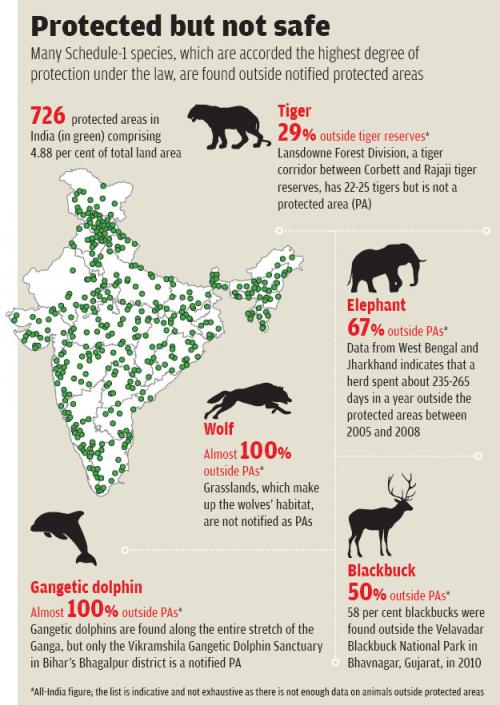
A primary reason for the increasing human-animal conflicts is the presence of a large number of animals and birds outside the notified protected areas. Wildlife experts estimate that 29 per cent of the tigers in India are outside the protected areas. “If we take their number to be 2,200, the tigers outside the protected areas are about 640. This is almost twice the number of tigers found in Russia.
Government action may fail to yield results
Another reason why animals move to new geographical areas is the government’s practice of translocating monkeys from the cities to forest areas near rural areas. Residents of Chaukha village, which is at an altitude of 2,072 metres above sea level, say monkeys were brought to the forests from Shimla and Mandi. Monkeys are never found at such high altitudes. But the government forcefully dumped the animals in our forests.
Even Delhi’s attempt to translocate monkeys has backfired. In 2007, the state wildlife department captured over 19,000 monkeys to translocate them to a wildlife sanctuary created at Asola Bhatti mines on the outskirts of the city. While New Delhi breathed a temporary sigh of relief by the move, the residents of Sanjay Colony near the sanctuary struggled. The illegal colony of the Od community, who for three decades mined Bhatti area of the Aravalli hills, registered an alarmingly high number of attacks by monkeys who would escape the sanctuary.
State governments have tried various strategies so far—from culling and sterilisation drives to awareness campaigns not to feed monkeys. In Himachal Pradesh, the sterilisation rate at the centres has been poor. On an average, each camp has the capacity to sterilise 45 monkeys every day. This adds up to 54,000 sterilisations every year or 430,000 sterilisations in the past eight years. But just 96,500 monkeys have been sterilised since 2007.
Wildlife experts warn that if wildlife protection is confined to reserves and parks alone, several species will stand at the brink of extinction. This is best exemplified by the Great Indian Bustard, which is a Schedule-I animal. Despite having sanctuaries to itself, the bird has been driven to the brink of extinction. Various bustard sanctuaries had sizeable population once upon a time. But as of March 2015, there are an estimated 169 birds left. The problem is how do you restrict a bird? They fly out of the protected areas and are then hunted for their meat.
Receive Daily Updates
Recent Posts
Petrol in India is cheaper than in countries like Hong Kong, Germany and the UK but costlier than in China, Brazil, Japan, the US, Russia, Pakistan and Sri Lanka, a Bank of Baroda Economics Research report showed.
Rising fuel prices in India have led to considerable debate on which government, state or central, should be lowering their taxes to keep prices under control.
The rise in fuel prices is mainly due to the global price of crude oil (raw material for making petrol and diesel) going up. Further, a stronger dollar has added to the cost of crude oil.
Amongst comparable countries (per capita wise), prices in India are higher than those in Vietnam, Kenya, Ukraine, Bangladesh, Nepal, Pakistan, Sri Lanka, and Venezuela. Countries that are major oil producers have much lower prices.
In the report, the Philippines has a comparable petrol price but has a per capita income higher than India by over 50 per cent.
Countries which have a lower per capita income like Kenya, Bangladesh, Nepal, Pakistan, and Venezuela have much lower prices of petrol and hence are impacted less than India.
“Therefore there is still a strong case for the government to consider lowering the taxes on fuel to protect the interest of the people,” the report argued.
India is the world’s third-biggest oil consuming and importing nation. It imports 85 per cent of its oil needs and so prices retail fuel at import parity rates.
With the global surge in energy prices, the cost of producing petrol, diesel and other petroleum products also went up for oil companies in India.
They raised petrol and diesel prices by Rs 10 a litre in just over a fortnight beginning March 22 but hit a pause button soon after as the move faced criticism and the opposition parties asked the government to cut taxes instead.
India imports most of its oil from a group of countries called the ‘OPEC +’ (i.e, Iran, Iraq, Saudi Arabia, Venezuela, Kuwait, United Arab Emirates, Russia, etc), which produces 40% of the world’s crude oil.
As they have the power to dictate fuel supply and prices, their decision of limiting the global supply reduces supply in India, thus raising prices
The government charges about 167% tax (excise) on petrol and 129% on diesel as compared to US (20%), UK (62%), Italy and Germany (65%).
The abominable excise duty is 2/3rd of the cost, and the base price, dealer commission and freight form the rest.
Here is an approximate break-up (in Rs):
a)Base Price | 39 |
b)Freight | 0.34 |
c) Price Charged to Dealers = (a+b) | 39.34 |
d) Excise Duty | 40.17 |
e) Dealer Commission | 4.68 |
f) VAT | 25.35 |
g) Retail Selling Price | 109.54 |
Looked closely, much of the cost of petrol and diesel is due to higher tax rate by govt, specifically excise duty.
So the question is why government is not reducing the prices ?
India, being a developing country, it does require gigantic amount of funding for its infrastructure projects as well as welfare schemes.
However, we as a society is yet to be tax-compliant. Many people evade the direct tax and that’s the reason why govt’s hands are tied. Govt. needs the money to fund various programs and at the same time it is not generating enough revenue from direct taxes.
That’s the reason why, govt is bumping up its revenue through higher indirect taxes such as GST or excise duty as in the case of petrol and diesel.
Direct taxes are progressive as it taxes according to an individuals’ income however indirect tax such as excise duty or GST are regressive in the sense that the poorest of the poor and richest of the rich have to pay the same amount.
Does not matter, if you are an auto-driver or owner of a Mercedes, end of the day both pay the same price for petrol/diesel-that’s why it is regressive in nature.
But unlike direct tax where tax evasion is rampant, indirect tax can not be evaded due to their very nature and as long as huge no of Indians keep evading direct taxes, indirect tax such as excise duty will be difficult for the govt to reduce, because it may reduce the revenue and hamper may programs of the govt.