


ISRO’s Reusable Launch Vehicle :-
The first technology demonstrator (TD) launch of the Indian Space Research Organisation’s Reusable Launch Vehicle (RLV), or the spaceplane in popular parlance, will take place soon from the Satish Dhawan Space Centre (SDSC), Sriharikota,
However, the popular perception of the technology as a marriage between rocket and aircraft is a misnomer.
The objective is to achieve hypersonic speeds to basically test the hypersonic aero-thermodynamic characterisation of the winged body’s re-entry, its control and guidance systems, autonomous mission management to land at a specific location at sea and testing of “hot structures” that make up the structure of the RLV.
Complex technology
A conventional launch vehicle (LV) spends the lowest time of its flight in the atmosphere, whereas the RLV system spends all the time in the atmosphere. Also, while an aircraft experiences limited flight regime of say Mach 0 to Mach 2 or so, the RLV experiences a much wider range of flight regimes.
Hence the technology of an RLV is much more complex basically arising from the design of the control and guidance systems.
The ultimate objective of the RLV programme of ISRO is to enable the vehicle traverse a very wide range of flight regimes from Mach 0 to Mach 25 based on air-breathing propulsion for achieving two-stage-to-orbit (TSTO) launch capability.
Flying test bed
The present design is basically “a flying test bed to evaluate various technologies, namely hypersonic flight, autonomous landing, powered cruise flight and hypersonic flight using air-breathing propulsion using a scramjet engine”, according to ISRO website.
The HEX series of experiments will be followed by the landing experiment (LEX), return flight experiment and scramjet propulsion experiment (SPEX).
The basic design of a scramjet has already been evolved.
The ghosts of Sykes-Picot
West Asia lies in tatters. Parts of the border between Iraq and Syria have been virtually erased by the Islamic State. Syria itself is divided among multiple groups. Iraq’s government has no control over at least a fourth of its territory.
Iraqi Kurdistan, an autonomous region, has demanded freedom from Baghdad. The Syrian Kurdistan region is being run by the Kurds themselves for the first time in several decades. The regional map is fractured in many more ways.
What triggered this crisis?
Part of the blame lies with a century-old agreement between Britain and France that is viewed as the source of the modern map of West Asia.
When the British and French signed the Sykes-Picot pact a century ago — on May 16, 1916 — to divide the huge land mass of the Ottoman Empire between themselves, their primary concern was to retain their colonial interests.
In the process, the map prepared by diplomats Mark Sykes and François Georges-Picot ignored local identities, leaving several ethnic and social contradictions unaddressed.
Even when actual boundaries were identified after the First World War, the focus was on colonial and regional interests, not on the political preferences of the people.
Against this background, it may not be a coincidence that over the years the most powerful political ideologies that emerged from the region directly or indirectly challenged the Sykes-Picot system.
Both Nasserism and Ba’athism sought to transcend the territorial nationalist boundaries. Egypt and Syria even went ahead to declare a United Arab Republic, an experiment that collapsed after the 1961 coup in Damascus. And now, even Abu Bakr al-Baghdadi, the leader of the IS, calls for an end to the “Sykes-Picot conspiracy”.
The modern map of the region may not bear any great resemblance to the original lines drawn by Sykes and Picot.
What matters more now than the actual Sykes-Picot map is the legacy of the agreement: foreign interventions. From the colonial carve-up to the Iraq war or the fight against the IS, foreign involvement in the region continues, and often exacerbates the crises rather than solving them.
Equally problematic has been the failure of West Asia’s leaders to live up to the challenges of their respective states. Over the years, they resisted reform and ran largely oppressive systems rooted in social conservatism and patronage. They showed no interest in tackling the problems the Sykes-Picot pact failed to address, such as the Kurdish question. Their authoritarianism simply sharpened the social contradictions in their states, while intra-regional rivalries made peace elusive.
The rise of the IS is a result of these external and internal problems. If the Iraq war unleashed sectarian and jihadist demons, they found a battlefield in Syria where President Bashar al-Assad’s dictatorship triggered a civil war, which was in turn worsened by his regional rivals. Both the interventionists from abroad and the warring dictators at home should rethink their approaches. Else, the ghosts of Sykes-Picot will continue to haunt West Asia.
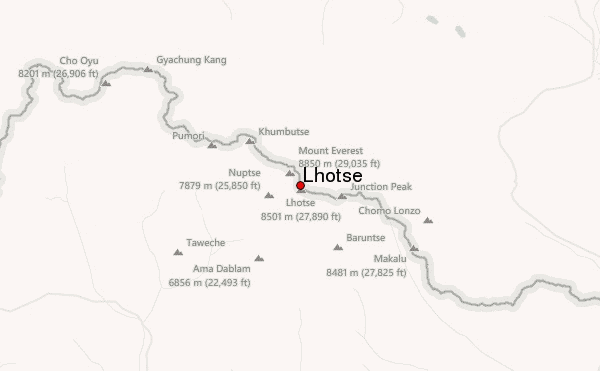
- Mount Lhotse, the fourth highest peak in the world at 8501 metres.
- Cyclonic Storm named ‘ROANU’ developed Over West Central region of Bay of Bengal
- Trikuta hills present in Jammu & Kashmir (News-Forest Fire)
Receive Daily Updates
Recent Posts
- In the Large States category (overall), Chhattisgarh ranks 1st, followed by Odisha and Telangana, whereas, towards the bottom are Maharashtra at 16th, Assam at 17th and Gujarat at 18th. Gujarat is one State that has seen startling performance ranking 5th in the PAI 2021 Index outperforming traditionally good performing States like Andhra Pradesh and Karnataka, but ranks last in terms of Delta
- In the Small States category (overall), Nagaland tops, followed by Mizoram and Tripura. Towards the tail end of the overall Delta ranking is Uttarakhand (9th), Arunachal Pradesh (10th) and Meghalaya (11th). Nagaland despite being a poor performer in the PAI 2021 Index has come out to be the top performer in Delta, similarly, Mizoram’s performance in Delta is also reflected in it’s ranking in the PAI 2021 Index
- In terms of Equity, in the Large States category, Chhattisgarh has the best Delta rate on Equity indicators, this is also reflected in the performance of Chhattisgarh in the Equity Pillar where it ranks 4th. Following Chhattisgarh is Odisha ranking 2nd in Delta-Equity ranking, but ranks 17th in the Equity Pillar of PAI 2021. Telangana ranks 3rd in Delta-Equity ranking even though it is not a top performer in this Pillar in the overall PAI 2021 Index. Jharkhand (16th), Uttar Pradesh (17th) and Assam (18th) rank at the bottom with Uttar Pradesh’s performance in line with the PAI 2021 Index
- Odisha and Nagaland have shown the best year-on-year improvement under 12 Key Development indicators.
- In the 60:40 division States, the top three performers are Kerala, Goa and Tamil Nadu and, the bottom three performers are Uttar Pradesh, Jharkhand and Bihar.
- In the 90:10 division States, the top three performers were Himachal Pradesh, Sikkim and Mizoram; and, the bottom three performers are Manipur, Assam and Meghalaya.
- Among the 60:40 division States, Orissa, Chhattisgarh and Madhya Pradesh are the top three performers and Tamil Nadu, Telangana and Delhi appear as the bottom three performers.
- Among the 90:10 division States, the top three performers are Manipur, Arunachal Pradesh and Nagaland; and, the bottom three performers are Jammu and Kashmir, Uttarakhand and Himachal Pradesh
- Among the 60:40 division States, Goa, West Bengal and Delhi appear as the top three performers and Andhra Pradesh, Telangana and Bihar appear as the bottom three performers.
- Among the 90:10 division States, Mizoram, Himachal Pradesh and Tripura were the top three performers and Jammu & Kashmir, Nagaland and Arunachal Pradesh were the bottom three performers
- West Bengal, Bihar and Tamil Nadu were the top three States amongst the 60:40 division States; while Haryana, Punjab and Rajasthan appeared as the bottom three performers
- In the case of 90:10 division States, Mizoram, Assam and Tripura were the top three performers and Nagaland, Jammu & Kashmir and Uttarakhand featured as the bottom three
- Among the 60:40 division States, the top three performers are Kerala, Andhra Pradesh and Orissa and the bottom three performers are Madhya Pradesh, Jharkhand and Goa
- In the 90:10 division States, the top three performers are Mizoram, Sikkim and Nagaland and the bottom three performers are Manipur and Assam
In a diverse country like India, where each State is socially, culturally, economically, and politically distinct, measuring Governance becomes increasingly tricky. The Public Affairs Index (PAI 2021) is a scientifically rigorous, data-based framework that measures the quality of governance at the Sub-national level and ranks the States and Union Territories (UTs) of India on a Composite Index (CI).
States are classified into two categories – Large and Small – using population as the criteria.
In PAI 2021, PAC defined three significant pillars that embody Governance – Growth, Equity, and Sustainability. Each of the three Pillars is circumscribed by five governance praxis Themes.
The themes include – Voice and Accountability, Government Effectiveness, Rule of Law, Regulatory Quality and Control of Corruption.
At the bottom of the pyramid, 43 component indicators are mapped to 14 Sustainable Development Goals (SDGs) that are relevant to the States and UTs.
This forms the foundation of the conceptual framework of PAI 2021. The choice of the 43 indicators that go into the calculation of the CI were dictated by the objective of uncovering the complexity and multidimensional character of development governance

The Equity Principle
The Equity Pillar of the PAI 2021 Index analyses the inclusiveness impact at the Sub-national level in the country; inclusiveness in terms of the welfare of a society that depends primarily on establishing that all people feel that they have a say in the governance and are not excluded from the mainstream policy framework.
This requires all individuals and communities, but particularly the most vulnerable, to have an opportunity to improve or maintain their wellbeing. This chapter of PAI 2021 reflects the performance of States and UTs during the pandemic and questions the governance infrastructure in the country, analysing the effectiveness of schemes and the general livelihood of the people in terms of Equity.


Growth and its Discontents
Growth in its multidimensional form encompasses the essence of access to and the availability and optimal utilisation of resources. By resources, PAI 2021 refer to human resources, infrastructure and the budgetary allocations. Capacity building of an economy cannot take place if all the key players of growth do not drive development. The multiplier effects of better health care, improved educational outcomes, increased capital accumulation and lower unemployment levels contribute magnificently in the growth and development of the States.


The Pursuit Of Sustainability
The Sustainability Pillar analyses the access to and usage of resources that has an impact on environment, economy and humankind. The Pillar subsumes two themes and uses seven indicators to measure the effectiveness of government efforts with regards to Sustainability.


The Curious Case Of The Delta
The Delta Analysis presents the results on the State performance on year-on-year improvement. The rankings are measured as the Delta value over the last five to 10 years of data available for 12 Key Development Indicators (KDI). In PAI 2021, 12 indicators across the three Pillars of Equity (five indicators), Growth (five indicators) and Sustainability (two indicators). These KDIs are the outcome indicators crucial to assess Human Development. The Performance in the Delta Analysis is then compared to the Overall PAI 2021 Index.
Key Findings:-
In the Scheme of Things
The Scheme Analysis adds an additional dimension to ranking of the States on their governance. It attempts to complement the Governance Model by trying to understand the developmental activities undertaken by State Governments in the form of schemes. It also tries to understand whether better performance of States in schemes reflect in better governance.
The Centrally Sponsored schemes that were analysed are National Health Mission (NHM), Umbrella Integrated Child Development Services scheme (ICDS), Mahatma Gandh National Rural Employment Guarantee Scheme (MGNREGS), Samagra Shiksha Abhiyan (SmSA) and MidDay Meal Scheme (MDMS).
National Health Mission (NHM)
INTEGRATED CHILD DEVELOPMENT SERVICES (ICDS)
MID- DAY MEAL SCHEME (MDMS)
SAMAGRA SHIKSHA ABHIYAN (SMSA)
MAHATMA GANDHI NATIONAL RURAL EMPLOYMENT GUARANTEE SCHEME (MGNREGS)