


A temple is just another building. It has all the structural elements of a building — floor, walls, pillars, windows, sunshades, roof. But in different forms, shapes and functions; and an aesthetic that evolved over centuries.
There are three major types of temples in India, categorised by architecture and region:
- Naagara – from Himalayas to the Vindhyas
- Vesara – from Vindhyas to the Krishna river
- Dravida – from Krishna river to Kanyakumari
These are broad categories as mentioned in several shilpa shaastras, and there are many subcategories.

This is a small compact elegant Chola era temple from Visalur, Pudukottai district, Tamil Nadu. There is no window, obviously; because it is the sanctum of a God, not the abode of a human.
The roof, called vimanam (comprising prastara, greeva, shikara and kalasa) is very elaborate, and decorated with sculptures.
The whole structure is called a mandiram, devaalaya or praasaada. Similar names exist in Malayalam (ambalam — house), Tamil (kovil — house of ruler); Kannada (gudi — house); Odia (deula — a derivative of devaalaya) and Assamese (dol).
The vimaanam may have more than one tala (level). Each tala has the same elements as the one below it, except they may be narrower or separated by one or more other elements.
A Naagara temple also has six basic elements, the shadvarga — but its starkest, most visual contrast to a Dravida temple is its steep verticality.
A Dravida vimanam appears to be a series of squares stacked on one another — a stepped pyramidal look.
A Naagara vimanam seems like a series of triangles or trapezoids merging at the summit. The vimanam can be of one or many levels, called bhumi.
The vertical separations into three five, or seven segments (rathas) has more visual impact.
A large capstone, amalaka, is another distinguishing feature.

The Rajaraja Choleesvaram temple of Tanjavur is a thirteen tala vimanam, and is justly called Devaalaya Chakravarthi.

One can hardly call something so majestic, “just another building.”
In conception, design and practice, a devaalayam is:
- a place for devotion, ritual, celebration
- a locus for a community, a retreat from tumult
- an expression of the soul and spirit of a people
- chiseled into beauty by skill, pride, passion, learning and dedication
- by sculptors, devotees, patrons long forgotten
Why build such temples, though? Are they expressions of vanity of kings? Or are they famine relief projects, as conjectured by some?
One particular king, “Mamalla” Narasimha Pallava, has left us an answer, in a poetic inscription, in the town that bears his name, Mamallapuram.
One stanza goes:
tenedam kaaritam tunga dhoorjaTer mandiram shubham
prajaanaam ishTa siddhi arthamshankareem bhutim icchataa
Translation The king built (kaaritam) this auspicious (shubham) temple (mandiram) for DhoorjaTa (Shiva), to fulfill peoples (prajaanaam) desire (ishTa siddhi artham) to receive his blessings (bhutim)
History and Evolution
Temples have legends associated with them, that they are places where a Deva, an Asura, a Rishi, or a King worshipped a specific God.
Some of these stories are from a time before historic evidence, except a continuous tradition.
Temples have a history of evolution, rebuilding, expansion, renovation, and sometimes destruction and abandonment.
Some of these vandalised or abandoned temples are subjects of archaeological and historic interest.
An ancestor of Narasimha, Mahendra Pallava, left us a fascinating inscription in a granite cave temple excavated into a rocky hill, in Mandagapattu, in Viluppuram district of Tamil Nadu.
The inscription reads:

etat anishTakam adrumam aloham asudham vichitrachittena nirmaapita nrpeNa brahmeshvara vishNu lakshita aayatanam
Translation: This temple (aayatanam) called Lakshita was commissioned (nirmaapita) by the king(nrpeNA) VichitraChitta (a title of Mahendra Pallava) for Brahma, Ishvara and Vishnu, without brick (anishTakam), without wood (adrumam), without metal (aloham) and without mortar (asudham)
Chitta means Thinker; Vichitra means both Beautiful and Strange. VichitraChitta is a title for the playful and inventive spirit of Mahendra Pallava, and his sculptors.
The inscription also tells us of earlier temples that were built of perishable metals such as wood, mortar and brick.
Subsequent Chola, Pandya inscriptions tell us of many brick temples that were rebuilt as stone temples.
From records of travellers like Megasthenes and Hiuen Tsang, we know that wood and brick temples proliferated all over India.
Stone temples from the Gupta age are found all over India.
We see three types of temples:
- Excavated cave temple
- Single stone temples (monoliths)
- Structural temples
There are a number of Buddhist, Jain, Hindu cave temples (and two Ajivaka caves) in rocky hills far away from cities, all over India.
Monoliths are few and far between. Structural temples, that is temples created by aligning cut blocks of rock, then sculpted and embellished, are the most common, popular and durable types of temples.
Materials, too, vary by region. Sandstone temples are common in northern Karnataka, Orissa, Gujarat and Madhya Pradesh, granite in Tamil Nadu and Andhra Pradesh, basalt in Maharashtra and Telengana, soapstone in southern Karnataka, and timber in rainy or hilly areas like Kerala and Himachal Pradesh.
The earliest surviving stone temples, even the small ones, are quite well developed. They have several features that remind us of their wood and brick predecessors.
The simplest temples have a sanctum and an ardha-mandapa (Dravida) or antarala (Naagara).
Larger temples have an additional maha-mandapa, and, perhaps, one or more mandapas.
Often, these are nrtta or nata mandiras, for ceremonial dance. Frequently, marvelous sculptures adorn them. Orissa temples have a bhoga mandapa, where a number of food items are offered to the deity.
Some Nagari mahamandapas have beautifully decorated windows; others elaborate porticos, which focus light on the main deity.
The largest temples have a saandhaara passage, an inner circumambulatory corridor around the sanctum.
Some Pallava temples — Kanchi Vaikuntha, Uthiramerur Sundara Varada; and Pandya temples — Madurai Koodal Azhagar, Cheranmaadevi Ramaswamy — are three tiered.
There are three sanctums, one above the other inside a single vimanam, featuring one murthy of Vishnu each in standing, sitting and reclining positions.
Internal staircases are brilliantly designed to accommodate these.
Later, smaller parivaara shrines or other adjunct mandapas have also been built. The Vijayanagar kings, and their governors, the Nayaks of Madurai, Tanjavur, Gingee and Mysore, built enormous thousand-pillar halls, famous in Madurai and Srirangam.

The shadvarga themselves have many components, giving room for variety and the imagination of its creators.
The adishtaana of Dravida temples have two major parts — the kumudam and the jagati.
The kumudam is either three faces of a six faced beam or semi cylindrical. A jagati can be flat, or shaped like an inverted lotus. They may be either plain or decorated.

The paada or wall of a Dravida temple has one or more niches with sculptures of deities, but usually plain in between, except for pilasters, which may be elaborately decorated in different segments.
Pillars often have similar segments. The most elaborate of pillars are found in Kakatiya and Hoysala architecture, with extremely intricate sculptures.

The walls of early Nagari temples are plain, but later temples use pilasters of different styles adjacent to each other. The Mukteshvara temple features a cylindrical pilaster with a naga winding around, and a shadvarga flat pilaster with a dwarf, a shaalabhanjika etc. In contrast, Brahmeshvara temple features a two part pilaster with a mithuna couple, a dikpala et cetera.

There are also several other architectural features that we shall look at when we look at specific temples in detail.
Sthapathis and Shilpa Texts
An inscription in the Tanjavur temple of Rajaraja Chola names its architect as Kunjaramallan Rajaraja Perum Tacchan (Perum = great; Tacchan = Taksha, architect).
It seems that the king was so impressed with the enormous accomplishment, that he honoured the sthapathi with his own royal title.
Sadly, except in Karnataka, rarely are the builders and sculptors even mentioned.
Neither ancient aliens nor random people working for food during a famine, built our temples.
The Vishvakarma community, with a dedicated and vast volume of shilpa shaastra literature, scattered across the country in various clans and families, were and are the master artisans across millennia.
Poorly recognised in their own land, they jealously guarded several secrets of survey, engineering, logistics, art, technique, painting and tool design.
In the last century, some of their books have been translated and published for public perusal.
Maya Math, Shilpa Ratna Kosha, Marici Samhita and Kashyapa Samhita are shilpa shaastras.
Several agamas like Kaamika aagama, Karana aagama and many puranas too, have detailed information on architecture, sculpture, painting et cetera.
Karnataka remains a sterling exception to this lamentable neglect. The Chalukya monuments of Badami, Aihole and Pattadakkal are festooned with names of sculptors, artists, and master sthapathis.
Aihole temples proudly boast of Ganasobba and Narasobba, “the lion among sculptors.”
Sarvasiddhi Achari and Gundan Anavarita Achari are honoured as the architects of the Virupaksha temple in Pattadakkal.
There is even a gossip inscription accusing a Vakkasivadeva of questionable behaviour. Several popular legends, formerly orally transmitted, are now part of Kannada literature.
Receive Daily Updates
Recent Posts
The United Nations has shaped so much of global co-operation and regulation that we wouldn’t recognise our world today without the UN’s pervasive role in it. So many small details of our lives – such as postage and copyright laws – are subject to international co-operation nurtured by the UN.
In its 75th year, however, the UN is in a difficult moment as the world faces climate crisis, a global pandemic, great power competition, trade wars, economic depression and a wider breakdown in international co-operation.
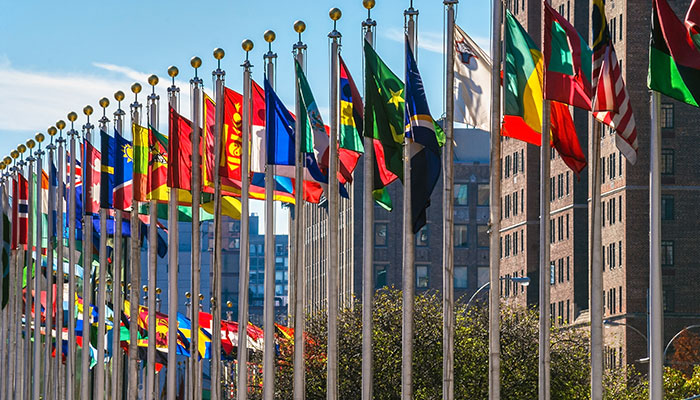
Still, the UN has faced tough times before – over many decades during the Cold War, the Security Council was crippled by deep tensions between the US and the Soviet Union. The UN is not as sidelined or divided today as it was then. However, as the relationship between China and the US sours, the achievements of global co-operation are being eroded.
The way in which people speak about the UN often implies a level of coherence and bureaucratic independence that the UN rarely possesses. A failure of the UN is normally better understood as a failure of international co-operation.
We see this recently in the UN’s inability to deal with crises from the ethnic cleansing of the Rohingya Muslims in Myanmar, to civil conflict in Syria, and the failure of the Security Council to adopt a COVID-19 resolution calling for ceasefires in conflict zones and a co-operative international response to the pandemic.
The UN administration is not primarily to blame for these failures; rather, the problem is the great powers – in the case of COVID-19, China and the US – refusing to co-operate.
Where states fail to agree, the UN is powerless to act.
Marking the 75th anniversary of the official formation of the UN, when 50 founding nations signed the UN Charter on June 26, 1945, we look at some of its key triumphs and resounding failures.
Five successes
1. Peacekeeping
The United Nations was created with the goal of being a collective security organisation. The UN Charter establishes that the use of force is only lawful either in self-defence or if authorised by the UN Security Council. The Security Council’s five permanent members, being China, US, UK, Russia and France, can veto any such resolution.
The UN’s consistent role in seeking to manage conflict is one of its greatest successes.
A key component of this role is peacekeeping. The UN under its second secretary-general, the Swedish statesman Dag Hammarskjöld – who was posthumously awarded the Nobel Peace prize after he died in a suspicious plane crash – created the concept of peacekeeping. Hammarskjöld was responding to the 1956 Suez Crisis, in which the US opposed the invasion of Egypt by its allies Israel, France and the UK.
UN peacekeeping missions involve the use of impartial and armed UN forces, drawn from member states, to stabilise fragile situations. “The essence of peacekeeping is the use of soldiers as a catalyst for peace rather than as the instruments of war,” said then UN Secretary-General Javier Pérez de Cuéllar, when the forces won the 1988 Nobel Peace Prize following missions in conflict zones in the Middle East, Africa, Asia, Central America and Europe.
However, peacekeeping also counts among the UN’s major failures.
2. Law of the Sea
Negotiated between 1973 and 1982, the UN Convention on the Law of the Sea (UNCLOS) set up the current international law of the seas. It defines states’ rights and creates concepts such as exclusive economic zones, as well as procedures for the settling of disputes, new arrangements for governing deep sea bed mining, and importantly, new provisions for the protection of marine resources and ocean conservation.
Mostly, countries have abided by the convention. There are various disputes that China has over the East and South China Seas which present a conflict between power and law, in that although UNCLOS creates mechanisms for resolving disputes, a powerful state isn’t necessarily going to submit to those mechanisms.
Secondly, on the conservation front, although UNCLOS is a huge step forward, it has failed to adequately protect oceans that are outside any state’s control. Ocean ecosystems have been dramatically transformed through overfishing. This is an ecological catastrophe that UNCLOS has slowed, but failed to address comprehensively.
3. Decolonisation
The idea of racial equality and of a people’s right to self-determination was discussed in the wake of World War I and rejected. After World War II, however, those principles were endorsed within the UN system, and the Trusteeship Council, which monitored the process of decolonisation, was one of the initial bodies of the UN.
Although many national independence movements only won liberation through bloody conflicts, the UN has overseen a process of decolonisation that has transformed international politics. In 1945, around one third of the world’s population lived under colonial rule. Today, there are less than 2 million people living in colonies.
When it comes to the world’s First Nations, however, the UN generally has done little to address their concerns, aside from the non-binding UN Declaration on the Rights of Indigenous Peoples of 2007.
4. Human rights
The Human Rights Declaration of 1948 for the first time set out fundamental human rights to be universally protected, recognising that the “inherent dignity and of the equal and inalienable rights of all members of the human family is the foundation of freedom, justice and peace in the world”.
Since 1948, 10 human rights treaties have been adopted – including conventions on the rights of children and migrant workers, and against torture and discrimination based on gender and race – each monitored by its own committee of independent experts.
The language of human rights has created a new framework for thinking about the relationship between the individual, the state and the international system. Although some people would prefer that political movements focus on ‘liberation’ rather than ‘rights’, the idea of human rights has made the individual person a focus of national and international attention.
5. Free trade
Depending on your politics, you might view the World Trade Organisation as a huge success, or a huge failure.
The WTO creates a near-binding system of international trade law with a clear and efficient dispute resolution process.
The majority Australian consensus is that the WTO is a success because it has been good for Australian famers especially, through its winding back of subsidies and tariffs.
However, the WTO enabled an era of globalisation which is now politically controversial.
Recently, the US has sought to disrupt the system. In addition to the trade war with China, the Trump Administration has also refused to appoint tribunal members to the WTO’s Appellate Body, so it has crippled the dispute resolution process. Of course, the Trump Administration is not the first to take issue with China’s trade strategies, which include subsidises for ‘State Owned Enterprises’ and demands that foreign firms transfer intellectual property in exchange for market access.
The existence of the UN has created a forum where nations can discuss new problems, and climate change is one of them. The Intergovernmental Panel on Climate Change (IPCC) was set up in 1988 to assess climate science and provide policymakers with assessments and options. In 1992, the UN Framework Convention on Climate Change created a permanent forum for negotiations.
However, despite an international scientific body in the IPCC, and 165 signatory nations to the climate treaty, global greenhouse gas emissions have continued to increase.
Under the Paris Agreement, even if every country meets its greenhouse gas emission targets we are still on track for ‘dangerous warming’. Yet, no major country is even on track to meet its targets; while emissions will probably decline this year as a result of COVID-19, atmospheric concentrations of greenhouse gases will still increase.
This illustrates a core conundrum of the UN in that it opens the possibility of global cooperation, but is unable to constrain states from pursuing their narrowly conceived self-interests. Deep co-operation remains challenging.
Five failures of the UN
1. Peacekeeping
During the Bosnian War, Dutch peacekeeping forces stationed in the town of Srebrenica, declared a ‘safe area’ by the UN in 1993, failed in 1995 to stop the massacre of more than 8000 Muslim men and boys by Bosnian Serb forces. This is one of the most widely discussed examples of the failures of international peacekeeping operations.
On the massacre’s 10th anniversary, then UN Secretary General Kofi Annan wrote that the UN had “made serious errors of judgement, rooted in a philosophy of impartiality”, contributing to a mass murder that would “haunt our history forever”.
If you look at some of the other infamous failures of peacekeeping missions – in places such as Rwanda, Somalia and Angola – it is the limited powers given to peacekeeping operations that have resulted in those failures.
2. The invasion of Iraq
The invasion of Iraq by the US in 2003, which was unlawful and without Security Council authorisation, reflects the fact that the UN is has very limited capacity to constrain the actions of great powers.
The Security Council designers created the veto power so that any of the five permanent members could reject a Council resolution, so in that way it is programmed to fail when a great power really wants to do something that the international community generally condemns.
In the case of the Iraq invasion, the US didn’t veto a resolution, but rather sought authorisation that it did not get. The UN, if you go by the idea of collective security, should have responded by defending Iraq against this unlawful use of force.
The invasion proved a humanitarian disaster with the loss of more than 400,000 lives, and many believe that it led to the emergence of the terrorist Islamic State.
3. Refugee crises
The UN brokered the 1951 Refugee Convention to address the plight of people displaced in Europe due to World War II; years later, the 1967 Protocol removed time and geographical restrictions so that the Convention can now apply universally (although many countries in Asia have refused to sign it, owing in part to its Eurocentric origins).
Despite these treaties, and the work of the UN High Commission for Refugees, there is somewhere between 30 and 40 million refugees, many of them, such as many Palestinians, living for decades outside their homelands. This is in addition to more than 40 million people displaced within their own countries.
While for a long time refugee numbers were reducing, in recent years, particularly driven by the Syrian conflict, there have been increases in the number of people being displaced.
During the COVID-19 crisis, boatloads of Rohingya refugees were turned away by port after port. This tragedy has echoes of pre-World War II when ships of Jewish refugees fleeing Nazi Germany were refused entry by multiple countries.
And as a catastrophe of a different kind looms, there is no international framework in place for responding to people who will be displaced by rising seas and other effects of climate change.
4. Conflicts without end
Across the world, there is a shopping list of unresolved civil conflicts and disputed territories.
Palestine and Kashmir are two of the longest-running failures of the UN to resolve disputed lands. More recent, ongoing conflicts include the civil wars in Syria and Yemen.
The common denominator of unresolved conflicts is either division among the great powers, or a lack of international interest due to the geopolitical stakes not being sufficiently high. For instance, the inaction during the Rwandan civil war in the 1990s was not due to a division among great powers, but rather a lack of political will to engage.
In Syria, by contrast, Russia and the US have opposing interests and back opposing sides: Russia backs the government of the Syrian dictator Bashar al-Assad, whereas the US does not.
5. Acting like it’s 1945
The UN is increasingly out of step with the reality of geopolitics today.
The permanent members of the Security Council reflect the division of power internationally at the end of World War II. The continuing exclusion of Germany, Japan, and rising powers such as India and Indonesia, reflects the failure to reflect the changing balance of power.
Also, bodies such as the IMF and the World Bank, which are part of the UN system, continue to be dominated by the West. In response, China has created potential rival institutions such as the Asian Infrastructure Investment Bank.
Western domination of UN institutions undermines their credibility. However, a more fundamental problem is that institutions designed in 1945 are a poor fit with the systemic global challenges – of which climate change is foremost – that we face today.