


Why in News: Odisha has begun the process to declare the Rushikulya rookery in Ganjam district as a Biodiversity Heritage Site, recognising its global importance as a major nesting ground for Olive Ridley sea turtles and a lifeline for local communities.
Rushikulya rookery: a unique coastal ecosystem
The Rushikulya rookery stretches for about 10 km from New Podampeta to Agasti Nuagaon along the river mouth and adjoining sea beach in Ganjam district. It is recognised as one of the world’s major mass nesting, or Arribada, sites where thousands of Olive Ridley sea turtles come ashore to lay eggs every year. This fragile coastal belt also supports migratory and resident birds, diverse plant species and a rich estuarine environment.
The surrounding Prayagi reserve forest, spread over nearly 415 hectares near the sea mouth, further enhances the ecological value of the landscape. This forest harbouring many native and medicinal plants links the marine and terrestrial habitats, creating a mosaic of biodiversity that is rare along India’s eastern coast.
Why biodiversity heritage status matters
The Odisha government, through the Odisha Biodiversity Board, has initiated the process to confer Biodiversity Heritage Site status on around 747 hectares in and around the rookery under Section 37 of the Biological Diversity Act, 2002. Scientists and researchers have already conducted a preliminary survey along the river mouth and sea beach after the Berhampur forest division submitted a formal proposal. This move signals a policy-level commitment to long-term protection of the rookery’s ecology and its associated cultural landscape.
Confluence of nature, culture and faith
Rushikulya is not only an ecological asset but also a cultural and spiritual space. The river is closely associated with local rituals, festivals and traditional practices that have evolved around its seasonal rhythms and natural cycles. Near the river mouth stands the Bateswar Temple, which embodies a convergence of sacred ecology and cultural heritage amid a biodiverse landscape.
What are Biodiversity Heritage Sites ?
Biodiversity Heritage Sites (BHS) are unique, ecologically fragile, and biodiversity-rich areas—terrestrial, coastal, or inland waters—designated under Section 37 of India’s Biological Diversity Act, 2002. They harbor rare, threatened species and high endemism, emphasizing conservation without restricting local community usage
Key Features of Biodiversity Heritage Sites:
- Designation: Declared by State Governments in consultation with local bodies (Panchayats/BMCs).
- Significance: These sites often contain high species richness, wild ancestors of cultivated plants, and significant cultural/aesthetic values.
- Purpose: To enhance the quality of life of local communities and preserve unique ecosystems.
- Notable Examples in India:
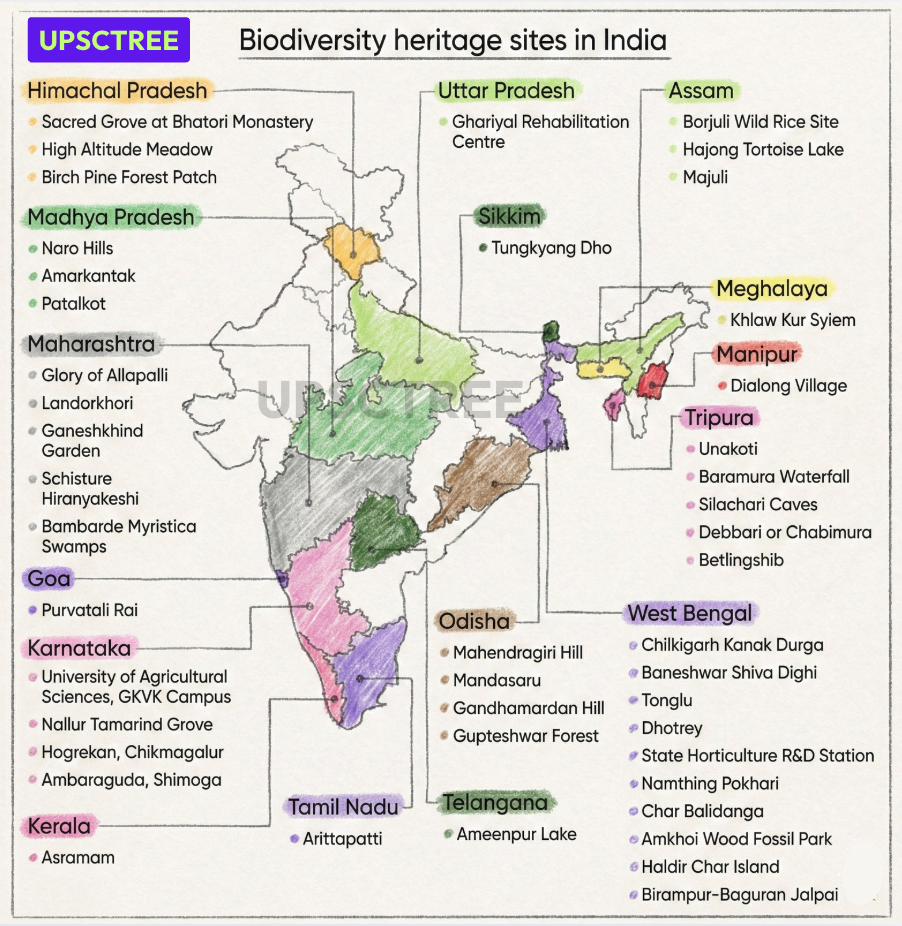
- Nallur Tamarind Grove (Karnataka): India’s first BHS (2007), known for ancient tamarind trees.
- Majuli Island (Assam): Largest river island with unique aquatic/terrestrial biodiversity.
- Aravalli Biodiversity Park (Haryana): Urban green space.
- Chilika Lake (Odisha): Major habitat for migratory birds.
- Gupteswar Forest (Odisha): Rich in biodiversity and sacred groves.
- Ambaragudda (Karnataka): Features rare Shola vegetation.
Biodiversity Heritage Sites of India:
Q1. Consider the following statements regarding the Rushikulya Rookery:
-
It is located in the Ganjam district of Odisha and is globally recognized as an Arribada site for Olive Ridley sea turtles.
-
The rookery is situated at the mouth of the Mahanadi River, supporting a rich estuarine environment.
-
The ecosystem’s ecological value is further enhanced by the adjoining Prayagi reserve forest, which connects marine and terrestrial habitats.
Which of the statements given above are correct?
(a) 1 and 2 only
(b) 1 and 3 only
(c) 2 and 3 only
(d) 1, 2, and 3
Q2. With reference to ‘Biodiversity Heritage Sites (BHS)’ in India, consider the following statements:
-
They are notified by the Central Government under the Environment (Protection) Act, 1986.
-
The designation of a BHS restricts all traditional resource usage by local communities to ensure absolute conservation of threatened species.
-
India’s first Biodiversity Heritage Site was declared in Karnataka.
Which of the statements given above is/are correct?
(a) 1 and 2 only
(b) 3 only
(c) 1 and 3 only
(d) None
Q3. Consider the following pairs of Biodiversity Heritage Sites and their key features/locations:
-
Ambaragudda : Rare Shola vegetation
-
Majuli Island : Largest river island located in West Bengal
-
Nallur Tamarind Grove : Ancient trees and India’s first BHS
How many of the above pairs are correctly matched?
(a) Only one pair
(b) Only two pairs
(c) All three pairs
(d) None of the pairs
Q4. Consider the following statements:
-
Statement-I: State Governments have the authority to unilaterally declare any ecologically fragile area as a Biodiversity Heritage Site (BHS) for immediate conservation.
-
Statement-II: The Biological Diversity Act, 2002 mandates consultation with local bodies, such as Panchayats or Biodiversity Management Committees (BMCs), before designating a BHS.
Which one of the following is correct in respect of the above statements?
(a) Both Statement-I and Statement-II are correct and Statement-II is the correct explanation for Statement-I.
(b) Both Statement-I and Statement-II are correct but Statement-II is not the correct explanation for Statement-I.
(c) Statement-I is correct but Statement-II is incorrect.
(d) Statement-I is incorrect but Statement-II is correct.
Answer Key and Explanations
Ans 1. (b) 1 and 3 only
-
Statement 1 is correct: The passage states the Rushikulya rookery is in the Ganjam district and is a major mass nesting (Arribada) site for Olive Ridley turtles.
-
Statement 2 is incorrect: It is located along the Rushikulya river mouth, not the Mahanadi river.
-
Statement 3 is correct: The text mentions the surrounding Prayagi reserve forest links the marine and terrestrial habitats.
Ans 2. (b) 3 only
-
Statement 1 is incorrect: BHS are designated under Section 37 of India’s Biological Diversity Act, 2002 (not the EPA, 1986) by State Governments (not the Central Government).
-
Statement 2 is incorrect: The passage explicitly notes that BHS designation emphasizes conservation without restricting local community usage.
-
Statement 3 is correct: Nallur Tamarind Grove in Karnataka was India’s first BHS, declared in 2007.
Ans 3. (b) Only two pairs
-
Pair 1 is correctly matched: Ambaragudda (Karnataka) features rare Shola vegetation.
-
Pair 2 is incorrectly matched: Majuli Island is the largest river island, but it is located in Assam, not West Bengal.
-
Pair 3 is correctly matched: Nallur Tamarind Grove is known for its ancient tamarind trees and was the first BHS.
Ans 4. (d) Statement-I is incorrect but Statement-II is correct.
-
Statement-I is incorrect: State Governments cannot declare these sites “unilaterally.” They must do so in consultation with local bodies.
-
Statement-II is correct: Section 37 of the Biological Diversity Act, 2002 requires the State Government to consult with local bodies like Panchayats/BMCs before making the declaration.