


1) The President of India has promulgated ordinance for constitution of commercial courts.
Commercial Courts Bill, 2015
- The Commercial Courts, Commercial Division and Commercial Appellate Division of High Courts Bill, 2015 was introduced in Rajya Sabha on April 29, 2015 by the Minister of Finance, Mr. Arun Jaitley.
- The Bill enables the creation of commercial divisions in high courts, and commercial courts at the district level.
- Commercial dispute: A commercial dispute is defined to include any dispute related to transactions between merchants, bankers, financiers, traders, etc. Such transactions deal with mercantile documents, partnership agreements, intellectual property rights, insurance, etc.
- Commercial courts: Commercial courts, equivalent to district courts, may be set up in all states and union territories, by the state governments after consulting with their respective high courts
- Valuation of dispute: Such commercial divisions in high courts and commercial courts will deal with all matters relating to commercial disputes involving an amount of Rs one crore or more.
- Commercial appellate divisions: Commercial appellate divisions may be set up in all high courts to hear appeals against: (i) orders of commercial divisions of high courts; (ii) orders of commercial courts; and (iii) appeals arising from arbitration matters that are filed before the high courts.
- Any appeal filed in a high court against the orders of certain tribunals like: (i) Competition Appellate Tribunal; (ii) Debt Recovery Appellate Tribunal; (iii) Intellectual Property Appellate Board; (iv) Company Law Board or the National Company Law Tribunal; (v) Securities Appellate Tribunal; and (vi) Telecom Dispute Settlement and Appellate tribunal may be heard by the commercial appellate division of the high court if it relates to a commercial dispute.
- Transfer of pending suits: All suits, that are yet to reach judgement, of a value of Rs one crore or more that are pending in the high court or district court shall be transferred to the commercial division, after it is constituted.
2) Third Indo-African Summit to be held in New Delhi.
Indo-African Summit
- The India–Africa Forum Summit is the official platform for the Inida-Africa relations. It was first held New Delhi, India. It was the first such meeting between the heads of state and government of India and 14 countries of Africa chosen by the African Union.
- Topics
agricultural sector
trade
industry and investment
peace and security
promotion of good governance and civil society
information and communication technology
3) Unakoti – Rock Cut Carving , Tales of a lost Civilization
- Unakoti , situated in North Tripura , hosts finest of rock-cut architecture and stone- images.
- Unakoti pantheons are of two types namely rock-carved and stone images. Central to these rock cut carvings are the Shiva and Ganesha. The colossal image of Shiva head, of 30 ft height, carved in a vertical rock is known as ‘Unakotiswara Kal Bhairava’
- Near by, there is a rock cut image of goddess Durga standing on a lion, while on the other there is an image of goddess Ganga sitting on a Capricorn. There are also images of Nandi Bull lying half buried in the ground
- At the bottom of Unakoti, a beautiful spring descending the hill terraces fills up a cavern, called “Sita Kunda”, having a dip into which is regarded as sacred.
- Unakoti is believed to have had the influence of the Shiva cult originating from the Pala-era of the mediaeval period of Indian history. At the same time, the influences of several other cults like Tantric, Shakti, and Hatha yogis are also found to be present around this archaeological wonder. According to the Archaeological Survey of India (ASI),Unakoti dates back to the 8th or 9th century AD. Yet, many others differ with the opinion, conceding that it dates back longer further holding that those images were carved out in different spell of time.


4) Deprtment of Atomic Energy, Mandates and Achievements
- Mandate:-
- Research Innovation Education
- National Security
- Advanced technology and water resources
- Food, Agriculture and Industrial Applications
- Healthcare
- Nuclear Power and Fuel Cycle
- Highlights:-
- Tummalapalle (A.P) uranium mine: Processing plant to be commissioned in 2015-16.
- India will host the International Thorium Energy Conference (ThEC) in Mumbai in October 2015
- DAE Units supply over 23,000 consignments of radiopharmaceuticals to over 150 nuclear medicine centres and hospitals all over India.
- Vitrified Cesium-137 pencil, First-of-a-kind in the world, developed by BARC by recovery from High Level Waste. First set of 10 pencils delivered for use in Blood Irradiator units produced by BRIT-DAE.
- High yielding pigeon-pea variety Trombay Akola Red Arhar released for commercial cultivation
- Radiation processing plants set up with DAE technology at Unnao, Lucknow and Bavla, Ahmedabad
- Low-cost wound dressing (BaNOcol) developed at BARC – very effective against a broad spectrum of infection-causing microbes
- Strengthened collaborative involvement with LHC- CERN; process to become an Associate Member of CERN initiated.
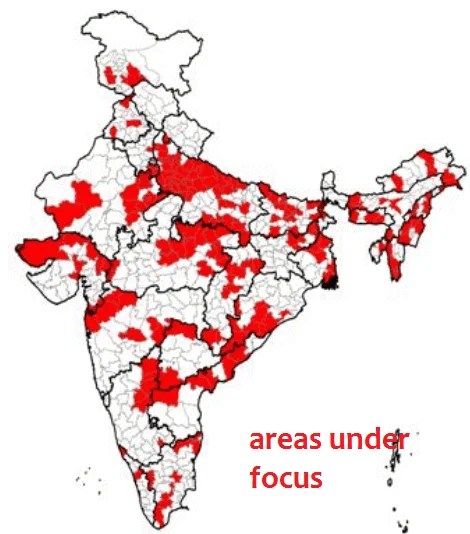
5) Mission IndraDhanush :-
- The Ministry of Health and Family Welfare, Government of India has launched Mission Indradhanush on 25 December, 2014 as a special nationwide initiative to vaccinate all unvaccinated and partially vaccinated children under the Universal Immunization Programme and sustain it by health system strengthening by 2020
- The Mission focuses on interventions to expand full immunization coverage in India from 65% in 2014 to at least 90% children in the next five years
- The programme provides immunization against seven life-threatening diseases (diphtheria, whooping cough, tetanus, polio, tuberculosis, measles and hepatitis B) in the entire country. In addition, vaccination against Heamophilus influenza type B and Japanese Encephalitis is provided in select districts/states.

6) International Tourism Mart:-
- The Ministry of Tourism, Government of India, in association with the North Eastern States and West Bengal has been successfully organising the International Tourism Mart over the last three years in various North Eastern States with the objective of highlighting the tourism potential of the region in the domestic and international markets. This Mart also brings together the tourism business fraternity and entrepreneurs from the eight North Eastern States and West Bengal.
Sorces- PIB and Various relevant newspapers