


National Hydrology Project:-
Background :-The Union Cabinet chaired by the Prime Minister has given its approval to Implementation of the National Hydrology Project.The National Hydrology Project (NHP) is intended for setting up of a system for timely and reliable water resources data acquisition, storage, collation and management. It will also provide tools/systems for informed decision making through Decision Support Systems (DSS) for water resources assessment, flood management, reservoir operations, drought management, etc. NHP also seeks to build capacity of the State and Central sector organisations in water resources management through the use of Information Systems and adoption of State-of-the-art technologies like Remote Sensing.
Details:-
The NHP will help in gathering Hydro-meteorological data which will be stored and analysed on a real time basis and can be seamlessly accessed by any user at the State/District/village level. The project envisages to cover the entire country as the earlier hydrology projects covered only 13 States.
The components of the proposal are:
- In Situ Hydromet Monitoring System and Hydromet Data Acquisition System.
- Setting up of National Water Informatics Centre (NWIC).
- Water Resources Operation and Management System
- Water Resources Institutions and Capacity Building
The NHP will result in the improvement of:
- Data storage, exchange, analysis and dissemination through National Water Informatics Centre.
- Lead time in flood forecast from 1 day to at least 3 days
- Mapping of flood inundation areas for use by the disaster management authorities
- Assessment of surface and ground water resources in a river basin for better planning & allocation for PMKSY and other schemes of Govt. of India
- Reservoir operations through seasonal yield forecast, drought management, SCADA systems, etc.
- Design of SW & GW structures, hydropower units, interlinking of rivers, Smart Cities.
- Fulfilling the objectives of Digital India.
- People Centric approach: The programme envisages ultimate aim for water management through scientific data collection, dissemination of information on water availability in all blocks of the country and establishing of National Water Information Centre. The automated systems for Flood Forecasting is aimed to reduce water disaster ultimately helping vulnerable population. It is people and farmer centric programme as information on water can help in predicting water availability and help farmers to plan their crops and other farm related activities. Through this programme India would make a place among nations known for scientific endeavors.
Different names of New year :-
Background :- Presidents of India’s greeting.
- Ugadi – Celebrated in Andhra Pradesh, telengana, Karnataka
- Gudi Padva:- Celebrated in Maharastra
- Chaitra Sukladi – North India
- Cheti Chand – Sindh region of India and Pakistan
- Navreh – Kashmir
- Sajibu Cheiraoba – Manipur
- Thapna – Rajasthan
Terrorism is on the rise – but there’s a bigger threat we’re not talking about
Note :- Data are given for understanding purpose only and except few not much of the data can be helpful from exam point of view.Hence, read with due care.
High-profile attacks on major cities in Belgium, France and the United States have set the world on edge. Commentators are talking of a new kind of protracted guerrilla war stretching from the Americas and Europe across Africa, Asia and the Arab world. This one is irregular, hybrid and networked, involving a constellation of terrorist organizations such as ISIS and Al Qaeda. Rather than hitting specific groups of people or symbolic sites, cities themselves are coming under siege. Complicating matters, violent extremists are recruiting directly from poorer and marginal neighbourhoods across the West.
The extent of local recruitment and so-called “extremist travelling” from Western countries is certainly cause for concern. One study estimates that as many as 31,000 people from 86 countries have made the trip to Iraq or Syria to join ISIS or other extremist groups since June 2014. It is not just Western Europe or North America that is proving to be fertile ground for so-called remote radicalization, but also Russia and Central Asia. Many foreign fighters are killed while fighting abroad, but as many as 30% of them eventually make the trip back home. Politicians are scrambling to respond and hate crimes against minority groups are on the rise.
It is statistically undeniable that terrorist violence is on the rise. But is today’s terrorist violence really more intense and widespread than in, say, the 1960s and 1970s? Are Western European and North American cities really the new front line of a global jihad? The answer partly depends on how terrorism is defined. There is currently no international legal or even academic agreement on what constitutes terrorism. Some experts say that it consists of violence perpetrated by non-state actors against civilians to achieve political religious or ideological change, but that sounds a lot like armed conflict. Complicating matters, governments routinely conflate terrorism and insurgency.

One way to better map out the extent of the terrorist threat is to follow the data. Notwithstanding serious challenges related to the quality and coverage of statistics on terrorism, warfare and homicide, it is possible to detect trends and patterns by honing in on the prevalence of lethal violence.
A not-so global jihad
It turns out that extremist violence is much less pervasive than you might think. As other analysts have noted, it is significantly more prolific outside Western countries than in them. A recent assessment of terrorist risks in 1,300 cities ranked urban centres in Afghanistan, Iraq, Libya, Nigeria, Pakistan and Somalia as significantly more vulnerable than those in Belgium, France, the UK or the US. At least 65 cities were described as facing extreme risk, with Iraq – especially Baghdad, Mosul, Al Ramadi, Ba´qubah, Kirkuk and Al Hillah – fielding six of the top 10. Consider that between 2000 and 2014, there were around 3,659 terrorist-related deaths in all Western countries combined. In Baghdad there were 1,141 deaths and 3,654 wounded in 2014 alone.
It is true that there have been dozens of terrorist attacks in recent years, but how are they spread around the world? The Global Terrorism Database (GTD) tracks terrorist-related fatalities between 2005 and 2014 in 160 countries. In a handful of cases where there is ongoing warfare – including Afghanistan, Iraq, Syria and Yemen – the GTD sometimes conflates terrorist and conflict-related deaths. The authors of the database go to great lengths to avoid this from happening, but it is unavoidable. There are alternative datasets that apply much more restrictive inclusion criteria, but they are not as broad in their coverage and also suffer flaws. Rather than focusing on absolute numbers of violent deaths, it may be more useful to consider prevalence rates.
On the one hand, most countries at the top of the list of most terrorism-prone are clustered in North Africa, the Middle East and South Asia. They include war-torn countries such as Iraq, Afghanistan, Somalia, Libya, the Occupied Palestinian Territories, Lebanon, Israel, Yemen, Pakistan and Syria. Other countries in the top 15 are more unexpected, not least the Former Yugoslavian Republic of Macedonia, Central African Republic, and Kenya. Belgium comes in at 86th place while France and the United States come in at 98th and 105th respectively. These latter rankings will obviously shift upwards given recent attacks in 2015 and 2016, but not by as much as you might expect.

Note: Fatalities are classified as terrorist-related if the action occurs outside the context of legitimate warfare activities, insofar as it targets non‐combatants as expressed by international humanitarian law.
Victims of war
Innocent civilians are much more likely to be killed during the course of armed conflicts. The difference between the two is that terrorism is intended specifically to indiscriminately kill civilians, while in wars the killing of innocent civilians and prisoners is expressly prohibited, even if it does occur. War-related killings may be labelled criminal or even terrorist when they are determined to be disproportionate. So how does the risk rating of violent deaths occurring in war zones compare to those due to terrorism? The Uppsala Conflict Database Program records conflict deaths occurring in more than 60 wars between 2005 and 2014. After adjusting the absolute numbers of violent deaths relative to the total population per country, it is possible to determine an approximate conflict death rate per 100,000 people.
It turns out that the risk of dying violently from war is considerable higher than the probability of being killed in the course of extremist violence. Although in some countries this risk is an order of magnitude higher, the overall conflict death rate in conflict zones is still far lower than many might have predicted. For example, the average conflict death rate is sky-high in Syria – site of some of the most horrific warfare over the past decade. But it is comparatively lower in places like Afghanistan, Iraq, Libya, South Sudan, Chad and Yemen, countries that have been exposed to industrial-scale violence. The conflict death rate of course varies according to the ebb and flow of warfare, but the average prevalence is surprisingly low.
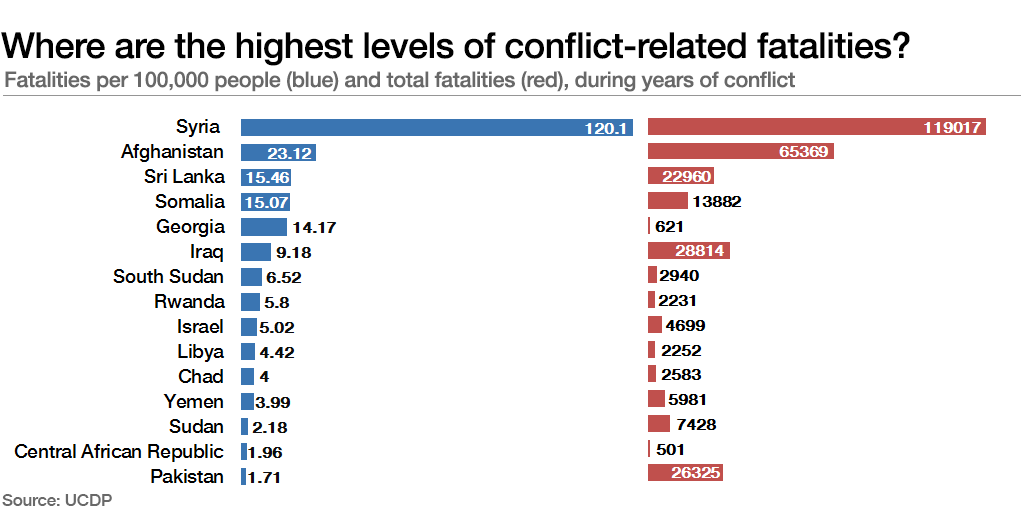
Note: Conflict deaths are defined as “battle deaths” caused by warring parties that can be directly attributed to combat. This includes traditional battlefield fighting, guerrilla activity, bombardment of bases and other actions where the target are military forces or representatives of the parties. Collateral damage, including civilian deaths, are counted.
The greatest threat of all: homicide
And now for the most surprising finding of all. A review of the data reveals that civilians around the world are much more at risk of being killed as result of homicide than either terrorist violence or warfare. Drawing on the Homicide Monitor, it is possible to track murder rates for more than 225 countries and territories from 2005 to 2014.
Although homicidal violence is steadily declining in most parts of the world, it still presents one of the greatest threats of what public health experts call external causes of mortality – especially among young adult and adolescent males.
As in the case of terrorist and conflict-related violence, there are also hot spots where murder tends to concentrate. People living in Central and South America, the Caribbean and Southern Africa are more at risk of dying of homicide than in most other places. The most murderous countries in the world include El Salvador, Honduras, Jamaica, Venezuela, the US Virgin Islands, Guatemala, Saint Kitts and Nevis, Belize, Colombia, Trinidad and Tobago, and Brazil. About 46 of the 50 most violent cities are concentrated in the Americas. Also included in the top 15 most murderous countries, though located outside the Americas, are South Africa, Swaziland and the Democratic Republic of Congo.
And beyond these pockets of extreme homicidal violence, the risk of murder is also more widely distributed than violent deaths associated with terrorism or war. There are roughly 85 countries that are consistently above the global average of around seven homicides per 100,000 people. In fact, about nine in every 10 violent deaths occurring around the world over the past decade were due to murder; just a fraction can be attributed to either war or terrorism. This is not to minimize the real dangers and destruction associated with these latter phenomena, but rather to ensure that we keep our eye firmly on the ball.
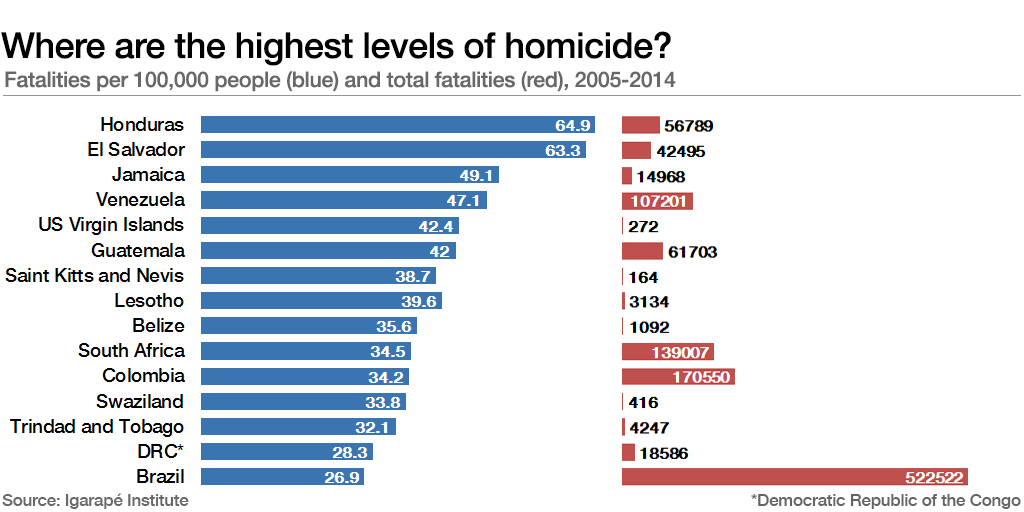
Note: Homicides are defined as the deliberate and unlawful killing of one person by another and are registered by police and health departments.
Drawing lessons from the data
So what does this morbid retreat into the data of violent death tell us? First, it is a reminder that a relatively small number of countries are dramatically more at risk of terrorist and conflict-related violence than others – especially Afghanistan, Iraq, Libya, Nigeria, Pakistan, Somalia, Syria and Yemen. While they must protect their homeland from terrorist events, diplomats, development experts and defence specialists would do well to double down on preventive diplomacy and conflict prevention in the most badly affected countries. Doing so could have a dramatic effect on reducing the global burden of terrorist and conflict violence and related humanitarian consequences such as refugee flows and internal population displacement.
Second, there are also a handful of countries – most of them in Latin America and the Caribbean – where homicidal violence is off-the charts. Most of the murders in these states are concentrated in fast-growing large- and medium-sized cities. If homicides are to be reduced there, it is essential that federal and municipal planners focus on risk factors that are driving urban violence – not least social and economic inequality, high rates of youth unemployment, poor and uneven governance, and the limited purchase of the rule of law. There is mounting evidence of data-driven strategies that work – including focused-deterrence, cognitive therapy and targeted prevention, but they need sustained leadership to have lasting effect.
Finally, we need to get better at nurturing resilience – the ability to cope, adapt and rebound in the face of adversity – in high-risk communities. While obviously distinct in their causes and consequences, there are still many commonalities connecting terrorist, conflict and homicidal violence. When communities are disorganized and suffer from neglect, there is a higher likelihood of politically, criminally and ideologically motivated organized violence erupting. Governments, businesses and civil society groups need to make sure that political settlements are inclusive, that marginalized groups and broken families are taken care of, and that resilience is designed in to communities from the get-go
ISBN Portal
The centre has launched a portal for registration and allotment of International Standard Book Number (ISBN).The ISBN portal is a part of central government’s e-governance initiative for streamlining the process of registration for publishers and authors which will make the process user friendly.This initiative is aimed at ensuring ease of registration, enhanced accessibility, wider transparency, trust and credibility and greater efficiency for the book writing fraternity in the country.
- The portal has been created to facilitate publishers and authors to register for ISBN number. ISBN gives an identity to a book without which the bookshops will not sell it.
- The ISBN portal seeks to completely automate the process of seeking application, their examination and allotment of ISBNs. The developed software has several modules including users’ registration and online application submission.
- The automation process also seeks to maintain inventory as well as process the data that will be provided by the users. There will be doing away with receipt of hard copy of any document unless considered appropriate for establishing the identity of the applicant and for confirming the book publishing activity.
ISBN :-
ISBN is a unique number used to identify monographic publications. Displayed in barcode format, ISBN is a 13-character identification allotted by the International ISBN Agency based in Britain through the National ISBN Agency. It provides access to bibliographic data bases used by the book industry and libraries to provide information.
Cabinet approves recommendations of 14th Finance Commissio:-
The Cabinet has approved the 14th Finance Commission’s recommendations on fiscal deficit targets and additional targets for states during 2015-20.
Key details:-
- Fiscal deficit target of 3% for states.
- Besides, the Commission has also provided for year-to-year flexibility for additional deficit. It has provided additional headroom to a maximum of 0.5% over and above the normal limit of 3% in any given year to states that have had a favourable debt-GSDP ratio and interest payments-revenue receipts ratio in the previous two years.
- However, the flexibility in availing the additional fiscal deficit will be available to a state if there is no revenue deficit in the year in which borrowing limits are to be fixed and immediately preceding year.
- Since the year 2015-16 is already over, the States will not get any benefit of additional borrowings for 2015-16. However, the implications for the remaining period of FFC award of 2016-17 to 2019-20, would depend upon respective States’ eligibility based on the criteria prescribed by FFC.
- If a State is not able to fully utilise its sanctioned fiscal deficit of 3% of GSDP in any particular year during the 2016-17 to 2018-19 of FFC award period, it will have the option of availing this un-utilised fiscal deficit amount (calculated in rupees) only in the following year but within FFC award period.
Decoupling Growth from Carbon Emission :-
Throughout the 20th century, the global economy was fuelled by burning coal to run factories and power plants, and burning oil to move planes, trains and automobiles. The more coal and oil countries burned — and the more planet-warming carbon dioxide they emitted — the higher the economic growth.
And so it seemed logical that any policy to reduce emissions would also push countries into economic decline.
Now there are signs that GDP growth and carbon emissions need not rise in tandem, and that the era of decoupling could be starting.
In 2014, for the first time in the 40 years since both metrics have been recorded, global GDP grew but global carbon emissions leveled off. Economists got excited, but they also acknowledged that it could have been an anomalous blip. But a study released by the International Energy Agency last month found that the trend continued in 2015.
Of course, even if 21 countries have achieved decoupling, more than 170 countries have not. They continue to follow the traditional economic path of growth directly tied to carbon pollution. Among those are some of the world’s biggest polluters: China, India, Brazil and Indonesia.
And decoupling by just 21 countries is not enough to save the planet as we know it. The decoupled countries lowered emissions about 1 billion tonnes — but overall global emissions grew about 10 billion tonnes.
The question is whether what happened in the 21 countries can be a model for the rest of the world. Almost all of them are European, but not all are advanced Group of 20 economies. Bulgaria, Romania and Uzbekistan are among them.
The Paris Agreement, the landmark climate change accord reached in December, commits nearly every country to actions to tackle climate change — and to continuously increase the intensity of those actions in the coming decades. But absent major breakthroughs in decoupling, governments are likely to be hesitant to take aggressive steps to curb emissions if they mean economic loss.
In the United States, the decoupling of emissions and economic growth was driven chiefly by the boom in domestic natural gas, which when burned produces about half the carbon pollution of coal. The glut of cheap natural gas drove electric utilities away from coal, while still lighting and powering ever more homes and factories. The decoupling was also driven by improvements in energy-efficiency technology.
But decoupling can hurt. Even as the industrial sector grew overall in those years, a push by U.S. factories to use more energy-efficient technology contributed to a 21 percent loss of industrial jobs.
In smaller economies, decoupling hurts less. Sweden experienced economic growth of 31 percent as its emissions fell 8 percent, continuing a long-standing trend driven by its tax on carbon emissions, instituted in 1991. Today Sweden gets nearly half of its electricity from nuclear power, which produces no emissions, and 35 percent from renewable sources, particularly hydroelectric.
But in large, industrial economies that are trying to decouple, the change raises thorny questions. For example, will the pollution just move elsewhere? In Britain, emissions fell 20 percent between 2000 and 2014, while GDP grew 27 percent. That was largely the result of a push to de-industrialize in the country that gave birth to the Industrial Revolution. As Britain’s financial and service sectors grew and its coal mines, mills and steel factories closed, some of those industries went to China, which became the world’s largest polluter.
China’s GDP has increased 270 per cent since 2000 and its carbon emissions 178 per cent. But there are very tentative signs that even China may be decoupling.
China’s emissions may have peaked in 2014 and have now begun a modest decline. It is hard to know for sure because China’s self-reported emissions data can be faulty. But if it is true, and China’s economy continues on even a modest growth path, it could have profound implications for the future of climate change.
Decoupling presents another problem. “The countries that have achieved decoupling have de-industrialized — and that has increased income inequality,One of the things that has not been analyzed is the job prospects for those families. There’s going to be unintended consequences of their livelihoods being curtailed.
Few Facts :-
- ANM Online application-ANMOL .ANMOL is a tablet-based application that allows ANMs (Auxiliary Nurse Midwife) to enter and updated data for beneficiaries of their jurisdiction.
- E-RaktKosh is an integrated Blood Bank Management Information System that has been conceptualized and developed after multiple consultations with all stakeholders. This web-based mechanism interconnects all the Blood Banks of the State into a single network.
- United Nations Industrial Development Organization in its report has placed India at 6th among the world’s top 10 largest manufacturing countries. China tops the list of 10-top industrial producers followed by the US, Japan, Germany and Korea. Indonesia was at the bottom of the list.
Receive Daily Updates
Recent Posts
- India’s telecom market has seen monopoly as well as hyper-competition.
- Twenty-five years ago, the government alone could provide services.
- Ten years later, there were nearly a dozen competing operators.
- Most service areas now have four players.
- The erstwhile monopolies, BSNL and MTNL, are now bit players and often ignored.
- India is ranked second globally—after China—in the number of people connected to the internet. However, it is also first in the number of people unconnected.
- Over 50% of Indians are not connected to the internet, despite giant strides in network reach and capacity.
- India’s per capita or device data usage is low. It has an impressive 4G mobile network. However, its fixed network—wireline or optical fibre—is sparse and often poor.
- 5G deployment has yet to start and will be expensive.
Context
Sunil Mittal, the chairman of Bharti Airtel, said recently that it would be “tragic” if India’s telecom-access market was to be reduced to only two competing operators. He was probably referring to the possible exit of the financially-stressed Vodafone Idea and the increasing irrelevance of government-owned operators, BSNL and MTNL. This would essentially leave the market to Reliance Jio and Airtel. A looming duopoly, or the exit of a global telecommunications major, are both worrying. They deserve a careful and creative response.
[wptelegram-join-channel link=”https://t.me/s/upsctree” text=”Join @upsctree on Telegram”]Thus Far
The reduced competition is worrying. Competition has delivered relatively low prices, advanced technologies, and an acceptable quality of services. These gains are now at risk. There is a long way to go in expanding access as well as network capacity.
The Indian Telecom Irony
Vodafone Tragedy
Filling the gaps in infrastructure and access will require large investments and competition. The exit of Vodafone Idea will hurt both objectives. The company faces an existential crisis since it was hit hardest by the Supreme Court judgment on the AGR issue in 2019, with an estimated liability of Rs 58,000 crore.
The closure of Vodafone Idea is an arguably greater concern than the fading role of BSNL and MTNL. The government companies are yet to deploy 4G and have become progressively less competitive. Vodafone Idea, on the other hand, still accounts for about a quarter of subscriptions and revenues and can boast of a quality network.
It has been adjudged the fastest, for three consecutive quarters, by Ookla, a web-service that monitors internet metrics. India can ill-afford to waste such network capacity. The company’s liabilities will deter any potential buyer.
Vodafone+MTNL+BSNL ?
A possible way out could be to combine the resources of the MTNL and BSNL and Vodafone Idea through a strategic partnership. Creative government action can save Vodafone Idea as well as improve the competitiveness of BSNL and MTNL.
It could help secure government dues, investment, and jobs. It is worth recalling here that, about 30 years ago, the Australian government’s conditions for the entry of its first private operator, Optus, required the latter to take over the loss-making government satellite company, Aussat. Similar out-of-the-box thinking may well be key to escape the looming collateral damage.
It is not trivial to expand competition in India’s telecom market. Especially since there are no major regulatory barriers to entry anymore. Any new private player will be driven largely by commercial considerations. Global experience suggests that well-entrenched incumbents have massive advantages. New players are daunted by the large investments—and much patience!—needed to set up networks, lure existing customers and sign new ones.
However, regulators and policymakers have other options to expand choice for telecom consumers. Their counterparts in mature regulatory regimes—e.g., in the European Union—have helped develop extensive markets for resale. Recognising the limited influence of smaller players, regulators mandate that the incumbent offer wholesale prices to resellers who then expand choice for end-users.
This has been virtually impossible in India. There is a near absence of noteworthy virtual network operators (VNOs) and other resellers. A key barrier to resale is India’s licence fee regime which requires licence-holders to share a proportion of their revenues with the government. Thus, resale could hurt exchequer revenues unless resellers are subject to identical levies. Understandably, the levies—and consequently additional reporting and compliance—is a disincentive for smaller players. The disincentive flows from levies based on revenues which comes with considerable costs of compliance. It would almost vanish if the levies were replaced by say, a flat fee computed objectively.
The ball is in the court of the regulator and the government. They have options. But will they take decisive action to exercise them? It will be ‘tragic’ if they can’t.
INTRODUCTION
Since most of the early scholars, researchers and historians were men, many aspects of society did not find a place in history books. For example, child-birth, menstruation, women’s work, transgenders, households etc. did not find much mention.
[wptelegram-join-channel link=”https://t.me/s/upsctree” text=”Join @upsctree on Telegram”]Rather than building a holistic picture of the past, some select aspects such as polity and the different roles of men became the central focus of history writing. Women were confined to one corner of the chapter where a paragraph or two was devoted to the ‘status and position of women’.
Even the details of these paragraphs were hardly different from each other. This made it look like as if history (and thereby society, polity, economy and all culture) belonged to men while women were only a small static unit to be mentioned separately. Of course, there were some exceptions, but these were however rare. This practice is being corrected now and the roles and presence of women are being read into all parts of historical questions.
SOURCES FOR UNDERSTANDING GENDER HISTORY
Sources are the bases of history writing. From simple pre-historic tools to abstruse texts, everything can be utilized to understand life and roles of women in history. The presence as well as the absence of women from sources needs to be duly noticed, deliberated and argued upon and only then to be theorised upon.
Certain objects being directly related to the lives of women or depicting the ideas of the female principle are of central importance. These include but are not limited to female figurines, art objects, texts attributed to or authored or compiled by women, monuments created by or for women, various objects relating to their lifestyle, objects associated with women on account of their cultural roles and so on.
It has been rightly pointed out by Uma Chakravarti that much of the gender history written in early phase was a ‘partial view from above’. This referred to the utilization of select textual sources and focused only on relational identity of women. There were, however, a few exceptions.
GENDER HISTORIOGRAPHY
Amongst the many narratives propagated to denigrate Indian civilization and culture by the British colonial rulers, the condition of Indian women became a point of central reference. Various social evils that made the life of women miserable were pointed out and efforts were also made to introduce ‘reforms.’ Sati, child-marriages, imposed widowhood, polygamy, dowry, educational and economic inequality, purdah (ghoonghat) and many other practices prevailed during the colonial period that made the life of women difficult and pitiable.
Some practices affected women of higher social and economic households while others led to misery for poorer women. Many social reform movements were started in the 19th century to address these issues and contributions were made by Indian reformers as well as British officials and other Europeans.
Women in India came to be treated as a homogeneous category and over generalisation became the norm. While many communities in India practised widow remarriage and did not practise (much less forced) sati and while some practised divorces or separation, the image of the Indian woman who had been subjugated as woman, wife and widow became a dominant theme in history writing.
Secondly, a western vision was placed over the non-western societies and hence interpretations were far removed from the context. For example, notion of stridhan was equated with dowry and little regard was paid to the provisions regarding its use and ownership by women.
The huge social stigma that came along with the selling of jewellery of the household (one of the main components of stridhan) was paid no attention to. Similarly, penal provisions listed by ancient texts for misappropriation of women’s property were not even looked into.
During the Paleolithic age, hunting and gathering was norm. However much importance was given to Hunting than gathering in all literature of history. Studies, however, show that hunted prey formed only 35% of the diet while gathering fruits and other edible material supplied the major portion. Gathering of food resources was ordinarily done by women. Since gathering was an important activity, more than hunting for game, it could point to significant role playing by women.
The gendered understanding of Harappan civilization is being built upon and various archaeological remains have been studied in this respect. The female figurines, idols of pregnant women, the statue of the ‘dancing girl’, various pieces of jewellery and personal belongings that have been discovered at various sites and offer useful insights on the public and private lives of women and men.
The statue of a girl obtained from Mohanjodaro has been called a ‘dancing girl’ on grounds of familiarity with the institution of devadasis in the later times. Such backward looking explanations are problematic.
There is a wide variety of terracotta female figurines that have been found at different sites right from the pre-Harappan times. Women figures are found suckling a baby, holding utensils, kneading dough, nursing infants, carrying objects like drums, seated figures for board games, with steatopygia (fat deposition on the hips and elsewhere), with floral head-dresses and in many other forms.
Even figurines of pregnant women are quite common. However, most of these have been uncritically associated with fertility, religiosity and reproductive ideas, and have been passed off as representations of the Mother Goddesses. While some of them were votive objects, others are held to be toys or other utilities. The focus on female form has been so stereotypical that women have been seen as associated only with home, hearth, fertility, sexuality and divinity. So much so that sometimes even male figurines in assumed womanly roles were classified as female figurines.
POSITION OF WOMEN IN EARLY INDIA
The first literary tradition in the Indian subcontinent (and the oldest in the world) is that of the Vedic corpus. From the four Samhitas to the Upanishads, we find many interesting references to women in various roles. Some of these women have left their mark on the cultural heritage to this day and are remembered in various ritual and social contexts. Their names, stories, some highly revered hymns, and other interesting facets are mentioned in the Vedic corpus.
The Vedic literature has been classified as Early Vedic and Later Vedic. The Rigvedic society and polity seems to be teeming with life and agro-pastoral economy was enmeshed in close kinship ties. Women as well as men participated in society, economy and polity. Some of the most revered hymns including the gayatri mantra are ascribed to women.
Various natural phenomena are depicted as Goddesses and they are offered prayers. While quantitative analysis highlights the predominance of Indra, Agni, Varuna and other male gods, the power and stature of the goddesses is equally well established.
Women participated in all three Vedic socio-political assemblies viz. Sabha, Samiti and Vidhata. They had access to education and were even engaged in knowledge creation. They could choose to be brahmavadinis with or without matrimony.
Hence, there is no reason to believe that they were only confined to home and hearth. T. S. Rukmani attempts to understand if women had agency in early India. Her work has highlighted many interesting details. The author acknowledges the fact that though the patriarchal set up put women at a loss, there were instances where women found space to exercise their agency.
She points out that though the texts like the Kalpasutras (Srautasutras, Dharmasutras and Grhasutras) revolved around the ideology of Dharma and there was not much space to express alternative ideas, still these works also find some leeway to express ideas reflecting changed conditions.
For example, there is a statement in the Apastamba Dharmasutra that one should follow what women say in the funeral samskaras. Stephanie Jamison believes that in hospitality and exchange relations, women played an important role. She says that the approval of the wife was important in the successful completion of the soma sacrifice. In another study it has been shown that women enjoyed agency in deciding what was given in a sacrifice, bhiksha to a sanyasin. The men had no authority in telling her what to do in these circumstances.
Vedic society was the one which valued marriage immensely. In such contexts, Gender Perspectives if a woman chose not to marry, then it would point to her exercising choice in her decision to go against the grain and remain unmarried.
Mention may be made of Gargi. She was a composer of hymns and has been called a brahmavadini. This term applies to a woman who was a composer of hymns and chose to remain unmarried, devoting herself to the pursuit of learning.
Similarly, in the case of Maitreyi, she consciously opts to be educated in the Upanishadic lore and Yajnavalkya does not dissuade her from exercising her choice.
The statement in the Rigveda that learned daughters should marry learned bridegrooms indicates that women had a say in marriage. Though male offspring is desired, there is a mantra in the Rigveda, recitation of which ensures the birth of a learned daughter.
Altekar refers to the yajnas like seethayagna, rudrayajna etc. that were to be performed exclusively by women. Some of the women were known for their exceptional calibre, for example, from the Rigveda Samhita we find mention of women like Apala, Ghosha, Lopamudra, Gargi, Maitreyi, Shachi, Vishwavara Atri, Sulabha and others.
Women have not only been praised as independent individuals but also with reference to their contributions towards their natal or marital families.
The Later Vedic literature shows the progression towards a State society with a change in the organization of the society and polity. The chief comes to be referred to as bhupati instead of gopati. However, within the twelve important positions (ratnis) mentioned, the chief queen retains a special position under the title mahisi.
The importance of the chief queen continued as gleaned from several references to them in the Epics, Arthashastra and even in coins and epigraphs from early historical times.
The other Samhitas also refer to women sages such as Rishikas. The wife is referred to as sahadharmini. Brahmanas or the texts dealing with the performance of the yajna (Vedic ritual), requires a man to be accompanied by his wife to be able to carry out rituals.
For example, Aitareya Brahmana looks upon the wife as essential to spiritual wholesomeness of the husband. However, there is a mention of some problematic institutions as well.
Uma Chakravarti has pointed towards the condition of Vedic Dasis (female servant/slave) who are referred to in numerous instances. They were the objects of dana (donation/gift) and dakshina (fee).
It is generally believed that from the post Vedic period the condition of the women steadily deteriorated. However, Panini’s Ashtadhyayi and subsequent grammatical literature speak highly of women acharyas and Upadhyayas.
Thus, the memory and practice of a brahmavadini continued even after the Vedic period. The Ramayana, Mahabharata and even the Puranas keep the memory of brhamavadini alive.
Mention may be made of Anasuya, Kunti, Damyanti, Draupadi, Gandhari, Rukmini who continued to fire the imagination of the poets. Texts show that the daughter of Kuni-garga refused marriage because she did not find anyone worthy of her.
The Epics also mention women whose opinions were sought in major events. For example, after the thirteen years of exile, while debating upon the future course of action regarding the restoration of their share, the Pandavas along with Krshna asks Draupadi for her views. Similarly, when Krishna goes to the Kaurava’s court to plead the case of Pandavas, Gandhari is called upon to persuade her sons to listen to reason.
Since a woman taking sanyasa was an act of transgression, one can explore women’s agency through such instances. In the Ramayana, Sabari, who was the disciple of Sage Matanga, and whose hermitage was on the banks of river Pampa was one such sanyasin.
Such women find mention in Smriti literature and Arthashashtra. Kautilya’s prohibition against initiating women into Sanyasa can make sense only if women were being initiated into sanyasa. He advises the king to employ female parivrajakas as spies.
Megasthenes mentions women who accompanied their husbands to the forest, probably referring to the Vanaprastha stage. Another category of literature called Shastras that comprises of sutras (aphorisms) and the smriti texts (‘that which is remembered’) becomes important in the postVedic period.
These textual traditions cover many subjects relating to the four kinds of pursuits of life referred to as purusharthas (namely dharma, karma, kama and moksha). In all these texts we find very liberal values and freedom for both women and men.
The setting up of a household is seen as an ideal for men as well as women (though asceticism for learning is equally praised for both). For example, Apastambha Sutra opines that rituals carried out by an unmarried man do not please the devatas (divinities). Similarly, Manusmriti provides that ‘for three years shall a girl wait after the onset of her puberty; after that time, she may find for herself a husband of equal status. If a woman who has not been given in marriage finds a husband on her own, she does not incur any sin, and neither does the man she finds’
Thus, we see that women enjoyed choice in matters of matrimony. It is interesting to note that unmarried daughters were to be provided for by the father. In fact, daughter is stated to be the object of utmost affection. Should a girl lose her parents, her economic interests were well looked after. It was provided that from their shares, ‘the brothers shall give individually to the unmarried girls, one-quarter from the share of each. Those unwilling to give will become outcastes’
With regards to defining contemporary attitude towards women, Apastambha Sutra prescribed that ‘All must make a way for a woman when she is treading a path.’ Later Dharmashastra also makes similar statements.
Yagnavalkyasmriti mentions that ‘women are the embodiment of all divine virtues on earth.’ However, there are several provisions that look problematic.
On one hand, we have reverence assigned to the feminine (divine and worldly) and important roles being played by them, on the other hand we have questionable provisions and descriptions like right to chastise them through beating or discarding.
The post-Vedic phase from 6th century BCE onwards is also rich in literary traditions with ample depictions of women. Interestingly, we have an entire body of literature that is ascribed totally to women who became Buddhist nuns. These are referred to as Therigathas i.e. the Songs of the Elder Bhikkhunis (Buddhist Women who joined the Sangha).
The Arthashastra Gender Perspectives gives us information on women who were engaged in economic activities of various kinds. They formed a part of both the skilled and the unskilled workforce. They were into professional as well as non-professional employment.
Some of their vocations were related to their gender, while the others were not. There were female state employees as well as independent working women. Similarly, some of them were engaged in activities which though not dependent on their biological constitution are nonetheless categorized as women’s domain, e.g. domestic services etc. Some of them were actual state employees, while some others were in contractual relations with the State. For example, we have female bodyguards and spies in the State employment.
Jaiswal suggests that these women perhaps came from Bhila or Kirata tribe. Female spies were not only to gather information and relay it to proper source, but also to carry out assassinations. However, a closer look at the text shows that there were different classes of female spies engaged for different purposes. Amongst others ‘women skilled in arts were to be employed as spies living inside their houses’. Others were required to work as assassins. Some were to the play the roles of young and beautiful widows to tempt the lust of greedy enemy.
We also have various Buddhist and Jaina traditions giving us some glimpses of the ideas and institutions of the times. Apart from the orthodox (Vedic and Brahmanic) and heterodox normative tradition we have many popular texts like the Epics in Sanskrit and Jatakas in Pali.
Even Prakrit language has many interesting narratives and poetic texts. The Therigatha by the Buddhist nuns are an interesting literary source that provides us with a glimpse of various women who attained arhantship or similar other stages of Realisation.
The deliberation on the age and deterioration of the body by Ambapali, the non-importance of sensual or bodily pleasures by Nanda, Vimla and Shubha etc points towards the intellectual and spiritual engagements and attainments of women.
It is interesting to note that an absolutely contrary picture is presented by the Jatakas wherein more often than not, women are depicted as evil. It is important to note that women were given an evil aura mostly in their roles as wives or beloveds.
Both the texts and the archaeological remains have been studied by various scholars and opposing interpretations are not rare. For example, on one side Sita (from Ramayana) and Draupadi (from Mahabharata) have been seen as victims of the patriarchal order; on the other hand, they are also represented as selfwilled women.
Draupadi after the game of dice presents herself as a forceful and articulate woman. It’s her wit that saves her husbands from becoming slaves of the Kauravas. Her incensed outrage at the attack on her modesty, her bitter lamentations to Krishna, her furious tirade against Yudhishthira for his seeming inability to defend her honour and many more such instances show her to be an aggressive woman. This persona is juxtaposed to her representations as an ideal wife elsewhere. However, Draupadi is never idealised as a perfect wife who endures the most severe trials without complaint. This honour is reserved for Sita in the Ramayana. She is also presented as a victim like Draupadi and voices her concern at her fate openly. However, her aggression is directed inwards as indicated by her action against the self which culminate in her union with the mother Earth.
Are the limited number of hymns ascribed to the Vedic women a signifier of their general status? Are the goddesses merely representational with no connection to the ideas and behaviour towards women? Did only princesses choose their spouses? Are the warrior women an exception? Such searching questions need to be addressed with due diligence.
While women studies are a good development there is a need to expand the horizons to include other varieties of human existence. We have narratives of fluid sexuality in various texts. The one year of Arjuna’s life spent as Brihallana and rebirth of Amba as Shikhandi are some interesting instances. The artefacts found at the site of Sheri Khan Tarakai include visibly hermaphroditic figurines. There is a need to understand the notions of the feminine, masculine, neuter, and other forms of gender and sexual identities. These will have ramifications for understanding the ideas of conjugality, family, community, society and even polity and spirituality.
CONCLUSION
Human civilisations were built by men as well as women, however, history writing has a huge male-bias. Women were confined to questions of status and position that were largely evaluated in terms of their roles in the domestic sphere.
Their treatment as wives and widows became a central focus of most research alongside their place in ritual or religious context. This made them peripheral to mainstream history. This was questioned by various scholars from time to time and led to the development of gendered understanding of history. Focusing attention on women’s history helps to rectify the method which sees women as a monolithic homogeneous category. Writing gender history has helped in building an image of the past that is wholesome and nuanced.