


“Operation Sindoor was a strike. But defeating the ‘Other Punjab’—Pakistan’s jihadi heartland—will require a war of patience, precision, and persistence.”
To truly defeat terrorism, India must go beyond bombs. It must break the spine of Pakistan’s Punjab—the breeding ground of jihad.”
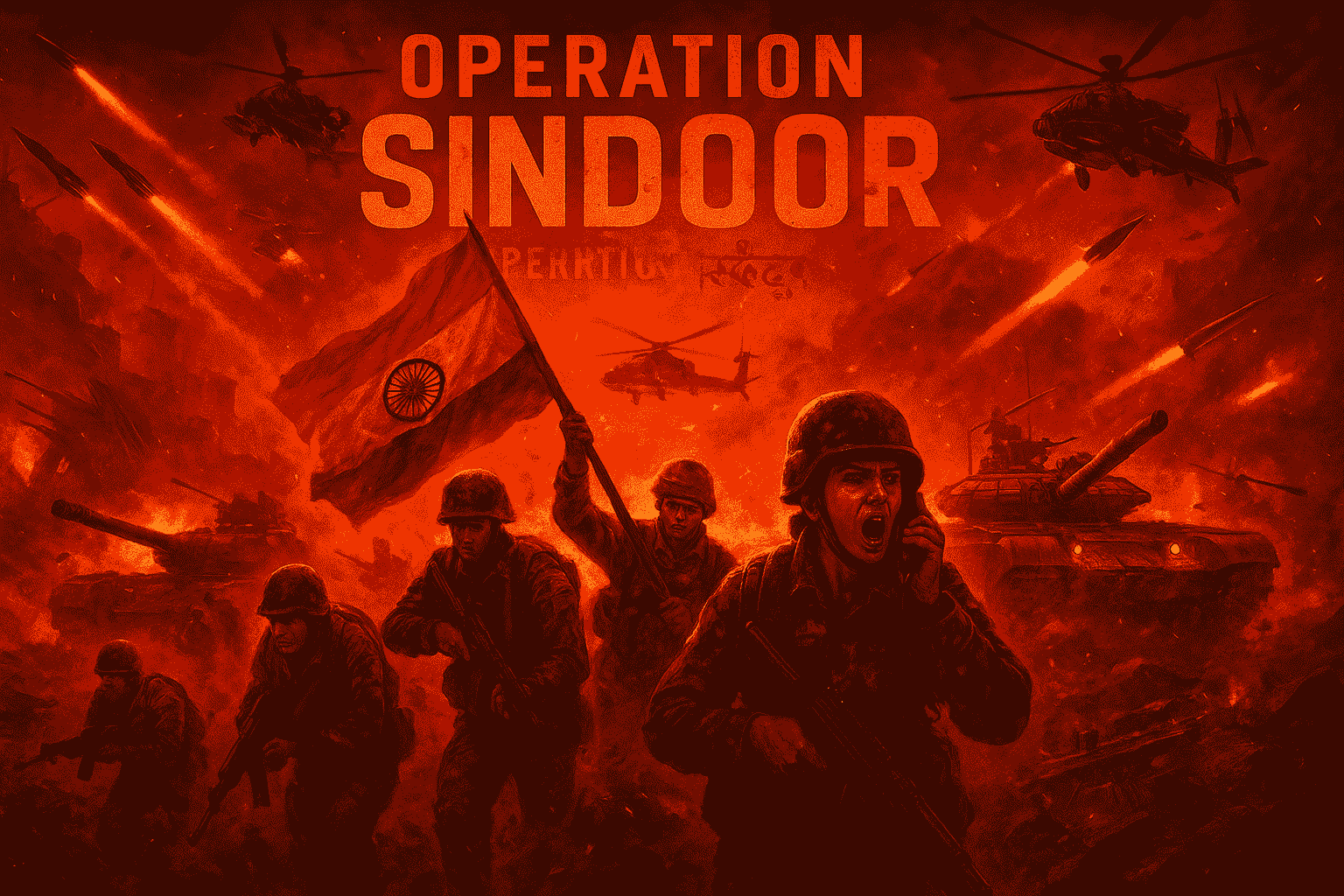
From Pahalgam to Bahawalpur:
On April 22, 2025, the scenic town of Pahalgam was shattered by a brutal terrorist attack that killed 26 civilians. The strike was not random—it was orchestrated. And India knew where it came from: across the border, where terror groups enjoy not just sanctuary—but sponsorship.
India’s answer was swift. Operation Sindoor, launched on May 6, saw the Indian Air Force targeting terror hubs across Pakistan-occupied Kashmir (PoK), Khyber Pakhtunkhwa, and critically—Pakistan’s Punjab.
Operation Sindoor: Tactical Victory, Strategic Pause
Between May 6 and 10, the Indian Air Force pounded terror camps and airbases across PoK, Khyber Pakhtunkhwa, and Pakistani Punjab, including high-value targets like Muridke (Lashkar-e-Taiba) and Bahawalpur (Jaish-e-Mohammad). For the first time since the 1971 war, India hit deep inside Punjab, Pakistan’s political and military core.
And Pakistan blinked. The Director General of Military Operations (DGMO) reached out to halt the escalation—marking a short-term tactical win for India.
But will it deter future attacks?
Pakistan’s Punjab – The Heart of Pakistan’s ‘Jihadi-industrial Complex’
Pakistani Punjab is not just another province. It is the recruitment base of the Pakistan Army, the cradle of terrorist tanzeems, and the nerve centre of anti-India jihad. It is t Pakistan’s ‘Fertile Crescent’ of Terrorism.
It is Pakistan’s political and military powerhouse, home to:
-
Over 60% of Pakistan’s population
-
The bulk of the Pakistan Army’s recruitment
-
The headquarters of terror outfits like Lashkar-e-Taiba (Muridke) and Jaish-e-Mohammad (Bahawalpur)
With a robust counter-intelligence network, Rawalpindi has successfully shielded this region from Indian covert penetration—making it India’s toughest target.
Even lethal airstrikes cannot uproot deeply embedded jihadist networks. What India needs is a non-linear, layered, and patient campaign to dismantle the ecosystem feeding Pakistan’s terrorism. For India, this is the real battlefield. And it is as psychological as it is territorial.
Beyond the Bombs: Why India Needs a Strategy of Attrition
Military might is necessary, but not sufficient.
Like Israel’s shadow war with Iran, India must now embrace a strategy of exhaustion (Ermattungsstrategie)—wearing down Pakistan’s ability and will to support terrorism through:
-
Covert Intelligence Operations: Targeting terror leadership and infrastructure, especially in Pakistan’s Punjab.
-
Economic Warfare: Leveraging tools like FATF blacklisting and trade isolation.
-
Hydro-Diplomacy: Reconsidering the Indus Waters Treaty to tighten the pressure.
-
Cyber & Narrative Warfare: Exposing Pakistan’s duplicity on global platforms.
India’s past restraint has shifted now, which has shown greater political will to escalate post-attack. However, unless consistent across future administrations, India risks reverting to the oscillation between airstrikes and inaction—a dangerous pattern.
Deterrence won’t work if India swings between surgical strikes and strategic silence. There must be political continuity, regardless of party in power.
If not, Pakistan’s jihadi machine will adapt, recover, and return.
Attrition is the Only Way to Break Pakistan’s Terror Hub
Attritional warfare does not seek a single decisive victory. It seeks to bleed the adversary slowly but irreversibly—militarily, economically, diplomatically, and psychologically.
To make this work, India must:
-
Invest in language-capable, deep-cover intelligence assets
-
Build long-term technological and cyber capabilities
-
Ensure cross-party strategic consistency
-
Prepare conventional forces for short, sharp wars—even two-front scenarios with China
Strategic Patience Over Tactical Blows
The lesson from Operation Sindoor is clear: strikes punish, but they don’t dismantle. Without a sustained attritional campaign—surgical, covert, and prolonged—the terror networks embedded in the “Other Punjab” will regenerate.
India’s security doctrine must now evolve. Not just to retaliate, but to reshape the battlefield. Attrition—silent, deliberate, and sustained—is not weakness. It is the warfare of those who think long, and strike deep.
Beyond Operation Sindoor:
If Operation Sindoor leads to months of silence on the terror front, it will be hailed as a deterrent victory.
If another Chittisinghpura, Pulwama, or Pahalgam happens, India must not hesitate—but escalate wisely. And more importantly, do so silently, consistently, and surgically.
Receive Daily Updates
Recent Posts
Petrol in India is cheaper than in countries like Hong Kong, Germany and the UK but costlier than in China, Brazil, Japan, the US, Russia, Pakistan and Sri Lanka, a Bank of Baroda Economics Research report showed.
Rising fuel prices in India have led to considerable debate on which government, state or central, should be lowering their taxes to keep prices under control.
The rise in fuel prices is mainly due to the global price of crude oil (raw material for making petrol and diesel) going up. Further, a stronger dollar has added to the cost of crude oil.
Amongst comparable countries (per capita wise), prices in India are higher than those in Vietnam, Kenya, Ukraine, Bangladesh, Nepal, Pakistan, Sri Lanka, and Venezuela. Countries that are major oil producers have much lower prices.
In the report, the Philippines has a comparable petrol price but has a per capita income higher than India by over 50 per cent.
Countries which have a lower per capita income like Kenya, Bangladesh, Nepal, Pakistan, and Venezuela have much lower prices of petrol and hence are impacted less than India.
“Therefore there is still a strong case for the government to consider lowering the taxes on fuel to protect the interest of the people,” the report argued.
India is the world’s third-biggest oil consuming and importing nation. It imports 85 per cent of its oil needs and so prices retail fuel at import parity rates.
With the global surge in energy prices, the cost of producing petrol, diesel and other petroleum products also went up for oil companies in India.
They raised petrol and diesel prices by Rs 10 a litre in just over a fortnight beginning March 22 but hit a pause button soon after as the move faced criticism and the opposition parties asked the government to cut taxes instead.
India imports most of its oil from a group of countries called the ‘OPEC +’ (i.e, Iran, Iraq, Saudi Arabia, Venezuela, Kuwait, United Arab Emirates, Russia, etc), which produces 40% of the world’s crude oil.
As they have the power to dictate fuel supply and prices, their decision of limiting the global supply reduces supply in India, thus raising prices
The government charges about 167% tax (excise) on petrol and 129% on diesel as compared to US (20%), UK (62%), Italy and Germany (65%).
The abominable excise duty is 2/3rd of the cost, and the base price, dealer commission and freight form the rest.
Here is an approximate break-up (in Rs):
a)Base Price | 39 |
b)Freight | 0.34 |
c) Price Charged to Dealers = (a+b) | 39.34 |
d) Excise Duty | 40.17 |
e) Dealer Commission | 4.68 |
f) VAT | 25.35 |
g) Retail Selling Price | 109.54 |
Looked closely, much of the cost of petrol and diesel is due to higher tax rate by govt, specifically excise duty.
So the question is why government is not reducing the prices ?
India, being a developing country, it does require gigantic amount of funding for its infrastructure projects as well as welfare schemes.
However, we as a society is yet to be tax-compliant. Many people evade the direct tax and that’s the reason why govt’s hands are tied. Govt. needs the money to fund various programs and at the same time it is not generating enough revenue from direct taxes.
That’s the reason why, govt is bumping up its revenue through higher indirect taxes such as GST or excise duty as in the case of petrol and diesel.
Direct taxes are progressive as it taxes according to an individuals’ income however indirect tax such as excise duty or GST are regressive in the sense that the poorest of the poor and richest of the rich have to pay the same amount.
Does not matter, if you are an auto-driver or owner of a Mercedes, end of the day both pay the same price for petrol/diesel-that’s why it is regressive in nature.
But unlike direct tax where tax evasion is rampant, indirect tax can not be evaded due to their very nature and as long as huge no of Indians keep evading direct taxes, indirect tax such as excise duty will be difficult for the govt to reduce, because it may reduce the revenue and hamper may programs of the govt.