


Written by: Umakant Sir (Civil Servant & Mentor)
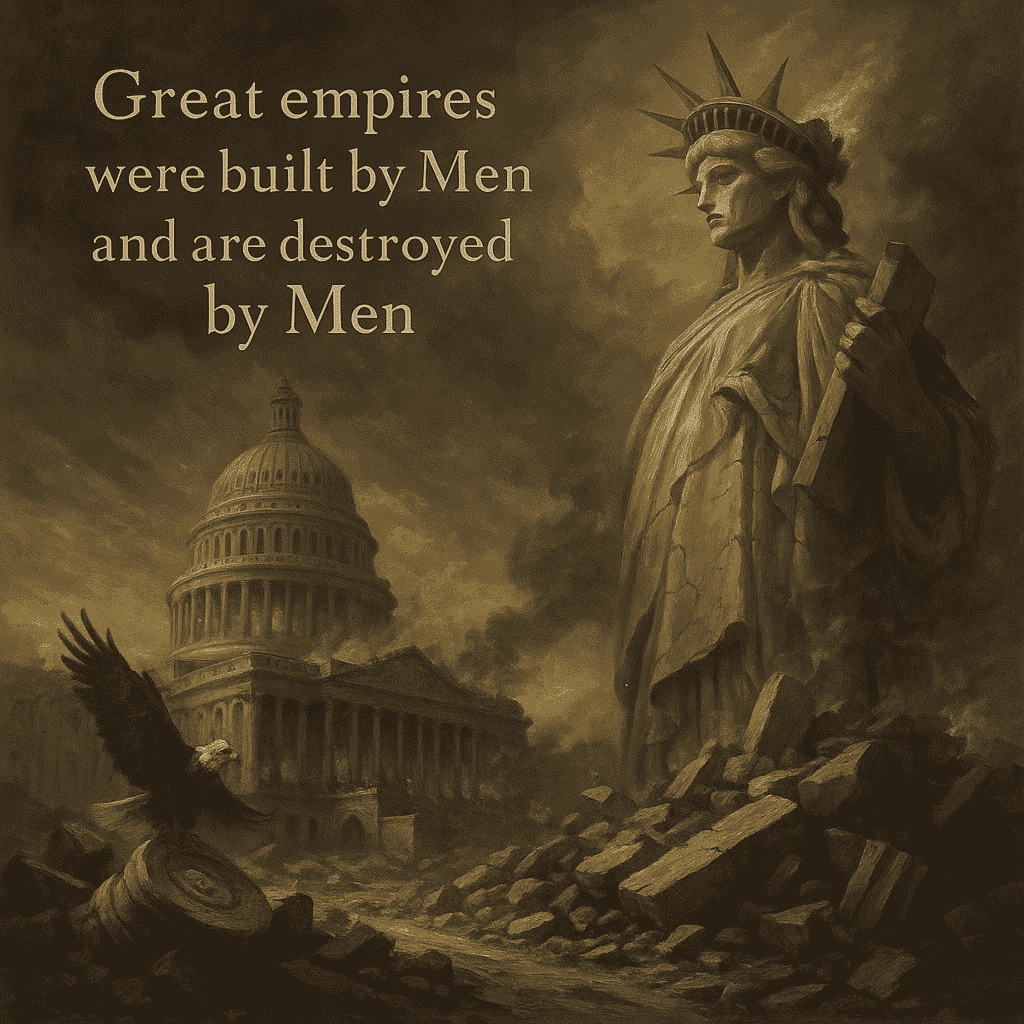
History repeats itself, first as tragedy and then as farce.
Great empires were built by Men and are destroyed by Men. Men of strength, vision, and resolve build empires and Men of comfort, confusion, and compromise ruin it.
History is replete with it:
🏛️ Rome — From Golden Empire to Ghost Towns
The Great “Golden” Roman Empire — is gone. Today, Italy grapples with economic stagnation, political instability, and a declining population. “The Great Empire” is turning into “Ghost Towns”
🧠 Greece — The Philosopher’s Shadow
The Great Greeks, once known for their epic battles, great philosophers, and maritime dominance, are now remembered more for their past glory than present influence. Modern Greece, is suffering from debt crises, lacks innovation and is a shadow of its ancient self. It is a museum of its former glory — proud, but powerless.
👑 The British Empire — Where the Sun Set
The Giant British Empire, on which the sun never set, is now just an island nation, going through post-colonial identity crisis, political disarray, and waning global clout. From Brexit to leadership chaos, its global relevance dims as its domestic challenges grow.
Empires don’t fall overnight. They rot slowly — from within.
Now, America Stands at the Precipice
In the modern world, the “Great Empire of America” is withering. Their interventions around the Globe often left destruction in their wake.
They had no business:
- going to Vietnam, only to leave after decades of bloodshed and failure;
- ruining Afghanistan, where after 20 years and trillions of dollars, they exited overnight—leaving chaos behind;
- invading Iraq on false pretexts, destabilising an entire region, and unleashing forces they could never control.
Each war weakened their moral standing, drained their economy, and fractured their own society.
The Noise of a Crumbling Power
Today, American leadership is louder on social media than in policy rooms. What was once statesmanship has been replaced by soundbites, sarcasm, and spectacle.
Warning signs are clear:
-
Polarized leadership chasing headlines, not harmony.
-
Legislative paralysis, where reform dies in partisan trenches.
-
Collapse of trust in institutions, elections, and even truth itself.
-
Global disengagement, with allies unsure and adversaries emboldened.
-
Rising inequality, where billionaires fly to space while the poor sink in debt.
-
Social fragmentation, where identity wars outpace unity.
Empires don’t always fall with fire and fury. Sometimes, they just fade — slowly, silently, shamefully. Not because of one bad ruler, but because a civilization forgets what made it great in the first place: vision, vigilance, and virtue.
Leadership is the key. Strong leaders build and guard empires and Weak ones destroys them. That’s just a lesson in history that everyone knows but no one cares.
Receive Daily Updates
Recent Posts
Petrol in India is cheaper than in countries like Hong Kong, Germany and the UK but costlier than in China, Brazil, Japan, the US, Russia, Pakistan and Sri Lanka, a Bank of Baroda Economics Research report showed.
Rising fuel prices in India have led to considerable debate on which government, state or central, should be lowering their taxes to keep prices under control.
The rise in fuel prices is mainly due to the global price of crude oil (raw material for making petrol and diesel) going up. Further, a stronger dollar has added to the cost of crude oil.
Amongst comparable countries (per capita wise), prices in India are higher than those in Vietnam, Kenya, Ukraine, Bangladesh, Nepal, Pakistan, Sri Lanka, and Venezuela. Countries that are major oil producers have much lower prices.
In the report, the Philippines has a comparable petrol price but has a per capita income higher than India by over 50 per cent.
Countries which have a lower per capita income like Kenya, Bangladesh, Nepal, Pakistan, and Venezuela have much lower prices of petrol and hence are impacted less than India.
“Therefore there is still a strong case for the government to consider lowering the taxes on fuel to protect the interest of the people,” the report argued.
India is the world’s third-biggest oil consuming and importing nation. It imports 85 per cent of its oil needs and so prices retail fuel at import parity rates.
With the global surge in energy prices, the cost of producing petrol, diesel and other petroleum products also went up for oil companies in India.
They raised petrol and diesel prices by Rs 10 a litre in just over a fortnight beginning March 22 but hit a pause button soon after as the move faced criticism and the opposition parties asked the government to cut taxes instead.
India imports most of its oil from a group of countries called the ‘OPEC +’ (i.e, Iran, Iraq, Saudi Arabia, Venezuela, Kuwait, United Arab Emirates, Russia, etc), which produces 40% of the world’s crude oil.
As they have the power to dictate fuel supply and prices, their decision of limiting the global supply reduces supply in India, thus raising prices
The government charges about 167% tax (excise) on petrol and 129% on diesel as compared to US (20%), UK (62%), Italy and Germany (65%).
The abominable excise duty is 2/3rd of the cost, and the base price, dealer commission and freight form the rest.
Here is an approximate break-up (in Rs):
a)Base Price | 39 |
b)Freight | 0.34 |
c) Price Charged to Dealers = (a+b) | 39.34 |
d) Excise Duty | 40.17 |
e) Dealer Commission | 4.68 |
f) VAT | 25.35 |
g) Retail Selling Price | 109.54 |
Looked closely, much of the cost of petrol and diesel is due to higher tax rate by govt, specifically excise duty.
So the question is why government is not reducing the prices ?
India, being a developing country, it does require gigantic amount of funding for its infrastructure projects as well as welfare schemes.
However, we as a society is yet to be tax-compliant. Many people evade the direct tax and that’s the reason why govt’s hands are tied. Govt. needs the money to fund various programs and at the same time it is not generating enough revenue from direct taxes.
That’s the reason why, govt is bumping up its revenue through higher indirect taxes such as GST or excise duty as in the case of petrol and diesel.
Direct taxes are progressive as it taxes according to an individuals’ income however indirect tax such as excise duty or GST are regressive in the sense that the poorest of the poor and richest of the rich have to pay the same amount.
Does not matter, if you are an auto-driver or owner of a Mercedes, end of the day both pay the same price for petrol/diesel-that’s why it is regressive in nature.
But unlike direct tax where tax evasion is rampant, indirect tax can not be evaded due to their very nature and as long as huge no of Indians keep evading direct taxes, indirect tax such as excise duty will be difficult for the govt to reduce, because it may reduce the revenue and hamper may programs of the govt.