


1. Rising Tensions in the States
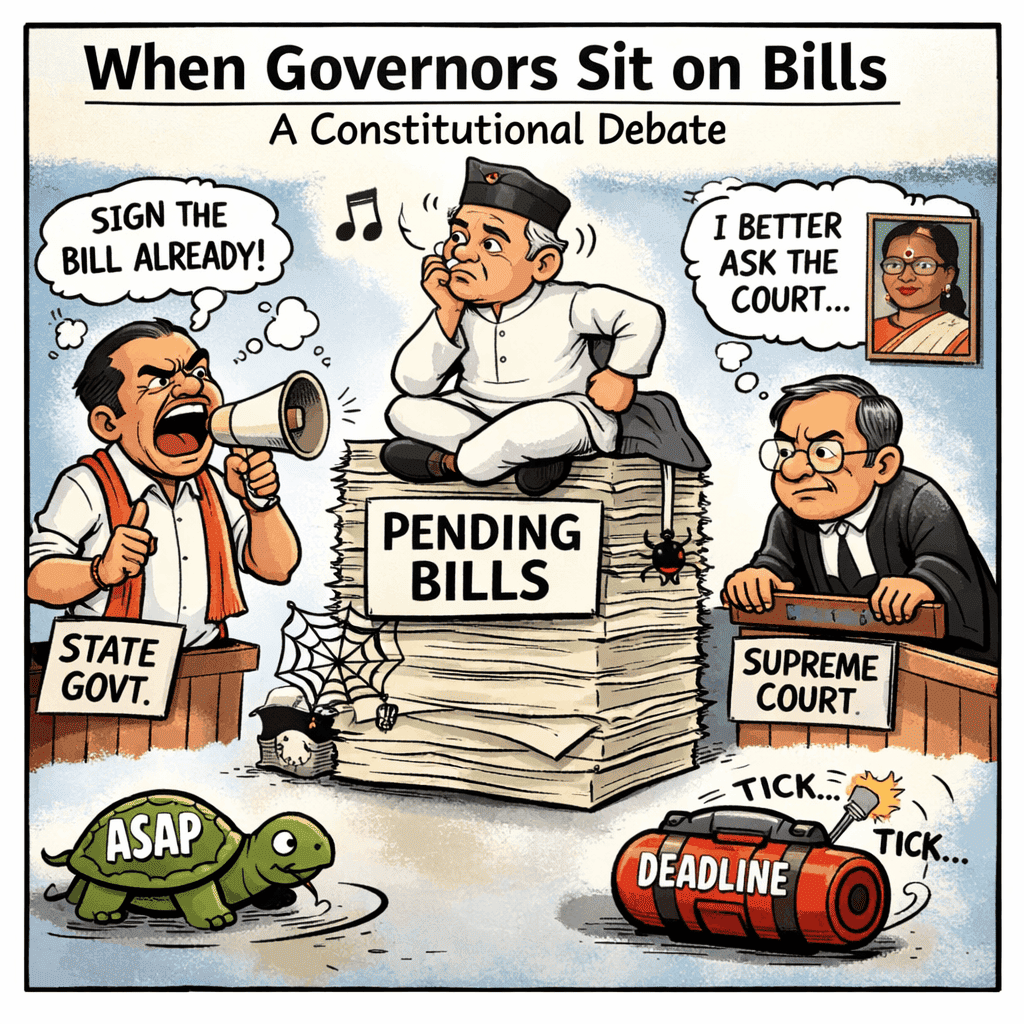
Across several Indian states, tensions emerged between elected state governments and their respective Governors. State governments alleged that Governors were delaying assent to key legislative bills passed by the state legislatures. In many instances, bills remained pending for extended periods without clear explanations.
Such delays effectively stalled legislative initiatives of democratically elected governments. States increasingly perceived this practice as a form of indirect veto exercised by unelected constitutional authorities, thereby intensifying Centre–State tensions within India’s federal framework.
 2. The Tamil Nadu Governor Case (2025)
In response to prolonged delays in gubernatorial assent, the Government of Tamil Nadu approached the Supreme Court. The state challenged the Governor’s inaction on several bills passed by the legislature.
In 2025, the Supreme Court delivered its judgment in State of Tamil Nadu v. Governor of Tamil Nadu. The Court attempted to address the growing constitutional controversy surrounding delays in assent.
Key observations of the Court included:
- Governors and the President are expected to act within a “reasonable time” when dealing with legislative bills.
- In exceptional circumstances, the Court suggested that Article 142 could allow courts to treat certain bills as having received “deemed assent.”
- The judgment also indicated that actions (or inaction) by Governors and the President could be subject to judicial review.
Many states welcomed the judgment as a necessary safeguard against prolonged constitutional inaction. However, the Union government and several constitutional experts expressed concern that the Court had expanded judicial authority into areas traditionally governed by constitutional conventions. While the ruling offered immediate relief in specific cases, it also generated uncertainty regarding established constitutional practices.
3. Presidential Intervention: Article 143 Reference
In light of the legal ambiguity created by the judgment, President Droupadi Murmu invoked Article 143 of the Constitution, which allows the President to seek the Supreme Court’s advisory opinion on questions of law or constitutional interpretation of public importance.
This became the 16th Presidential Reference to the Supreme Court. The President sought clarity on several crucial constitutional questions, including:
- What options are available to Governors and the President when a bill is presented to them?
- Can courts prescribe specific timelines for constitutional authorities to act?
- Is the concept of “deemed assent” constitutionally valid?
- To what extent are decisions under Articles 200 and 201 subject to judicial review?
A five-judge Constitution Bench, led by the Chief Justice of India, was constituted to examine these issues. The proceedings signaled that the Court would need to revisit and clarify the implications of its earlier ruling.
4. Preliminary Question: Validity of the Presidential Reference
At the outset, some legal experts argued that the Presidential Reference was improper. They contended that it functioned as a disguised appeal against the earlier Tamil Nadu Governor judgment.
The Constitution Bench rejected this argument. It noted that several earlier Presidential References had arisen from concrete constitutional disputes. The Court described the present matter as a “functional reference” because it directly affects the everyday functioning of the offices of the Governor and the President.
The Court therefore held the Reference to be constitutionally valid. It also acknowledged that the earlier judgment had created uncertainty by appearing to depart from principles laid down by larger benches.
While recognizing that advisory opinions may depart from earlier judicial interpretations if necessary, the Bench clarified that the purpose of the Reference was not to rehear the previous case but to clarify the constitutional framework going forward.
The Court also declined to answer certain questions that it considered excessively broad or unnecessary, thereby narrowing the scope of its advisory opinion.
5. Options Available to a Governor Under Article 200
A central issue before the Court concerned the range of actions available to a Governor when a bill is presented for assent under Article 200.
The Union government argued that the Governor possesses four distinct options:
- Grant assent.
- Reserve the bill for the President.
- Withhold assent.
- Return the bill for reconsideration.(If not a Money bill)
Several state governments contended that there are only three practical options:
- Grant assent.
- Reserve the bill for the President.
- Return the bill to the legislature for reconsideration.
According to this view, the Governor cannot simply reject a bill outright without engaging the legislature.
The Court agreed with the states’ interpretation. It held that if the Governor chooses to withhold assent, the bill must be returned to the legislature for reconsideration, thereby preserving a constitutional dialogue between the elected legislature and the constitutional head.
However, the Court also corrected a key aspect of the earlier Tamil Nadu Governor ruling. The previous judgment had suggested that once a legislature re-passes a bill after reconsideration, the Governor is bound to grant assent.
The advisory opinion clarified that even after reconsideration, the Governor retains two options:
- Grant assent, or
- Reserve the bill for the President.
This ensures that bills raising serious constitutional or federal concerns can still undergo scrutiny at the national level.
6. Nature of the Governor’s Discretion
Another major issue concerned the extent of the Governor’s discretionary powers.
Some interpretations suggested that Article 200 grants the Governor substantial discretion. Others argued that the Governor must generally act on the aid and advice of the Council of Ministers, except in explicitly specified situations.
The Court relied on the precedent of Nabam Rebia v. Deputy Speaker (2016), which recognised the existence of limited but real discretionary powers for the Governor.
The Bench clarified that when deciding whether to reserve a bill for the President, the Governor may exercise independent constitutional judgment. This power is intended to safeguard the Constitution in exceptional circumstances.
At the same time, the Court emphasized that such discretion is strictly limited. The Governor cannot indefinitely delay decisions or use inaction as a political tool. The office is not intended to function as a rival centre of political authority within the state.
The Court also rejected the argument that Governors and the President operate merely as ceremonial figures comparable to the British monarch. Instead, India’s constitutional design requires them to exercise judgment within clearly defined limits.
7. Whether Courts Can Impose Timelines
One of the most contentious issues involved the question of judicially imposed timelines for decisions under Articles 200 and 201.
The earlier Tamil Nadu Governor judgment had interpreted the phrase “as soon as possible” to justify strict judicial deadlines.
The Constitution Bench revisited the constitutional text and noted that only two relevant time indicators exist:
- Under Article 200, a Governor who withholds assent must return the bill “as soon as possible.”
- Under Article 201, if the President returns a reserved bill with suggestions, the state legislature must reconsider it within six months.
Importantly, the Constitution does not prescribe a fixed time limit for Governors or the President to act.
The Court concluded that the phrase “as soon as possible” cannot be converted into a rigid deadline applicable in all cases. It also criticised reliance on the Keisham Meghachandra case, noting that the Speaker’s quasi-judicial role in disqualification proceedings is fundamentally different from a Governor’s constitutional role in legislative assent.
Furthermore, the Court rejected attempts to rely on executive circulars issued by the Ministry of Home Affairs, emphasizing that executive instructions cannot override constitutional provisions.
8. Rejection of the “Deemed Assent” Doctrine
The earlier judgment had raised the possibility that courts could treat bills as having received “deemed assent” in cases of prolonged delay.
The advisory Bench rejected this doctrine.
It held that Article 142 cannot be used to artificially create assent where the Constitution expressly assigns that power to the Governor or the President. Allowing courts to effectively grant assent would violate the principle of separation of powers.
Accordingly, courts cannot treat a bill as enacted simply because of delay in decision-making.
9. Scope of Judicial Review
The Court next addressed the extent to which decisions under Articles 200 and 201 are subject to judicial review.
The Bench adopted a restrained approach. It observed that the process of assent to bills constitutes a constitutional dialogue between institutions, rather than a typical administrative decision.
Therefore, courts generally cannot review the merits of a Governor’s or the President’s decision to grant assent, withhold assent, or reserve a bill.
Such review would require courts to analyse legislative proposals before they become law, which the Bench described as constitutionally inappropriate.
Where significant constitutional doubts arise prior to enactment, the Court indicated that the proper mechanism is a Presidential Reference under Article 143.
10. Judicial Remedy for Prolonged Inaction
Despite limiting judicial intervention, the Court recognised a practical constitutional problem: a Governor could potentially stall legislation indefinitely by taking no action.
To address this possibility, the Court permitted limited judicial review of prolonged inaction.
If a Governor delays a decision for an unreasonably long period without justification, courts may:
- Examine the delay, and
- Direct the Governor to take a decision within a reasonable time.
However, courts cannot instruct the Governor how to decide. They may require a decision to be made, but not dictate its outcome.
The Court also clarified the scope of Article 361, which provides immunity to Governors from personal legal proceedings. While the Governor cannot be personally summoned to court, judicial review may still examine whether the constitutional office has acted within its lawful authority.
11. Constitutional Significance of the Advisory Opinion
The advisory opinion ultimately represents a careful recalibration of constitutional doctrine.
It retreats from several expansive aspects of the earlier Tamil Nadu Governor judgment—particularly regarding judicially imposed timelines, deemed assent, and extensive judicial review.
At the same time, it affirms that:
- Governors and the President possess limited but genuine constitutional discretion, especially in reserving bills for presidential consideration.
- The judiciary retains a narrow supervisory role to prevent indefinite constitutional inaction.
Overall, the judgment emphasises that India’s constitutional system depends on institutional cooperation rather than confrontation. Governors, Presidents, state governments, and courts must each operate within their respective constitutional boundaries to preserve the balance of India’s federal democracy.
Receive Daily Updates
Recent Posts
On March 31, the World Economic Forum (WEF) released its annual Gender Gap Report 2021. The Global Gender Gap report is an annual report released by the WEF. The gender gap is the difference between women and men as reflected in social, political, intellectual, cultural, or economic attainments or attitudes. The gap between men and women across health, education, politics, and economics widened for the first time since records began in 2006.
[wptelegram-join-channel link=”https://t.me/s/upsctree” text=”Join @upsctree on Telegram”]No need to remember all the data, only pick out few important ones to use in your answers.
The Global gender gap index aims to measure this gap in four key areas : health, education, economics, and politics. It surveys economies to measure gender disparity by collating and analyzing data that fall under four indices : economic participation and opportunity, educational attainment, health and survival, and political empowerment.
The 2021 Global Gender Gap Index benchmarks 156 countries on their progress towards gender parity. The index aims to serve as a compass to track progress on relative gaps between women and men in health, education, economy, and politics.
Although no country has achieved full gender parity, the top two countries (Iceland and Finland) have closed at least 85% of their gap, and the remaining seven countries (Lithuania, Namibia, New Zealand, Norway, Sweden, Rwanda, and Ireland) have closed at least 80% of their gap. Geographically, the global top 10 continues to be dominated by Nordic countries, with —Iceland, Norway, Finland, and Sweden—in the top five.
The top 10 is completed by one country from Asia Pacific (New Zealand 4th), two Sub-Saharan countries (Namibia, 6th and Rwanda, 7th, one country from Eastern Europe (the new entrant to the top 10, Lithuania, 8th), and another two Western European countries (Ireland, 9th, and Switzerland, 10th, another country in the top-10 for the first time).There is a relatively equitable distribution of available income, resources, and opportunities for men and women in these countries. The tremendous gender gaps are identified primarily in the Middle East, Africa, and South Asia.
Here, we can discuss the overall global gender gap scores across the index’s four main components : Economic Participation and Opportunity, Educational Attainment, Health and Survival, and Political Empowerment.
The indicators of the four main components are
(1) Economic Participation and Opportunity:
o Labour force participation rate,
o wage equality for similar work,
o estimated earned income,
o Legislators, senior officials, and managers,
o Professional and technical workers.
(2) Educational Attainment:
o Literacy rate (%)
o Enrollment in primary education (%)
o Enrollment in secondary education (%)
o Enrollment in tertiary education (%).
(3) Health and Survival:
o Sex ratio at birth (%)
o Healthy life expectancy (years).
(4) Political Empowerment:
o Women in Parliament (%)
o Women in Ministerial positions (%)
o Years with a female head of State (last 50 years)
o The share of tenure years.
The objective is to shed light on which factors are driving the overall average decline in the global gender gap score. The analysis results show that this year’s decline is mainly caused by a reversal in performance on the Political Empowerment gap.
Global Trends and Outcomes:
– Globally, this year, i.e., 2021, the average distance completed to gender parity gap is 68% (This means that the remaining gender gap to close stands at 32%) a step back compared to 2020 (-0.6 percentage points). These figures are mainly driven by a decline in the performance of large countries. On its current trajectory, it will now take 135.6 years to close the gender gap worldwide.
– The gender gap in Political Empowerment remains the largest of the four gaps tracked, with only 22% closed to date, having further widened since the 2020 edition of the report by 2.4 percentage points. Across the 156 countries covered by the index, women represent only 26.1% of some 35,500 Parliament seats and 22.6% of over 3,400 Ministers worldwide. In 81 countries, there has never been a woman head of State as of January 15, 2021. At the current rate of progress, the World Economic Forum estimates that it will take 145.5 years to attain gender parity in politics.
– The gender gap in Economic Participation and Opportunity remains the second-largest of the four key gaps tracked by the index. According to this year’s index results, 58% of this gap has been closed so far. The gap has seen marginal improvement since the 2020 edition of the report, and as a result, we estimate that it will take another 267.6 years to close.
– Gender gaps in Educational Attainment and Health and Survival are nearly closed. In Educational Attainment, 95% of this gender gap has been closed globally, with 37 countries already attaining gender parity. However, the ‘last mile’ of progress is proceeding slowly. The index estimates that it will take another 14.2 years to close this gap on its current trajectory completely.
In Health and Survival, 96% of this gender gap has been closed, registering a marginal decline since last year (not due to COVID-19), and the time to close this gap remains undefined. For both education and health, while progress is higher than economy and politics in the global data, there are important future implications of disruptions due to the pandemic and continued variations in quality across income, geography, race, and ethnicity.
India-Specific Findings:
India had slipped 28 spots to rank 140 out of the 156 countries covered. The pandemic causing a disproportionate impact on women jeopardizes rolling back the little progress made in the last decades-forcing more women to drop off the workforce and leaving them vulnerable to domestic violence.
India’s poor performance on the Global Gender Gap report card hints at a serious wake-up call and learning lessons from the Nordic region for the Government and policy makers.
Within the 156 countries covered, women hold only 26 percent of Parliamentary seats and 22 percent of Ministerial positions. India, in some ways, reflects this widening gap, where the number of Ministers declined from 23.1 percent in 2019 to 9.1 percent in 2021. The number of women in Parliament stands low at 14.4 percent. In India, the gender gap has widened to 62.5 %, down from 66.8% the previous year.
It is mainly due to women’s inadequate representation in politics, technical and leadership roles, a decrease in women’s labor force participation rate, poor healthcare, lagging female to male literacy ratio, and income inequality.
The gap is the widest on the political empowerment dimension, with economic participation and opportunity being next in line. However, the gap on educational attainment and health and survival has been practically bridged.
India is the third-worst performer among South Asian countries, with Pakistan and Afghanistan trailing and Bangladesh being at the top. The report states that the country fared the worst in political empowerment, regressing from 23.9% to 9.1%.
Its ranking on the health and survival dimension is among the five worst performers. The economic participation and opportunity gap saw a decline of 3% compared to 2020, while India’s educational attainment front is in the 114th position.
India has deteriorated to 51st place from 18th place in 2020 on political empowerment. Still, it has slipped to 155th position from 150th position in 2020 on health and survival, 151st place in economic participation and opportunity from 149th place, and 114th place for educational attainment from 112th.
In 2020 reports, among the 153 countries studied, India is the only country where the economic gender gap of 64.6% is larger than the political gender gap of 58.9%. In 2021 report, among the 156 countries, the economic gender gap of India is 67.4%, 3.8% gender gap in education, 6.3% gap in health and survival, and 72.4% gender gap in political empowerment. In health and survival, the gender gap of the sex ratio at birth is above 9.1%, and healthy life expectancy is almost the same.
Discrimination against women has also been reflected in Health and Survival subindex statistics. With 93.7% of this gap closed to date, India ranks among the bottom five countries in this subindex. The wide sex ratio at birth gaps is due to the high incidence of gender-based sex-selective practices. Besides, more than one in four women has faced intimate violence in her lifetime.The gender gap in the literacy rate is above 20.1%.
Yet, gender gaps persist in literacy : one-third of women are illiterate (34.2%) than 17.6% of men. In political empowerment, globally, women in Parliament is at 128th position and gender gap of 83.2%, and 90% gap in a Ministerial position. The gap in wages equality for similar work is above 51.8%. On health and survival, four large countries Pakistan, India, Vietnam, and China, fare poorly, with millions of women there not getting the same access to health as men.
The pandemic has only slowed down in its tracks the progress India was making towards achieving gender parity. The country urgently needs to focus on “health and survival,” which points towards a skewed sex ratio because of the high incidence of gender-based sex-selective practices and women’s economic participation. Women’s labour force participation rate and the share of women in technical roles declined in 2020, reducing the estimated earned income of women, one-fifth of men.
Learning from the Nordic region, noteworthy participation of women in politics, institutions, and public life is the catalyst for transformational change. Women need to be equal participants in the labour force to pioneer the societal changes the world needs in this integral period of transition.
Every effort must be directed towards achieving gender parallelism by facilitating women in leadership and decision-making positions. Social protection programmes should be gender-responsive and account for the differential needs of women and girls. Research and scientific literature also provide unequivocal evidence that countries led by women are dealing with the pandemic more effectively than many others.
Gendered inequality, thereby, is a global concern. India should focus on targeted policies and earmarked public and private investments in care and equalized access. Women are not ready to wait for another century for equality. It’s time India accelerates its efforts and fight for an inclusive, equal, global recovery.
India will not fully develop unless both women and men are equally supported to reach their full potential. There are risks, violations, and vulnerabilities women face just because they are women. Most of these risks are directly linked to women’s economic, political, social, and cultural disadvantages in their daily lives. It becomes acute during crises and disasters.
With the prevalence of gender discrimination, and social norms and practices, women become exposed to the possibility of child marriage, teenage pregnancy, child domestic work, poor education and health, sexual abuse, exploitation, and violence. Many of these manifestations will not change unless women are valued more.
[wptelegram-join-channel link=”https://t.me/s/upsctree” text=”Join @upsctree on Telegram”]2021 WEF Global Gender Gap report, which confirmed its 2016 finding of a decline in worldwide progress towards gender parity.
Over 2.8 billion women are legally restricted from having the same choice of jobs as men. As many as 104 countries still have laws preventing women from working in specific jobs, 59 countries have no laws on sexual harassment in the workplace, and it is astonishing that a handful of countries still allow husbands to legally stop their wives from working.
Globally, women’s participation in the labour force is estimated at 63% (as against 94% of men who participate), but India’s is at a dismal 25% or so currently. Most women are in informal and vulnerable employment—domestic help, agriculture, etc—and are always paid less than men.
Recent reports from Assam suggest that women workers in plantations are paid much less than men and never promoted to supervisory roles. The gender wage gap is about 24% globally, and women have lost far more jobs than men during lockdowns.
The problem of gender disparity is compounded by hurdles put up by governments, society and businesses: unequal access to social security schemes, banking services, education, digital services and so on, even as a glass ceiling has kept leadership roles out of women’s reach.
Yes, many governments and businesses had been working on parity before the pandemic struck. But the global gender gap, defined by differences reflected in the social, political, intellectual, cultural and economic attainments or attitudes of men and women, will not narrow in the near future without all major stakeholders working together on a clear agenda—that of economic growth by inclusion.
The WEF report estimates 135 years to close the gap at our current rate of progress based on four pillars: educational attainment, health, economic participation and political empowerment.
India has slipped from rank 112 to 140 in a single year, confirming how hard women were hit by the pandemic. Pakistan and Afghanistan are the only two Asian countries that fared worse.
Here are a few things we must do:
One, frame policies for equal-opportunity employment. Use technology and artificial intelligence to eliminate biases of gender, caste, etc, and select candidates at all levels on merit. Numerous surveys indicate that women in general have a better chance of landing jobs if their gender is not known to recruiters.
Two, foster a culture of gender sensitivity. Take a review of current policies and move from gender-neutral to gender-sensitive. Encourage and insist on diversity and inclusion at all levels, and promote more women internally to leadership roles. Demolish silos to let women grab potential opportunities in hitherto male-dominant roles. Work-from-home has taught us how efficiently women can manage flex-timings and productivity.
Three, deploy corporate social responsibility (CSR) funds for the education and skilling of women and girls at the bottom of the pyramid. CSR allocations to toilet building, the PM-Cares fund and firms’ own trusts could be re-channelled for this.
Four, get more women into research and development (R&D) roles. A study of over 4,000 companies found that more women in R&D jobs resulted in radical innovation. It appears women score far higher than men in championing change. If you seek growth from affordable products and services for low-income groups, women often have the best ideas.
Five, break barriers to allow progress. Cultural and structural issues must be fixed. Unconscious biases and discrimination are rampant even in highly-esteemed organizations. Establish fair and transparent human resource policies.
Six, get involved in local communities to engage them. As Michael Porter said, it is not possible for businesses to sustain long-term shareholder value without ensuring the welfare of the communities they exist in. It is in the best interest of enterprises to engage with local communities to understand and work towards lowering cultural and other barriers in society. It will also help connect with potential customers, employees and special interest groups driving the gender-equity agenda and achieve better diversity.