


1. Rising Tensions in the States
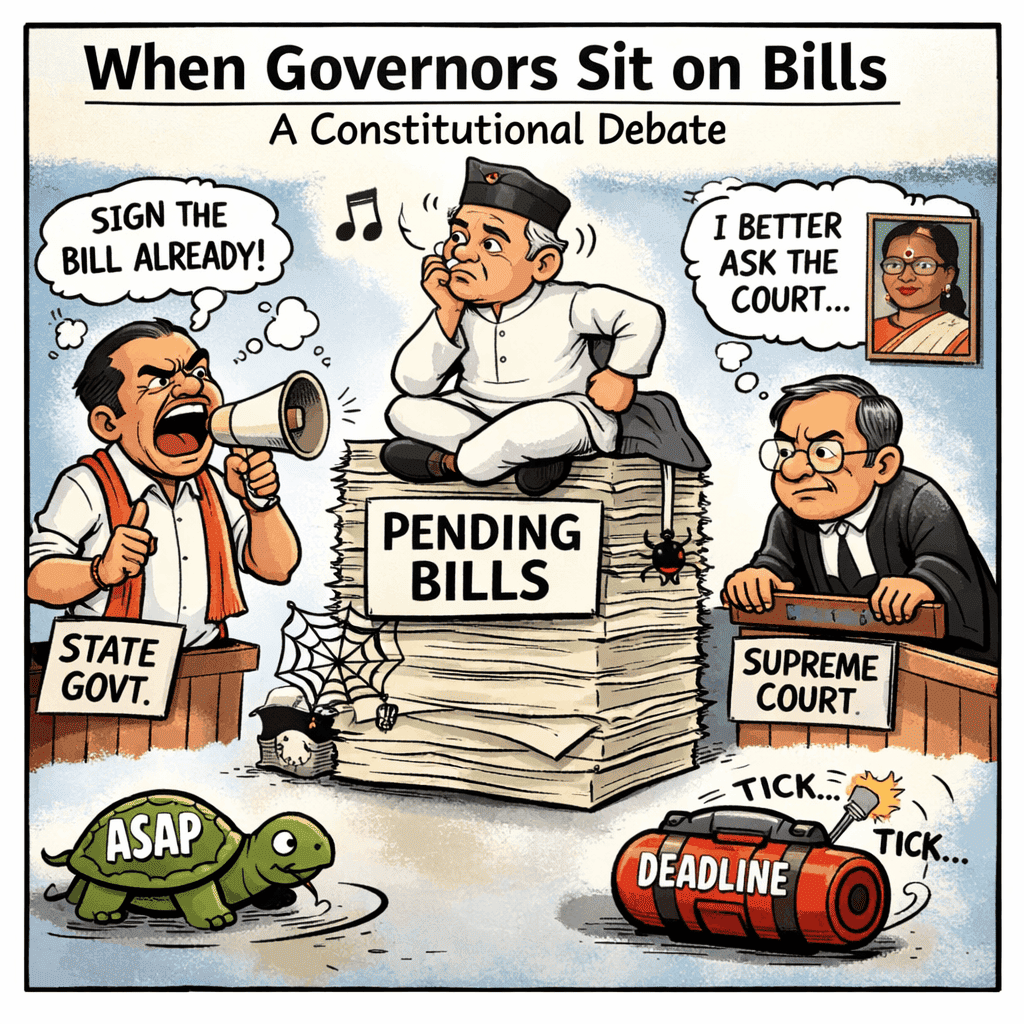
Across several Indian states, tensions emerged between elected state governments and their respective Governors. State governments alleged that Governors were delaying assent to key legislative bills passed by the state legislatures. In many instances, bills remained pending for extended periods without clear explanations.
Such delays effectively stalled legislative initiatives of democratically elected governments. States increasingly perceived this practice as a form of indirect veto exercised by unelected constitutional authorities, thereby intensifying Centre–State tensions within India’s federal framework.
 2. The Tamil Nadu Governor Case (2025)
In response to prolonged delays in gubernatorial assent, the Government of Tamil Nadu approached the Supreme Court. The state challenged the Governor’s inaction on several bills passed by the legislature.
In 2025, the Supreme Court delivered its judgment in State of Tamil Nadu v. Governor of Tamil Nadu. The Court attempted to address the growing constitutional controversy surrounding delays in assent.
Key observations of the Court included:
- Governors and the President are expected to act within a “reasonable time” when dealing with legislative bills.
- In exceptional circumstances, the Court suggested that Article 142 could allow courts to treat certain bills as having received “deemed assent.”
- The judgment also indicated that actions (or inaction) by Governors and the President could be subject to judicial review.
Many states welcomed the judgment as a necessary safeguard against prolonged constitutional inaction. However, the Union government and several constitutional experts expressed concern that the Court had expanded judicial authority into areas traditionally governed by constitutional conventions. While the ruling offered immediate relief in specific cases, it also generated uncertainty regarding established constitutional practices.
3. Presidential Intervention: Article 143 Reference
In light of the legal ambiguity created by the judgment, President Droupadi Murmu invoked Article 143 of the Constitution, which allows the President to seek the Supreme Court’s advisory opinion on questions of law or constitutional interpretation of public importance.
This became the 16th Presidential Reference to the Supreme Court. The President sought clarity on several crucial constitutional questions, including:
- What options are available to Governors and the President when a bill is presented to them?
- Can courts prescribe specific timelines for constitutional authorities to act?
- Is the concept of “deemed assent” constitutionally valid?
- To what extent are decisions under Articles 200 and 201 subject to judicial review?
A five-judge Constitution Bench, led by the Chief Justice of India, was constituted to examine these issues. The proceedings signaled that the Court would need to revisit and clarify the implications of its earlier ruling.
4. Preliminary Question: Validity of the Presidential Reference
At the outset, some legal experts argued that the Presidential Reference was improper. They contended that it functioned as a disguised appeal against the earlier Tamil Nadu Governor judgment.
The Constitution Bench rejected this argument. It noted that several earlier Presidential References had arisen from concrete constitutional disputes. The Court described the present matter as a “functional reference” because it directly affects the everyday functioning of the offices of the Governor and the President.
The Court therefore held the Reference to be constitutionally valid. It also acknowledged that the earlier judgment had created uncertainty by appearing to depart from principles laid down by larger benches.
While recognizing that advisory opinions may depart from earlier judicial interpretations if necessary, the Bench clarified that the purpose of the Reference was not to rehear the previous case but to clarify the constitutional framework going forward.
The Court also declined to answer certain questions that it considered excessively broad or unnecessary, thereby narrowing the scope of its advisory opinion.
5. Options Available to a Governor Under Article 200
A central issue before the Court concerned the range of actions available to a Governor when a bill is presented for assent under Article 200.
The Union government argued that the Governor possesses four distinct options:
- Grant assent.
- Reserve the bill for the President.
- Withhold assent.
- Return the bill for reconsideration.(If not a Money bill)
Several state governments contended that there are only three practical options:
- Grant assent.
- Reserve the bill for the President.
- Return the bill to the legislature for reconsideration.
According to this view, the Governor cannot simply reject a bill outright without engaging the legislature.
The Court agreed with the states’ interpretation. It held that if the Governor chooses to withhold assent, the bill must be returned to the legislature for reconsideration, thereby preserving a constitutional dialogue between the elected legislature and the constitutional head.
However, the Court also corrected a key aspect of the earlier Tamil Nadu Governor ruling. The previous judgment had suggested that once a legislature re-passes a bill after reconsideration, the Governor is bound to grant assent.
The advisory opinion clarified that even after reconsideration, the Governor retains two options:
- Grant assent, or
- Reserve the bill for the President.
This ensures that bills raising serious constitutional or federal concerns can still undergo scrutiny at the national level.
6. Nature of the Governor’s Discretion
Another major issue concerned the extent of the Governor’s discretionary powers.
Some interpretations suggested that Article 200 grants the Governor substantial discretion. Others argued that the Governor must generally act on the aid and advice of the Council of Ministers, except in explicitly specified situations.
The Court relied on the precedent of Nabam Rebia v. Deputy Speaker (2016), which recognised the existence of limited but real discretionary powers for the Governor.
The Bench clarified that when deciding whether to reserve a bill for the President, the Governor may exercise independent constitutional judgment. This power is intended to safeguard the Constitution in exceptional circumstances.
At the same time, the Court emphasized that such discretion is strictly limited. The Governor cannot indefinitely delay decisions or use inaction as a political tool. The office is not intended to function as a rival centre of political authority within the state.
The Court also rejected the argument that Governors and the President operate merely as ceremonial figures comparable to the British monarch. Instead, India’s constitutional design requires them to exercise judgment within clearly defined limits.
7. Whether Courts Can Impose Timelines
One of the most contentious issues involved the question of judicially imposed timelines for decisions under Articles 200 and 201.
The earlier Tamil Nadu Governor judgment had interpreted the phrase “as soon as possible” to justify strict judicial deadlines.
The Constitution Bench revisited the constitutional text and noted that only two relevant time indicators exist:
- Under Article 200, a Governor who withholds assent must return the bill “as soon as possible.”
- Under Article 201, if the President returns a reserved bill with suggestions, the state legislature must reconsider it within six months.
Importantly, the Constitution does not prescribe a fixed time limit for Governors or the President to act.
The Court concluded that the phrase “as soon as possible” cannot be converted into a rigid deadline applicable in all cases. It also criticised reliance on the Keisham Meghachandra case, noting that the Speaker’s quasi-judicial role in disqualification proceedings is fundamentally different from a Governor’s constitutional role in legislative assent.
Furthermore, the Court rejected attempts to rely on executive circulars issued by the Ministry of Home Affairs, emphasizing that executive instructions cannot override constitutional provisions.
8. Rejection of the “Deemed Assent” Doctrine
The earlier judgment had raised the possibility that courts could treat bills as having received “deemed assent” in cases of prolonged delay.
The advisory Bench rejected this doctrine.
It held that Article 142 cannot be used to artificially create assent where the Constitution expressly assigns that power to the Governor or the President. Allowing courts to effectively grant assent would violate the principle of separation of powers.
Accordingly, courts cannot treat a bill as enacted simply because of delay in decision-making.
9. Scope of Judicial Review
The Court next addressed the extent to which decisions under Articles 200 and 201 are subject to judicial review.
The Bench adopted a restrained approach. It observed that the process of assent to bills constitutes a constitutional dialogue between institutions, rather than a typical administrative decision.
Therefore, courts generally cannot review the merits of a Governor’s or the President’s decision to grant assent, withhold assent, or reserve a bill.
Such review would require courts to analyse legislative proposals before they become law, which the Bench described as constitutionally inappropriate.
Where significant constitutional doubts arise prior to enactment, the Court indicated that the proper mechanism is a Presidential Reference under Article 143.
10. Judicial Remedy for Prolonged Inaction
Despite limiting judicial intervention, the Court recognised a practical constitutional problem: a Governor could potentially stall legislation indefinitely by taking no action.
To address this possibility, the Court permitted limited judicial review of prolonged inaction.
If a Governor delays a decision for an unreasonably long period without justification, courts may:
- Examine the delay, and
- Direct the Governor to take a decision within a reasonable time.
However, courts cannot instruct the Governor how to decide. They may require a decision to be made, but not dictate its outcome.
The Court also clarified the scope of Article 361, which provides immunity to Governors from personal legal proceedings. While the Governor cannot be personally summoned to court, judicial review may still examine whether the constitutional office has acted within its lawful authority.
11. Constitutional Significance of the Advisory Opinion
The advisory opinion ultimately represents a careful recalibration of constitutional doctrine.
It retreats from several expansive aspects of the earlier Tamil Nadu Governor judgment—particularly regarding judicially imposed timelines, deemed assent, and extensive judicial review.
At the same time, it affirms that:
- Governors and the President possess limited but genuine constitutional discretion, especially in reserving bills for presidential consideration.
- The judiciary retains a narrow supervisory role to prevent indefinite constitutional inaction.
Overall, the judgment emphasises that India’s constitutional system depends on institutional cooperation rather than confrontation. Governors, Presidents, state governments, and courts must each operate within their respective constitutional boundaries to preserve the balance of India’s federal democracy.
Receive Daily Updates
Recent Posts
Petrol in India is cheaper than in countries like Hong Kong, Germany and the UK but costlier than in China, Brazil, Japan, the US, Russia, Pakistan and Sri Lanka, a Bank of Baroda Economics Research report showed.
Rising fuel prices in India have led to considerable debate on which government, state or central, should be lowering their taxes to keep prices under control.
The rise in fuel prices is mainly due to the global price of crude oil (raw material for making petrol and diesel) going up. Further, a stronger dollar has added to the cost of crude oil.
Amongst comparable countries (per capita wise), prices in India are higher than those in Vietnam, Kenya, Ukraine, Bangladesh, Nepal, Pakistan, Sri Lanka, and Venezuela. Countries that are major oil producers have much lower prices.
In the report, the Philippines has a comparable petrol price but has a per capita income higher than India by over 50 per cent.
Countries which have a lower per capita income like Kenya, Bangladesh, Nepal, Pakistan, and Venezuela have much lower prices of petrol and hence are impacted less than India.
“Therefore there is still a strong case for the government to consider lowering the taxes on fuel to protect the interest of the people,” the report argued.
India is the world’s third-biggest oil consuming and importing nation. It imports 85 per cent of its oil needs and so prices retail fuel at import parity rates.
With the global surge in energy prices, the cost of producing petrol, diesel and other petroleum products also went up for oil companies in India.
They raised petrol and diesel prices by Rs 10 a litre in just over a fortnight beginning March 22 but hit a pause button soon after as the move faced criticism and the opposition parties asked the government to cut taxes instead.
India imports most of its oil from a group of countries called the ‘OPEC +’ (i.e, Iran, Iraq, Saudi Arabia, Venezuela, Kuwait, United Arab Emirates, Russia, etc), which produces 40% of the world’s crude oil.
As they have the power to dictate fuel supply and prices, their decision of limiting the global supply reduces supply in India, thus raising prices
The government charges about 167% tax (excise) on petrol and 129% on diesel as compared to US (20%), UK (62%), Italy and Germany (65%).
The abominable excise duty is 2/3rd of the cost, and the base price, dealer commission and freight form the rest.
Here is an approximate break-up (in Rs):
a)Base Price | 39 |
b)Freight | 0.34 |
c) Price Charged to Dealers = (a+b) | 39.34 |
d) Excise Duty | 40.17 |
e) Dealer Commission | 4.68 |
f) VAT | 25.35 |
g) Retail Selling Price | 109.54 |
Looked closely, much of the cost of petrol and diesel is due to higher tax rate by govt, specifically excise duty.
So the question is why government is not reducing the prices ?
India, being a developing country, it does require gigantic amount of funding for its infrastructure projects as well as welfare schemes.
However, we as a society is yet to be tax-compliant. Many people evade the direct tax and that’s the reason why govt’s hands are tied. Govt. needs the money to fund various programs and at the same time it is not generating enough revenue from direct taxes.
That’s the reason why, govt is bumping up its revenue through higher indirect taxes such as GST or excise duty as in the case of petrol and diesel.
Direct taxes are progressive as it taxes according to an individuals’ income however indirect tax such as excise duty or GST are regressive in the sense that the poorest of the poor and richest of the rich have to pay the same amount.
Does not matter, if you are an auto-driver or owner of a Mercedes, end of the day both pay the same price for petrol/diesel-that’s why it is regressive in nature.
But unlike direct tax where tax evasion is rampant, indirect tax can not be evaded due to their very nature and as long as huge no of Indians keep evading direct taxes, indirect tax such as excise duty will be difficult for the govt to reduce, because it may reduce the revenue and hamper may programs of the govt.