


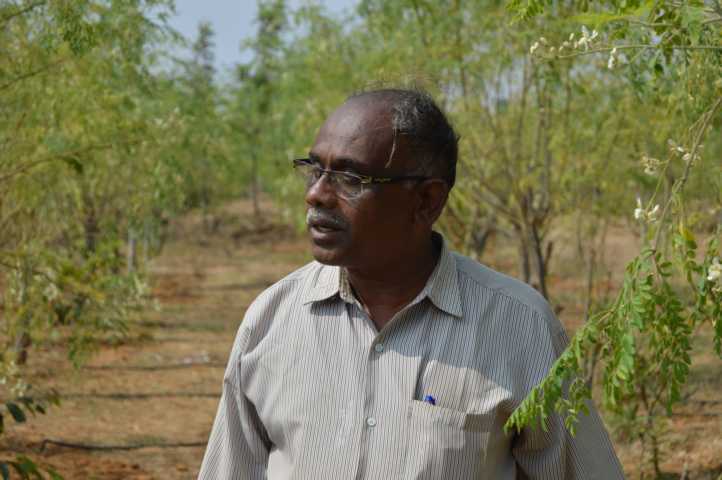
Ayyappa Masagi has a simple message: “You want water? Call me!” Thousands have. And his phone rings dozens of times a day. There appears to be an endless supply of patients for the man nicknamed India’s “Water Doctor”. “I faced a lot of water problems in my childhood,” he said. “I used to go at 3am to fetch water from the stream. So I made an oath that when I grew up I would find a solution. So I quit my job as a mechanical engineer in 2002 to solve India’s water problem,
India is enduring a catastrophic water crisis. About 330 million people are suffering water shortages after the failure of the last two monsoons. Reservoirs are dry. Farmers have committed suicide. Thousands of drought-stricken villagers have flocked to cities, desperate for water, praying for rain. According to Ayyappa’s calculations, if just 30 per cent of India’s rainwater were captured and stored, “one year’s rain would sustain the nation for three years.”
To prove it, in 2014 Ayyappa bought 84 acres of barren land near Chilamathur, a famously drought-prone region of Andhra Pradesh, 110km northeast of Bangalore. “The wind here was like a firewind. I told my partners, ‘Within one year I will make this land a water bowl.’” Today, a network of 25,000 sand-filled pits and four new lakes capture and store any rainwater that falls here. No drop is allowed to escape into rivers and run off to the sea. It stays on and in the land, keeping the subsoil charged with water which, when needed, is drawn from five shallow bore-wells.
The topsoil from digging out the lakes has helped level the land, which has been planted with trees and crops. Roughly 60 per cent of the trees will form dense forest, while 40 per cent will be fruit trees to generate income. Grains and vegetables have also been planted, and next year there will be a dairy here too. The plan is to make this a sustainable organic farm, totally self-sufficient for all its water needs.
Through his Water Literacy Foundation, Ayyappa is training “water warriors” to spread his message. He’s already written seven books and trained more than 100 interns from India and abroad, including Germany, Japan and the US. “If you only talk, nothing will happen. You have to do something and prove it. Governments are coming forward to take up my service, replicating my model. Once the community attitude changes, our political attitudes change, we can replicate this concept throughout the world.”
Recent Posts
Petrol in India is cheaper than in countries like Hong Kong, Germany and the UK but costlier than in China, Brazil, Japan, the US, Russia, Pakistan and Sri Lanka, a Bank of Baroda Economics Research report showed.
Rising fuel prices in India have led to considerable debate on which government, state or central, should be lowering their taxes to keep prices under control.
The rise in fuel prices is mainly due to the global price of crude oil (raw material for making petrol and diesel) going up. Further, a stronger dollar has added to the cost of crude oil.
Amongst comparable countries (per capita wise), prices in India are higher than those in Vietnam, Kenya, Ukraine, Bangladesh, Nepal, Pakistan, Sri Lanka, and Venezuela. Countries that are major oil producers have much lower prices.
In the report, the Philippines has a comparable petrol price but has a per capita income higher than India by over 50 per cent.
Countries which have a lower per capita income like Kenya, Bangladesh, Nepal, Pakistan, and Venezuela have much lower prices of petrol and hence are impacted less than India.
“Therefore there is still a strong case for the government to consider lowering the taxes on fuel to protect the interest of the people,” the report argued.
India is the world’s third-biggest oil consuming and importing nation. It imports 85 per cent of its oil needs and so prices retail fuel at import parity rates.
With the global surge in energy prices, the cost of producing petrol, diesel and other petroleum products also went up for oil companies in India.
They raised petrol and diesel prices by Rs 10 a litre in just over a fortnight beginning March 22 but hit a pause button soon after as the move faced criticism and the opposition parties asked the government to cut taxes instead.
India imports most of its oil from a group of countries called the ‘OPEC +’ (i.e, Iran, Iraq, Saudi Arabia, Venezuela, Kuwait, United Arab Emirates, Russia, etc), which produces 40% of the world’s crude oil.
As they have the power to dictate fuel supply and prices, their decision of limiting the global supply reduces supply in India, thus raising prices
The government charges about 167% tax (excise) on petrol and 129% on diesel as compared to US (20%), UK (62%), Italy and Germany (65%).
The abominable excise duty is 2/3rd of the cost, and the base price, dealer commission and freight form the rest.
Here is an approximate break-up (in Rs):
a)Base Price | 39 |
b)Freight | 0.34 |
c) Price Charged to Dealers = (a+b) | 39.34 |
d) Excise Duty | 40.17 |
e) Dealer Commission | 4.68 |
f) VAT | 25.35 |
g) Retail Selling Price | 109.54 |
Looked closely, much of the cost of petrol and diesel is due to higher tax rate by govt, specifically excise duty.
So the question is why government is not reducing the prices ?
India, being a developing country, it does require gigantic amount of funding for its infrastructure projects as well as welfare schemes.
However, we as a society is yet to be tax-compliant. Many people evade the direct tax and that’s the reason why govt’s hands are tied. Govt. needs the money to fund various programs and at the same time it is not generating enough revenue from direct taxes.
That’s the reason why, govt is bumping up its revenue through higher indirect taxes such as GST or excise duty as in the case of petrol and diesel.
Direct taxes are progressive as it taxes according to an individuals’ income however indirect tax such as excise duty or GST are regressive in the sense that the poorest of the poor and richest of the rich have to pay the same amount.
Does not matter, if you are an auto-driver or owner of a Mercedes, end of the day both pay the same price for petrol/diesel-that’s why it is regressive in nature.
But unlike direct tax where tax evasion is rampant, indirect tax can not be evaded due to their very nature and as long as huge no of Indians keep evading direct taxes, indirect tax such as excise duty will be difficult for the govt to reduce, because it may reduce the revenue and hamper may programs of the govt.