


Syllabus Connect :- GS I ( Population and associated issues)
Context
Recently, population control measures are being discussed by the states of Assam and Uttar Pradesh. Many other states like Rajasthan, Madhya Pradesh, Telangana and Andhra Pradesh, Gujarat, Maharashtra, Uttarakhand, Karnataka and Odisha have been following a two-child norm for local body elections for a while.
The bill proposed by the Uttar Pradesh law commission suggests that those with one or two children be made eligible for benefits in terms of increment in job promotions, monetary benefits, health coverage benefits and many more perks.
More than two children might involve penalties such as being debarred from government jobs and local body elections, and limiting ration cards to four people. The logic being offered is that a dip in population will allow UP to reach sustainable development goals and an equitable distribution of resources.
Population Trends
1) The population of India exploded between 1930 and 1980, with decadal growth of 11 per cent in the 1931 census increasing to around 25 per cent in the 1981 census.
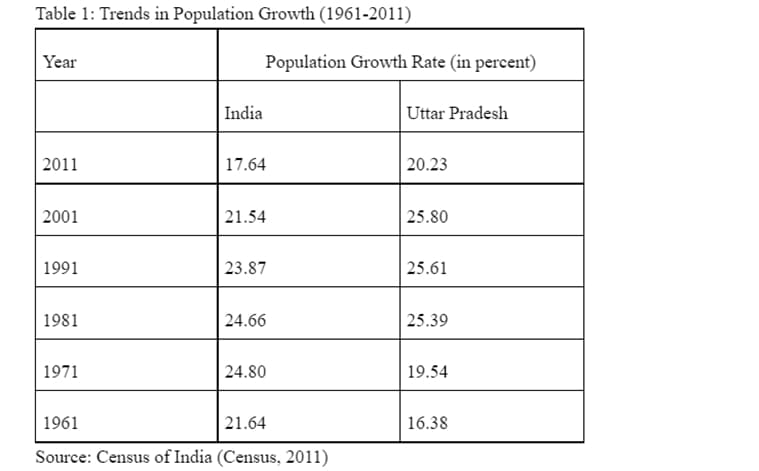
2) Since 1981, the population growth has seen declining trends, and in the 2011 census, India saw a 17.1 per cent decadal growth rate.
3) Table 1 below shows that UP has started showing a declining trend in the last decade, which is a positive sign towards population stabilization.
4) A Lancet study in 2020 has projected that India’s population will peak around 2048 to 160 crores and thereafter it will see a decline and reach around 109 crores around 2100.
Trends in TFR
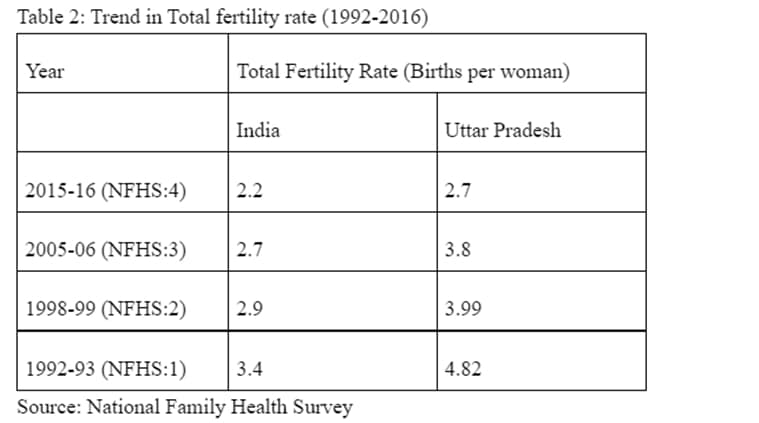
1) The Total Fertility Rate at the national level is 2.2 births per woman according to NFHS- 4, 2015-16 (NFHS, 2015-16).
2) The TFR is projected to decline to 1.24 by 2020.
3) Several states already have a TFR lower than the national average.
4) Uttar Pradesh, too, has seen a decline in TFR from 4.8 children per woman in 1992 to 2.7 children per woman in 2016 (Table: 2). This is in spite of a fall in child mortality rate from 83 in 2000 to 43 in 2016 (Health and Family Welfare Department, U.P., 2021).
Trends in Contraceptive Use
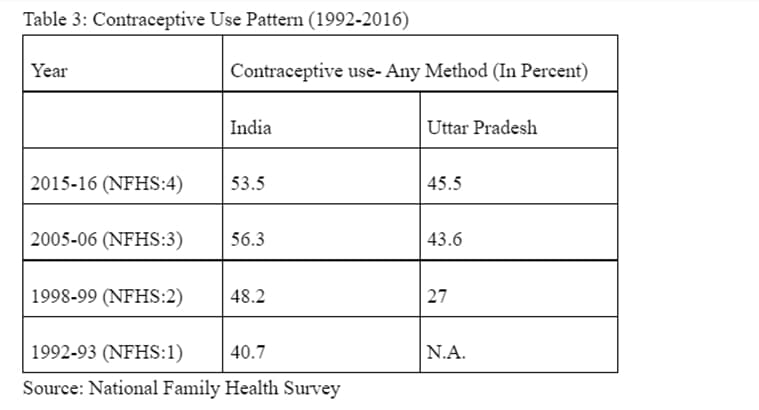
1) The present contraceptive use of any method for India is 53.5 per cent.
2) Studies suggest that the sex composition of children is associated with contraceptive use in India.
3) Couples with four or more children are more likely to use modern contraceptives, when they have at least one son and one daughter. They are less likely to use contraceptives when they have all daughters and no sons.
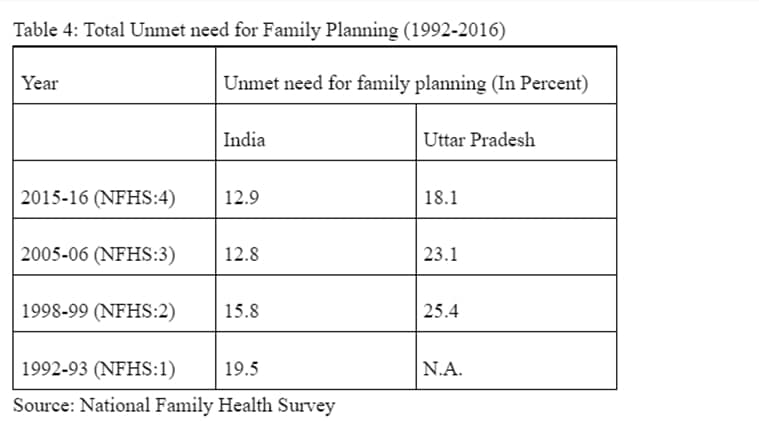
4) For states like UP, the contraceptive uses of any method have been below the national average and unmet needs are quite high, around 18 per cent (Table 4). In such cases, the state should focus on providing a basket of choices to the family.
Education is the Contraceptive
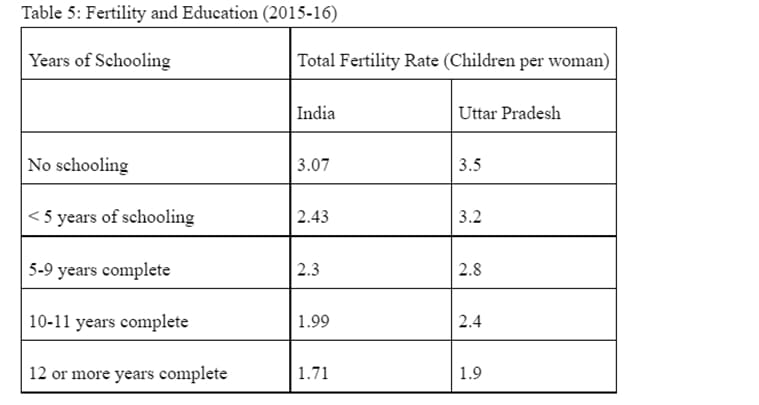
1) There is a reduction in the TFR for both the national level and UP, with the years of schooling.
2) Also, states like Kerala and Punjab with a TFR of 1.6 indicate the same.
3) From Table 5 it’s clear, the woman with no schooling has a high TFR of 3.07 for India and 3.5 for UP.
4) As education levels increase, the TFR decreases up to 1.71 for India and 1.9 for UP for more than 12 more years of schooling.
5) Studies have also indicated the same in the case of UP. Higher fertility was concentrated in districts with low levels of women’s education, predominantly in the north-central UP.
Conclusion
1) In India, the number of missing girls at birth has increased from 35 lakhs in 1987-96 to 55 lakhs in 2007-16.
2) Bringing any such population control bill will worsen in states where sex-selective abortion is still practiced.
3) Whereas there has been an overall improvement in sex ratio from 898 women per 1,000 men in 2001 to 912 in 2011, the child sex ratio (0-6 years) has seen a fall from 916 to 902 in the same period in UP.
4) This should be a cause of concern as any coercive measure is likely to worsen this ratio against girls.
Given UP’s large population and geography, family planning and fertility should be targeted. Bringing educational reforms and giving choices for family planning would work more appropriately. This would lead to an overall improvement in the fertility outcome of the state as well as at the national level.
Recent Posts
Petrol in India is cheaper than in countries like Hong Kong, Germany and the UK but costlier than in China, Brazil, Japan, the US, Russia, Pakistan and Sri Lanka, a Bank of Baroda Economics Research report showed.
Rising fuel prices in India have led to considerable debate on which government, state or central, should be lowering their taxes to keep prices under control.
The rise in fuel prices is mainly due to the global price of crude oil (raw material for making petrol and diesel) going up. Further, a stronger dollar has added to the cost of crude oil.
Amongst comparable countries (per capita wise), prices in India are higher than those in Vietnam, Kenya, Ukraine, Bangladesh, Nepal, Pakistan, Sri Lanka, and Venezuela. Countries that are major oil producers have much lower prices.
In the report, the Philippines has a comparable petrol price but has a per capita income higher than India by over 50 per cent.
Countries which have a lower per capita income like Kenya, Bangladesh, Nepal, Pakistan, and Venezuela have much lower prices of petrol and hence are impacted less than India.
“Therefore there is still a strong case for the government to consider lowering the taxes on fuel to protect the interest of the people,” the report argued.
India is the world’s third-biggest oil consuming and importing nation. It imports 85 per cent of its oil needs and so prices retail fuel at import parity rates.
With the global surge in energy prices, the cost of producing petrol, diesel and other petroleum products also went up for oil companies in India.
They raised petrol and diesel prices by Rs 10 a litre in just over a fortnight beginning March 22 but hit a pause button soon after as the move faced criticism and the opposition parties asked the government to cut taxes instead.
India imports most of its oil from a group of countries called the ‘OPEC +’ (i.e, Iran, Iraq, Saudi Arabia, Venezuela, Kuwait, United Arab Emirates, Russia, etc), which produces 40% of the world’s crude oil.
As they have the power to dictate fuel supply and prices, their decision of limiting the global supply reduces supply in India, thus raising prices
The government charges about 167% tax (excise) on petrol and 129% on diesel as compared to US (20%), UK (62%), Italy and Germany (65%).
The abominable excise duty is 2/3rd of the cost, and the base price, dealer commission and freight form the rest.
Here is an approximate break-up (in Rs):
a)Base Price | 39 |
b)Freight | 0.34 |
c) Price Charged to Dealers = (a+b) | 39.34 |
d) Excise Duty | 40.17 |
e) Dealer Commission | 4.68 |
f) VAT | 25.35 |
g) Retail Selling Price | 109.54 |
Looked closely, much of the cost of petrol and diesel is due to higher tax rate by govt, specifically excise duty.
So the question is why government is not reducing the prices ?
India, being a developing country, it does require gigantic amount of funding for its infrastructure projects as well as welfare schemes.
However, we as a society is yet to be tax-compliant. Many people evade the direct tax and that’s the reason why govt’s hands are tied. Govt. needs the money to fund various programs and at the same time it is not generating enough revenue from direct taxes.
That’s the reason why, govt is bumping up its revenue through higher indirect taxes such as GST or excise duty as in the case of petrol and diesel.
Direct taxes are progressive as it taxes according to an individuals’ income however indirect tax such as excise duty or GST are regressive in the sense that the poorest of the poor and richest of the rich have to pay the same amount.
Does not matter, if you are an auto-driver or owner of a Mercedes, end of the day both pay the same price for petrol/diesel-that’s why it is regressive in nature.
But unlike direct tax where tax evasion is rampant, indirect tax can not be evaded due to their very nature and as long as huge no of Indians keep evading direct taxes, indirect tax such as excise duty will be difficult for the govt to reduce, because it may reduce the revenue and hamper may programs of the govt.