


Scientists say a month of concentrated efforts is all it takes to control mosquitoes responsible for diseases like dengue and chikungunya. But the claim sounds far-fetched at a time when almost the entire country has been reporting these diseases for the past few months .
The country registered 36,110 confirmed cases of dengue and 14,656 cases of chikungunya till September 11. Government data shows dengue has also claimed 70 lives. An alarming number of cases have been reported of another type of fever whose symptoms are similar to chikungunya and dengue. It is being dubbed mystery fever. Unable to understand what causes the fever, government agencies have started screening for Zika, another vector-borne disease, as a precaution. The National Institute of Virology, Pune, has already checked over 300 blood samples for Zika virus, but the samples have tested negative, confirms D T Mourya, director of the institute.
Ask B N Nagpal, scientist at the National Institute of Malaria Research, Delhi, why the country has failed to avert such an outbreak of vector-borne diseases and he says it is because of lack of political will. “Even if existing methods are employed properly, it is possible to control the population of mosquitoes,” says Nagpal. His sentiments were echoed by the National Green Tribunal, which on September 21, reprimanded the Delhi government for its “shameful and shocking” response to the outbreak. The capital has so far registered four dengue deaths.

 Note*: Disability-adjusted life year (DALY) is a measure of overall disease burden and is expressed as the number of years lost due to ill-health, disability or early death
Shifting places
A fallout of this political apathy has been the failure of the government to adapt to the changing nature of Aedes aegypti mosquito, which is responsible for the diseases plaguing the country.
Normally, the mosquito would breed only in clean stagnant water accumulated in potholes, discarded containers and tyres. Not only has intermittent rains associated with climate change increased breeding places for the mosquito, the vector is also adapting to newer environments. Now there is evidence that it can grow in dirty water, using it as a habitat throughout the year. A study published in the Indian Journal of Medical Research in 2015 shows that Aedes mosquitoes that breed in dirty water are bigger and have longer wing spans. The National Vector Borne Disease Control Programme’s 2016 Urban Vector-Borne Disease Scheme does not consider dirty water as a breeding area. The authors of the 2015 study suggest that the country’s vector control programme should include sewage drains as breeding habitats of dengue vector mosquitoes.
The scheme includes methods such as controlling mosquito breeding sites, use of anti-larval methods with approved larvicides and biological control through larvivorous fishes and biolarvicides. And even these are not being employed properly, which is clear from the current outbreak.
High on research, low on practice
Many innovative methods have been developed in the past few years to fight mosquitoes, but they are still in experimental stages . One way is the use of crowd-sourced data to predict the disease outbreaks in advance. Scientists at Nanyang Technological University (NTU), National University of Singapore (NUS), and the Indian Institute of Technology Bombay, Mumbai (IITB), collaborated to create a web- and mobile-based application for dengue surveillance.
The Mo-Buzz application combines three elements of dengue management—predictive surveillance, civic engagement and health communication. It was first used in Colombo in 2013 through a group of Sri Lanka’s public health inspectors.
The inspectors monitored different areas in the city and fed their reports in the system, which used a pre-loaded algorithm to generate hotspots of infection in real time. “The predictions informed public health inspectors about the areas that needed immediate interventions,” says May O Lwin, professor at NTU and the principal investigator at Mo-Buzz. The application also allows citizens to “report dengue-breeding sites through geo-tagged picture reports”. The application has not been tried in India so far because of funding issues, says Ravi Poovaiah of IITB, who was part of the team that developed the app.
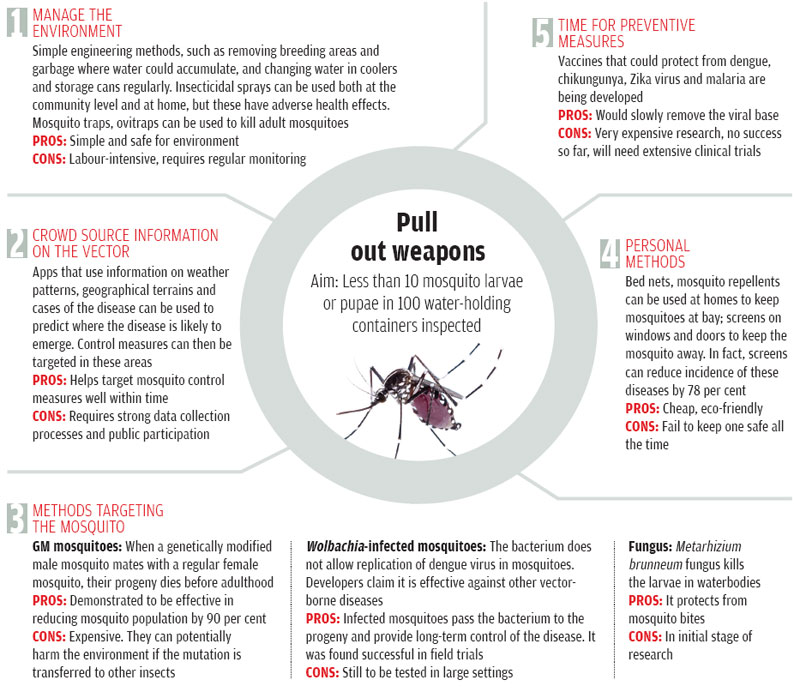
In fact, the lone experiment in India to use crowd sourced data for sensitising people about dengue has been tried by a Mumbai-based agency called Vamanetra Digihealth. The company, set up in April 2014, started an app in Mumbai to detect dengue-breeding spots in the city. “The response from the public was lukewarm primarily because of limited marketing of the product and the underlying campaign,” says Rintu R Patnaik, managing partner, Vamanetra Digihealth.
He adds that the veracity of data is a big issue on crowd-sourcing platforms. “The challenge we faced in running the trial was similar to what the public health teams regularly face—people are generally unwilling to volunteer or allow health workers to find trouble spots that can allow mosquito breeding.” Though the company has stopped developing apps that require crowd sourcing of data, they are still working on modules that rely on government data and open data sets. Patnaik says the behaviour of people can change for the better “through greater media coverage and awareness”.
Researchers across the globe are also actively developing genetically modified (GM) mosquitoes to control vector population. GM mosquitoes are created by injecting the eggs with modified DNA. The male progeny is released to mate with normal mosquitoes and their progeny has a short lifespan.
Oxitec, a British company, has tested GM mosquitoes in Piracicaba, Brazil, and found that it resulted in an 82 per cent decline of the mosquito population in the area in just eight months.
In August last year, the company got a go-ahead from the US Food and Drug Administration to release the GM mosquitoes as part of an investigational field trial in Key Haven in Florida Keys. Residents of Key Haven will soon vote on the trial and the final approval will be given by the Florida Keys Mosquito Control Board. “In India, we have recommended controlled field trials of GM mosquitoes,” says K Gunasekaran, scientist at the Vector Control Research Centre in Puducherry. He says the Department of Science and Technology is in the process of preparing guidelines for conducting trials in India.
 A device effective in controlling mosquito population in septic tanks
The use of GM mosquito, however, is controversial as they have been implicated in the spread of the Zika virus. Zika virus infection began in those areas of Brazil where Oxitec had first released the modified mosquitoes. Even activists in Florida Keys are against the use of these mosquitoes.
Use of Wolbachia bacterium has shown potential in controlling the vector. The bacterium reduces the growth of the disease-causing virus such as dengue, chikungunya and Zika in the body of Aedes aegypti. Both Wolbachia-infected male and female mosquitoes are released into the environment. When they mate with normal mosquitoes, they transfer the bacterium to the progeny. Wolbachia is self-sustaining. “This makes the method cost effective,” says Lewti Hunghanfoo, communications adviser for Eliminate Dengue, international collaboration led by Monash University, Australia.
Some experiments have also shown that when Wolbachia-infected male mosquitoes mate with normal female mosquitoes, they are unable to reproduce. Singapore plans to introduce male Aedes mos quitoes carrying Wolbachia bacteria in three housing estates in October this year. The field trial will continue for six months to assess the impact on the mosquito popu lation. India too plans to use Wolbachia in the next two years.
Preliminary research shows that parasitic fungus Metarhizium brunneum has the potential to control the population of the Aedes mosquito. A study published on July 7, 2016, in PLoS Pathogens demonstrates that the fungus can attack Aedes larvae in a rapid and effective way. Researchers of the study say the approach is safe for humans. The biggest advantage of the fungus is that it grows in freshwater, which is the natural habitat of Aedes mosquito.
There is an Indian invention to combat mosquitoes as well. Hawker is an indigenous mosquito and fly trapper developed by Kerala resident Mathews K Mathew. The device uses biogas to lure mosquitoes and sunlight to kill them. It makes use of the smell from the septic tank to attract the mosquitoes. Once the mosquitoes get trapped, the heat built up inside the device kills them. Mathew says a single Hawker can control mosquito population in 0.4 hectare of land and its surroundings. He initially used Hawker in churches and old age homes and has got a patent for the product. He now plans to start mass-producing the device, which currently sells for Rs 1,500.
 Colombo mayor A J M Muzammil (second from right) launches the Mo-Buzz application for mapping dengue hotspots at the Colombo Municipal Council on February 12, 2015. Hawker (Courtesy: mo-buzz.org)
He is in talks with officials of the Kochi Municipal Corporation (KMC) because the city has over 260,000 septic tanks. A senior KMC official says, “The device is the most effective fly remedy we have seen so far. It does not produce chemicals or other toxic waste and has a larger operational area with little maintenance cost. We have already proposed to use Hawker widely.”
Experts say the key lies in using a combined effort, which should have both national policies and local innovations.
“All the innovative methods have potential, but it is unlikely that any of them when used alone, will be effective in disease prevention and control. None has been fully validated so it is too early to tell which will be most effective,” says Duane J Gubler, professor emeritus and founding director of Signature Research Program in Emer ging Infectious Disease, Duke-NUS Medical School, Singapore.
The vector Aedes aegypti has spread across the globe and India is infested with it. It is time we used the one-month opportunity to control the population. We have both established and experimental tools. “These are not difficult to implement. What is difficult is to have sustainable commitment by the government and the people,” says Gubler.
Sri Lanka conquers malariaThe last case of malaria was reported in the country in October 2012
A public health officer treats patients at a mobile malaria clinic in Sri Lanka (Courtesy: Government Of Sri Lanka)The world Health Organization (WHO) declared Sri Lanka malaria-free on September 6, 2016. “Sri Lanka’s achievement is truly remarkable. In the mid-20th century, it was among the most malaria-affected countries, but now it is malaria-free,” says Poonam Khetrapal Singh, WHO regional director. Health officials in Colombo claim that policy and programmatic shifts led to the success. “This is a combination that worked,” says Hemantha Herath, deputy director, Anti-Malaria Campaign. Sri Lanka signed up early for WHO’s Global Malaria Eradication Programme (GMEP) in 1958 which resulted in an immediate decline in reported malaria cases spread by Anopheles mosquito. But malaria cases continued to spike intermittently in the 1960s, 1980s and 1990s. Malaria reached epidemic levels in 1999 with confirmed cases reaching 265,000. This served as a wake-up call for the government. The country first shifted from the single-vector control to an integrated vector-control programme that was applied across the island. A decade later, Sri Lanka added web-based surveillance methods and began working closely with the community to eradicate malaria. By November 2012, there was remarkable progress. The locally reported cases by then stood at zero with the last local case being reported in October 2012. It is about vigilance and follow up, says Herath. In the three years that followed, 95, 49 and 36 cases of malaria were reported, all of them having contracted malaria overseas. Due to a strong web-based surveillance, the campaign was able to track citizens travelling from countries with a history of malaria transmission and immediately refer them for treatment. Special attention was paid to security forces personnel, immigrants and tourists. “A 24×7 hotline was added next for improved tracking and the method of treatment was also changed. Isolation treatment was provided to patients to contain the spreading of infection.” The country’s strong public health system is responsible for the success, says Anura Jayawickrama, Sri Lanka’s health secretary. Early detection and continuous treatment were the key to success. For years, mobile clinics have been used to reach communities, particularly those living in the malaria-affected regions such as the island’s north-west and north-central, he says. Mobile malaria clinics in high transmission areas meant that prompt and effective treatment could reduce the parasite reservoir and the possibility of further transmission, WHO stated in its statement issued after announcing the country malaria-free. Sri Lanka is the second country in Southeast Asia to eradicate malaria. Last year, WHO had declared the Maldives malaria-free. The country has not reported malaria cases since 1982. The country maintained strong epidemiological and entomological surveillance to sustain its malaria-free status for the past three decades. The same strategy is adopted in India but according to K Gunaksekaran, scientist, Vector Control Research Centre, Puducherry, the reason for Sri Lanka’s success is that they were consistent with the effort. “Unlike us, Sri Lanka continued its efforts even after it had brought down the number of malaria cases. We don’t even have regular surveillance for dengue and chikungunya.” |

Receive Daily Updates
Recent Posts
On March 31, the World Economic Forum (WEF) released its annual Gender Gap Report 2021. The Global Gender Gap report is an annual report released by the WEF. The gender gap is the difference between women and men as reflected in social, political, intellectual, cultural, or economic attainments or attitudes. The gap between men and women across health, education, politics, and economics widened for the first time since records began in 2006.
[wptelegram-join-channel link=”https://t.me/s/upsctree” text=”Join @upsctree on Telegram”]No need to remember all the data, only pick out few important ones to use in your answers.
The Global gender gap index aims to measure this gap in four key areas : health, education, economics, and politics. It surveys economies to measure gender disparity by collating and analyzing data that fall under four indices : economic participation and opportunity, educational attainment, health and survival, and political empowerment.
The 2021 Global Gender Gap Index benchmarks 156 countries on their progress towards gender parity. The index aims to serve as a compass to track progress on relative gaps between women and men in health, education, economy, and politics.
Although no country has achieved full gender parity, the top two countries (Iceland and Finland) have closed at least 85% of their gap, and the remaining seven countries (Lithuania, Namibia, New Zealand, Norway, Sweden, Rwanda, and Ireland) have closed at least 80% of their gap. Geographically, the global top 10 continues to be dominated by Nordic countries, with —Iceland, Norway, Finland, and Sweden—in the top five.
The top 10 is completed by one country from Asia Pacific (New Zealand 4th), two Sub-Saharan countries (Namibia, 6th and Rwanda, 7th, one country from Eastern Europe (the new entrant to the top 10, Lithuania, 8th), and another two Western European countries (Ireland, 9th, and Switzerland, 10th, another country in the top-10 for the first time).There is a relatively equitable distribution of available income, resources, and opportunities for men and women in these countries. The tremendous gender gaps are identified primarily in the Middle East, Africa, and South Asia.
Here, we can discuss the overall global gender gap scores across the index’s four main components : Economic Participation and Opportunity, Educational Attainment, Health and Survival, and Political Empowerment.
The indicators of the four main components are
(1) Economic Participation and Opportunity:
o Labour force participation rate,
o wage equality for similar work,
o estimated earned income,
o Legislators, senior officials, and managers,
o Professional and technical workers.
(2) Educational Attainment:
o Literacy rate (%)
o Enrollment in primary education (%)
o Enrollment in secondary education (%)
o Enrollment in tertiary education (%).
(3) Health and Survival:
o Sex ratio at birth (%)
o Healthy life expectancy (years).
(4) Political Empowerment:
o Women in Parliament (%)
o Women in Ministerial positions (%)
o Years with a female head of State (last 50 years)
o The share of tenure years.
The objective is to shed light on which factors are driving the overall average decline in the global gender gap score. The analysis results show that this year’s decline is mainly caused by a reversal in performance on the Political Empowerment gap.
Global Trends and Outcomes:
– Globally, this year, i.e., 2021, the average distance completed to gender parity gap is 68% (This means that the remaining gender gap to close stands at 32%) a step back compared to 2020 (-0.6 percentage points). These figures are mainly driven by a decline in the performance of large countries. On its current trajectory, it will now take 135.6 years to close the gender gap worldwide.
– The gender gap in Political Empowerment remains the largest of the four gaps tracked, with only 22% closed to date, having further widened since the 2020 edition of the report by 2.4 percentage points. Across the 156 countries covered by the index, women represent only 26.1% of some 35,500 Parliament seats and 22.6% of over 3,400 Ministers worldwide. In 81 countries, there has never been a woman head of State as of January 15, 2021. At the current rate of progress, the World Economic Forum estimates that it will take 145.5 years to attain gender parity in politics.
– The gender gap in Economic Participation and Opportunity remains the second-largest of the four key gaps tracked by the index. According to this year’s index results, 58% of this gap has been closed so far. The gap has seen marginal improvement since the 2020 edition of the report, and as a result, we estimate that it will take another 267.6 years to close.
– Gender gaps in Educational Attainment and Health and Survival are nearly closed. In Educational Attainment, 95% of this gender gap has been closed globally, with 37 countries already attaining gender parity. However, the ‘last mile’ of progress is proceeding slowly. The index estimates that it will take another 14.2 years to close this gap on its current trajectory completely.
In Health and Survival, 96% of this gender gap has been closed, registering a marginal decline since last year (not due to COVID-19), and the time to close this gap remains undefined. For both education and health, while progress is higher than economy and politics in the global data, there are important future implications of disruptions due to the pandemic and continued variations in quality across income, geography, race, and ethnicity.
India-Specific Findings:
India had slipped 28 spots to rank 140 out of the 156 countries covered. The pandemic causing a disproportionate impact on women jeopardizes rolling back the little progress made in the last decades-forcing more women to drop off the workforce and leaving them vulnerable to domestic violence.
India’s poor performance on the Global Gender Gap report card hints at a serious wake-up call and learning lessons from the Nordic region for the Government and policy makers.
Within the 156 countries covered, women hold only 26 percent of Parliamentary seats and 22 percent of Ministerial positions. India, in some ways, reflects this widening gap, where the number of Ministers declined from 23.1 percent in 2019 to 9.1 percent in 2021. The number of women in Parliament stands low at 14.4 percent. In India, the gender gap has widened to 62.5 %, down from 66.8% the previous year.
It is mainly due to women’s inadequate representation in politics, technical and leadership roles, a decrease in women’s labor force participation rate, poor healthcare, lagging female to male literacy ratio, and income inequality.
The gap is the widest on the political empowerment dimension, with economic participation and opportunity being next in line. However, the gap on educational attainment and health and survival has been practically bridged.
India is the third-worst performer among South Asian countries, with Pakistan and Afghanistan trailing and Bangladesh being at the top. The report states that the country fared the worst in political empowerment, regressing from 23.9% to 9.1%.
Its ranking on the health and survival dimension is among the five worst performers. The economic participation and opportunity gap saw a decline of 3% compared to 2020, while India’s educational attainment front is in the 114th position.
India has deteriorated to 51st place from 18th place in 2020 on political empowerment. Still, it has slipped to 155th position from 150th position in 2020 on health and survival, 151st place in economic participation and opportunity from 149th place, and 114th place for educational attainment from 112th.
In 2020 reports, among the 153 countries studied, India is the only country where the economic gender gap of 64.6% is larger than the political gender gap of 58.9%. In 2021 report, among the 156 countries, the economic gender gap of India is 67.4%, 3.8% gender gap in education, 6.3% gap in health and survival, and 72.4% gender gap in political empowerment. In health and survival, the gender gap of the sex ratio at birth is above 9.1%, and healthy life expectancy is almost the same.
Discrimination against women has also been reflected in Health and Survival subindex statistics. With 93.7% of this gap closed to date, India ranks among the bottom five countries in this subindex. The wide sex ratio at birth gaps is due to the high incidence of gender-based sex-selective practices. Besides, more than one in four women has faced intimate violence in her lifetime.The gender gap in the literacy rate is above 20.1%.
Yet, gender gaps persist in literacy : one-third of women are illiterate (34.2%) than 17.6% of men. In political empowerment, globally, women in Parliament is at 128th position and gender gap of 83.2%, and 90% gap in a Ministerial position. The gap in wages equality for similar work is above 51.8%. On health and survival, four large countries Pakistan, India, Vietnam, and China, fare poorly, with millions of women there not getting the same access to health as men.
The pandemic has only slowed down in its tracks the progress India was making towards achieving gender parity. The country urgently needs to focus on “health and survival,” which points towards a skewed sex ratio because of the high incidence of gender-based sex-selective practices and women’s economic participation. Women’s labour force participation rate and the share of women in technical roles declined in 2020, reducing the estimated earned income of women, one-fifth of men.
Learning from the Nordic region, noteworthy participation of women in politics, institutions, and public life is the catalyst for transformational change. Women need to be equal participants in the labour force to pioneer the societal changes the world needs in this integral period of transition.
Every effort must be directed towards achieving gender parallelism by facilitating women in leadership and decision-making positions. Social protection programmes should be gender-responsive and account for the differential needs of women and girls. Research and scientific literature also provide unequivocal evidence that countries led by women are dealing with the pandemic more effectively than many others.
Gendered inequality, thereby, is a global concern. India should focus on targeted policies and earmarked public and private investments in care and equalized access. Women are not ready to wait for another century for equality. It’s time India accelerates its efforts and fight for an inclusive, equal, global recovery.
India will not fully develop unless both women and men are equally supported to reach their full potential. There are risks, violations, and vulnerabilities women face just because they are women. Most of these risks are directly linked to women’s economic, political, social, and cultural disadvantages in their daily lives. It becomes acute during crises and disasters.
With the prevalence of gender discrimination, and social norms and practices, women become exposed to the possibility of child marriage, teenage pregnancy, child domestic work, poor education and health, sexual abuse, exploitation, and violence. Many of these manifestations will not change unless women are valued more.
[wptelegram-join-channel link=”https://t.me/s/upsctree” text=”Join @upsctree on Telegram”]2021 WEF Global Gender Gap report, which confirmed its 2016 finding of a decline in worldwide progress towards gender parity.
Over 2.8 billion women are legally restricted from having the same choice of jobs as men. As many as 104 countries still have laws preventing women from working in specific jobs, 59 countries have no laws on sexual harassment in the workplace, and it is astonishing that a handful of countries still allow husbands to legally stop their wives from working.
Globally, women’s participation in the labour force is estimated at 63% (as against 94% of men who participate), but India’s is at a dismal 25% or so currently. Most women are in informal and vulnerable employment—domestic help, agriculture, etc—and are always paid less than men.
Recent reports from Assam suggest that women workers in plantations are paid much less than men and never promoted to supervisory roles. The gender wage gap is about 24% globally, and women have lost far more jobs than men during lockdowns.
The problem of gender disparity is compounded by hurdles put up by governments, society and businesses: unequal access to social security schemes, banking services, education, digital services and so on, even as a glass ceiling has kept leadership roles out of women’s reach.
Yes, many governments and businesses had been working on parity before the pandemic struck. But the global gender gap, defined by differences reflected in the social, political, intellectual, cultural and economic attainments or attitudes of men and women, will not narrow in the near future without all major stakeholders working together on a clear agenda—that of economic growth by inclusion.
The WEF report estimates 135 years to close the gap at our current rate of progress based on four pillars: educational attainment, health, economic participation and political empowerment.
India has slipped from rank 112 to 140 in a single year, confirming how hard women were hit by the pandemic. Pakistan and Afghanistan are the only two Asian countries that fared worse.
Here are a few things we must do:
One, frame policies for equal-opportunity employment. Use technology and artificial intelligence to eliminate biases of gender, caste, etc, and select candidates at all levels on merit. Numerous surveys indicate that women in general have a better chance of landing jobs if their gender is not known to recruiters.
Two, foster a culture of gender sensitivity. Take a review of current policies and move from gender-neutral to gender-sensitive. Encourage and insist on diversity and inclusion at all levels, and promote more women internally to leadership roles. Demolish silos to let women grab potential opportunities in hitherto male-dominant roles. Work-from-home has taught us how efficiently women can manage flex-timings and productivity.
Three, deploy corporate social responsibility (CSR) funds for the education and skilling of women and girls at the bottom of the pyramid. CSR allocations to toilet building, the PM-Cares fund and firms’ own trusts could be re-channelled for this.
Four, get more women into research and development (R&D) roles. A study of over 4,000 companies found that more women in R&D jobs resulted in radical innovation. It appears women score far higher than men in championing change. If you seek growth from affordable products and services for low-income groups, women often have the best ideas.
Five, break barriers to allow progress. Cultural and structural issues must be fixed. Unconscious biases and discrimination are rampant even in highly-esteemed organizations. Establish fair and transparent human resource policies.
Six, get involved in local communities to engage them. As Michael Porter said, it is not possible for businesses to sustain long-term shareholder value without ensuring the welfare of the communities they exist in. It is in the best interest of enterprises to engage with local communities to understand and work towards lowering cultural and other barriers in society. It will also help connect with potential customers, employees and special interest groups driving the gender-equity agenda and achieve better diversity.