


The disappearance of the dinosaurs is probably the world’s most famous example of a mass extinction, but it’s certainly not the only one.
There have been at least four other mass extinctions on Earth over the past 500 million years.
A mass extinction refers to the die-off of a huge number of species in a relatively short period of time. In the past, mass extinctions have been caused by geological or climatic events, such as the asteroid strike that wiped out the dinosaurs.
But according to scientists, we are experiencing another mass extinction. And this time, it’s of our own making.
Biological Armageddon
A new study published in the journal Proceedings of the National Academy of Sciences says that there is a “biological annihilation” underway.
Researchers from Stanford University and the National Autonomous University of Mexico looked at 27,600 terrestrial vertebrate species (animals with a backbone that live on land), which represent around half of all vertebrate species, and found that 32% are decreasing in population.
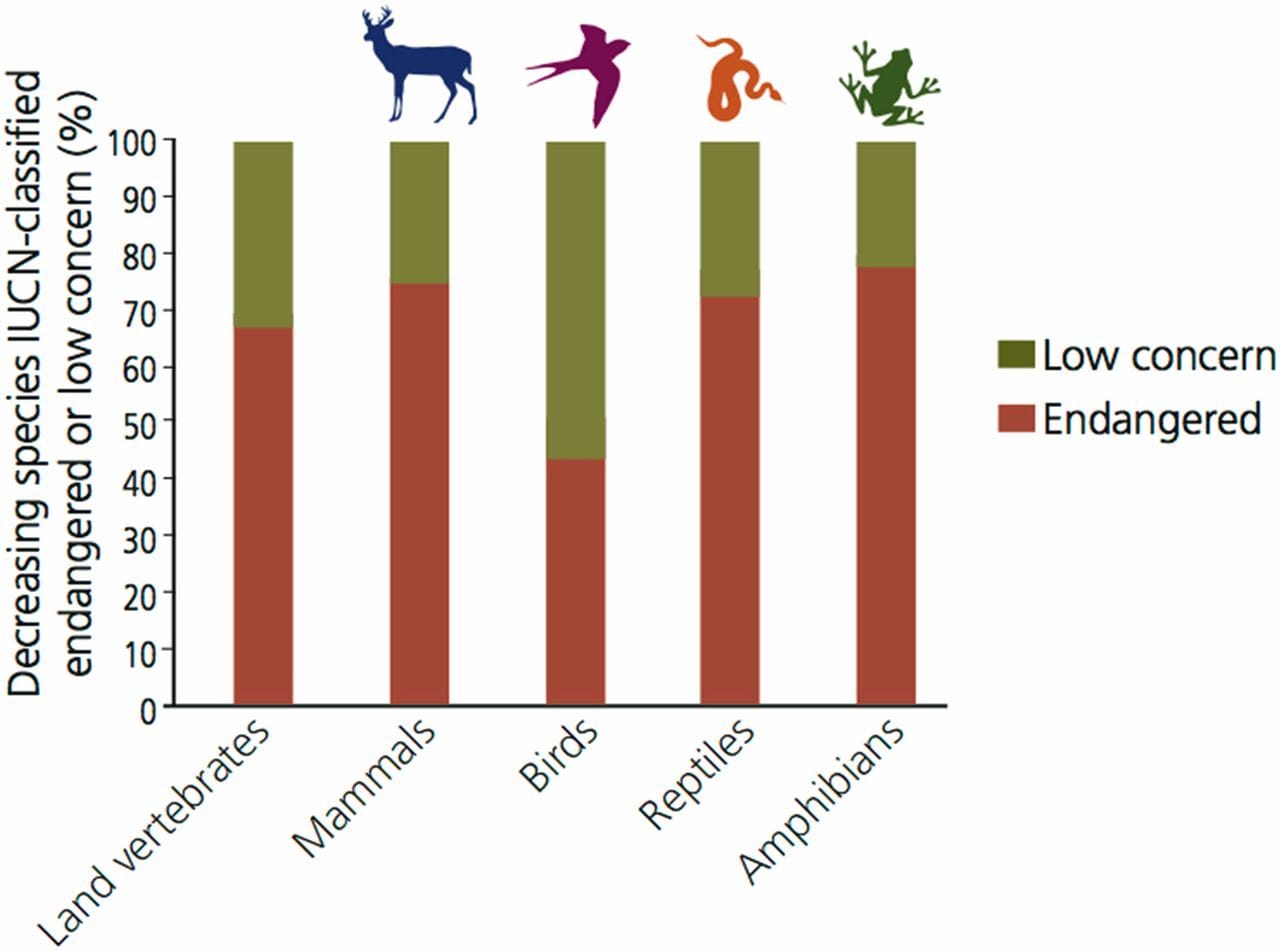
They also looked at 177 mammal species, and found that all have lost at least a third of their geographic ranges. In addition, nearly one in two of the species have experienced severe population declines.
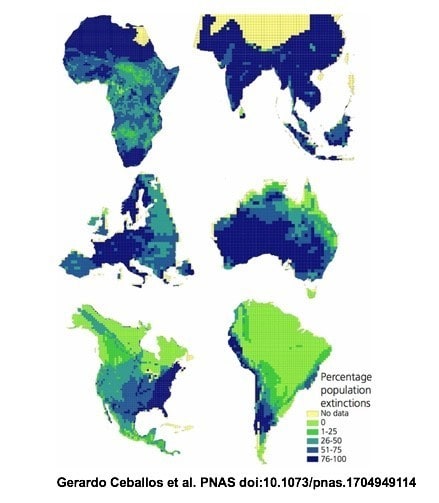
Several species of mammals that were relatively safe one or two decades ago are now endangered. For instance, the number of African lions has dropped by 43% since 1993.
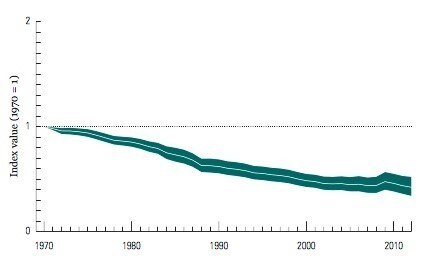
The study is not the only piece of research to come to the conclusion that certain species are declining rapidly. The Living Planet Index, which measures the number of 3706 vertebrate species, also shows a persistent downward trend.
This one is different
Although mass extinctions occurred before humans took over the planet, the scientists say that the rate of die-offs has speeded up considerably.
Even by their conservative estimates, almost 200 species of vertebrates have become extinct in the last 100 years. This is equivalent to around two species a year. In past extinctions, the loss of 200 species would have taken up to 10,000 years.
The problem, say the authors of the study, is that two extinctions a year do not attract enough global attention, especially if people have not heard of the creature in the first place. They use the examples of the Catarina pupfish and the Christmas Island pipistrelle, a small bat, which have both vanished in recent years.
They argue that the world should be paying attention, because the loss of biological diversity is one of the most severe human-caused global environmental problems.
In the last few decades, humans have taken over vast swathes of animal habitat and caused pollution and global warming. All of which, the authors say, have led to catastrophic declines in populations of both common and rare vertebrate species.
The problem with extinction is that it’s irreversible, and it has a profound effect on the planet’s ecosystem. Everything from the food we eat to the resources that we use are with us because of the Earth’s extraordinary biodiversity.
There’s not enough time, they say, to prevent the shrinking of biodiversity, and any notion that we can somehow bring extinct animals back to life is a “misimpression”.
But not everyone agrees with the scientists’ gloomy assessment.
Earth bouncing back?
Some argue that if we really were in the middle of a mass extinction, the world would already be over. Smithsonian paleontologist Doug Erwin told The Atlantic:
“People who claim we’re in the sixth mass extinction don’t understand enough about mass extinctions to understand the logical flaw in their argument.
“To a certain extent they’re claiming it as a way of frightening people into action, when in fact, if it’s actually true we’re in a sixth mass extinction, then there’s no point in conservation biology.”
Although he warns:
“I think that if we keep things up long enough, we’ll get to a mass extinction, but we’re not in a mass extinction yet, and I think that’s an optimistic discovery because that means we actually have time to avoid Armageddon.”
And there is another reason for a more optimistic outlook. New species are coming into existence faster than ever thanks to humans, according to Chris D Thomas, Professor of Evolutionary Biology at the University of York.
He argues that we underestimate just how far nature can adapt.
“Throughout the history of the Earth, species have survived by moving to new locations that permit them to flourish,” he says.
“A million or so years from now, the world could end up supporting more species, not fewer, as a consequence of the evolution of Homo sapiens.”
But the authors of the biological annihilation study have a stark warning: even our own days might be numbered.
“Earth’s sixth mass extinction episode has proceeded further than most assume,” they conclude.
“The window for effective action is very short, probably two or three decades at most.
“All signs point to ever more powerful assaults on biodiversity in the next two decades, painting a dismal picture of the future of life, including human life.”
Receive Daily Updates
Recent Posts
- Lowering Emissions by Accelerating Forest Finance (LEAF) Coalition, a collective of the United States, United Kingdom and Norway governments, came up with a $1 billion fund.
- LEAF is supported by transnational corporations (TNCs) like Unilever plc, Amazon.com, Inc, Nestle, Airbnb, Inc as well as Emergent, a US-based non-profit.
- The world lost more than 10 million hectares of primary tropical forest cover last year, an area roughly the size of Switzerland.
- Ending tropical and subtropical forest loss by 2030 is a crucial part of meeting global climate, biodiversity and sustainable development goals. Protecting tropical forests offers one of the biggest opportunities for climate action in the coming decade.
- Tropical forests are massive carbon sinks and by investing in their protection, public and private players are likely to stock up on their carbon credits.
- The LEAF coalition initiative is a step towards concretising the aims and objectives of the Reducing Emissions from Deforestation and Forest Degradation (REDD+) mechanism.
- REDD+ was created by the United Nations Framework Convention on Climate Change (UNFCCC). It monetised the value of carbon locked up in the tropical forests of most developing countries, thereby propelling these countries to help mitigate climate change.
- It is a unique initiative as it seeks to help developing countries in battling the double-edged sword of development versus ecological commitment.
- The initiative comes at a crucial time. The tropics have lost close to 12.2 million hectares (mha) of tree cover last year according to global estimates released by Global Forest Watch.
- Of this, a loss of 4.2 mha occurred within humid tropical primary forests alone. It should come as no surprise that most of these lost forests were located in the developing countries of Latin America, Africa and South Asia.
- Brazil has fared dismally on the parameter of ‘annual primary forest loss’ among all countries. It has lost 1.7 mha of primary forests that are rich storehouse of carbon. India’s estimated loss in 2020 stands at 20.8 kilo hectares.
- Between 2002-2020, Brazil’s total area of humid primary forest reduced by 7.7 per cent while India’s reduced by 3.4 per cent.
- Although the loss in India is not as drastic as in Brazil, its position is nevertheless precarious. For India, this loss is equivalent to 951 metric tonnes worth carbon dioxide emissions released in the atmosphere.
- It is important to draw comparisons between Brazil and India as both countries have adopted a rather lackadaisical attitude towards deforestation-induced climate change. The Brazilian government hardly did anything to control the massive fires that gutted the Amazon rainforest in 2019.
- It is mostly around May that forest fires peak in India. However, this year India, witnessed massive forest fires in early March in states like Odisha, Uttarakhand, Madhya Pradesh and Mizoram among others.
- The European Union’s Copernicus Atmospheric Monitoring Service claimed that 0.2 metric tonnes of carbon was emitted in the Uttarakhand forest fires.
- Implementation of the LEAF Coalition plan will help pump in fresh rigour among developing countries like India, that are reluctant to recognise the contributions of their forest dwelling populations in mitigating climate change.
- With the deadline for proposal submission fast approaching, India needs to act swiftly on a revised strategy.
- Although India has pledged to carry out its REDD+ commitments, it is impossible to do so without seeking knowledge from its forest dwelling population.
Context:-
At the recently concluded Leaders’ Summit on Climate in April 2021, Lowering Emissions by Accelerating Forest Finance (LEAF) Coalition, a collective of the United States, United Kingdom and Norway governments, came up with a $1 billion fund plan that shall be offered to countries committed to arrest the decline of their tropical forests by 2030.
[wptelegram-join-channel link=”https://t.me/s/upsctree” text=”Join @upsctree on Telegram”]What is LEAF Coalition?
Why LEAF Coalition?
Brazil & India
According to the UN-REDD programme, after the energy sector, deforestation accounts for massive carbon emissions — close to 11 per cent — in the atmosphere. Rapid urbanisation and commercialisation of forest produce are the main causes behind rampant deforestation across tropical forests.
Tribes, Forests and Government
Disregarding climate change as a valid excuse for the fires, Indian government officials were quick to lay the blame for deforestation on activities of forest dwellers and even labelled them “mischievous elements” and “unwanted elements”.
Policy makers around the world have emphasised the role of indigenous tribes and local communities in checking deforestation. These communities depend on forests for their survival as well as livelihood. Hence, they understand the need to protect forests. However, by posing legitimate environmental concerns as obstacles to real development, governments of developing countries swiftly avoid protection of forests and rights of forest dwellers.
For instance, the Government of India has not been forthcoming in recognising the socio-economic, civil, political or even cultural rights of forest dwellers. According to data from the Union Ministry of Tribal Affairs in December, 2020 over 55 per cent of this population has still not been granted either individual or community ownership of their lands.
To make matters worse, the government has undertaken systematic and sustained measures to render the landmark Scheduled Tribes and Other Traditional Forest Dwellers (Recognition of Forest Rights) Act, 2006 ineffective in its implementation. The Act had sought to legitimise claims of forest dwellers on occupied forest land.
Various government decisions have seriously undermined the position of indigenous people within India. These include proposing amendments to the obsolete Indian Forest Act, 1927 that give forest officials the power to take away forest dwellers’ rights and to even use firearms with impunity.
There is also the Supreme Court’s order of February, 2019 directing state governments to evict illegal encroachers of forest land or millions of forest dwellers inhabiting forests since generations as a measure to conserve wildlife. Finally, there is the lack of data on novel coronavirus disease (COVID-19) deaths among the forest dwelling population;
Tardy administration, insufficient supervision, apathetic attitude and a lack of political intent defeat the cause of forest dwelling populations in India, thereby directly affecting efforts at arresting deforestation.
Way Forward
Tuntiak Katan, a global indigenous leader from Ecuador and general coordinator of the Global Alliance of Territorial Communities, aptly indicated the next steps at the Climate Summit:
“The first step is recognition of land rights. The second step is the recognition of the contributions of local communities and indigenous communities, meaning the contributions of indigenous peoples.We also need recognition of traditional knowledge practices in order to fight climate change”
Perhaps India can begin by taking the first step.