


National Court of Appeal :-
Background :-
A National Court of Appeal is being advocated as an intermediate forum between the Supreme Court and the various high courts of India. But a better solution to ease the higher judiciary’s burden may lie in strengthening that of the lower.
Excerpt From Editorial :-
India’s Supreme Court too is a “is a very special kind of court”. It is special because it acts as a final court of appeal. It is special because its decisions are determinative; its pronouncements constitute the law of the land. And it is very special because under our political structure, the court acts as the ultimate arbiter on disputes concerning any interpretation of the Constitution. However, in recent times, especially over the last two decades or so, the court’s ability to remain special, to retain its allure, has somewhat been thwarted by the enormity of its burden.
Unlike its American counterpart, the Indian Supreme Court is a multifarious institution. It often tasks itself with ruling on run-of-the-mill civil and criminal appeals. The court’s docket, in fact, tends to burst with seemingly mundane disputes. These tend to include, to name but a few typical cases, rent control quarrels between landlords and tenants, factual squabbles over tax assessments, internal managerial rows concerning societies and trusts, and what not! As a result of entertaining these everyday appeals, which have little bearing on the larger public interest, the court’s focus has wavered from what many believe is its core task: deliberating on, and settling, questions of pure constitutional significance.
An oft-repeated suggestion aimed at correcting this perceived imbalance in the apex court’s role is the establishment of a National Court of Appeal (NCA) that would act as an intermediate forum between the Supreme Court and the various high courts of India. Although there is little scope under our country’s constitutional structure for the creation of such a court, the idea has once again come into vogue.
It is undeniable that the Supreme Court’s role as the Constitution’s sheet anchor has been weakened in recent times. This dilution, at least partly, owes to the court’s inability to devote itself substantially to the determination of important public questions.
Broadly, the Constitution prescribes to the Supreme Court two types of jurisdiction: an original jurisdiction — i.e. the power to entertain cases at the first instance — where fundamental rights have been violated, or where a State is involved in a dispute with another State or with the Centre; and an appellate jurisdiction, where a case involving a substantial question of law requires adjudication, on appeal. The court was therefore always seen not merely as an arbiter of constitutional disputes, but also as a plenary body that would settle the law of the land. However, by all accounts, the Constituent Assembly believed the court would exercise great discretion in choosing its own scope of work. The court was not seen as a forum to argue over ordinary disputes between litigants that had no larger public bearing. It was believed the lower judiciary and the various high courts would be sufficiently equipped to dispense justice in these kinds of cases.
That the Supreme Court has today used the pliability of its power to grant special leave to often interfere in mundane disputes is therefore not a product of any structural problem, but rather of a deliberate decision by the court’s judges. Viewed thus, it is difficult to understand how the creation of an NCA would somehow ease the burden on the Supreme Court, allowing it to eschew its authority to grant special leave; this power was, after all, always meant to be used only in exceptional cases, where a particular interpretation of a law required definite resolution.
What the NCA is meant to do, therefore, can quite easily be achieved by strengthening the lower judiciary, which generally constitutes the courts of first instance. Correspondingly, as was always intended, the high courts can be viewed as the regular — and, in most cases, final — appellate court. No doubt, to achieve this, it is necessary that there is greater rigor involved in choosing our judges. If socially conscious and meritorious women and men, who subscribe to the best constitutional values, are elevated as judges to our subordinate judiciary and the high courts, the idea of viewing the Supreme Court as a routine court of appeal can be renounced altogether. This would allow the Supreme Court to be more discerning in its use of discretion, thus substantially reducing its burden of acting as a corrector of simple errors. Moreover, at the same time, at least two constitution benches can be designated to hear cases Monday through Friday, thereby solving problems concerning the inability of the Supreme Court to devote itself to its most important duty.
Our Analysis:-
- An intermediary like NCA is not a solution , for the simple reason that those who went to Supreme court from lower courts will still go to Supreme court if they have to.This means , as long as the verdict does not bear the finality of Supreme Court , it will be contested.So , creating another intermediary body with all leg and teeth but no finality will serve no purpose at all.
- Another important aspect is that , if we look at who really goes to supreme court , our understanding might emerge clear.For many of us (“Common Man”) , contesting the verdicts until it reaches supreme court is a very costly affair.Moreover geographical proximity plays its role too , a person far from Delhi would not think of going to supreme court if he/she does not have the means and methods to do so.
- Thus, the “common man” is generally guided by the immediate needs of life rather than contesting a verdict till the end and putting his/her job and family in stress.This comes from rationality.
- The above statements are true if anyone cares to compare the number of cases and distribute them geographically.So , to call supreme court is “everyone’s court” does sound prudential in theory but fails in practice.Many of us would like to go to supreme court but our limited means and methods does not allow us to do so, thus rendering deniability of justice.
- Justice have two fundamental principles – equality before law and equal access to law. Although we have equality before the law , equal access to law is far from real.
- As mentioned above if any court that does not bear the finality of supreme court would be of little help , for the simple reason that those who can reach NCA , can also reach supreme court as they have the means and methods to do so.
- The real question is how to dispense justice without delay, how to give the verdict the necessary “finality” and lastly how to make the supreme court as an accessible court for all.
- The possible solution that can serve all above mentioned purpose is to – expand the reach of supreme court itself by establishing supreme court benches in every state.Any intermediary would do no good as far as the finality of verdict is concerned.
- The another issue raised by the editorial is the decline of the questions of importance before supreme court and its engagement with mundane tasks.
- When there is a decline in cases and especially cases that have wider public impact, it simply means , we have advanced as a society. Lets not forget , between two societies , one having a profound supreme court and another having no supreme court at all as there is no need , the best society would be the latter one and not the former one.Yes, if we transform in to a society that does not need supreme court at all instead to a society that has a profound supreme court, the preferable choice would be the former one.After all , why a few men in robe should decide what the society should do or not do , when the society can decide itself.Moreover, if the solution comes form society that means it has a broader consensus than thrusting a court order in societies throat.
- But, to our dismay , mankind has both – the good lot and the evil lot.So , to deal with the devil ,we need the court. Hence , any decline of so called “constitutional” cases is a good sign , which implies that our constitution has evolved and does meet the needs of many.And when jurist cry over decline of the “grandeur ” and “allure” of “great cases” of our supreme court, we as a society should be happy instead.Lesser the litigation , better the society.
- To sum it up , it is a better to expand the constitutional benches than to create an intermediary court of appeal.This would help the court to dispense the cases speedily and make the supreme court accessible to all geographically.And finally, there is bound to be decline in quality of cases, if the 60’s and 70’s were the decades of “Constitutional debate”, the decades of 21st century going to be decades of “environmental debate”. Environmental debate has replaced the constitutional debate , and the number of cases are indicative of it.So , the “grandeur” of the supreme court remains but the theme has shifted , from deliberating the constitution to debating the environment and pollution and in it’s entirety – it’s a good sign for society.
River and Reservoir Map of India:-
Click on the images to view/save the large images with clarity.

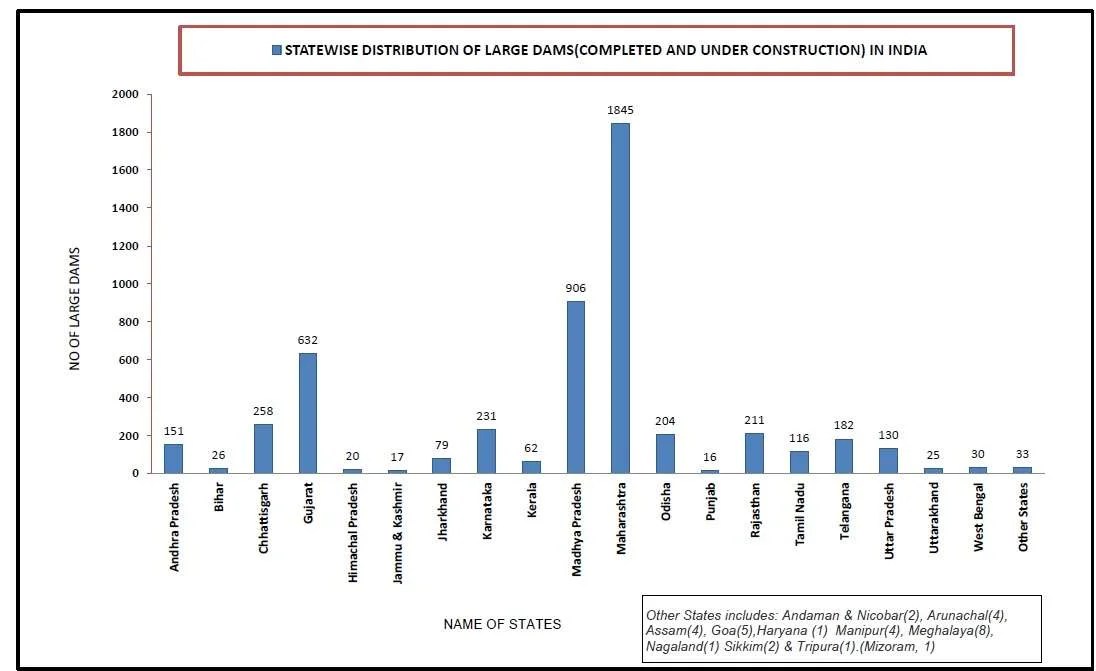
Large Dams of India :-
|
Dam Name | River | Nearest city |
|
|
|||||||||||||||||||
| 1 | Tehri Dam | Bhagirathi | Pratapnagar | Uttarakhand | Ganga | |||||||||||||||||||
| 2 | Lakhwar Dam | Yamuna | Dehradun | Uttarakhand | Ganga | |||||||||||||||||||
| 3 | Idukki (Eb)/Idukki Arch Dam | Periyar | Todupulai | Kerala | West flowing rivers from Tadri to Kanyakumari | |||||||||||||||||||
| 4 | Bhakra Dam | Satluj | Bilaspur | Himachal Pradesh | Indus up to International Border | |||||||||||||||||||
| 5 | Pakal Dul Dam | Marusudar | Kishtwar | Jammu & Kashmir | Indus up to International Border | |||||||||||||||||||
| 6 | Sardar Sarover Gujarat Dam | Narmada | Rajpipla | Gujarat | Narmada | |||||||||||||||||||
| 7 | Srisailam (N.S.R.S.P) Dam | Krishna | Nandikotkur | Telangana | Krishna | |||||||||||||||||||
| 8 | Ranjit Sagar Dam | Ravi | Pathankot | Punjab | Indus up to International Border | |||||||||||||||||||
| 9 | Baglihar Dam | CHENAB | Ramban | Jammu & Kashmir | Indus up to International Border | |||||||||||||||||||
| 10 | Chemera I Dam | Ravi | Bhattiyat | Himachal Pradesh | Indus up to International Border | |||||||||||||||||||
| 11 | Cheruthoni (Eb) Dam | Cheruthoni | Todupulai | Kerala | West flowing rivers from Tadri to Kanyakumari | |||||||||||||||||||
| 12 | Pong Dam | Beas | Dera Gopipur | Himachal Pradesh | Indus up to International Border | |||||||||||||||||||
| 13 | Jamrani Dam | Gola | Naini Tal | Uttarakhand | Ganga | |||||||||||||||||||
| 14 | Subansiri Lower HE (Nhpc) Dam | Subansiri | Lower Subansiri | Arunachal Pradesh | Brahmaputra | |||||||||||||||||||
| 15 | Ramganga Dam | Ramganga | Lansdowne | Uttarakhand | Ganga | |||||||||||||||||||
| 16 | Nagarjuna Sagar Dam | Krishna | Guruzala | Telangana | Krishna | |||||||||||||||||||
| 17 | Kakki (Eb) Dam | Kakki | Rani | Kerala | West flowing rivers from Tadri to Kanyakumari | |||||||||||||||||||
| 18 | Nagi Dam | Nagi | Jamui | Bihar | Ganga | |||||||||||||||||||
| 19 | Salal (Rockfill And Concrete ) Dam | Chenab | Gool Gulab Garh | Jammu & Kashmir | Indus up to International Border | |||||||||||||||||||
| 20 | Lakhya Dam | Lakhya hole | Mudigere | Karnataka | Krishna | |||||||||||||||||||
| 21 | Sholayar Dam | Sholayar | Pollachi | Tamil Nadu | West flowing rivers from Tadri to Kanyakumari | |||||||||||||||||||
| 22 | Koyna Dam | Koyna | Patan | Maharashtra | Krishna | |||||||||||||||||||
| 23 | Idamalayar (Eb) Dam | Idamalayar | Devikolam | Kerala | West flowing rivers from Tadri to Kanyakumari | |||||||||||||||||||
| 24 | Supa Dam | Kali Nadi | Supa | Karnataka | West flowing rivers from Tapi to Tadri | |||||||||||||||||||
| 25 | Karjan Dam | Karjan | Rajpipla | Gujarat | Narmada | |||||||||||||||||||
| 26 | Kulamavu (Eb) Dam | Kilivillithode | Todupulai | Kerala | West flowing rivers from Tadri to Kanyakumari | |||||||||||||||||||
| 27 | Koteshwar Dam | Bhagirathi | Pratapnagar | Uttarakhand | Ganga | |||||||||||||||||||
| 28 | Lower : PPSP Dam | Puruliya | West Bengal | Subarnarekha | ||||||||||||||||||||
| 29 | Doyang Hep Dam | Doyang | Wokha | Nagaland | Brahmaputra | |||||||||||||||||||
| 30 | Rihand Dam | Rihand | Dudhi | Uttar Pradesh | Ganga | |||||||||||||||||||
| 31 | Indira Sagar (NHDC) Dam | Narmada | Khandwa | Madhya Pradesh | Narmada | |||||||||||||||||||
| 32 | Warna Dam | Varna | Shahuwadi | Maharashtra | Krishna | |||||||||||||||||||
| 33 | Bhatsa Dam | Bhatsa and chorna | Shahapur | Maharashtra | West flowing rivers from Tapi to Tadri | |||||||||||||||||||
| 34 | Pillur Dam | Bhavani | Mettuppalaiyam | Tamil Nadu | Cauvery | |||||||||||||||||||
| 35 | Upper Kodayar Dam | Kodayar | Kalkulam | Tamil Nadu | West flowing rivers from Tadri to Kanyakumari | |||||||||||||||||||
| 36 | Minimata (Hasdeo) Bango Dam | Hasdeo | Katghora | Chhattisgarh | Mahanadi | |||||||||||||||||||
| 37 | Jakham Main Dam | Jakham (mahi) | Pratapgarh | Rajasthan | Mahi | |||||||||||||||||||
| 38 | Teesta -V (NHPC) Dam | Teesta | North | Sikkim | Brahmaputra | |||||||||||||||||||
| 39 | Lower Ghatghar Dam | Shahapur | Maharashtra | West flowing rivers from Tapi to Tadri | ||||||||||||||||||||
| 40 | Kallada (Parappar) (Id) Dam | Kallada | Pattanapuram | Kerala | West flowing rivers from Tadri to Kanyakumari | |||||||||||||||||||
| 41 | Madupetty (Eb) Dam | Palar | Devikolam | Kerala | West flowing rivers from Tadri to Kanyakumari | |||||||||||||||||||
| 42 | Parbati II Dam | Parbati | Kullu | Himachal Pradesh | Indus up to International Border | |||||||||||||||||||
| 43 | Chakra Dam | Chakra | Hosanagara | Karnataka | West flowing rivers from Tadri to Kanyakumari | |||||||||||||||||||
| 44 | Bandardhara Dam | Paravara | Akola | Maharashtra | Godavari | |||||||||||||||||||
| 45 | Lower Vaitarna Dam | Vaitarna | Shahapur | Maharashtra | West flowing rivers from Tapi to Tadri | |||||||||||||||||||
| 46 | Ukai Dam | Tapi | Songadh | Gujarat | Tapi | |||||||||||||||||||
| 47 | Upper Aliyar Dam | Aliyar | Pollachi | Tamil Nadu | West flowing rivers from Tadri to Kanyakumari | |||||||||||||||||||
| 48 | Aruna Dam | Aruna | Vaibhavwadi | Maharashtra | West flowing rivers from Tapi to Tadri | |||||||||||||||||||
| 49 | Upper Bhavani Dam | Bhavani | Udagamandalam | Tamil Nadu | Cauvery | |||||||||||||||||||
| 50 | Podagada Dam | Podagada | Nabarangapur | Odisha | Godavari |

NGT halts Tawang hydro power project
The National Green Tribunal (NGT) has suspended the Union Environment Ministry’s clearance for hydro power project in Tawang, Arunachal Pradesh. The clearance by the centre was granted in 2012.This move was particularly aimed at protecting the vulnerable black-necked crane in the region.
Background:
The project was planned on the Nyamjang Chhu river and was the largest of 13 hydro power projects to be built in the Tawang basin.
Regarding the black-necked crane:
- Black-necked crane is a species that breeds on the Tibetan plateau and migrates to Tawang for the winter.
- The bird, most commonly found in China, is legally protected in Bhutan and India and is considered sacred to certain Buddhist traditions.
- It is rated as ‘vulnerable’ in the International Union for Conservation of Nature (IUCN) list of endangered species.
- It is also listed in India’s Wildlife Act as a Schedule 1 species, which gives animals and birds the highest legal protection.
Celebrating the Earth Day
Earth Day 2016 is being celebrated around the world today (April 22).
Theme for Earth Day 2016: Trees for the Earth!
Earth Day
Earth Day was first celebrated in 1970. The idea for it was first proposed at a UNESCO conference a year earlier, when activist John McConnell suggested a day to honour the planet and the idea of peace. US senator Gaylord Nelson founded Earth Day in the US. It was made into an international day in 1990 and now is celebrated by over 193 countries every year.
Significance
Earth Day 2016 is particularly important as it will see nations across the world sign the Paris Agreement on climate change, set out in COP21 last year. The historic agreement saw countries pledge to limit global warming to below 2C on pre-industrial levels. From 22 April, it will be open for signatures for one year. The agreement will come into effect in 2020.
ISRO’s New Light-As-Air Gel Can Keep Indian Soldiers Warm In Siachen Snow
ISRO scientists have developed the world’s lightest synthetic material called ‘silica aerogel’ or ‘blue air’ or ‘frozen smoke’.
Silica aerogel is a nano-structured material with high specific surface area, high porosity, low density, low dielectric constant and excellent heat insulation properties.
- This material has excellent thermal resistance and if used as a filler in soldiers’ uniforms it can possibly help save many lives at the Siachen glacier.
- It can also be used in thermal jacket, foot insoles, as well as in window glazing. It is extremely useful for people working in very cold environments, in a very strategic way.
The problems faced by soldiers in Siachen :-
- Frost bite
- Snow blindness
- Neurotic disorder
- Cold induced Depression
President nominated six members to Rajya Sabha
The President of India has nominated Shri Swapan Das Gupta, Shri Navjot Singh Sidhu, Dr. Subramanian Swamy, Shri Narendra Jadhav, Sh. Suresh Gopi and Ms. Mary Kom to the Rajya Sabha.
12 people can be recommended to the Upper House. As of now, there are seven vacancies among these 12, for which six names have been announced, and one kept in abeyance.
Nominations to the Upper House:
The government recommends names of people having “special knowledge or practical experience in literature, science, art and social service”.
- As per Article 80 of the Indian constitution, members are nominated by the President to the Upper House on the recommendation of the government.
- The government recommends members in this category at anytime and it is not bound to an electoral cycle like the other seats.
Panama disease stalks banana cultivation in Kerala
The Panama disease caused by a soil-borne fungus is threatening banana crops across Kerala, posing a potential crisis for farmers.Scientists are concerned that the sporadic cases of infestation could turn into an epidemic. Most of the popular cultivars have shown signs of infestation.
Prevention:-Scientists have recommend soil treatment with fungicides for control of the disease.
About the disease:
Also called Fusarium Wilt of banana, Panama is caused by the soil-borne fungus Fusarium oxysporum f. sp. Cubense (Foc). The fungus enters the plant through the roots and goes on to colonise the plant through the vascular system.
- It causes discoloration and wilting of leaves, and eventually kills the plant.
- The fungus spreads through infected planting material, soil and water.
Why the name “Panama”:
In the 1950s, Panama wiped out the Gros Michel banana, the dominant cultivar. Over the years, it spread from Panama to neighbouring countries. A new virulent strain of the disease known as Tropical Race 4 (TR4) is now threatening banana crops in Asia, Australia, Africa and the Middle East.
Cure for high medicine bills: A generics prescription law
The Central government is considering the introduction of a law to make it mandatory for doctors to prescribe generic drugs so that patients can access affordable medicines provided through state-run Jan Aushadhi stores.It is because doctors usually don’t prescribe generic medicines supplied through Jan Aushadi stores. So patients find it tough to ask for the correct generic equivalents.Also, ex-factory cost of medicines gets marked up multiple times owing to supply chain costs and incentives for medical representatives. But, the Jan Aushadhi stores are able to provide the same drugs at very cheaper prices.
Background:
The Government, in June 2015, had proposed to open 1000 more stores under the ‘Jan Aushadhi Scheme’ to make available quality generic medicines at affordable prices through these special outlets.
Jan Aushadhi Scheme:-
- Under this, less priced quality unbranded generic medicines will be made available through Jan Aushadhi stores which inherently are less priced but are of same and equivalent quality, efficacy and safety as compared to branded generic medicines.
- Under this Scheme, the State Government has to provide space in Government Hospital premises for the running of the outlets (JAS). Government hospitals, NGOs, Charitable Organisations and public societies like Red Cross Society, Rogi Kalyan Samiti typically constituted for the purpose can be operating agencies for the JAS.
- The operating agency for JAS is nominated on the basis of the recommendations of the State government. Operational expenditure is met from trade margins admissible for the medicines.
- The State Government has to ensure prescription of unbranded generic medicines by the Government doctors.
- The Jan Aushadhi Programme is accordingly a self sustaining business model not dependent on government subsidies or assistance. It is run on the principle of “Not for Profits but with Minimal Profits”.
Jan Aushadhi Campaign:-
- Improve access to healthcare in as much as cost of treatment would come down substantially. This would enable the Public Health System to increase the coverage.
- Secure a socio-economically viable mechanism/institutional arrangement for efficacious sales of Pharma CPSU products, thereby improving their viability.
- Promote & encourage private industry to sell their quality unbranded generic products through these retail outlets.
- Educate doctors that unbranded generic medicines provide a better option that branded products since quality of generic medicines can be equally efficacious and safe at much lower prices.
- Create consumer awareness by involving private, charitable bodies and NGOs by making them part of the campaign.
- Reduce promotional cost and profits for the benefit of patients.
At present, there are 283 stores in 22 States and Union Territories.