


1)Center Seeks Memorandum from the States for Providing Drought Assistance :-
News :-
- In view of sustained dry spell during the last Kharif season, as also in the early Rabi period in some part of the country, the Center has asked the affected states to submit memorandum for drought assistance immediately.
- In a communication to the state Government of Bihar, Uttar Pradesh, Orissa, Jharkhand, Telagana and Ander Pradesh, Union Ministry of Agriculture and Farmers welfare has urged the states to intimate immediately number of drought affected districts in the state and whether drought has been declared in these area or not. States have also been asked to submit the financial memorandum for assistance from National Drought Relief Fund (NDRF).
Drought:-
- Drought is one of the most frequently occurring national disasters in India. With its increased frequency and expanded coverage in the recent years, about one third of the
country is either drought prone or under desert areas. - These areas are lagging behind in agriculture and also in overall economic growth. They experience wide year-to-year fluctuations in agricultural production and incomes and have a relatively high incidence of poverty.
- The poor in these regions are highly vulnerable to a variety of risks due to their low and fluctuating incomes, high indebtedness and low human development. Helping the poor to come out of vulnerability and poverty and integrating the drought prone areas into the mainstream of development is a serious challenge faced by policy makers at present.
The History of Drought in India:-
- Droughts and famines have received attention of rulers in India right from the 13th and 14th century.
- Muhammad Tughlakh was perhaps the first Sultan to take systematic steps to alleviate efforts of droughts by distributing grains to drought affected people in Delhi in 1343 AD.
- This approach was followed and improved upon by Mughals and many other kings and rulers later on.
- During the British period also efforts were made to provide relief to droughts / famine affected people by organizing relief works and food distribution, distribution of fodder, loans to farmers to start cultivation in the next season etc.The first Scarcity Manual was prepared by the British Government in 1883, which was followed by other manuals by some provincial governments.
- The Royal Commission on Agriculture in 1928 recommended promotion of dry land farming to promote agriculture in famine affected regions. However, the efforts were
scanty and there was an alarming increase in the frequency of during the British period.
After Independence government has adopted a three pronged strategy to face droughts:
(1) providing relief to drought hit population under scarcity relief programmes
(2) designing special area development programme for drought prone areas and desert areas (DPAP – drought prone area programme and DDP – desert development programme) and
(3) promoting dry farming agriculture as a part of agricultural policy.
Somehow this approach has not worked very well, as is evident from the increasing drought prone areas in the country and the relatively high poverty and vulnerability of
people living in these areas.The new opportunities of globalization are likely to bypass these regions if adequate steps are not taken to integrate them into the mainstream economy.
Long term impacts of drought :-
- Its long term impact on agriculture in terms of farmers’ adjustment to uncertain rainfall and uncertain agricultural prospects
- poor performance of agriculture and of the overall economy
- impact on environmental resources like water, forest, land etc and biodiversity including damages to animal and plant species, which tend to raise the frequency
and intensity of droughts in the long run and which affect the life and livelihood of people adversely. - income poverty, vulnerability, and human poverty, which tend to raise the incidence of chronic poverty and of vulnerability of the poor.
What is Drought :-
According to IMD (Indian Meteorological Department) drought is a situation when the rainfall is less than 25 percent of the normal rainfall. The meteorological definition,
however, need not coincide with the hydrological or agricultural definition of drought.
Hydrological drought: Hydrological drought is a situation when the surface and ground water levels fall below the average levels and are affected not only by precipitation but also by infiltration and evaporation. Hydrological dimension of drought refers to the water distribution on land surface after precipitation has reached the ground. Major
indicators of hydrological drought are low reservoir storage, inadequate stream flows, aggregate runoff less than long term average runoff and precipitation at high elevation. Its
frequency is defined on the basis of its influence on river basin: SWSI (surface water supply index) is mostly used to measure hydrological drought.
Agricultural drought: Agricultural drought refers to shortage of water for crop growth or consistently high soil moisture deficiency over the growing season. Major indicators of agricultural drought are shortage of precipitation – departure from the normal, abnormal evaporation, deficiency of sub-soil moisture etc. Its intensity depends on the difference.between plants water demand and water availability. Crop moisture index (CMI) is used to measure agricultural drought.
Ecological drought: Ecological drought occurs when primary productivity of natural or (managed) ecosystem declines significantly owing to reduced precipitation. Socioeconomic drought incorporates features of all the above types of droughts. It occurs when precipitation is not sufficient to meet needs of human activities.
Socio-economic droughts are the aggregate of all the above droughts when precipitation is not adequate to meet the needs of human activities.
Though meteorological drought is mainly a natural phenomenon, a natural disaster, the intensity of its impact on hydrological, agricultural and ecological droughts can be
reduced by appropriate interventions, which, in turn, can also impact on socio-economic droughts. The crux of drought policy is to reduce this impact so as to reduce the adverse
impact of droughts on human well-being. The impact of droughts varies with the time scale of droughts. The longer the period of drought and the larger the number of
consecutive droughts, the greater will be its impact on agriculture, ecology and economy. The regions, which are subjected to frequent droughts, therefore need careful attention of policy makers.
Drought Prone areas of India:-
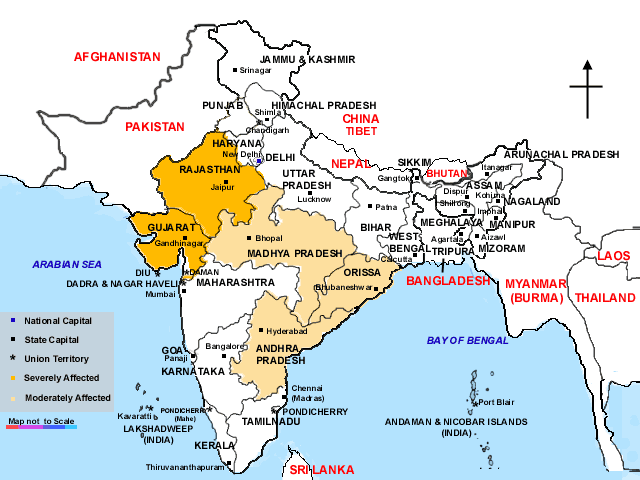
Drought Prone Area Programmee:-
The basic objective of the programme is to minimise the adverse effects of drought on production of crops and livestock and productivity of land, water and human resources ultimately leading to drought proofing of the affected areas. The programme also aims to promote overall economic development and improving the socio-economic conditions of the resource poor and disadvantaged sections inhabiting the programme areas.
How to Fight Drought :-
Drougth is a climatic phenomenon, hence it can only be fought as a long term strategy.
Short-term:- The short-term drought fighting mechanism is to reduce the socio-economic impact of drought. This is essentially bringing the vulnerable from out of imminent danger .
Long – Term:-The long term requires a integrated approach :-
- Integrated watershed development
- Ground water recharge programmes
- Afforestation to contain loss of moisture
- Desert development programmee- Fighting the aridity and restricting new regions getting decertified.
- River valley Projects
2)Launch of Technology Acquisition and Development Fund (TADF) under National Manufacturing Policy (NMP) :-
- Technology Acquisition and Development Fund (TADF) under National Manufacturing Policy being implemented by Department of Industrial Policy & Promotion(DIPP)
- TADF is a new scheme to facilitate acquisition of Clean, Green & Energy Efficient Technologies, in form of Technology / Customised Products / Specialised Services / Patents / Industrial Design available in the market available in India or globally, by Micro, Small & Medium Enterprises (MSMEs)
- The Scheme is conceptualised to catalyse the manufacturing growth in MSME sector to contribute to the national focus of “Make in India”. Under the Scheme which would be implemented through Global Innovation and Technology Alliance (GITA), a joint venture company, support to MSME units is envisaged by the following:
- Direct Support for Technology Acquisition- Proposals from Indian industry will be invited for reimbursement of 50% of technology transfer fee or Rs. 20 lakhs, whichever is lower
- In-direct Support for Technology Acquisition through Patent Pool- Financial support will be provided in acquiring of technology/Patent from across the Globe based on applications received from MSMEs. Technology/Patent will be licensed to selected companies, with a mutually agreed value and the selected companies will get a subsidy of 50% of the mutually agreed value or Rs. 20 lakhs
- Technology / Equipment Manufacturing Subsidies: The fund will support, via subsidies, manufacturing of equipment / machines / devices for controlling pollution, reducing energy consumption and water conservation. The manufacturing units will be provided with a subsidy of up to 10% of capital expenditure incurred on new plant & machinery subject to a maximum of Rs. 50 lakhs
- Green Manufacturing – Incentive Scheme: The scheme will facilitate resource conservation activities in industries located in NIMZ through the introduction of incentive/subsidy schemes for energy/ environmental/ water audits, construction of green buildings, implementation of waste treatment facilities and implementation of renewable energy projects through financial support under the TADF
*The amounts are not required to be remembered as such but the components are important.
3)Highlights of Recommendations of Seventh Central Pay Commission :-
Recommended Date of implementation: 01.01.2016
Minimum Pay: Based on the Aykroyd formula, the minimum pay in government is recommended to be set at ₹18,000 per month.
Maximum Pay: ₹2,25,000 per month for Apex Scale and ₹2,50,000 per month for Cabinet Secretary and others presently at the same pay level.
Financial Implications:
The total financial impact in the FY 2016-17 is likely to be ₹1,02,100 crore, over the expenditure as per the ‘Business As Usual’ scenario. Of this, the increase in pay would be ₹39,100 crore, increase in allowances would be ₹ 29,300 crore and increase in pension would be ₹33,700 crore
In percentage terms the overall increase in pay & allowances and pensions over the ‘Business As Usual’ scenario will be 23.55 percent. Within this, the increase in pay will be 16 percent, increase in allowances will be 63 percent, and increase in pension would be 24 percent.
Fitment: A fitment factor of 2.57 is being proposed to be applied uniformly for all employees.
Annual Increment: The rate of annual increment is being retained at 3 percent.
Modified Assured Career Progression (MACP):
Performance benchmarks for MACP have been made more stringent from “Good” to “Very Good”.
The Commission has also proposed that annual increments not be granted in the case of those employees who are not able to meet the benchmark either for MACP or for a regular promotion in the first 20 years of their service.
No other changes in MACP recommended.
Military Service Pay (MSP): The Military Service Pay, which is a compensation for the various aspects of military service, will be admissible to the Defence forces personnel only. As before, Military Service Pay will be payable to all ranks up to and inclusive of Brigadiers and their equivalents.
4)Inter-Linking of River :-
- Government has taken up Interlinking of River (ILR) programme under National Perspective Plan (NPP) on a high priority
- The Detailed Project Reports (DPR) of Ken – Betwa Link Project, Damanganga – Pinjal Link Project and Par-Tapi-Narmada link project have been completed.
- In addition to NPP links, National Water Development Agency (NWDA) has taken up the proposals of Intra-State links in a vigorous manner.Intra-State link projects namely (i) Burhi Gandak-Noon-Baya-Ganga and (ii) Kosi-Mechi have already been prepared and submitted to Government of Bihar.
- The Interlinking of Rivers Programme is critical for enhancing water and food security of the country especially in the water short, drought prone and rainfed farming areas
5)Special Mahila Police Volunteers :-
- The Minister of Women and Child Development, Smt. Maneka Sanjay Gandhi briefed the Committee members about scheme of Special Mahila Police Volunteers (MPVs), an initiative for facilitating Police force through community volunteerism and other initiatives taken by the Government for women’s welfare such as One Stop Centre for women affected by violence, Women Helpline across the country with the single number 181 to meet women’s emergency and non-emergency needs and Beti Bachao, Beti Padhao.
Receive Daily Updates
Recent Posts
Petrol in India is cheaper than in countries like Hong Kong, Germany and the UK but costlier than in China, Brazil, Japan, the US, Russia, Pakistan and Sri Lanka, a Bank of Baroda Economics Research report showed.
Rising fuel prices in India have led to considerable debate on which government, state or central, should be lowering their taxes to keep prices under control.
The rise in fuel prices is mainly due to the global price of crude oil (raw material for making petrol and diesel) going up. Further, a stronger dollar has added to the cost of crude oil.
Amongst comparable countries (per capita wise), prices in India are higher than those in Vietnam, Kenya, Ukraine, Bangladesh, Nepal, Pakistan, Sri Lanka, and Venezuela. Countries that are major oil producers have much lower prices.
In the report, the Philippines has a comparable petrol price but has a per capita income higher than India by over 50 per cent.
Countries which have a lower per capita income like Kenya, Bangladesh, Nepal, Pakistan, and Venezuela have much lower prices of petrol and hence are impacted less than India.
“Therefore there is still a strong case for the government to consider lowering the taxes on fuel to protect the interest of the people,” the report argued.
India is the world’s third-biggest oil consuming and importing nation. It imports 85 per cent of its oil needs and so prices retail fuel at import parity rates.
With the global surge in energy prices, the cost of producing petrol, diesel and other petroleum products also went up for oil companies in India.
They raised petrol and diesel prices by Rs 10 a litre in just over a fortnight beginning March 22 but hit a pause button soon after as the move faced criticism and the opposition parties asked the government to cut taxes instead.
India imports most of its oil from a group of countries called the ‘OPEC +’ (i.e, Iran, Iraq, Saudi Arabia, Venezuela, Kuwait, United Arab Emirates, Russia, etc), which produces 40% of the world’s crude oil.
As they have the power to dictate fuel supply and prices, their decision of limiting the global supply reduces supply in India, thus raising prices
The government charges about 167% tax (excise) on petrol and 129% on diesel as compared to US (20%), UK (62%), Italy and Germany (65%).
The abominable excise duty is 2/3rd of the cost, and the base price, dealer commission and freight form the rest.
Here is an approximate break-up (in Rs):
a)Base Price | 39 |
b)Freight | 0.34 |
c) Price Charged to Dealers = (a+b) | 39.34 |
d) Excise Duty | 40.17 |
e) Dealer Commission | 4.68 |
f) VAT | 25.35 |
g) Retail Selling Price | 109.54 |
Looked closely, much of the cost of petrol and diesel is due to higher tax rate by govt, specifically excise duty.
So the question is why government is not reducing the prices ?
India, being a developing country, it does require gigantic amount of funding for its infrastructure projects as well as welfare schemes.
However, we as a society is yet to be tax-compliant. Many people evade the direct tax and that’s the reason why govt’s hands are tied. Govt. needs the money to fund various programs and at the same time it is not generating enough revenue from direct taxes.
That’s the reason why, govt is bumping up its revenue through higher indirect taxes such as GST or excise duty as in the case of petrol and diesel.
Direct taxes are progressive as it taxes according to an individuals’ income however indirect tax such as excise duty or GST are regressive in the sense that the poorest of the poor and richest of the rich have to pay the same amount.
Does not matter, if you are an auto-driver or owner of a Mercedes, end of the day both pay the same price for petrol/diesel-that’s why it is regressive in nature.
But unlike direct tax where tax evasion is rampant, indirect tax can not be evaded due to their very nature and as long as huge no of Indians keep evading direct taxes, indirect tax such as excise duty will be difficult for the govt to reduce, because it may reduce the revenue and hamper may programs of the govt.