


Budget Simplified :-
1. Government spending simplified
The Indian government has proposed to spend Rs.19,78,060 crore in the fiscal year 2016-17, which is 10.8% higher than Rs. 17,65,436 crore, revised estimates for previous year. Here is how the allocation is proposed to be distributed across ministries:
(The size of circles is proportional to the proposed amount)

2. Which ministry gained the most?
Proposed allocation to Ministry of Women and Child Development has increased by 313 per cent, from Rs. 747 crores in 2015-16 to Rs. 3,094 crores in 2016-17.
Ministry of Land Resources has been allocated Rs. 230.51, a 437 per cent increase from Rs. 43.71 crore last year.
A 13 per cent increase in Higher Education allocation, from Rs. 25,344 crore to Rs.28,765 crore.
Ministry of Civil Aviation has been allocated Rs. 2,590.68 crore, a 38 per cent decrease from Rs. 4,198 crore.
(All comparisons are between revised estimates for 2015-16 to budget estimates for 2016-17)
3. Comparison of BRICS Nations
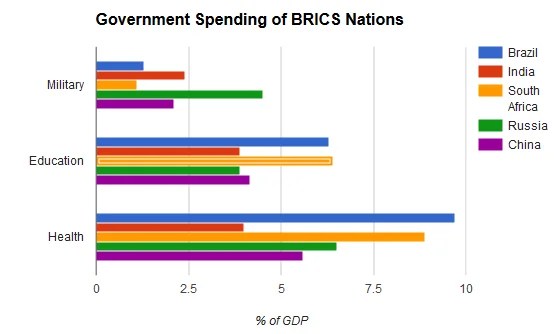
How does government spending vary across BRICS nations? BRICS is the acronym for the association of five major emerging economies – Brazil, Russia, India, China and South Africa. As the total government revenue varies widely among the BRICS nations, budgetary allocation to a sector as percentage of GDP is good indicator to compare government spending. Russia has the highest military allocation in percentage terms, followed by India and China. For education and health, India has the lowest allocation in percentage terms.
4. Subsidy subsides

Share of subsidies as proportion of total expenditure has decreased from 2012 onwards, when it reached a peak value of 18.23 per cent. In 2016-17, 12.66 per cent of spending — Rs. 2,50,432.93 crore — has been proposed for various subsidies.
5. Food eats up bulk of subsidy

A closer look at how subsidies are distributed across various sectors reveals that share of food subsidies has been the highest since 2013. Now, half of the total subsidy goes to food. Subsidy of petroleum has varied over time, perhaps due to fluctuating oil prices. Share of fertilisers in total subsidy has gone down from 43% in 2009 to 28% in 2016-17 budget estimates.
6. How does the government earn money?

Corporation tax and income tax together constitute one-third of the total government earnings.
7. How has the share of taxes changed?

Of the total tax — Rs. 16,30,887.81 crore — collected by the central government, corporation tax has the major share, though it has declined from 39 per cent in 2009-10 to estimated 30.2 per cent in 2016-17. On the other hand, the share of service tax has gradually increased, now contributing 14 per cent of total tax collected by the government.
8. More revenue forgone

From 2006-07, the government has released a statement of revenue that is forgone, which analyses the impact on government revenue due to the tax incentives available under the Central Tax system. For 2016-17, this amount is projected to be Rs. 6,11,128.31 crores — approximately a third of the total government revenue — higher than last year, when the impact on revenue was Rs. 5,54,349.04 crores.
In contrast, subsidies on various sectors amount to Rs. 2,50,432.93 crores in this year’s allocation.
Festival of Innovations:-
Background:-The three day Global Roundtable on Inclusive Innovation held as part of the ongoing ‘Festival of Innovations’ concluded at Rashtrapati Bhavan
The Gandhian Young Technological Innovation (GYTI) awards-2016 were conferred as part of the ‘Festival of Innovations’. The GYTI Awards is an initiative to foster youth driven innovations across India and were organised by the Society for Research and Initiatives for Sustainable Technologies and Institutions (SRISTI) with support from the Biotechnology Industry Research Assistance Council (BIRAC).
Scheme for new Entrepreneurs:-
a. Simplification and Handholding
· Simple Compliance Regime for startups based on Self-certification
· Launch of Mobile app and Portal for compliance and information exchange
· Startup India Hub to handhold startups during various phases of their development
· Legal support and fast-tracking patent examination at reduced costs
· Relaxed norms of public procurement for startups
· Faster exit for startups
b. Funding support and Incentives
· Providing funding support through a Fund of Funds with a corpus of Rupees 10,000 crore
· Credit guarantee fund for startups
· Tax exemption on capital gains invested in Fund of Funds
· Tax exemption to startups for 3 years
c. Industry-Academia Partnership and Incubation
· Organizing Startup Fests to showcase innovations and providing collaboration platforms
· Launch of Atal Innovation Mission (AIM) with Self –Employment and Talent Utilization (SETU) Program of NITI Aayog
· Harnessing private sector expertise for setting up incubators
· Setting up of 7 new research parks modeled on the Research Park at IIT Madras
· Launching of innovation focused programs for students.
· Annual Incubator Grand Challenge to promote good practices among incubators.
World Heritage Sites and Policy:-
Background :-
UNESCO, with the help of 21 member World Heritage Committee and advisory bodies such as International Council on Monuments and Sites (ICOMOS) and International Union for Conservation of Nature (IUCN), within the framework of its Operational Guidelines, decides about the cultural and natural sites to be included on the World Heritage list. Such cultural and natural sites must display the necessary Outstanding Universal Value (OUV), fulfill one or more out of 10 prescribed criteria (as given below), maintain the condition of authenticity and integrity and should be in a good state of conservation.
Criteria for the assessment of Outstanding Universal Value (OUV) as per UNESCO’s Operational Guidelines:-
- to represent a masterpiece of human creative genius;
- to exhibit an important interchange of human values, over a span of time or within a cultural area of the world, on developments in architecture or technology, monumental arts, town-planning or landscape design;
- to bear a unique or at least exceptional testimony to a cultural tradition or to a civilization which is living or which has disappeared;
- to be an outstanding example of a type of building, architectural or technological ensemble or landscape which illustrates (a) significant stage(s) in human history;
- to be an outstanding example of a traditional human settlement, land-use, or sea-use which is representative of a culture (or cultures), or human interaction with the environment especially when it has become vulnerable under the impact of irreversible change;
- to be directly or tangibly associated with events or living traditions, with ideas, or with beliefs, with artistic and literary works of outstanding universal significance. (The Committee considers that this criterion should preferably be used in conjunction with other criteria.
- to contain superlative natural phenomena or areas of exceptional natural beauty and aesthetic importance;
- to be outstanding examples representing major stages of earth’s history, including the record of life, significant ongoing geological processes in the development of landforms, or significant geomorphic or physiographic features;
- to be outstanding examples representing significant ongoing ecological and biological processes in the evolution and development of terrestrial, fresh water, coastal and marine ecosystems and communities of plants and animals;
- to contain the most important and significant natural habitats for in-situ conservation of biological diversity, including those containing threatened species of outstanding universal value from the point of view of science or conservation.
There are 32 sites from India declared as World Heritage properties as follows:-
CULTURAL SITES
(Under Protection of Archaeological Survey of India)
| S.No | Name of Site | State |
| 1. | Ajanta Caves (1983) | Maharashtra |
| 2. | Ellora Caves (1983) | Maharashtra |
| 3. | Agra Fort (1983) | Uttar Pradesh |
| 4. | Taj Mahal (1983) | Uttar Pradesh |
| 5. | Sun Temple, Konarak (1984) | Odisha |
| 6. | Group of Monuments at Mahabalipuram (1984) | Tamil Nadu |
| 7. | Churches and Convents of Goa (1986) | Goa |
| 8. | Group of Temples, Khajuraho (1986) | Madhya Pradesh |
| 9. | Group of Monuments at Hampi (1986) | Karnataka |
| 10. | Group of Monuments, FatehpurSikri (1986) | Uttar Pradesh |
| 11. | Group of Temples, Pattadakal (1987) | Karnataka |
| 12. | Elephanta Caves ( 1987) | Maharashtra |
| 13. | Great Living Chola temples at Thanjavur, Gangaikondacholapuram and Darasuram (1987 & 2004) | Tamil Nadu |
| 14. | Buddhist Monuments at Sanchi (1989) | Madhya Pradesh |
| 15. | Humayun’s Tomb, Delhi (1993) | Delhi |
| 16. | Qutb Minar Complex, Delhi (1993) | Delhi |
| 17. | Prehistoric Rock Shelters of Bhimbetka (2003) | Madhya Pradesh |
| 18. | Champaner-Pavagarh Archaeological Park (2004) | Gujarat |
| 19. | Red Fort Complex, Delhi (2007) | Delhi |
| 20. | Hill Forts of Rajasthan
(Chittaurgarh, Kumbhalgarh, Jaisalmer and Ranthambhore, Amber and Gagron Forts) (2013) (Amber and Gagron Forts are under protection of Rajasthan State Archaeology and Museums) |
Rajasthan |
| 21. | Rani ki Vav (2014) | Gujarat |
Under Protection of Ministry of Railways
| 22. | Mountain Railway of India ( Darjeeling,1999), Nilgiri (2005), Kalka-Shimla(2008) | West Bengal, Tamil Nadu, Himachal Pradesh |
| 23. | Chhatrapati Shivaji Terminus (formerly Victoria Terminus) (2004) | Maharashtra |
Under Protection of Bodhgaya Temple Management Committee
| 24. | Mahabodhi Temple, Bodhgaya (2002) | Bihar |
Under Protection of Rajasthan State Archaeology and Museums Department
| 25. | Jantar Mantar, Jaipur (2010) | Rajasthan |
NATURAL SITES
Under Protection of Ministry of Environment & Forest
| 26. | Kaziranga National Park (1985) | Assam |
| 27. | Manas Wild Life Sanctuary (1985) | Assam |
| 28. | Keoladeo National Park (1985) | Rajasthan |
| 29. | Sunderban National Park (1987) | West Bengal |
| 30. | Nanda Devi and Valley of Flowers National Parks (1988, 2005) | Uttarakhand |
| 31. | Western Ghats (2012) | Karnataka, Kerala, Maharashtra,Tamil Nadu |
| 32. | Great Himalayan National Park (2014) | Himachal Pradesh |
Garuda Shakti IV:-
Its a INDO- Indonesia Joint Training Exercise of Army.
Snapshot of Schemes related to Higher Education:-
1)National Institutional Ranking Framework (NIRF) :-
Under the NIRF, Educational Institutions will be ranked by an independent ranking Agency for which objective criteria has been developed. They shall be ranked separately in fields such as Engineering, Management, Pharma, Architecture etc
2)Impacting Research, Innovation & Technology (IMPRINT):-
Under the IMPRINT initiative, the Government has taken the initiative to address major engineering challenges through the collaborative efforts of the Indian Institutes of Technology (IITs) and Indian Institute of Science (IISc). Under this, a roadmap is finalised to pursue engineering challenges in ten technology domains that have large social impact.
3)Uchchtar Avishkar Yojna (UAY):-
The objectives of UAY scheme are to promote innovation in IITs addressing issues of manufacturing industries; to spur innovative mindset; to co-ordinate action between academia & industry and to strengthen labs & research facilities
4)Global Initiative of Academic Networks (GIAN):-
GIAN scheme is for facilitating partnership between Higher Educational Institutions of the country and other countries. The scheme is aimed at tapping international talent pool of scientists and entrepreneurs.
5)Rashtriya Uchchatar Shiksha Abhiyan (RUSA):-
For strategic funding and reforms in the State Higher Education sector.
Note :- Few News of importance are not yet published and will be published in the upcoming posts. The intention was not to make the post bulky or cumbersome, hence judicious distribution of News over the month/week is important.This has been considered after giving heed to the feedbacks from many of you.Thank you.