


Most aspirants who fail the Mains exam know the content. They’ve read the books. They’ve followed the newspaper. They can recite facts. And yet, their marks don’t reflect their knowledge.
The problem, almost always, is in how they write — not what they know.
After years of coaching feedback, topper interviews, and examiner insights, a clear pattern of recurring mistakes emerges. This article breaks them all down — so you don’t repeat them.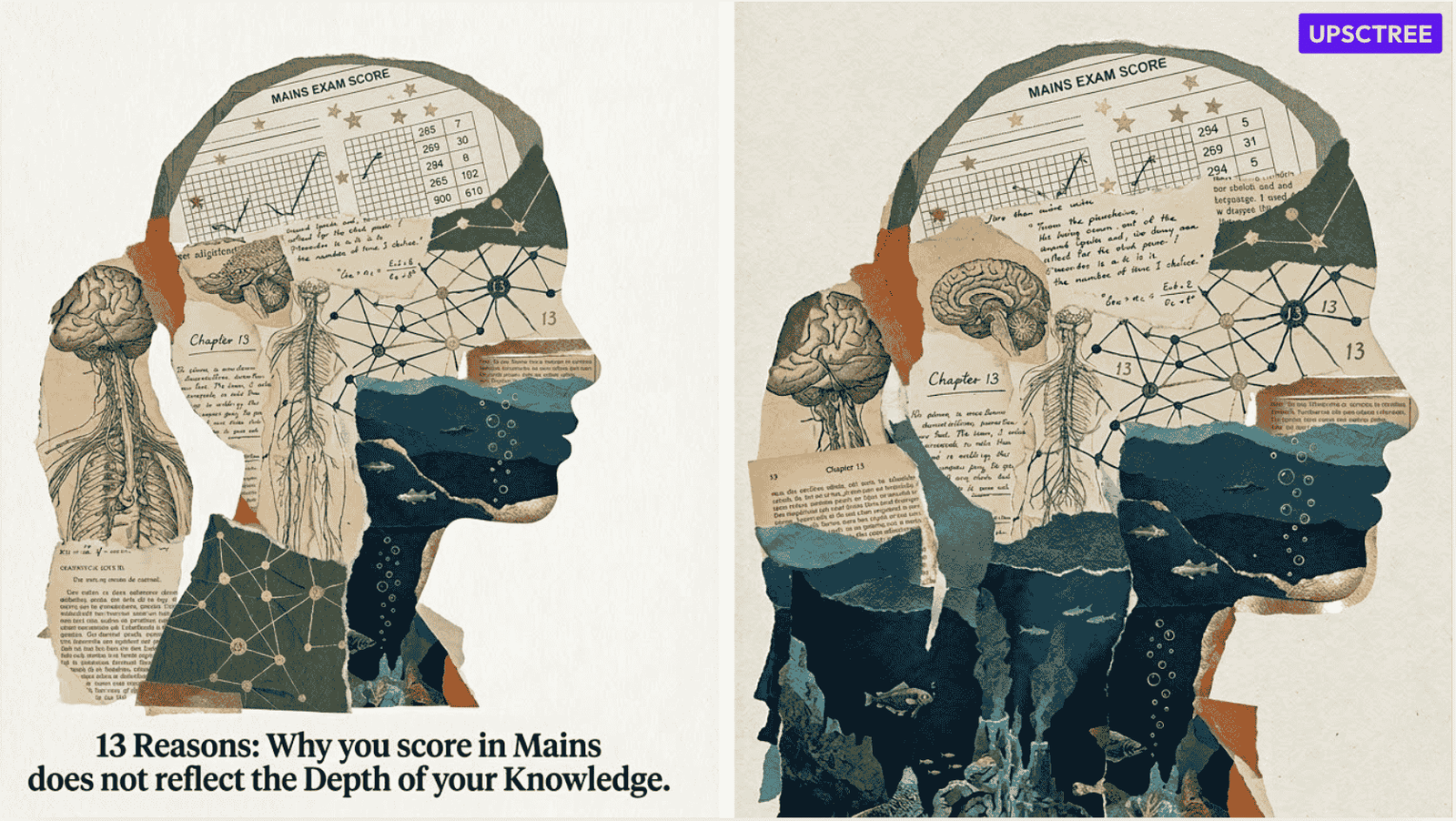
1. Not Reading the Question Carefully
This is the single most common — and most costly — mistake. Students begin writing within seconds of reading the question, missing the precise demand the examiner has placed in the question.
Mains questions contain directive words that tell you exactly what to do:
- Discuss — Examine from multiple angles, weigh pros and cons
- Critically examine / Critically analyse — Present both sides, then give a balanced judgement
- Examine — Investigate and evaluate the claim
- Comment — Give a brief, reasoned opinion
- Analyse — Break down the issue into its components
- Elucidate — Explain clearly with examples
Writing a one-sided “discuss” answer or giving a general essay when “critically analyse” is asked, loses marks regardless of how good your content is.
Solution: Underline the directive word. Underline the key theme. Then write.
2. No Introduction — Or a Weak One
Many students dive straight into points without an introduction, or begin with a definition lifted mechanically from a textbook. Both approaches miss an opportunity.
A strong introduction does three things in 2–3 lines: it establishes context, signals that you understand what the question is really asking, and sets the tone of a well-structured answer. Examiners read hundreds of copies — a sharp opening makes yours stand out immediately.
Solution: Open with a quote, a recent news hook, a surprising fact, or a crisp contextual statement. Avoid starting with “Since time immemorial…” or the likes.
3. Writing in Paragraphs When Points Are More Effective (and Vice Versa)
A common misunderstanding is that bullet points always look better in Mains answers. They don’t — it depends on the question.
For analytical or opinion-based questions (e.g., GS Paper 4 ethics cases, or “Critically examine…” questions), flowing paragraphs demonstrate reasoning ability and are preferred. For factual or multi-part questions (e.g., “List the features of…”, “What are the challenges of…”), well-organised bullet points are faster to read and easier to evaluate.
Solution: Match the format to the nature of the question. Use a mix — a short para for context, bullets for causes/effects/suggestions, a para for conclusion.
4. Missing the Multi-Dimensional Approach
Mains rewards 360-degree thinking. A question on a government policy is not just about the policy — it touches on economics, governance, social equity, constitutional provisions, international comparisons, and ground-level implementation challenges.
Students who cover only one or two dimensions score average marks even with correct content. Those who weave in multiple dimensions — political, economic, social, environmental, ethical, institutional — score in the top tier.
Solution: Before writing, spend few seconds mapping out dimensions. Ask yourself: what are the economic implications? Constitutional angle? Historical context? Gender dimension? Data points?
5. No Structure: Missing Introduction, Body, and Conclusion
Every answer, regardless of word limit, must have a beginning, middle, and end. Many students write pages of content with no conclusion, leaving the examiner with an unfinished thought. Others have a good intro and conclusion but no logical flow in the body.
A well-structured answer signals to the examiner that the candidate thinks clearly — a quality essential for a future administrator.
Solution: Even for a 150-word answer, reserve 2 lines for conclusion. For 250-word answers, aim for: Introduction (3–4 lines) → Body (organised by sub-heads or grouped bullets) → Conclusion (2–3 lines with a forward-looking statement).
6. Conclusions That Don’t Conclude
The most wasted part of an answer is the conclusion. Most students either skip it or write vague lines like “Thus, the government should take necessary steps” or “Hence, it can be concluded that this is an important issue.”
A strong conclusion adds value. It can:
- Cite a relevant committee recommendation or policy (e.g., “As recommended by the ARC…”)
- Quote a constitutional provision, a Supreme Court judgment, or a national/international target
- Offer a forward-looking, solution-oriented statement
- Summarise the crux of your argument in one powerful line
Solution: Never repeat what you’ve already said. Add something — a quote, a recommendation, a vision statement.
7. Content Dumping Without Relevance Filtering
In the anxiety of the exam, many candidates write everything they know about a topic — even if half of it is not relevant to the specific question asked. This is called content dumping, and it actively hurts your score.
Examiners mark based on relevance and precision. Irrelevant content signals that the candidate couldn’t distinguish what the question was actually asking. It also wastes precious time.
Solution: Ask yourself after every paragraph: “Does this directly answer what the question is asking?” If not, cut it.
8. Ignoring Examples, Case Studies, and Data
Abstract answers without any grounding in real-world examples feel hollow. Examiners look for candidates who can connect theoretical knowledge to real situations — because that is what administrators must do.
Solution: Maintain a running list of examples, data points, and case studies across all GS topics. Even one concrete example per answer dramatically improves quality.
9. Poor Time Management Across the Paper
Attempting only 15 out of 20 questions because you wrote 350 words on a 250-word question is one of the most preventable ways to lose marks. In Mains, an unattempted question scores zero — meaning spreading attempts across all questions is almost always better than perfecting a few.
Solution: Strictly follow the word limit. A 150-word answer should not exceed 2 pages. A 250-word answer should not exceed 3 pages. Practice timed writing at home until this becomes muscle memory.
10. Illegible or Untidy Handwriting
This is not about having beautiful handwriting. It is about legibility. Examiners evaluate hundreds of copies under time pressure. If your answer is hard to read, it creates friction — and that friction reflects in the marks.
Common handwriting-related issues: writing too small in margins, cramming content to fit the word limit, crossing out large sections untidily, and inconsistent letter sizing.
Solution: Write slightly larger than your natural size. Leave margins. Use underlining sparingly but effectively for key terms. If you cross something out, do it with a single clean line.
11. Not Using Diagrams, Flowcharts, or Tables Where Appropriate
A well-placed diagram or flowchart in a GS Paper 1 (Geography) or GS Paper 3 (Economy/Science) answer can communicate in seconds what would take a paragraph to explain — and it makes the answer visually distinctive in a stack of identical copies.
Tables work particularly well for comparison questions: “Distinguish between X and Y”, “Compare the approaches of A and B.”
Solution: Practice drawing simple labelled diagrams for key Geography topics. Create comparison tables for commonly contrasted concepts across all GS papers.
12. Over-Reliance on Memorised Templates
Answer writing practice is essential — but it can produce a different problem: memorised, rigid templates that get applied regardless of the question. Examiners can immediately identify templated answers, and they score them poorly.
A template is a scaffold — it should guide your structure, not replace your thinking.
Solution: Understand why a structure works, not just what the structure is. Adapt to each question rather than pasting in a pre-written framework.
13. Weak Ethics and Essay Paper Answers
GS Paper 4 (Ethics) and the Essay paper are where the gap between toppers and average scorers is widest — and most avoidable. Common mistakes here include:
- Listing ethical theories without applying them to the case
- Being preachy or moralistic instead of analytical in case studies
- Writing the Essay as a GS answer (all facts, no reflection or voice)
- Not taking a clear position in the Essay
Solution: In Ethics case studies, always identify stakeholders, competing values, and the institutional vs. personal dilemma. In the Essay, develop a clear thesis and return to it throughout.
A Final Word
The Mains exam does not reward the candidate who knows the most. It rewards the candidate who communicates clearly, thinks in multiple dimensions, manages time ruthlessly, and writes with the examiner in mind. Every mistake on this list is fixable — but only through deliberate, reviewed practice.
Write an answer. Get it evaluated. Fix one mistake at a time. Repeat.
That is the only strategy that works.
Receive Daily Updates
Recent Posts
- Anonymity: Darknet allows users to communicate and transact with each other anonymously. Users can maintain their privacy and avoid being tracked by law enforcement agencies or other entities.
- Access to Information: The darknet provides access to information and resources that may be otherwise unavailable or censored on the regular internet. This can include political or sensitive information that is not allowed to be disseminated through other channels.
- Freedom of Speech: The darknet can be a platform for free speech, as users are able to express their opinions and ideas without fear of censorship or retribution.
- Secure Communication: Darknet sites are encrypted, which means that communication between users is secure and cannot be intercepted by third parties.
- Illegal Activities: Many darknet sites are associated with illegal activities, such as drug trafficking, weapon sales, and hacking services. Such activities can attract criminals and expose users to serious legal risks.
- Scams: The darknet is a hotbed for scams, with many fake vendors and websites that aim to steal users’ personal information and cryptocurrency. The lack of regulation and oversight on the darknet means that users must be cautious when conducting transactions.
- Security Risks: The use of the darknet can expose users to malware and other security risks, as many sites are not properly secured or monitored. Users may also be vulnerable to hacking or phishing attacks.
- Stigma: The association of the darknet with illegal activities has created a stigma that may deter some users from using it for legitimate purposes.
- Virtual assistants: Siri, Alexa, and Google Assistant are examples of virtual assistants that use natural language processing to understand and respond to users’ queries.
- Recommendation systems: Companies like Netflix and Amazon use AI to recommend movies and products to their users based on their browsing and purchase history.
- Efficiency: AI systems can work continuously without getting tired or making errors, which can save time and resources.
- Personalization: AI can help provide personalized recommendations and experiences for users.
- Automation: AI can automate repetitive and tedious tasks, freeing up time for humans to focus on more complex tasks.
- Job loss: AI has the potential to automate jobs previously performed by humans, leading to job loss and economic disruption.
- Bias: AI systems can be biased due to the data they are trained on, leading to unfair or discriminatory outcomes.
- Safety and privacy concerns: AI systems can pose safety risks if they malfunction or are used maliciously, and can also raise privacy concerns if they collect and use personal data without consent.
Darknet
Definition:
Darknet, also known as dark web or darknet market, refers to the part of the internet that is not indexed or accessible through traditional search engines. It is a network of private and encrypted websites that cannot be accessed through regular web browsers and requires special software and configuration to access.
The darknet is often associated with illegal activities such as drug trafficking, weapon sales, and hacking services, although not all sites on the darknet are illegal.
Examples:
Examples of darknet markets include Silk Road, AlphaBay, and Dream Market, which were all shut down by law enforcement agencies in recent years.
These marketplaces operate similarly to e-commerce websites, with vendors selling various illegal goods and services, such as drugs, counterfeit documents, and hacking tools, and buyers paying with cryptocurrency for their purchases.
Pros :
Cons:
Artificial Intelligence
Definition:
AI, or artificial intelligence, refers to the development of computer systems that can perform tasks that would normally require human intelligence, such as recognizing speech, making decisions, and understanding natural language.
Examples:
Pros :
Cons: