


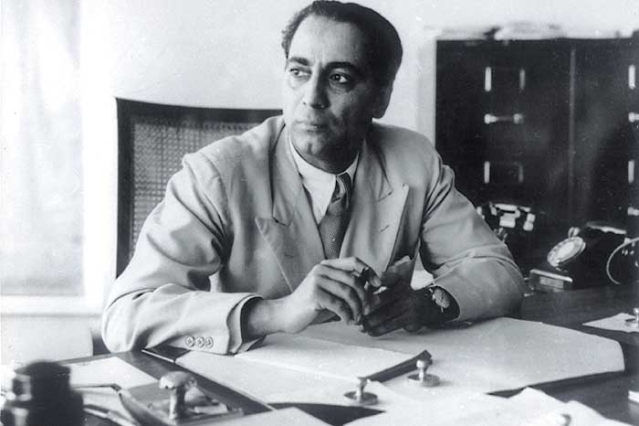
 What Benjamin Franklin said long ago “If you would be famous after you are dead either write things worth reading or do things worth writing about” – is true both ways of one of India’s renowned scientists who happened to be a passenger on the ill-fated Air India plane which crashed on the icy Alps on January 24, 1966 – Dr. Homi Jehangir Bhabha. The simplest and perhaps the most appropriate homage that can be paid to him is to recollect his ideals and philosophy for the promotion of science and technology for the good of the common man.
Honours Galore
After early education in India, Bhabha worked at Cambridge for some years. His original contribution on cosmic rays and related fundamental studies in physics won him wide recognition. He was made a Fellow of the Royal Society and doctoral degrees (honoris causa) were conferred on him by several universities of the West. By returning to his homeland he sacrificed a scientific career at Cambridge; as a true patriot, he worked with phenomenal patience and zeal under not too comfortable an environment but with a strong belief expressed in his own words: “that if proper appreciation and financial support are forthcoming it is the duty of people like us to study in our country and build on it outstanding schools of research such as some other countries are fortunate to possess.” To many of the younger generation, who are prone to criticise the Indian scene, his answer was: “For thousands of scientists who can do good work in a good environment there is perhaps only one who like Rutherford can create his own environment wherever he may be.”
A Queer Blend of Many virtues
Bhabha was a queer blend of many virtues difficult to enumerate. His love of Nature and his exquisite artistic tastes were imprinted on everyone of the institutions he founded. His character baffles analysis. Perhaps where analysis fails there genius begins, as Dr. John Holland Rose of Cambridge said of Napoleon.
The development of the atomic energy programme in India has all along been the exploitation of the atom for peaceful purposes only and in this he endeavoured with a strong faith that the essential difference between developed and underdeveloped countries is the lack of modern science and an economy based on modern technology without establishing science as a live force. A true symbol of this faith is the Tarapur nuclear energy station generating cheap electric power. Similar ones at Kalpakkam (Tamil Nadu) and Rana Pratapsagar (Raiasthan) will considerably add to our power resources.
Building from within
Bhabha struck a new path in bringing up new institutions, though at the outset, it appeared unconventional and even hazardous. First, research scientists were found and the subjects were allowed to grow consistent with the expansion of the scientific base. He had always advocated and followed the policy of “building from within” and the emphasis had been on developing knowhow indigenously.
In a brilliant talk, hardly a few days before his death on “Science and Problems of Development” at the International Council of Scientific Unions attended by scientists from 35 countries, Bhabha said: “There are many factors which hamper progress in science but in general, the absence of the proper administrative set-up for science is greater than the paucity of scientists and technologists. A majority of scientists are made less effective through lack of the right type of administrative support.”
The administration of scientific research and development is an even more subtle matter than the administration of industrial enterprises and Bhabha was convinced that it could not be done on the basis of borrowed knowledge. It must necessarily be done as in the technologically advanced countries by scientists and technologists themselves.
Atom for Peace
Indeed, no one was more aware of the limitation of our fuel resources, fossil as well as nuclear, than Bhabha. As he said in his Presidential address to the Geneva Conference on “The Peaceful Uses of Atomic Energy” in 1965: “For the full industrialisation of the underdeveloped areas, for the continuation of civilisation and its further development, atomic energy is not merely an aid; it is an absolute necessity.”
His philosophy of life expressed in his words should be an example to all scientists of the day: “The scientist must be free to think and put forward whatever ideas he considers right. Ideas are some of the most important things in life and men are prepared to suffer and die for them. Good ideas cannot be suppressed even by violence. Nothing is irreversible except death,”
The formula for the success of a scientist is PAML (Patience, ability, money and luck) and Bhabha had all of them one by one in the course of his career, but alas, when he had all in plenty and interacting favourably the country was unlucky to lose him in tragic circumstances.
Recent Posts
Petrol in India is cheaper than in countries like Hong Kong, Germany and the UK but costlier than in China, Brazil, Japan, the US, Russia, Pakistan and Sri Lanka, a Bank of Baroda Economics Research report showed.
Rising fuel prices in India have led to considerable debate on which government, state or central, should be lowering their taxes to keep prices under control.
The rise in fuel prices is mainly due to the global price of crude oil (raw material for making petrol and diesel) going up. Further, a stronger dollar has added to the cost of crude oil.
Amongst comparable countries (per capita wise), prices in India are higher than those in Vietnam, Kenya, Ukraine, Bangladesh, Nepal, Pakistan, Sri Lanka, and Venezuela. Countries that are major oil producers have much lower prices.
In the report, the Philippines has a comparable petrol price but has a per capita income higher than India by over 50 per cent.
Countries which have a lower per capita income like Kenya, Bangladesh, Nepal, Pakistan, and Venezuela have much lower prices of petrol and hence are impacted less than India.
“Therefore there is still a strong case for the government to consider lowering the taxes on fuel to protect the interest of the people,” the report argued.
India is the world’s third-biggest oil consuming and importing nation. It imports 85 per cent of its oil needs and so prices retail fuel at import parity rates.
With the global surge in energy prices, the cost of producing petrol, diesel and other petroleum products also went up for oil companies in India.
They raised petrol and diesel prices by Rs 10 a litre in just over a fortnight beginning March 22 but hit a pause button soon after as the move faced criticism and the opposition parties asked the government to cut taxes instead.
India imports most of its oil from a group of countries called the ‘OPEC +’ (i.e, Iran, Iraq, Saudi Arabia, Venezuela, Kuwait, United Arab Emirates, Russia, etc), which produces 40% of the world’s crude oil.
As they have the power to dictate fuel supply and prices, their decision of limiting the global supply reduces supply in India, thus raising prices
The government charges about 167% tax (excise) on petrol and 129% on diesel as compared to US (20%), UK (62%), Italy and Germany (65%).
The abominable excise duty is 2/3rd of the cost, and the base price, dealer commission and freight form the rest.
Here is an approximate break-up (in Rs):
a)Base Price | 39 |
b)Freight | 0.34 |
c) Price Charged to Dealers = (a+b) | 39.34 |
d) Excise Duty | 40.17 |
e) Dealer Commission | 4.68 |
f) VAT | 25.35 |
g) Retail Selling Price | 109.54 |
Looked closely, much of the cost of petrol and diesel is due to higher tax rate by govt, specifically excise duty.
So the question is why government is not reducing the prices ?
India, being a developing country, it does require gigantic amount of funding for its infrastructure projects as well as welfare schemes.
However, we as a society is yet to be tax-compliant. Many people evade the direct tax and that’s the reason why govt’s hands are tied. Govt. needs the money to fund various programs and at the same time it is not generating enough revenue from direct taxes.
That’s the reason why, govt is bumping up its revenue through higher indirect taxes such as GST or excise duty as in the case of petrol and diesel.
Direct taxes are progressive as it taxes according to an individuals’ income however indirect tax such as excise duty or GST are regressive in the sense that the poorest of the poor and richest of the rich have to pay the same amount.
Does not matter, if you are an auto-driver or owner of a Mercedes, end of the day both pay the same price for petrol/diesel-that’s why it is regressive in nature.
But unlike direct tax where tax evasion is rampant, indirect tax can not be evaded due to their very nature and as long as huge no of Indians keep evading direct taxes, indirect tax such as excise duty will be difficult for the govt to reduce, because it may reduce the revenue and hamper may programs of the govt.
Globally, around 80% of wastewater flows back into the ecosystem without being treated or reused, according to the United Nations.
This can pose a significant environmental and health threat.
In the absence of cost-effective, sustainable, disruptive water management solutions, about 70% of sewage is discharged untreated into India’s water bodies.
A staggering 21% of diseases are caused by contaminated water in India, according to the World Bank, and one in five children die before their fifth birthday because of poor sanitation and hygiene conditions, according to Startup India.
As we confront these public health challenges emerging out of environmental concerns, expanding the scope of public health/environmental engineering science becomes pivotal.
For India to achieve its sustainable development goals of clean water and sanitation and to address the growing demands for water consumption and preservation of both surface water bodies and groundwater resources, it is essential to find and implement innovative ways of treating wastewater.
It is in this context why the specialised cadre of public health engineers, also known as sanitation engineers or environmental engineers, is best suited to provide the growing urban and rural water supply and to manage solid waste and wastewater.
Traditionally, engineering and public health have been understood as different fields.
Currently in India, civil engineering incorporates a course or two on environmental engineering for students to learn about wastewater management as a part of their pre-service and in-service training.
Most often, civil engineers do not have adequate skills to address public health problems. And public health professionals do not have adequate engineering skills.
India aims to supply 55 litres of water per person per day by 2024 under its Jal Jeevan Mission to install functional household tap connections.
The goal of reaching every rural household with functional tap water can be achieved in a sustainable and resilient manner only if the cadre of public health engineers is expanded and strengthened.
In India, public health engineering is executed by the Public Works Department or by health officials.
This differs from international trends. To manage a wastewater treatment plant in Europe, for example, a candidate must specialise in wastewater engineering.
Furthermore, public health engineering should be developed as an interdisciplinary field. Engineers can significantly contribute to public health in defining what is possible, identifying limitations, and shaping workable solutions with a problem-solving approach.
Similarly, public health professionals can contribute to engineering through well-researched understanding of health issues, measured risks and how course correction can be initiated.
Once both meet, a public health engineer can identify a health risk, work on developing concrete solutions such as new health and safety practices or specialised equipment, in order to correct the safety concern..
There is no doubt that the majority of diseases are water-related, transmitted through consumption of contaminated water, vectors breeding in stagnated water, or lack of adequate quantity of good quality water for proper personal hygiene.
Diseases cannot be contained unless we provide good quality and adequate quantity of water. Most of the world’s diseases can be prevented by considering this.
Training our young minds towards creating sustainable water management systems would be the first step.
Currently, institutions like the Indian Institute of Technology, Madras (IIT-M) are considering initiating public health engineering as a separate discipline.
To leverage this opportunity even further, India needs to scale up in the same direction.