


Come to think of it,
There is a huge degree of similarities between training an AI model and preparing for civil service, at least at the fundamental level. Let’s see how?
An AI model does not begin by “thinking.” It begins by consuming data—huge volumes of it. The quality of this data determines the quality of the output. If it fed with biased, noisy, or irrelevant information, and the model fails spectacularly.
Civil services preparation works the same way. Aspirants start with sources—NCERTs, standard textbooks, current affairs, previous year questions. Too many sources create a lot of confusion; poor sources create distortion. The early months of preparation are not about speed or brilliance, but about choosing the right inputs. This is where many journeys derail silently.
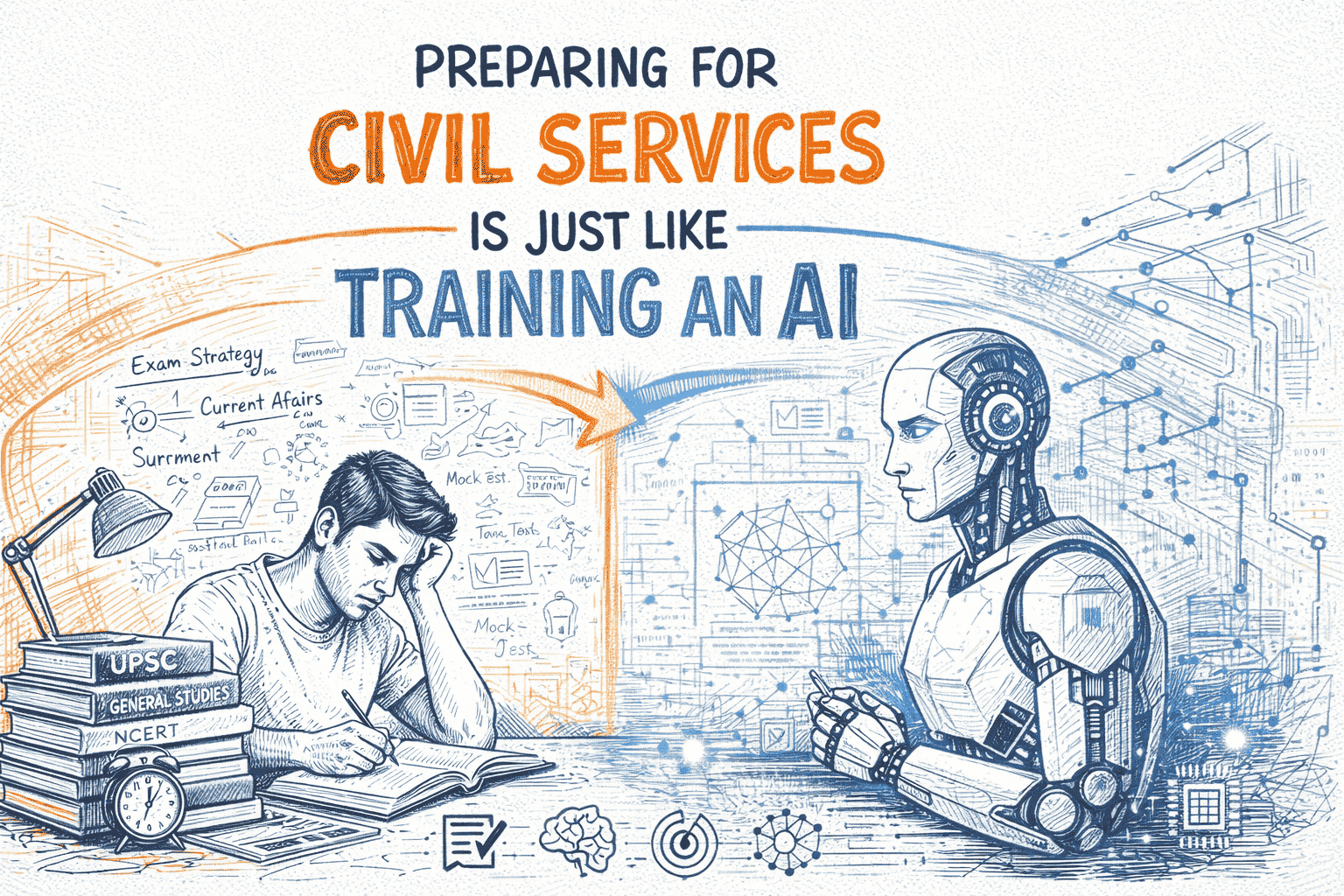 There is a popular myth that learning is sudden—that one-day clarity strikes. AI training exposes this myth. AI Models learn through repeated exposure, running over the same data again and again, adjusting minutely each time. Progress is invisible, incremental, and often boring.
So is serious civil service preparation. One reading rarely teaches anything. It is the second, third, and fourth revisions that build understanding. Confidence does not come from brilliance; it comes from familiarity. Like an AI model, an aspirant does not “get smarter” overnight—they get less wrong every day.
In AI training, errors are not embarrassing; they are essential. The system calculates how wrong it was and adjusts itself accordingly. This process—learning through error—is the very engine of improvement.
Aspirants, however, often fear mistakes. A bad score in mock feels personal. A poor answer feels like a verdict. But preparation does not punish mistakes; it rewards those who study them. Every wrong answer is data. Every weak topic is a signal. Those who treat failure as feedback eventually outperform those who chase perfection.
AI models can memorize training data so well that they fail when faced with new situations. They look intelligent but collapse in the real world.
This is a learning for aspirants as well. Rote learning, model answers, and recycled phrases may work in practice, but the exam demands application, synthesis, and judgment. The exam does not test memory; it tests adaptability. Like a well-trained model, a successful candidate understands patterns, not just facts.
No matter how well an AI is trained, its true worth is revealed only when it encounters new data. Similarly, no matter how many tests an aspirant takes, the real exam day is unfamiliar, unpredictable, and unforgiving.
There are no notes in the exam hall. No shortcuts. No retries. What remains is what has been internalized.
Even after deployment, AI systems continue to learn and adapt. Likewise, the civil services are not a destination but a beginning. Governance demands continuous learning and adaptation. So, the training never ends.
Intelligence—natural or artificial—is not magic. It is patience, feedback, discipline, and humility, applied consistently over time.
In the end, the civil services exam, like AI model training, rewards:
- Not those who rush, but those who refine.
- Not those who avoid mistakes, but those who learn from them and
- Not those who appear intelligent, but those who are quietly, steadily becoming so.