


Come to think of it,
There is a huge degree of similarities between training an AI model and preparing for civil service, at least at the fundamental level. Let’s see how?
An AI model does not begin by “thinking.” It begins by consuming data—huge volumes of it. The quality of this data determines the quality of the output. If it fed with biased, noisy, or irrelevant information, and the model fails spectacularly.
Civil services preparation works the same way. Aspirants start with sources—NCERTs, standard textbooks, current affairs, previous year questions. Too many sources create a lot of confusion; poor sources create distortion. The early months of preparation are not about speed or brilliance, but about choosing the right inputs. This is where many journeys derail silently.
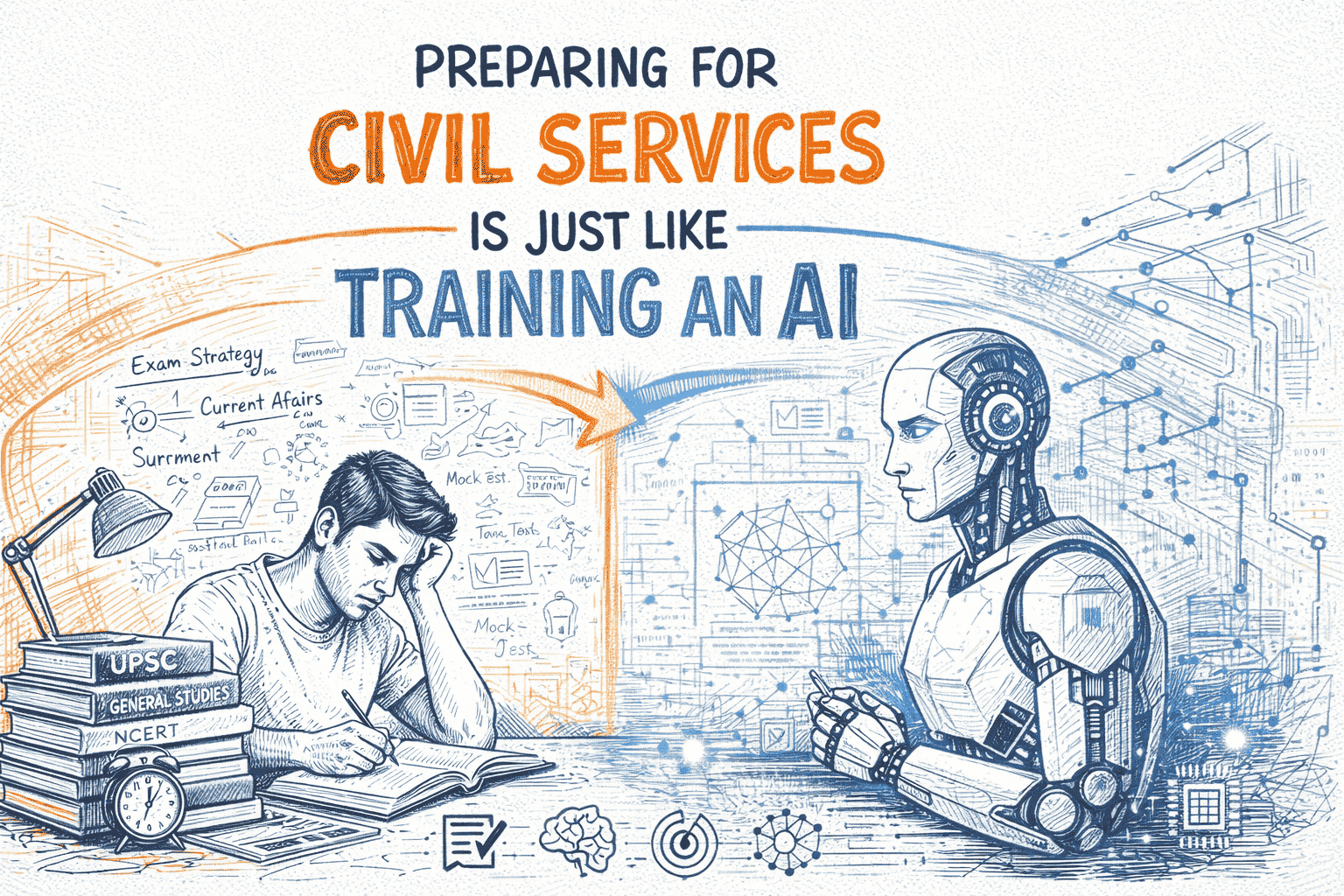 There is a popular myth that learning is sudden—that one-day clarity strikes. AI training exposes this myth. AI Models learn through repeated exposure, running over the same data again and again, adjusting minutely each time. Progress is invisible, incremental, and often boring.
So is serious civil service preparation. One reading rarely teaches anything. It is the second, third, and fourth revisions that build understanding. Confidence does not come from brilliance; it comes from familiarity. Like an AI model, an aspirant does not “get smarter” overnight—they get less wrong every day.
In AI training, errors are not embarrassing; they are essential. The system calculates how wrong it was and adjusts itself accordingly. This process—learning through error—is the very engine of improvement.
Aspirants, however, often fear mistakes. A bad score in mock feels personal. A poor answer feels like a verdict. But preparation does not punish mistakes; it rewards those who study them. Every wrong answer is data. Every weak topic is a signal. Those who treat failure as feedback eventually outperform those who chase perfection.
AI models can memorize training data so well that they fail when faced with new situations. They look intelligent but collapse in the real world.
This is a learning for aspirants as well. Rote learning, model answers, and recycled phrases may work in practice, but the exam demands application, synthesis, and judgment. The exam does not test memory; it tests adaptability. Like a well-trained model, a successful candidate understands patterns, not just facts.
No matter how well an AI is trained, its true worth is revealed only when it encounters new data. Similarly, no matter how many tests an aspirant takes, the real exam day is unfamiliar, unpredictable, and unforgiving.
There are no notes in the exam hall. No shortcuts. No retries. What remains is what has been internalized.
Even after deployment, AI systems continue to learn and adapt. Likewise, the civil services are not a destination but a beginning. Governance demands continuous learning and adaptation. So, the training never ends.
Intelligence—natural or artificial—is not magic. It is patience, feedback, discipline, and humility, applied consistently over time.
In the end, the civil services exam, like AI model training, rewards:
- Not those who rush, but those who refine.
- Not those who avoid mistakes, but those who learn from them and
- Not those who appear intelligent, but those who are quietly, steadily becoming so.
Receive Daily Updates
Recent Posts
Petrol in India is cheaper than in countries like Hong Kong, Germany and the UK but costlier than in China, Brazil, Japan, the US, Russia, Pakistan and Sri Lanka, a Bank of Baroda Economics Research report showed.
Rising fuel prices in India have led to considerable debate on which government, state or central, should be lowering their taxes to keep prices under control.
The rise in fuel prices is mainly due to the global price of crude oil (raw material for making petrol and diesel) going up. Further, a stronger dollar has added to the cost of crude oil.
Amongst comparable countries (per capita wise), prices in India are higher than those in Vietnam, Kenya, Ukraine, Bangladesh, Nepal, Pakistan, Sri Lanka, and Venezuela. Countries that are major oil producers have much lower prices.
In the report, the Philippines has a comparable petrol price but has a per capita income higher than India by over 50 per cent.
Countries which have a lower per capita income like Kenya, Bangladesh, Nepal, Pakistan, and Venezuela have much lower prices of petrol and hence are impacted less than India.
“Therefore there is still a strong case for the government to consider lowering the taxes on fuel to protect the interest of the people,” the report argued.
India is the world’s third-biggest oil consuming and importing nation. It imports 85 per cent of its oil needs and so prices retail fuel at import parity rates.
With the global surge in energy prices, the cost of producing petrol, diesel and other petroleum products also went up for oil companies in India.
They raised petrol and diesel prices by Rs 10 a litre in just over a fortnight beginning March 22 but hit a pause button soon after as the move faced criticism and the opposition parties asked the government to cut taxes instead.
India imports most of its oil from a group of countries called the ‘OPEC +’ (i.e, Iran, Iraq, Saudi Arabia, Venezuela, Kuwait, United Arab Emirates, Russia, etc), which produces 40% of the world’s crude oil.
As they have the power to dictate fuel supply and prices, their decision of limiting the global supply reduces supply in India, thus raising prices
The government charges about 167% tax (excise) on petrol and 129% on diesel as compared to US (20%), UK (62%), Italy and Germany (65%).
The abominable excise duty is 2/3rd of the cost, and the base price, dealer commission and freight form the rest.
Here is an approximate break-up (in Rs):
a)Base Price | 39 |
b)Freight | 0.34 |
c) Price Charged to Dealers = (a+b) | 39.34 |
d) Excise Duty | 40.17 |
e) Dealer Commission | 4.68 |
f) VAT | 25.35 |
g) Retail Selling Price | 109.54 |
Looked closely, much of the cost of petrol and diesel is due to higher tax rate by govt, specifically excise duty.
So the question is why government is not reducing the prices ?
India, being a developing country, it does require gigantic amount of funding for its infrastructure projects as well as welfare schemes.
However, we as a society is yet to be tax-compliant. Many people evade the direct tax and that’s the reason why govt’s hands are tied. Govt. needs the money to fund various programs and at the same time it is not generating enough revenue from direct taxes.
That’s the reason why, govt is bumping up its revenue through higher indirect taxes such as GST or excise duty as in the case of petrol and diesel.
Direct taxes are progressive as it taxes according to an individuals’ income however indirect tax such as excise duty or GST are regressive in the sense that the poorest of the poor and richest of the rich have to pay the same amount.
Does not matter, if you are an auto-driver or owner of a Mercedes, end of the day both pay the same price for petrol/diesel-that’s why it is regressive in nature.
But unlike direct tax where tax evasion is rampant, indirect tax can not be evaded due to their very nature and as long as huge no of Indians keep evading direct taxes, indirect tax such as excise duty will be difficult for the govt to reduce, because it may reduce the revenue and hamper may programs of the govt.