


Health & Society
No Road, No Map, But No Child Left Behind: The Five-Hour River Journey to Deliver Healthcare in Tripura
Deep inside Tripura’s Atharamura mountains, a tiny hamlet called Kalicharan Para has no road connecting it to the world. Getting there means a five-hour boat ride through rough waters and thick jungle. For the health teams who made the journey, that was exactly the point.
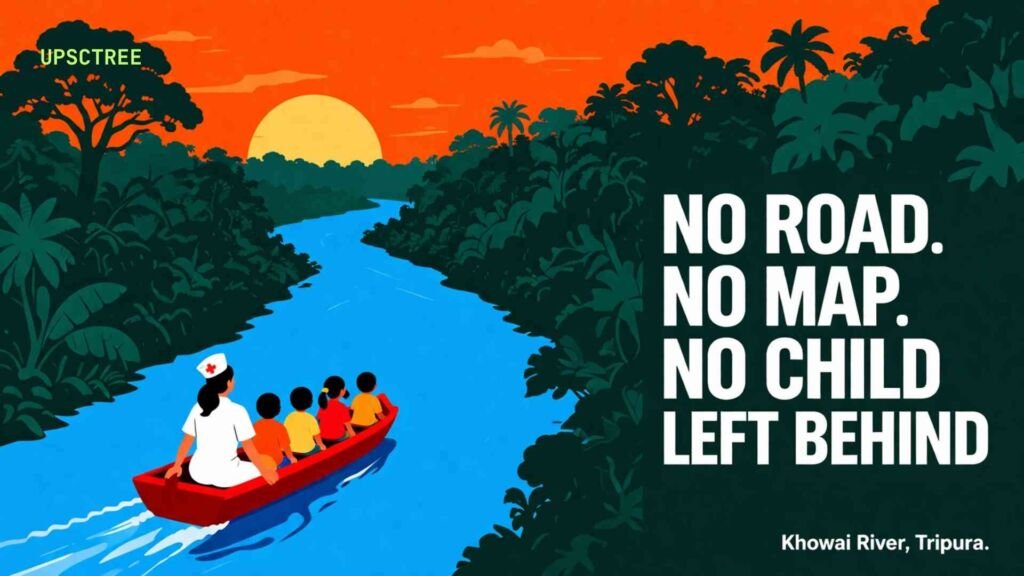 At dawn, the Khowai River runs quiet through dense forest and steep hills in Tripura. The water catches the early light. There are no roads here. No highway signs. No last-mile connectivity in any sense that a planner in a state capital would recognise. There is only the river, and the forest, and somewhere deep inside the Atharamura mountain range, a small hamlet called Kalicharan Para — home to families for whom this waterway is not a scenic route but the only route.
To reach Kalicharan Para, you must board a boat, navigate rough currents, pass through thick jungle and unforgiving terrain, and arrive — five hours later — at a village that exists, for most practical purposes, beyond the reach of the Indian public health system. No road means no regular ambulance. No routine immunisation visit.
That changed when the district administration and the WHO National Public Health Surveillance Network (WHO-NPSN) identified Kalicharan Para as a priority high-risk area and decided, simply, to go there.
The Team That Made the Journey
What made this outreach mission unusual was not just that it happened — it was who made it happen together. The team that arrived in Kalicharan Para was not a small squad of frontline workers sent alone into the forest. It included the Medical Officer from the Primary Health Centre, the Community Health Officer from the nearest Ayushman Arogya Mandir, the Chief Medical Officer, the Sub-Divisional Magistrate, and Primary Health Centre officials.
Critically, senior leadership made the journey too. Dr Soubhik Debbarma, Member Secretary of the National Health Mission, and Mr Rajat Pant, the District Magistrate and Collector of Khowai, travelled alongside frontline workers. They were joined by the WHO-NPSN team led by Dr Tigran Avagyan.
In public health, this matters more than it might seem. When senior officials travel to a remote village rather than receiving reports from it, the message to both their teams and to the community is unmistakable: this place is worth the effort. These people are worth the journey.
What the Team Brought — and What It Found
The outreach camp brought together multiple health services under one roof — something that is easy to take for granted in a city and extraordinary in a village with no road. Services included:
- Immunisation — scheduled childhood vaccines delivered directly to families
- Screening for non-communicable diseases — hypertension, diabetes, and other conditions that often go undetected in remote areas
- Malaria awareness activities — critical in a forested, river-adjacent region
- Antenatal care — check-ups and guidance for pregnant women
- Village Health and Nutrition Day services
- Deworming
What the team also found, and what no health camp checklist could have prepared them for, was the conversation. Sitting with villagers and listening to their daily realities — the difficulty of accessing even basic communication, the long distances to any government facility, the quiet weight of living beyond reach — transformed what could have been a logistical exercise into something more human. Statistics became people. Data became stories.
A Remarkable Finding: No Home Deliveries
One of the most significant things the team discovered was something that wasn’t a problem. Despite the extreme isolation of Kalicharan Para, the village has recorded no home deliveries. Every expectant mother has gone to a government-run health facility for an institutional delivery.
This is not something that happens automatically in remote communities. It reflects sustained effort, trust built over time between the community and health workers, and a commitment on the part of families to make extraordinarily difficult journeys — the same five-hour river route — for the sake of a safe birth. In public health terms, it is a significant achievement, and one that deserved to be recognised and strengthened rather than simply noted.
What Happens After the Visit
The value of a single outreach camp is real but limited. What makes the Kalicharan Para visit matter beyond the day itself is what was set in motion because of it.
Mr Pant directed the District Health Department to make regular visits to the village — not one-off events, but a sustained schedule of outreach. He also asked the Engineering Department to explore developing an alternative road. A physical connection to the rest of the district would change not just healthcare access but the entire texture of daily life for Kalicharan Para’s families.
The lessons from the visit also travelled back to the State Headquarters. WHO-NPSN convened a high-level meeting with senior officials to discuss building a sustainable, scalable framework for immunisation and primary healthcare delivery in hard-to-reach areas — so that what was done once in Kalicharan Para could become a repeatable system rather than a one-time effort.
What “Last-Mile Healthcare” Actually Means
“Last mile” is a term borrowed from logistics — it describes the final, hardest leg of a delivery, when a package has to get from a regional hub to an individual door. In healthcare, it refers to the challenge of reaching people who are geographically, economically, or socially the furthest from health services.
In India, last-mile healthcare is not a metaphor. It is a five-hour boat ride. It is a forest trail that becomes impassable in monsoon. It is a family that knows a government health facility exists somewhere, but has no practical way to reach it. Solving the last-mile problem requires more than good intentions — it requires systems, transport, trained workers, and the institutional will to keep showing up even when showing up is genuinely hard.
At dawn, the Khowai River is quiet again. The health team has gone back. The children who were vaccinated will not remember the day. The mothers whose blood pressure was checked will carry the results for a while, and then — as all of us do — file the paper somewhere and return to the business of living.
But something has shifted in Kalicharan Para. A place that was, for the purposes of the health system, effectively invisible is now visible. It has been visited by senior officials who will not forget having made the journey.
It has been entered into plans and directives and meeting agendas in Khowai and Agartala. The five-hour river route has been travelled once — which means it can be travelled again, and eventually, perhaps, it will not need to be travelled at all.
No child should be left behind, no matter how distant the destination. That sentence, spoken into the forested silence of the Atharamura hills, is the entire point. And in Kalicharan Para, someone finally came far enough to say it in person.
Receive Daily Updates
Recent Posts
- Lowering Emissions by Accelerating Forest Finance (LEAF) Coalition, a collective of the United States, United Kingdom and Norway governments, came up with a $1 billion fund.
- LEAF is supported by transnational corporations (TNCs) like Unilever plc, Amazon.com, Inc, Nestle, Airbnb, Inc as well as Emergent, a US-based non-profit.
- The world lost more than 10 million hectares of primary tropical forest cover last year, an area roughly the size of Switzerland.
- Ending tropical and subtropical forest loss by 2030 is a crucial part of meeting global climate, biodiversity and sustainable development goals. Protecting tropical forests offers one of the biggest opportunities for climate action in the coming decade.
- Tropical forests are massive carbon sinks and by investing in their protection, public and private players are likely to stock up on their carbon credits.
- The LEAF coalition initiative is a step towards concretising the aims and objectives of the Reducing Emissions from Deforestation and Forest Degradation (REDD+) mechanism.
- REDD+ was created by the United Nations Framework Convention on Climate Change (UNFCCC). It monetised the value of carbon locked up in the tropical forests of most developing countries, thereby propelling these countries to help mitigate climate change.
- It is a unique initiative as it seeks to help developing countries in battling the double-edged sword of development versus ecological commitment.
- The initiative comes at a crucial time. The tropics have lost close to 12.2 million hectares (mha) of tree cover last year according to global estimates released by Global Forest Watch.
- Of this, a loss of 4.2 mha occurred within humid tropical primary forests alone. It should come as no surprise that most of these lost forests were located in the developing countries of Latin America, Africa and South Asia.
- Brazil has fared dismally on the parameter of ‘annual primary forest loss’ among all countries. It has lost 1.7 mha of primary forests that are rich storehouse of carbon. India’s estimated loss in 2020 stands at 20.8 kilo hectares.
- Between 2002-2020, Brazil’s total area of humid primary forest reduced by 7.7 per cent while India’s reduced by 3.4 per cent.
- Although the loss in India is not as drastic as in Brazil, its position is nevertheless precarious. For India, this loss is equivalent to 951 metric tonnes worth carbon dioxide emissions released in the atmosphere.
- It is important to draw comparisons between Brazil and India as both countries have adopted a rather lackadaisical attitude towards deforestation-induced climate change. The Brazilian government hardly did anything to control the massive fires that gutted the Amazon rainforest in 2019.
- It is mostly around May that forest fires peak in India. However, this year India, witnessed massive forest fires in early March in states like Odisha, Uttarakhand, Madhya Pradesh and Mizoram among others.
- The European Union’s Copernicus Atmospheric Monitoring Service claimed that 0.2 metric tonnes of carbon was emitted in the Uttarakhand forest fires.
- Implementation of the LEAF Coalition plan will help pump in fresh rigour among developing countries like India, that are reluctant to recognise the contributions of their forest dwelling populations in mitigating climate change.
- With the deadline for proposal submission fast approaching, India needs to act swiftly on a revised strategy.
- Although India has pledged to carry out its REDD+ commitments, it is impossible to do so without seeking knowledge from its forest dwelling population.
Context:-
At the recently concluded Leaders’ Summit on Climate in April 2021, Lowering Emissions by Accelerating Forest Finance (LEAF) Coalition, a collective of the United States, United Kingdom and Norway governments, came up with a $1 billion fund plan that shall be offered to countries committed to arrest the decline of their tropical forests by 2030.
[wptelegram-join-channel link=”https://t.me/s/upsctree” text=”Join @upsctree on Telegram”]What is LEAF Coalition?
Why LEAF Coalition?
Brazil & India
According to the UN-REDD programme, after the energy sector, deforestation accounts for massive carbon emissions — close to 11 per cent — in the atmosphere. Rapid urbanisation and commercialisation of forest produce are the main causes behind rampant deforestation across tropical forests.
Tribes, Forests and Government
Disregarding climate change as a valid excuse for the fires, Indian government officials were quick to lay the blame for deforestation on activities of forest dwellers and even labelled them “mischievous elements” and “unwanted elements”.
Policy makers around the world have emphasised the role of indigenous tribes and local communities in checking deforestation. These communities depend on forests for their survival as well as livelihood. Hence, they understand the need to protect forests. However, by posing legitimate environmental concerns as obstacles to real development, governments of developing countries swiftly avoid protection of forests and rights of forest dwellers.
For instance, the Government of India has not been forthcoming in recognising the socio-economic, civil, political or even cultural rights of forest dwellers. According to data from the Union Ministry of Tribal Affairs in December, 2020 over 55 per cent of this population has still not been granted either individual or community ownership of their lands.
To make matters worse, the government has undertaken systematic and sustained measures to render the landmark Scheduled Tribes and Other Traditional Forest Dwellers (Recognition of Forest Rights) Act, 2006 ineffective in its implementation. The Act had sought to legitimise claims of forest dwellers on occupied forest land.
Various government decisions have seriously undermined the position of indigenous people within India. These include proposing amendments to the obsolete Indian Forest Act, 1927 that give forest officials the power to take away forest dwellers’ rights and to even use firearms with impunity.
There is also the Supreme Court’s order of February, 2019 directing state governments to evict illegal encroachers of forest land or millions of forest dwellers inhabiting forests since generations as a measure to conserve wildlife. Finally, there is the lack of data on novel coronavirus disease (COVID-19) deaths among the forest dwelling population;
Tardy administration, insufficient supervision, apathetic attitude and a lack of political intent defeat the cause of forest dwelling populations in India, thereby directly affecting efforts at arresting deforestation.
Way Forward
Tuntiak Katan, a global indigenous leader from Ecuador and general coordinator of the Global Alliance of Territorial Communities, aptly indicated the next steps at the Climate Summit:
“The first step is recognition of land rights. The second step is the recognition of the contributions of local communities and indigenous communities, meaning the contributions of indigenous peoples.We also need recognition of traditional knowledge practices in order to fight climate change”
Perhaps India can begin by taking the first step.