


Background – How to beat the “red ocean” (China) with “blue ocean diplomacy” has been a hotly debated topic across policy corridors in India , in Japan and in other Indian ocean littoral states, but a profound and sound strategy is yet to emerge.
One of India’s responses to China’s One Belt One Road project is to develop the “Freedom Corridor” in partnership with Japan.
This appears misconceived and too imitative of the OBOR project to make much of an impact.
Instead of trying to compete with China head-on, India should pursue blue ocean diplomacy to create value over the surrounding seas.
The principle of give and take is the principle of diplomacy — give one and take ten.– Mark Twain
Ambrose Bierce, American Civil War soldier, writer, wit and someone who was considered as one of the country’s foremost satirists of his century, once described diplomacy as “the patriotic art of lying for one’s country”. China’s grand inauguration of its gigantic ‘One Belt One Road’ (OBOR) project fits neatly into Bierce’s definition. They lied. OBOR is nothing short of war at a global scale, without a single shot having to be fired.
But conventional diplomacy, as practiced by nations, is like an opiate and is mildly soporific. It involves polite national commentary on the world stage as required by convention, and courteous exchanges of protocol, treaties and démarches. All the action usually happens behind the scenes that almost never get reported. However, people respond better to imagery and context that give verisimilitude, all of which is absent when countries meet to discuss and attempt to resolve issues of international diplomacy. This is particularly important in democracies where long-term buy-in from its citizens is important for governments to have credibility. True, foreign affairs never won elections, but when a democratic nation does wish to have the backing of political consensus on major issues of sovereignty, border conflict, foreign trade and aid, it ought to be ready to have these laid out in the public arena and have the support of the electorate.
Issues become relevant or absorbing, awakening curiosity and involvement among citizens, when diplomacy as imagery affords imagination and the potential threats or benefits of secretive political arrangements between nations are transparently put to greater debate. Such is the case of China’s OBOR that, so far, it has been dry as a bone in its descriptions.
Take a look at the following image of the Mongol conquests that Genghis Khan spearheaded in the thirteenth century, one that went on for over a 100 years and persisted in Iran into the fifteenth century as the Timurid Empire, and in India until the nineteenth century as the Mughal Empire. The Mongol conquests consolidated invasions and conquests into Asia and reached Eastern Europe:

Now take a look at the twenty-first century equivalent that goes by the name of OBOR:

Remarkable, isn’t it? The parallels are extraordinary: China may choose to describe OBOR as following the medieval “Silk Road”, but, in reality, it veritably combines the Mongol “empire of the land”, a tellurocracy, with the British “empire of the sea”, a thalassocracy. This is what the world is now facing up to, which will be rolled out over the next several decades and the true import of which would become clear by that time. British colonialism was neither apparent nor a foregone conclusion when it first set its ships to sail and, in India, the East India Company first came here to trade. Just imagine.
*A thalassocracy is a state with primarily maritime realms, an empire at sea
*A tellurocracy is a stete with primarily land-bdased realms and hegemony
Responding to OBOR
India has, of course, chosen to stay out of OBOR and articulated its position in the context of the “China-Pakistan Economic Corridor” (CPEC) that winds its way through Pakistan-occupied Kashmir (PoK), which India considers its territory. That would seem to imply that India is fine with the rest of OBOR if CPEC was somehow resolved to its satisfaction. But would OBOR and its manifestations over the next couple of decades really be fine with India?
One of India’s still-evolving responses of any tangible nature is to partner with Japan on “multiple infrastructure projects across Africa, Iran, Sri Lanka, and Southeast Asia in funding infrastructure and capacity building projects” as part of a “Freedom Corridor” that stretches from the Asia-Pacific to Africa. That is both ad hoc and indistinguishable from OBOR and, unfortunately, will be perceived as such. China’s global thrust has been visible for some years (in Central Asia, Africa and South America), and the formal inauguration of OBOR should not have come as a surprise. If India does have a response, it should have been planned all along and not be suddenly brought to the table as a “me too”.
A better alternative is to let imagery guide strategy and policy – one that evokes a true partnership of nations, not a presumptive superpower dictating the terms of engagement, and an articulation of how this partnership would work in practice.
Now take a look at the image below. What is particularly fascinating is that the whole Indian Ocean may be conceptualised with a clock metaphor: imagine you are located smack-dab in the middle of the ocean somewhere to the east and north of Mauritius. Straight up north, at 12 O’clock, are India and Sri Lanka; at 1 O’clock are our neighbours Nepal, Bhutan and Bangladesh; from 2 O’clock through 5 O’clock are Burma, Thailand, Malaysia, Singapore, Indonesia (the ASEAN members) and Australia; and at all points from 7 O’clock to 10 O’clock are the nations on the east coast of Africa from Mauritius and Madagascar to South Africa and thence through Mozambique, Tanzania, to Kenya; the Middle East, Iran and Afghanistan at 11 O’clock (ignoring Pakistan). That is to say, this is the Indian Ocean sphere that should be India’s main focus to work out a cooperative international political and economic pact that represents a win-win for all countries involved. It’s a huge space comprising a range of nations with different needs, resources, capabilities and expectations.

Blue Ocean Strategy
The phrase “blue ocean strategy” traces to a book of the same name by two Insead faculty, W Chan Kim and Renee Mauborgne. The basic thesis of their work is that the focus of a majority of research on “strategic thinking has been on competition-based red ocean strategies”. They write that this has been the case because corporate strategy has been heavily influenced by its roots in military strategy. Significantly, they add that in such a perspective, “strategy is about confronting an opponent and fighting over a given piece of land that is both limited and constant”.
Pause and think about this for a moment. China’s OBOR is, indeed, such a strategic framework – not disregarding the obvious fact that China is a Communist country with a red flag – and one that sees itself in competition only with one country: the United States (US). Given this geopolitical context, where the US has had historical energy “assets” in the Middle East, OBOR is nothing short of fighting its opponent – the US – over land and other resources (oil and gas, minerals, labour and markets), most of which are limited and constant. “Limited” has to be seen in the context of finite supplies or slowing growth of these resources within its country and, therefore, having to go out to secure them.
Now, suddenly, the imagery of the extensive OBOR tellurocratic (from the Greek telluro, meaning land, and cracy for power) and thalassocratic (Greek for thalassa, meaning sea) extensions across the Central Asian plains into the Middle East and across the oceans from the South China Sea to the Indian Ocean makes a lot more sense. Not for nothing has China come up with this ambitious programme of raising the geopolitical stakes for global leadership. In seeking to secure an unambiguous presence across continents and disparate nation-states, it is putting up its red flag in far outposts to claim, commandeer and appropriate resources for itself to power its huge economy and use trade as a means for hegemony.
But it is also blunt and, shall we say, unsophisticated. Sophistication comes from hiding intent with the means to secure the intent. Here, we have it all on show in the manner of the Genghis warriors plundering across the Eurasian plains with scythes and swords.
It is Colonialism 3.0 which takes off where the nineteenth-century imperial colonisers left off and then some. Evidence comes from a news article in Dawn, a national English-language daily in Pakistan, that accessed a Chinese government report that CPEC is based on showing a “range and scope” that, according to the Times of India, amounts to “deep penetration of Pakistan’s economic life”. The plan calls for leasing several thousand acres of agricultural land to Chinese companies, 24×7 monitoring and surveillance of all major cities, a national fibre-optic backbone network managed by China, in addition to sourcing minerals and gas and developing rail, road and port infrastructure. The report is mind-boggling in how blunt it is. The CPEC model itself follows China’s central Asian forays for oil and gas in the past decade, and will serve as the blueprint for the rest of OBOR.
As a nation that has perfected the art of hugely scaled manufacture, you can bet what they intend to roll out in Pakistan, in pursuit of its aims, will be the mold for OBOR in other places as well. The partner countries either just don’t know it yet or prefer to ignore the prospect for immediate gains. The world has decried the American and European imperialism. But, as Americans would say, you ain’t seen nothin’ yet. If this is unmistakably a “red ocean” strategy , how should India rethink its game?
Not with another red ocean strategy of its own.
The India-Japan Freedom Corridor, in this context, appears misconceived and too imitative of China’s OBOR to have much impact. First, China has over a trillion dollars in its war chest and a unitary decision-making apparatus that an India-Japan combine, with their individual consensus-driven democracies, cannot hope to match. Second, China has fundamental reasons – economic and political – to see advantages with OBOR, not least of it being to ensure that the slackening growth of its economy owing to over-investments could be successfully transitioned to consumption-led economic growth and there is no domestic disturbance that poses a danger to its dictatorship. Japan has been in a low-inflation, low-growth trap for two decades while the possibilities for India to show there is still room for considerable growth domestically. Neither country has the pressing preconditions to pursue an OBOR-like effort other than simply to thwart China in its efforts at global dominance.
Imitating China in its acquisition of energy assets and investments in railroad across the European landmass is flawed: it would raise the cost of such investments while the logic itself is questionable. Europe is in deep political and economic crisis – its aging demographics presage slow growth in the foreseeable future, national sentiments that are increasingly turning protectionist, the EU itself is facing an existential threat internally, and revealing cracks in uncharted areas of security. Russia is a superpower past its prime and which is yet to stabilise and articulate where and how it seeks to engage. It is verily bereft of ideas for itself. Central Asia, other than energy, presents tiny markets. Europe and Central Asia, therefore, hold few long-term advantages other than the weight of history from that area of the world.
India and Japan would be better off imagining, defining, articulating and executing a blue ocean strategy that dismisses China as competition and look to innovate in their foreign economic policy. The Indian Ocean, with its clock metaphor, would be a good place to start. The authors of the Blue Ocean Strategy note that the cornerstone of such a strategy is the practice of “value innovation”, whereby, instead of seeking to beat the competition, “you focus on making the competition irrelevant by creating a leap in value for buyers and your company, thereby opening up new and uncontested market space”.
Such a perspective would allow India and Japan to think of the Indian Ocean clock in two halves – the eastern Indian Ocean (12 O’clock to 5 O’clock) and the western Indian Ocean (7 O’clock to 11 O’clock). India would need to quickly involve and collaborate with its immediate neighbours – minus Pakistan – to create a South Asian Union that integrates completely with the Indian common market. If we put our minds to it, demonstrate largeness of heart, and offer our neighbours broad-based access to our markets, the SAU could be a reality within five years.
This complete, the SAU members would then have to work assiduously to integrate with the Association of South East Asian Nations (ASEAN). All of this, ideally, should happen in a spirit of generosity and welfare for all where India would need to take leadership and open its markets to neighbours for both products and services. Remember: Lee Kuan Yew of Singapore did invite India to become a founding member of ASEAN. As in numerous other occasions, we passed this over and have regretted it ever since. We now have the chance at recompense, with a much more mature and fast-growing Indian economy, but one also where everyone benefits and is shielded from China’s mercantilist onslaught.
The interesting thing about this eastern Indian Ocean market integration is that financial resources required for infrastructure development – road and rail networks linking the South Asian countries with ASEAN at the edges – would be far lower than OBOR’s capital infusion for its purposes. All that is needed is to connect India and its neighbours to the ASEAN logistics network.
When SAU and ASEAN integrate, a blue ocean strategy for value innovation of the eastern Indian Ocean would have been achieved. This would serve as the model for the western half – to cajole, collaborate and partner with countries along the east coast of Africa to create a similar common market of their region. Here is where India and Japan could come together to create infrastructure networks comprising road, rail and power to knit the countries together. The blue ocean strategy here would be to ensure this is not colonialism of the sort China is rolling out but a markedly different one that emphasises consent, consultation, collaboration and value delivery for every one of the partners.
Value innovation would, and should, emphasise continued ownership of infrastructure and capacity to rest within the respective countries in return for the creation of a common market that would integrate with the eastern half of the Indian Ocean. The private sector of the collaborating nations could participate and invest in assets in the normal course of business, but it cannot be in the form of subsidy capital by India or Japan to promote their own enterprises. That is exactly what China is pursuing with OBOR. India cannot pursue mercantilist ideas of wholesale ownership of everything from raw materials to intermediaries to final products without attracting domestic ire and opposition in several countries. That is also China’s way, and the results of this are now becoming more evident in Africa. In time, China would have to pay attention to these or have OBOR unravel even without the heavy indebtedness of partner countries that might likely ensue.
The essence of value innovation is to eschew a fundamental notion of international diplomacy, particularly foreign economic policy, that individual strategies pursued by nations is a zero-sum game – i.e., the idea of a fixed pie wherein one nation wins and another inevitably loses. A blue ocean strategy for the Indian Ocean, on the other hand, would argue for a growing pie wherein all participants could seek to grow with.
Genuine cooperation is more easily achieved when win-wins are apparent and shared from a large and growing pie. This presents an opportunity for an international economic strategy that is markedly different from China’s, innovates all along the continuum, and makes possible an “uncontested market” for its members.
Pipe dream? Perhaps. The world could never have imagined China would ever realistically roll out or seek to execute OBOR in its current stated form. But they have. China does not emphasise common markets, has not offered a spirit of cooperation or a win-win. It has chosen to tread the past imperialist path of neo-Colonialism modified for the twenty-first century that seeks to pillage and plunder without bloodshed.
That is the difference in thought leadership in international diplomacy that India could offer. The Indian Ocean is big enough for creative partnerships that could deliver on this front. The only thing required: to stop thinking in terms of red oceans and competing with China head-on. Let China not consume our thinking. Leave Pakistan for China to fret over.
Instead, make China irrelevant for India’s purposes and for the purposes of the larger Indian Ocean community. This is a huge market: when the dust settles, it could be bigger than the Chinese market, with two-thirds of its demographics comprising a young population, and serve as effective ballast for the world economy.
Recent Posts
The United Nations has shaped so much of global co-operation and regulation that we wouldn’t recognise our world today without the UN’s pervasive role in it. So many small details of our lives – such as postage and copyright laws – are subject to international co-operation nurtured by the UN.
In its 75th year, however, the UN is in a difficult moment as the world faces climate crisis, a global pandemic, great power competition, trade wars, economic depression and a wider breakdown in international co-operation.
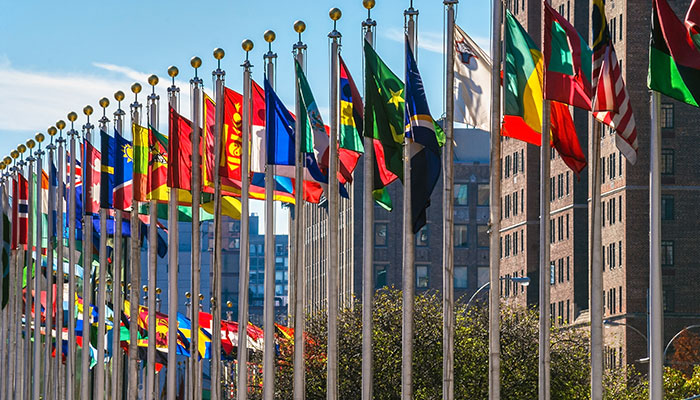
Still, the UN has faced tough times before – over many decades during the Cold War, the Security Council was crippled by deep tensions between the US and the Soviet Union. The UN is not as sidelined or divided today as it was then. However, as the relationship between China and the US sours, the achievements of global co-operation are being eroded.
The way in which people speak about the UN often implies a level of coherence and bureaucratic independence that the UN rarely possesses. A failure of the UN is normally better understood as a failure of international co-operation.
We see this recently in the UN’s inability to deal with crises from the ethnic cleansing of the Rohingya Muslims in Myanmar, to civil conflict in Syria, and the failure of the Security Council to adopt a COVID-19 resolution calling for ceasefires in conflict zones and a co-operative international response to the pandemic.
The UN administration is not primarily to blame for these failures; rather, the problem is the great powers – in the case of COVID-19, China and the US – refusing to co-operate.
Where states fail to agree, the UN is powerless to act.
Marking the 75th anniversary of the official formation of the UN, when 50 founding nations signed the UN Charter on June 26, 1945, we look at some of its key triumphs and resounding failures.
Five successes
1. Peacekeeping
The United Nations was created with the goal of being a collective security organisation. The UN Charter establishes that the use of force is only lawful either in self-defence or if authorised by the UN Security Council. The Security Council’s five permanent members, being China, US, UK, Russia and France, can veto any such resolution.
The UN’s consistent role in seeking to manage conflict is one of its greatest successes.
A key component of this role is peacekeeping. The UN under its second secretary-general, the Swedish statesman Dag Hammarskjöld – who was posthumously awarded the Nobel Peace prize after he died in a suspicious plane crash – created the concept of peacekeeping. Hammarskjöld was responding to the 1956 Suez Crisis, in which the US opposed the invasion of Egypt by its allies Israel, France and the UK.
UN peacekeeping missions involve the use of impartial and armed UN forces, drawn from member states, to stabilise fragile situations. “The essence of peacekeeping is the use of soldiers as a catalyst for peace rather than as the instruments of war,” said then UN Secretary-General Javier Pérez de Cuéllar, when the forces won the 1988 Nobel Peace Prize following missions in conflict zones in the Middle East, Africa, Asia, Central America and Europe.
However, peacekeeping also counts among the UN’s major failures.
2. Law of the Sea
Negotiated between 1973 and 1982, the UN Convention on the Law of the Sea (UNCLOS) set up the current international law of the seas. It defines states’ rights and creates concepts such as exclusive economic zones, as well as procedures for the settling of disputes, new arrangements for governing deep sea bed mining, and importantly, new provisions for the protection of marine resources and ocean conservation.
Mostly, countries have abided by the convention. There are various disputes that China has over the East and South China Seas which present a conflict between power and law, in that although UNCLOS creates mechanisms for resolving disputes, a powerful state isn’t necessarily going to submit to those mechanisms.
Secondly, on the conservation front, although UNCLOS is a huge step forward, it has failed to adequately protect oceans that are outside any state’s control. Ocean ecosystems have been dramatically transformed through overfishing. This is an ecological catastrophe that UNCLOS has slowed, but failed to address comprehensively.
3. Decolonisation
The idea of racial equality and of a people’s right to self-determination was discussed in the wake of World War I and rejected. After World War II, however, those principles were endorsed within the UN system, and the Trusteeship Council, which monitored the process of decolonisation, was one of the initial bodies of the UN.
Although many national independence movements only won liberation through bloody conflicts, the UN has overseen a process of decolonisation that has transformed international politics. In 1945, around one third of the world’s population lived under colonial rule. Today, there are less than 2 million people living in colonies.
When it comes to the world’s First Nations, however, the UN generally has done little to address their concerns, aside from the non-binding UN Declaration on the Rights of Indigenous Peoples of 2007.
4. Human rights
The Human Rights Declaration of 1948 for the first time set out fundamental human rights to be universally protected, recognising that the “inherent dignity and of the equal and inalienable rights of all members of the human family is the foundation of freedom, justice and peace in the world”.
Since 1948, 10 human rights treaties have been adopted – including conventions on the rights of children and migrant workers, and against torture and discrimination based on gender and race – each monitored by its own committee of independent experts.
The language of human rights has created a new framework for thinking about the relationship between the individual, the state and the international system. Although some people would prefer that political movements focus on ‘liberation’ rather than ‘rights’, the idea of human rights has made the individual person a focus of national and international attention.
5. Free trade
Depending on your politics, you might view the World Trade Organisation as a huge success, or a huge failure.
The WTO creates a near-binding system of international trade law with a clear and efficient dispute resolution process.
The majority Australian consensus is that the WTO is a success because it has been good for Australian famers especially, through its winding back of subsidies and tariffs.
However, the WTO enabled an era of globalisation which is now politically controversial.
Recently, the US has sought to disrupt the system. In addition to the trade war with China, the Trump Administration has also refused to appoint tribunal members to the WTO’s Appellate Body, so it has crippled the dispute resolution process. Of course, the Trump Administration is not the first to take issue with China’s trade strategies, which include subsidises for ‘State Owned Enterprises’ and demands that foreign firms transfer intellectual property in exchange for market access.
The existence of the UN has created a forum where nations can discuss new problems, and climate change is one of them. The Intergovernmental Panel on Climate Change (IPCC) was set up in 1988 to assess climate science and provide policymakers with assessments and options. In 1992, the UN Framework Convention on Climate Change created a permanent forum for negotiations.
However, despite an international scientific body in the IPCC, and 165 signatory nations to the climate treaty, global greenhouse gas emissions have continued to increase.
Under the Paris Agreement, even if every country meets its greenhouse gas emission targets we are still on track for ‘dangerous warming’. Yet, no major country is even on track to meet its targets; while emissions will probably decline this year as a result of COVID-19, atmospheric concentrations of greenhouse gases will still increase.
This illustrates a core conundrum of the UN in that it opens the possibility of global cooperation, but is unable to constrain states from pursuing their narrowly conceived self-interests. Deep co-operation remains challenging.
Five failures of the UN
1. Peacekeeping
During the Bosnian War, Dutch peacekeeping forces stationed in the town of Srebrenica, declared a ‘safe area’ by the UN in 1993, failed in 1995 to stop the massacre of more than 8000 Muslim men and boys by Bosnian Serb forces. This is one of the most widely discussed examples of the failures of international peacekeeping operations.
On the massacre’s 10th anniversary, then UN Secretary General Kofi Annan wrote that the UN had “made serious errors of judgement, rooted in a philosophy of impartiality”, contributing to a mass murder that would “haunt our history forever”.
If you look at some of the other infamous failures of peacekeeping missions – in places such as Rwanda, Somalia and Angola – it is the limited powers given to peacekeeping operations that have resulted in those failures.
2. The invasion of Iraq
The invasion of Iraq by the US in 2003, which was unlawful and without Security Council authorisation, reflects the fact that the UN is has very limited capacity to constrain the actions of great powers.
The Security Council designers created the veto power so that any of the five permanent members could reject a Council resolution, so in that way it is programmed to fail when a great power really wants to do something that the international community generally condemns.
In the case of the Iraq invasion, the US didn’t veto a resolution, but rather sought authorisation that it did not get. The UN, if you go by the idea of collective security, should have responded by defending Iraq against this unlawful use of force.
The invasion proved a humanitarian disaster with the loss of more than 400,000 lives, and many believe that it led to the emergence of the terrorist Islamic State.
3. Refugee crises
The UN brokered the 1951 Refugee Convention to address the plight of people displaced in Europe due to World War II; years later, the 1967 Protocol removed time and geographical restrictions so that the Convention can now apply universally (although many countries in Asia have refused to sign it, owing in part to its Eurocentric origins).
Despite these treaties, and the work of the UN High Commission for Refugees, there is somewhere between 30 and 40 million refugees, many of them, such as many Palestinians, living for decades outside their homelands. This is in addition to more than 40 million people displaced within their own countries.
While for a long time refugee numbers were reducing, in recent years, particularly driven by the Syrian conflict, there have been increases in the number of people being displaced.
During the COVID-19 crisis, boatloads of Rohingya refugees were turned away by port after port. This tragedy has echoes of pre-World War II when ships of Jewish refugees fleeing Nazi Germany were refused entry by multiple countries.
And as a catastrophe of a different kind looms, there is no international framework in place for responding to people who will be displaced by rising seas and other effects of climate change.
4. Conflicts without end
Across the world, there is a shopping list of unresolved civil conflicts and disputed territories.
Palestine and Kashmir are two of the longest-running failures of the UN to resolve disputed lands. More recent, ongoing conflicts include the civil wars in Syria and Yemen.
The common denominator of unresolved conflicts is either division among the great powers, or a lack of international interest due to the geopolitical stakes not being sufficiently high. For instance, the inaction during the Rwandan civil war in the 1990s was not due to a division among great powers, but rather a lack of political will to engage.
In Syria, by contrast, Russia and the US have opposing interests and back opposing sides: Russia backs the government of the Syrian dictator Bashar al-Assad, whereas the US does not.
5. Acting like it’s 1945
The UN is increasingly out of step with the reality of geopolitics today.
The permanent members of the Security Council reflect the division of power internationally at the end of World War II. The continuing exclusion of Germany, Japan, and rising powers such as India and Indonesia, reflects the failure to reflect the changing balance of power.
Also, bodies such as the IMF and the World Bank, which are part of the UN system, continue to be dominated by the West. In response, China has created potential rival institutions such as the Asian Infrastructure Investment Bank.
Western domination of UN institutions undermines their credibility. However, a more fundamental problem is that institutions designed in 1945 are a poor fit with the systemic global challenges – of which climate change is foremost – that we face today.