


Prelude :- The Middle east is in ruins, Civil war and games of geopolitics derailed the development, peace and prosperity pursuits of this region.In this context we at UPSCTREE observed that :-
“Spring has long left the Arab,The Arab world is now at cross roads with “destination Anarchy” on every path of its choosing.The world was waiting for a spring, but to its discomfort , it received an uprising “. Leaving us to contemplate what went wrong with Arab Spring
Arab Spring:-
- The Arab Spring was a revolutionary wave of demonstrations and protests (both non-violent and violent), riots, and civil wars in the Arab world that began on 18 December 2010 in Tunisia with the Tunisian Revolution, and spread throughout the countries of the Arab League and its surroundings. While the wave of initial revolutions and protests faded by mid-2012, some started to refer to the succeeding and still ongoing large-scale discourse conflicts in the Middle East and North Africa as the Arab Winter. The most radical discourse from Arab Spring into the still ongoing civil wars took place in Syria as early as the second half of 2011.
Syrian Crisis :-
- More than 250,000 Syrians have lost their lives in four-and-a-half years of armed conflict, which began with anti-government protests before escalating into a full-scale civil war. More than 11 million others have been forced from their homes as forces loyal to President Bashar al-Assad and those opposed to his rule battle each other – as well as jihadist militants from Islamic State.
- Uprising turns violent:-
- Pro-democracy protests erupted in March 2011 in the southern city of Deraa after the arrest and torture of some teenagers who painted revolutionary slogans on a school wall. After security forces opened fire on demonstrators, killing several, more took to the streets.The unrest triggered nationwide protests demanding President Assad’s resignation. The government’s use of force to crush the dissent merely hardened the protesters’ resolve. By July 2011, hundreds of thousands were taking to the streets across the country.Opposition supporters eventually began to take up arms, first to defend themselves and later to expel security forces from their local areas.
- Descent into civil war :-
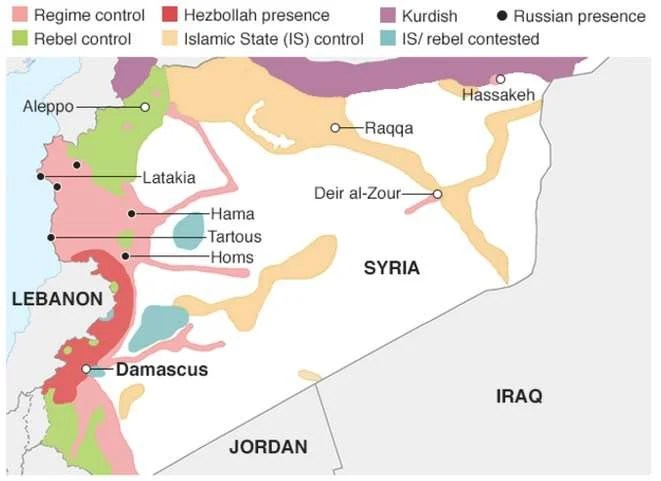
- Violence escalated and the country descended into civil war as rebel brigades were formed to battle government forces for control of cities, towns and the countryside. Fighting reached the capital Damascus and second city of Aleppo in 2012.By June 2013, the UN said 90,000 people had been killed in the conflict. However, by August 2014 that figure had more than doubled to 191,000 – and continued to climb to 250,000 by August 2015, according to activists and the UN.The conflict is now more than just a battle between those for or against President Assad. It has acquired sectarian overtones, pitching the country’s Sunni majority against the president’s Shia Alawite sect, and drawn in neighbouring countries and world powers. The rise of the jihadist groups, including Islamic State, has added a further dimension.
- War crimes:-
- A UN commission of inquiry, investigating alleged human rights violations since March 2011, has evidence that those on both sides of the conflict have committed war crimes – including murder, torture, rape and enforced disappearances. Government and rebel forces have also been accused by investigators of using civilian suffering – such as blocking access to food, water and health services – as a method of war.In February 2014, a UN Security Council resolution demanded all parties end the “indiscriminate employment of weapons in populated areas”. Since then, activists say, more than 6,000 civilians have been killed by barrel bombs dropped by government aircraft on rebel-held areas. The UN says in some instances, civilian gatherings have been deliberately targeted, constituting massacres.Islamic State has also been accused by the UN of waging a campaign of terror in northern and eastern Syria. It has inflicted severe punishments on those who transgress or refuse to accept its rule, including hundreds of public executions and amputations. Its fighters have also carried out mass killings of rival armed groups, members of the security forces and religious minorities, and beheaded hostages, including several Westerners.

- Chemical weapons:-
- Facing the prospect of US military intervention, President Assad agreed to the complete removal or destruction of Syria’s chemical weapons arsenal as part of a joint mission led by the UN and the Organisation for the Prohibition of Chemical Weapons (OPCW). The destruction of chemical agents and munitions was completed a year later.Despite the operation, the OPCW has since documented the use of toxic chemicals, such as chlorine and ammonia, by the government in attacks on rebel-held northern villages between April and July 2014 that resulted in the deaths of at least 13 people.Islamic State has also been accused of using homemade chemical weapons, possibly including the blistering agent sulphur mustard, against Kurdish forces and civilians in northern Syria.
- Humanitarian crisis:-
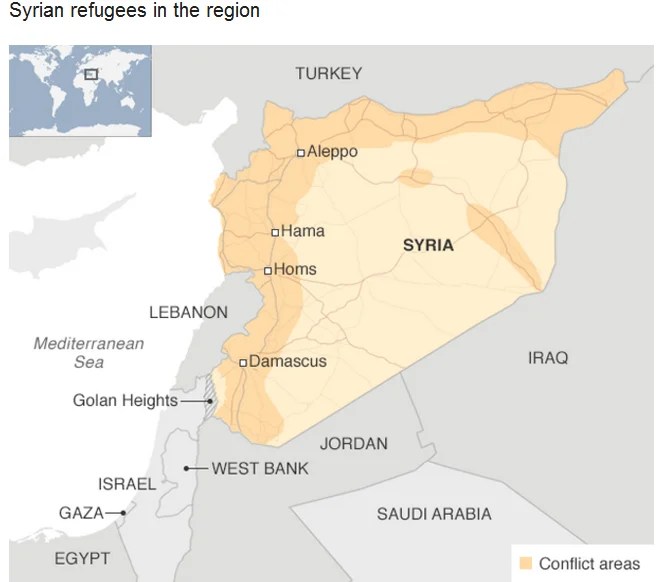
- More than four million people have fled Syria since the start of the conflict, most of them women and children. It is one of the largest refugee exodus in recent history. Neighboring countries have borne the brunt of the refugee crisis, with Lebanon, Jordan and Turkey struggling to accommodate the flood of new arrivals. The exodus accelerated dramatically in 2013, as conditions in Syria deteriorate
- A further 7.6 million Syrians have been internally displaced within the country, bringing the total number forced to flee their homes to more than 11 million – half the country’s pre-crisis population. Overall, an estimated 12.2 million are in need of humanitarian assistance inside Syria, including 5.6 million children, the UN says.
- A report published by the UN in March 2015 estimated the total economic loss since the start of the conflict was $202bn and that four in every five Syrians were now living in poverty – 30% of them in abject poverty. Syria’s education, health and social welfare systems are also in a state of collapse
- Rebels and the rise of the jihadists :-
- The armed rebellion has evolved significantly since its inception. Secular moderates are now outnumbered by Islamist and jihadists, whose brutal tactics have caused widespread concern and triggered rebel infighting.
- Capitalizing on the chaos in the region, Islamic State – the extremist group that grew out of al-Qaeda in Iraq – has taken control of huge swathes of territory across northern and eastern Syria, as well as neighbouring Iraq. Its many foreign fighters in Syria are now involved in a “war within a war”, battling rebels and jihadists from the al-Qaeda-affiliated Nusra Front, who object to their tactics, as well as Kurdish and government forces.
- Peace efforts:-
- With neither side able to inflict a decisive defeat on the other, the international community long ago concluded that only a political solution could end the conflict in Syria. However, a number of attempts by the Arab League and the UN to broker ceasefire and start dialogue have failed.
- In January 2014, the US, Russia and UN convened a conference in Switzerland to implement the 2012 Geneva Communique, an internationally backed agreement that called for the establishment of a transitional governing body in Syria formed on the basis of mutual consent.The talks, which became known as Geneva II, broke down in February after only two rounds. The then-UN special envoy Lakhdar Brahimi blamed the Syrian government’s refusal to discuss opposition demands and its insistence on a focus on fighting “terrorists” – a term Damascus uses to describe rebel groups.

- Proxy war :-What began as another Arab Spring uprising against an autocratic ruler has mushroomed into a brutal proxy war that has drawn in regional and world powers.
Conclusion :- The spill over of failed Arab Spring resulted in mass exodus,internal displacement , extremism in all forms , and this decade has seen the worst brutalities that mankind has ever endured in the past.The sheer no. of human casualties is numbing. People became refugees in their own country , the refugee crisis is enervating the Government across Europe and to protect their demographic profile without any significant alteration , Countries have stepped up vigil along the border with intermittent sealing of border.Desperate attempt by many to flee the conflict zone has led to loss of lives. Children and women are the most vulnerable groups among these and the brutalities that laid upon them is emotionally numbing.There seems no vestige of beginning , no prospect of an end of this crisis.Solution lays in constructive engagement of global powers and institutions , but major players are fighting each other , and Syria became their geopolitical battleground.
Receive Daily Updates
Recent Posts
- Lowering Emissions by Accelerating Forest Finance (LEAF) Coalition, a collective of the United States, United Kingdom and Norway governments, came up with a $1 billion fund.
- LEAF is supported by transnational corporations (TNCs) like Unilever plc, Amazon.com, Inc, Nestle, Airbnb, Inc as well as Emergent, a US-based non-profit.
- The world lost more than 10 million hectares of primary tropical forest cover last year, an area roughly the size of Switzerland.
- Ending tropical and subtropical forest loss by 2030 is a crucial part of meeting global climate, biodiversity and sustainable development goals. Protecting tropical forests offers one of the biggest opportunities for climate action in the coming decade.
- Tropical forests are massive carbon sinks and by investing in their protection, public and private players are likely to stock up on their carbon credits.
- The LEAF coalition initiative is a step towards concretising the aims and objectives of the Reducing Emissions from Deforestation and Forest Degradation (REDD+) mechanism.
- REDD+ was created by the United Nations Framework Convention on Climate Change (UNFCCC). It monetised the value of carbon locked up in the tropical forests of most developing countries, thereby propelling these countries to help mitigate climate change.
- It is a unique initiative as it seeks to help developing countries in battling the double-edged sword of development versus ecological commitment.
- The initiative comes at a crucial time. The tropics have lost close to 12.2 million hectares (mha) of tree cover last year according to global estimates released by Global Forest Watch.
- Of this, a loss of 4.2 mha occurred within humid tropical primary forests alone. It should come as no surprise that most of these lost forests were located in the developing countries of Latin America, Africa and South Asia.
- Brazil has fared dismally on the parameter of ‘annual primary forest loss’ among all countries. It has lost 1.7 mha of primary forests that are rich storehouse of carbon. India’s estimated loss in 2020 stands at 20.8 kilo hectares.
- Between 2002-2020, Brazil’s total area of humid primary forest reduced by 7.7 per cent while India’s reduced by 3.4 per cent.
- Although the loss in India is not as drastic as in Brazil, its position is nevertheless precarious. For India, this loss is equivalent to 951 metric tonnes worth carbon dioxide emissions released in the atmosphere.
- It is important to draw comparisons between Brazil and India as both countries have adopted a rather lackadaisical attitude towards deforestation-induced climate change. The Brazilian government hardly did anything to control the massive fires that gutted the Amazon rainforest in 2019.
- It is mostly around May that forest fires peak in India. However, this year India, witnessed massive forest fires in early March in states like Odisha, Uttarakhand, Madhya Pradesh and Mizoram among others.
- The European Union’s Copernicus Atmospheric Monitoring Service claimed that 0.2 metric tonnes of carbon was emitted in the Uttarakhand forest fires.
- Implementation of the LEAF Coalition plan will help pump in fresh rigour among developing countries like India, that are reluctant to recognise the contributions of their forest dwelling populations in mitigating climate change.
- With the deadline for proposal submission fast approaching, India needs to act swiftly on a revised strategy.
- Although India has pledged to carry out its REDD+ commitments, it is impossible to do so without seeking knowledge from its forest dwelling population.
Context:-
At the recently concluded Leaders’ Summit on Climate in April 2021, Lowering Emissions by Accelerating Forest Finance (LEAF) Coalition, a collective of the United States, United Kingdom and Norway governments, came up with a $1 billion fund plan that shall be offered to countries committed to arrest the decline of their tropical forests by 2030.
[wptelegram-join-channel link=”https://t.me/s/upsctree” text=”Join @upsctree on Telegram”]What is LEAF Coalition?
Why LEAF Coalition?
Brazil & India
According to the UN-REDD programme, after the energy sector, deforestation accounts for massive carbon emissions — close to 11 per cent — in the atmosphere. Rapid urbanisation and commercialisation of forest produce are the main causes behind rampant deforestation across tropical forests.
Tribes, Forests and Government
Disregarding climate change as a valid excuse for the fires, Indian government officials were quick to lay the blame for deforestation on activities of forest dwellers and even labelled them “mischievous elements” and “unwanted elements”.
Policy makers around the world have emphasised the role of indigenous tribes and local communities in checking deforestation. These communities depend on forests for their survival as well as livelihood. Hence, they understand the need to protect forests. However, by posing legitimate environmental concerns as obstacles to real development, governments of developing countries swiftly avoid protection of forests and rights of forest dwellers.
For instance, the Government of India has not been forthcoming in recognising the socio-economic, civil, political or even cultural rights of forest dwellers. According to data from the Union Ministry of Tribal Affairs in December, 2020 over 55 per cent of this population has still not been granted either individual or community ownership of their lands.
To make matters worse, the government has undertaken systematic and sustained measures to render the landmark Scheduled Tribes and Other Traditional Forest Dwellers (Recognition of Forest Rights) Act, 2006 ineffective in its implementation. The Act had sought to legitimise claims of forest dwellers on occupied forest land.
Various government decisions have seriously undermined the position of indigenous people within India. These include proposing amendments to the obsolete Indian Forest Act, 1927 that give forest officials the power to take away forest dwellers’ rights and to even use firearms with impunity.
There is also the Supreme Court’s order of February, 2019 directing state governments to evict illegal encroachers of forest land or millions of forest dwellers inhabiting forests since generations as a measure to conserve wildlife. Finally, there is the lack of data on novel coronavirus disease (COVID-19) deaths among the forest dwelling population;
Tardy administration, insufficient supervision, apathetic attitude and a lack of political intent defeat the cause of forest dwelling populations in India, thereby directly affecting efforts at arresting deforestation.
Way Forward
Tuntiak Katan, a global indigenous leader from Ecuador and general coordinator of the Global Alliance of Territorial Communities, aptly indicated the next steps at the Climate Summit:
“The first step is recognition of land rights. The second step is the recognition of the contributions of local communities and indigenous communities, meaning the contributions of indigenous peoples.We also need recognition of traditional knowledge practices in order to fight climate change”
Perhaps India can begin by taking the first step.