


The Priority Species and Critical regions of India
Asian Elephants

Habitat and distribution
In India, the Asian elephant was once widely distributed throughout the country, including in states like Punjab and Gujarat. Currently, they are found in four fragmented populations, in south, north, central and north-east India. Extreme habitat generalists, their habitat ranges from wet tropical evergreen forests to semi-arid thorn and scrub forests. However, highest densities of the elephant population are found in tropical deciduous forests. Elephants are ‘mega-herbivores’ that require vast tracts of forests, rich in food and water to survive.
Historically, Indians have through their long association with captive elephants that go back 4,000-5,000 years developed strong cultural and religious links with these mega herbivores. This makes elephants an excellent flagship species in generating public support for their conservation. Owing to their diverse range of habitats and large home ranges, elephants help protect the biodiversity within their range. Even their large dietary requirements enable elephants to have a significant impact on the trees and other vegetation, which results in a modification of their habitat. Thus their conservation could help maintain the biological diversity and ecological integrity of large forest tracts.
Bengal Tigers

At the turn of the 20th century, it is estimated that India probably had many thousands of tigers in the wild.The Wildlife Institute of India (WII) and the National Tiger Conservation Authority (NTCA), Government of India, have been conducting tiger estimation surveys in partnership with NGOs. WWF-India was the key NGO partner of the WII and NTCA in conducting the comprehensive country-wide tiger estimation exercise in 2010-11, which revealed a mean tiger population estimate of 1,706.
Based on a census using the pug mark technique, the number of tigers in 2002 stood at 3,642. As per the 2008 tiger estimation exercise conducted by WII in association with the NTCA using camera traps, there were only 1,411 tigers left in the wild in India.
The tiger is not just a charismatic species or just another wild animal living in some far away forest.
The tiger is a unique animal which plays a pivotal role in the health and diversity of an ecosystem. It is a top predator which is at the apex of the food chain and keeps the population of wild ungulates in check, thereby maintaining the balance between prey herbivores and the vegetation upon which they feed. Therefore, the presence of tigers in the forest is an indicator of the well being of the ecosystem. The extinction of this top predator is an indication that its ecosystem is not sufficiently protected, and neither would it exist for long thereafter.
If the tigers go extinct, the entire system would collapse.
For e.g. when the Dodos went extinct in Mauritius, one species of Acacia tree stopped regenerating completely. So when a species goes extinct, it leaves behind a scar, which affects the entire ecosystem. Another reason why we need to save the tiger is that our forests are water catchment areas.
Therefore, it’s not just about saving a beautiful animal. It is about making sure that we live a little longer as the forests are known to provide ecological services like clean air, water, pollination, temperature regulation etc.
What are white tigers?
A centennial event! Tiger numbers have finally increased!
The number of tigers in the wild is now 3,890! This updated minimum figure, compiled from IUCN data and the latest national tiger surveys, indicates an increase on the 2010 estimate of ‘as few as 3,200’, a first ever in the last 100 years.
With every tiger, we protect around 25,000 acres of forest.
When tigers are protected, we save so much more. As a large predator, the tiger shapes the ecosystem in which it lives.
One Horned Rhino
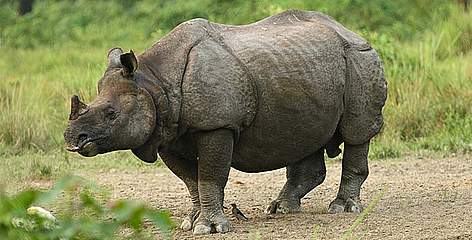
The Indian rhino has a single horn, which is present in both sexes. It is the largest of all the Asian rhinos. Considered to be the most amphibious of all the rhino species, the Indian rhino is an excellent swimmer. It can run at speeds of up to 55km/hr for short periods of time. Though it has an excellent sense of hearing and smell, its eyesight is relatively poor.The animal is solitary as a rule, though several may occupy the same patch of forest or water hole.
Habitat and distribution
The preferred habitat of an Indian rhinoceros is alluvial flood plains and areas containing tall grasslands along the foothills of the Himalayas. Formerly, extensively distributed in the Gangetic plains, today the species is restricted to small habitats in Indo-Nepal terai and northern West Bengal and Assam. In India, rhinos are mainly found in Kaziranga NP, Pobitara WLS, Orang NP, Manas NP in Assam, Jaldapara NP and Garumara NP in West Bengal and Dudhwa TR in Uttar Pradesh.
Indian Rhino Vision 2020
An ambitious plan to expand the distribution of Assam’s state animal, the greater one-horned rhinoceros, took yet another big leap, with the translocation of two rhinos from the Kaziranga National Park to the Burachopari Wildlife Sanctuary on 29 March 2016.
This operation was part of the Indian Rhino Vision 2020 (IRV 2020) programme launched by the Assam Forest Department in partnership with WWF-India, the International Rhino Foundation and US Fish & Wildlife Service in 2005.
The programme aims at increasing the number and range of rhinos in Assam through wild-to-wild translocations from Kaziranga National Park and Pobitora Wildlife Sanctuary to potential Protected Areas including Manas National Park, Burachapori Wildlife Sanctuary, Laokhowa Wildlife Sanctuary, and Dibru-Saikhowa National Park. The vision is to attain a population of 3000 wild rhinos in Assam, distributed over seven of its Protected Areas by 2020.
Snow Leopard

Habitat and distribution
Snow leopards live in the mountainous regions of central and southern Asia. In India, their geographical range encompasses a large part of the western Himalayas including the states of Jammu and Kashmir, Himachal Pradesh, Uttarakhand and Sikkim and Arunachal Pradesh in the eastern Himalayas. The last three states form part of the Eastern Himalayas – a priority global region of WWF and the Living Himalayas Network Initiative
Snow leopards prefer steep, rugged terrains with rocky outcrops and ravines. This type of habitat provides good cover and clear view to help them sneak up on their prey. They are found at elevations of 3,000-5,000 metres or higher in the Himalayas.
Status
The snow leopard is listed as Endangered on the IUCN-World Conservation Union’s Red List of the Threatened Species. In addition, the snow leopard, like all big cats, is listed on Appendix I of the Convention on International Trade of Endangered Species (CITES), which makes trading of animal body parts (i.e., fur, bones and meat) illegal in signatory countries. It is also protected by several national laws in its range countries.
Red Panda

Smooth-coated otter

Habitat and Distribution
Smooth-coated otter is distributed throughout the country from the Himalayas and to the south in India. It is sympatric with other otter species in the Western Ghats and the northeast India.
Smooth-coated otters are found in areas where freshwater is plentiful, preferring shallow and placid waters— wetlands and seasonal swamps, rivers, lakes, and rice paddies. Where they are the only species of otter, they may be found in almost any suitable habitat, but where they are sympatric with other species, they avoid smaller streams and canals in favour of larger bodies of water. Although they are often found in saltwater near the coast, especially on smaller islands, they require a nearby source of freshwater.
Major threats to Asian otter population are loss of wetland habitats due to construction of largescale hydroelectric projects, conversion of wetlands for settlements and agriculture, reduction in prey biomass, poaching and contamination of waterways by pesticides. Poaching for pelt and other body parts that are believed to possess therapeutic properties. Few nomadic hunting tribes eat otter flesh. Reductions in prey biomass (fish stocks) and infrastructural developments have led to disappearance of otters from the many streams and rivers which were once major otter habitats.
Ganges river dolphin

Habitat and Distribution
Ganges river dolphins prefer deep waters, in and around the confluence of rivers. The distribution range of the Ganges river dolphins in India covers seven states namely, Assam, Uttar Pradesh, Madhya Pradesh, Rajasthan, Bihar, Jharkhand and West Bengal. The upper Ganga River (in Uttar Pradesh), Chambal River (Madhya Pradesh and Uttar Pradesh), Ghaghra and Gandak Rivers (Bihar and Uttar Pradesh), Ganga River, from Varanasi to Patna (Uttar Pradesh and Bihar), Son and Kosi rivers (Bihar), Brahmaputra from Sadia (foothills of Arunachal Pradesh) upto Dhubri (on the Bangladesh border) and Kulsi River, a tributary of the Brahmaputra River, form ideal habitats for the Ganges river dolphin.
Once present in tens of thousands of numbers, the Ganges river dolphin has dwindled abysmally to less than 2000 during the last century owing to direct killing, habitat fragmentation by dams and barrages and indiscriminate fishing. It is for these reasons that despite high level of protection, its numbers continue to decline. The absence of a coordinated conservation plan, lack of awareness and continuing anthropogenic pressure, are posing incessant threats to the existing dolphin population.
Nilgiri tahr

Habitat and Distribution
The Nilgiri tahr inhabits the open montane grassland habitats at elevations from 1200 to 2600 m (generally above 2000 m) of the South Western Ghats. Their range extends over 400 km from north to south, and Eravikulam National Park is home to the largest population. The other significant concentration is in the Nilgiri Hills, with smaller populations in the Anamalai Hills, Periyar National Park, Palani Hills and other pockets in the Western Ghats south of Eravikulam, almost to India’s southern tip.
Nilgiri tahrs exist only in small, isolated populations due to extreme habitat fragmentation and illegal hunting. They are, as a result, vulnerable to local extinction. The reasons for the decline of tahr populations have not been fully understood. Despite several studies over the years, there are only rough estimations of Nilgiri tahr populations. The species has always been under severe stress on account of the construction of numerous hydroelectric projects, timber felling and monoculture plantation of eucalyptus and wattles. All these development activities, especially the plantation activities affect the heart of the tahr habitat, which are the grasslands – sholas.
Sarus Crane

The Sarus crane is the tallest flying bird in the world standing 152-156 cm tall with a wingspan of 240cm
Habitat and distribution
The Sarus crane has three disjunct populations in the Indian sub-continent, south-east Asia and northern Australia with an estimated global population of 25,000-37,000 individuals. In the Indian subcontinent, it is found in northern and central India, Terai Nepal and Pakistan. It was once a common site in the paddy fields of Uttar Pradesh, Bihar, Rajasthan, West Bengal, Gujarat, Madhya Pradesh and Assam. Their population is now on the decline with only 15,000-20,000 found in India, a majority of which are in Uttar Pradesh. The Sarus crane is known for its ability to live in association with humans, inhabiting open, cultivated, well watered plains, marshlands and jheels. These areas suit them well for foraging, roosting and nesting.
The main threat to the Sarus crane in India is habitat loss and degradation due to draining the wetland and conversion of land for agriculture. The landscape of its historic range is rapidly changing due to construction of highways, housing colonies, roads, and railway lines. More recently, many deaths have been recorded due to collision with power lines. Also, due to the increase in agricultural land, Sarus cranes are left with no choice but to forage in these fields, and as a result ingest pesticides, which lead to poisoning.
Black Necked Crane

Habitat and Distribution
The high altitude wetlands in the Tibetan plateau are the main breeding ground of the species. These wetlands with small mounds provide an excellent habitat to the birds for breeding. These birds winter at lower altitudes where they feed mainly on the leftovers in rice and potato fields. This species is found in India, China and Bhutan and breeds in high altitude wetlands in the Tibetan plateau at elevations of 2950-4900 m above mean sea level. High altitude marshes and lakes of Tibetan Plateau (Tibet, Qinghai, Xinjiang, Gansu), Sichuan (China), and eastern Ladakh (India) are the known breeding grounds of black-necked crane. The major wintering flocks are in Tibet, Yunnan and Guizhou (China) and Bhutan (Phobjika and Bomdaling Valleys). A small wintering population is also found in Sangti and Zimithang valleys of Arunachal Pradesh in India.
The major threat to the successful breeding of black-necked crane is the damage to the eggs and chicks, caused by feral dogs. These dogs are owned both by armed forces as well as by the local nomads. Another threat to the bird is the loss of habitat. The human pressure on the wetlands, the primary habitat of cranes, has increased tremendously over the last decade. The increased grazing pressure on the limited pastures near the wetlands is also leading to the degradation of the wetland habitat.
Sundarbans

Satpura Maikal landscape

Satpuda Maikal Landscape (SML) sprawls across 19 districts in the states of Madhya Pradesh, Maharashtra and Chhattisgarh covering a total area of 1,43,551km2. Of this, roughly 40,837km2 is under forest cover, with some of the country’s most famous tiger reserves and Protected Areas. This landscape supports 30 per cent of the world’s tiger population and 17 per cent of India’s tiger population with some of the largest contiguous forested tracks connected through wildlife corridors. Some of the tiger reserves critical from a conservation standpoint in this landscape are Kanha, Satpuda, Pench, Melghat, Tadoba and Achanakmar.
Terai Arc Landscape

Western Ghats


Nilgiris Eastern Ghats Landscape
The Nilgiris Eastern Ghats Landscape (NEG) is the foremost elephant country of the subcontinent. It has the single largest contiguous population of Asiatic elephants in its range and holds the key to the long term survival of the species. Over 6,000 elephants live in the Nilgiri and Eastern Ghats Landscape which spreads over an area of about 12,000km2. Other large mammals found in the area are the gaur, sambar and tiger. The terrain of the landscape is mostly undulating with low hills. The area extends from the south of the Brahmagiri hills in Karnataka through the Wayanad plateau into the northern Nilgiri hill slopes and the Mysore plateau which links up to the Sigur plateau and the Moyar river valley.
The Moyar valley rises up the slopes of the Eastern Ghats leading into the Thalamalai plateau going up to the east of the Biligirirangan range into Bargur, Sathyamangalam and Madeshwaramalai up to the Cauvery River.
Southern Western Ghats Landscape
The Southern Western Ghats (SWG) cover an area of 7000km2 through the states of Kerala and Tamil Nadu and harbour a very rich floral and faunal biodiversity. It forms one of the largest contiguous blocks of ‘good’ forest cover in the Southern Western Ghats. This region harbours high levels of endemism and over 15 per cent is under the Protected Area network. Some of the important and unique habitat types found here include wet evergreen forests and sholas in the higher elevations. The Southern Western Ghats is also a priority terrestrial and freshwater ecoregion of the world.
North Bank landscape

Kaziranga-Karbi Anglong landscape

The Kaziranga-Karbi Anglong Landscape (KKL) is a vital site situated within the Indo-Burma biodiversity hotspot. KKL is spread over 25,000 km2 south of the Brahmaputra River in Assam, touching the neighbouring states of Meghalaya and Nagaland in north-eastern India. The vision for this biodiversity-rich and culturally-diverselandscape is to ensure that large mammals, especially tigers, elephants and rhinos persist in connected ranges with minimal wildlife-human conflict.
Kaziranga National Park, the biggest protected area (PA) in this landscape is connected with the rest of the landscape through four corridors, namely Panbari, Haldhibari, Amguri and Kanchanjhuri, which are facing anthropogenic pressures. This landscape has a population of about 2500 elephants – about half of Assam’s elephant population and more than 70 per cent of Assam’s tigers. In addition, this landscape boasts of more than 2,000 rhinos, comprising close to 90 per cent of the rhino population of India. This makes the area critical for protection and conservation of wildlife and their habitats.
The region is also endowed with rich ethnic diversity. The diverse cultural and traditional practices among the ethnic tribes and other communities contribute to a complex demographic structure throughout the landscape.
Khangchendzonga landscape

Khangchendzonga Landscape lies at the heart of the eastern Himalayas. It includes the state of Sikkim as well as northern West Bengal. The area lies in the shadow of the towering 8,585-metre Khangchendzonga peak – the third highest mountain in the world. ‘Khangchendzonga’ literally means five repositories of God’s treasure, namely gold, silver, gems, grains and Holy Scriptures.
This landscape is nestled in the Himalayan biodiversity hotspot. A wide variety of endemic and threatened species thrive here because of the variations in elevation, climate, vegetation and habitat type. It is listed among the world’s ten most critical centres for biodiversity and endemism, with a vast array of floral and faunal species. Over 220 water bodies are found in Sikkim, fed mostly with glacial melt water, which also are the main sources for rivers in the state
The northern part of this landscape is comprised of the mountainous state of Sikkim, which has about 82 per cent of its geographical area under forest jurisdiction. Darjeeling district and parts of Jalpaiguri in northern West Bengal constitute the southern part of this landscape. The total area of this landscape is less than 10,000 km2. Due to a wide range of altitudes here, between 150 metres and 8500 metres, this landscape boasts of a great variety of plants that range from tropical and temperate to alpine and tundra. This is one of the few regions in the world to exhibit such diversity in a small area. A great variety of wild animals found in this area include the Bengal tiger, Asian elephant, clouded leopard and gaur in the lowland areas and the red panda – Sikkim’s state animal, Asiatic black bear, goral, serow, snow leopard, Himalayan tahr, Tibetan gazelle, Tibetan argali, and musk deer are found in the higher reaches. Sikkim is also renowned for orchids. It is home to an impressive 695 species of butterflies of the 1438 butterfly species found in India.
Western Arunachal landscape

Western Indian tiger landscape
The Western Indian Tiger Landscape (WITL) is spread over an area of 30,000km2 across the states of Rajasthan and Madhya Pradesh at the intersection of the Aravalli and Vindhya mountain ranges, the oldest hill ranges of India. It comprises two tiger reserves, two national parks and nine wildlife sanctuaries, all connected to each other through wildlife corridors in the form of territorial forests, reserve forests and tributaries of the river Chambal.This landscape supports the westernmost population of the Bengal tigers in India, and the world
The famous Ranthambore Tiger Reserve holds the source population of tigers, which disperse into adjoining national parks and wildlife sanctuaries through the wildlife corridors, in search of new territory, food and mate\
The landscape is a mix of dense forests comprising mostly dhak trees, a species known to withstand long periods of drought and heat, and grasslands on plateaus. Old ruins, palaces and forts form the backdrop of these forests, which were once the private hunting grounds of the Maharajas of Jaipur. While the tiger is the top predator here, other endangered wildlife include, the leopard, striped hyena, caracal, jungle cat and the black buck. The forests and wildlife here are threatened by habitat degradation, habitat fragmentation, encroachment, poaching of tigers and prey species and human-wildlife conflict.
Bharatpur

One of the most important waterfowl refuges of the world, a Ramsar site and a World Heritage site, Keoladeo National Park (KNP) is known for its rich biological diversity.
It is a man-made and managed wetland and was notified as a bird sanctuary in 1956 and elevated to the status of a national park in 1982. The reserve, primarily used as a waterfowl hunting reserve while protecting Bharatpur from frequent floods also provided grazing grounds for village cattle.
This 29 km2 reserve, locally known as Ghana, is a mosaic of dry grasslands, woodlands, woodland swamps, and wetlands. These diverse habitats are home to over 366 bird species, 379 floral species, 50 species of fish, 13 species of snakes, five species of lizards, seven amphibian species, seven turtle species and a variety of other invertebrates. Every year thousands of migratory waterfowl visit the park for wintering and breeding. By virtue of being one of the best bird areas of Asia, KNP attracts over 100,000 visitors every year.
Receive Daily Updates
Recent Posts
On March 31, the World Economic Forum (WEF) released its annual Gender Gap Report 2021. The Global Gender Gap report is an annual report released by the WEF. The gender gap is the difference between women and men as reflected in social, political, intellectual, cultural, or economic attainments or attitudes. The gap between men and women across health, education, politics, and economics widened for the first time since records began in 2006.
[wptelegram-join-channel link=”https://t.me/s/upsctree” text=”Join @upsctree on Telegram”]No need to remember all the data, only pick out few important ones to use in your answers.
The Global gender gap index aims to measure this gap in four key areas : health, education, economics, and politics. It surveys economies to measure gender disparity by collating and analyzing data that fall under four indices : economic participation and opportunity, educational attainment, health and survival, and political empowerment.
The 2021 Global Gender Gap Index benchmarks 156 countries on their progress towards gender parity. The index aims to serve as a compass to track progress on relative gaps between women and men in health, education, economy, and politics.
Although no country has achieved full gender parity, the top two countries (Iceland and Finland) have closed at least 85% of their gap, and the remaining seven countries (Lithuania, Namibia, New Zealand, Norway, Sweden, Rwanda, and Ireland) have closed at least 80% of their gap. Geographically, the global top 10 continues to be dominated by Nordic countries, with —Iceland, Norway, Finland, and Sweden—in the top five.
The top 10 is completed by one country from Asia Pacific (New Zealand 4th), two Sub-Saharan countries (Namibia, 6th and Rwanda, 7th, one country from Eastern Europe (the new entrant to the top 10, Lithuania, 8th), and another two Western European countries (Ireland, 9th, and Switzerland, 10th, another country in the top-10 for the first time).There is a relatively equitable distribution of available income, resources, and opportunities for men and women in these countries. The tremendous gender gaps are identified primarily in the Middle East, Africa, and South Asia.
Here, we can discuss the overall global gender gap scores across the index’s four main components : Economic Participation and Opportunity, Educational Attainment, Health and Survival, and Political Empowerment.
The indicators of the four main components are
(1) Economic Participation and Opportunity:
o Labour force participation rate,
o wage equality for similar work,
o estimated earned income,
o Legislators, senior officials, and managers,
o Professional and technical workers.
(2) Educational Attainment:
o Literacy rate (%)
o Enrollment in primary education (%)
o Enrollment in secondary education (%)
o Enrollment in tertiary education (%).
(3) Health and Survival:
o Sex ratio at birth (%)
o Healthy life expectancy (years).
(4) Political Empowerment:
o Women in Parliament (%)
o Women in Ministerial positions (%)
o Years with a female head of State (last 50 years)
o The share of tenure years.
The objective is to shed light on which factors are driving the overall average decline in the global gender gap score. The analysis results show that this year’s decline is mainly caused by a reversal in performance on the Political Empowerment gap.
Global Trends and Outcomes:
– Globally, this year, i.e., 2021, the average distance completed to gender parity gap is 68% (This means that the remaining gender gap to close stands at 32%) a step back compared to 2020 (-0.6 percentage points). These figures are mainly driven by a decline in the performance of large countries. On its current trajectory, it will now take 135.6 years to close the gender gap worldwide.
– The gender gap in Political Empowerment remains the largest of the four gaps tracked, with only 22% closed to date, having further widened since the 2020 edition of the report by 2.4 percentage points. Across the 156 countries covered by the index, women represent only 26.1% of some 35,500 Parliament seats and 22.6% of over 3,400 Ministers worldwide. In 81 countries, there has never been a woman head of State as of January 15, 2021. At the current rate of progress, the World Economic Forum estimates that it will take 145.5 years to attain gender parity in politics.
– The gender gap in Economic Participation and Opportunity remains the second-largest of the four key gaps tracked by the index. According to this year’s index results, 58% of this gap has been closed so far. The gap has seen marginal improvement since the 2020 edition of the report, and as a result, we estimate that it will take another 267.6 years to close.
– Gender gaps in Educational Attainment and Health and Survival are nearly closed. In Educational Attainment, 95% of this gender gap has been closed globally, with 37 countries already attaining gender parity. However, the ‘last mile’ of progress is proceeding slowly. The index estimates that it will take another 14.2 years to close this gap on its current trajectory completely.
In Health and Survival, 96% of this gender gap has been closed, registering a marginal decline since last year (not due to COVID-19), and the time to close this gap remains undefined. For both education and health, while progress is higher than economy and politics in the global data, there are important future implications of disruptions due to the pandemic and continued variations in quality across income, geography, race, and ethnicity.
India-Specific Findings:
India had slipped 28 spots to rank 140 out of the 156 countries covered. The pandemic causing a disproportionate impact on women jeopardizes rolling back the little progress made in the last decades-forcing more women to drop off the workforce and leaving them vulnerable to domestic violence.
India’s poor performance on the Global Gender Gap report card hints at a serious wake-up call and learning lessons from the Nordic region for the Government and policy makers.
Within the 156 countries covered, women hold only 26 percent of Parliamentary seats and 22 percent of Ministerial positions. India, in some ways, reflects this widening gap, where the number of Ministers declined from 23.1 percent in 2019 to 9.1 percent in 2021. The number of women in Parliament stands low at 14.4 percent. In India, the gender gap has widened to 62.5 %, down from 66.8% the previous year.
It is mainly due to women’s inadequate representation in politics, technical and leadership roles, a decrease in women’s labor force participation rate, poor healthcare, lagging female to male literacy ratio, and income inequality.
The gap is the widest on the political empowerment dimension, with economic participation and opportunity being next in line. However, the gap on educational attainment and health and survival has been practically bridged.
India is the third-worst performer among South Asian countries, with Pakistan and Afghanistan trailing and Bangladesh being at the top. The report states that the country fared the worst in political empowerment, regressing from 23.9% to 9.1%.
Its ranking on the health and survival dimension is among the five worst performers. The economic participation and opportunity gap saw a decline of 3% compared to 2020, while India’s educational attainment front is in the 114th position.
India has deteriorated to 51st place from 18th place in 2020 on political empowerment. Still, it has slipped to 155th position from 150th position in 2020 on health and survival, 151st place in economic participation and opportunity from 149th place, and 114th place for educational attainment from 112th.
In 2020 reports, among the 153 countries studied, India is the only country where the economic gender gap of 64.6% is larger than the political gender gap of 58.9%. In 2021 report, among the 156 countries, the economic gender gap of India is 67.4%, 3.8% gender gap in education, 6.3% gap in health and survival, and 72.4% gender gap in political empowerment. In health and survival, the gender gap of the sex ratio at birth is above 9.1%, and healthy life expectancy is almost the same.
Discrimination against women has also been reflected in Health and Survival subindex statistics. With 93.7% of this gap closed to date, India ranks among the bottom five countries in this subindex. The wide sex ratio at birth gaps is due to the high incidence of gender-based sex-selective practices. Besides, more than one in four women has faced intimate violence in her lifetime.The gender gap in the literacy rate is above 20.1%.
Yet, gender gaps persist in literacy : one-third of women are illiterate (34.2%) than 17.6% of men. In political empowerment, globally, women in Parliament is at 128th position and gender gap of 83.2%, and 90% gap in a Ministerial position. The gap in wages equality for similar work is above 51.8%. On health and survival, four large countries Pakistan, India, Vietnam, and China, fare poorly, with millions of women there not getting the same access to health as men.
The pandemic has only slowed down in its tracks the progress India was making towards achieving gender parity. The country urgently needs to focus on “health and survival,” which points towards a skewed sex ratio because of the high incidence of gender-based sex-selective practices and women’s economic participation. Women’s labour force participation rate and the share of women in technical roles declined in 2020, reducing the estimated earned income of women, one-fifth of men.
Learning from the Nordic region, noteworthy participation of women in politics, institutions, and public life is the catalyst for transformational change. Women need to be equal participants in the labour force to pioneer the societal changes the world needs in this integral period of transition.
Every effort must be directed towards achieving gender parallelism by facilitating women in leadership and decision-making positions. Social protection programmes should be gender-responsive and account for the differential needs of women and girls. Research and scientific literature also provide unequivocal evidence that countries led by women are dealing with the pandemic more effectively than many others.
Gendered inequality, thereby, is a global concern. India should focus on targeted policies and earmarked public and private investments in care and equalized access. Women are not ready to wait for another century for equality. It’s time India accelerates its efforts and fight for an inclusive, equal, global recovery.
India will not fully develop unless both women and men are equally supported to reach their full potential. There are risks, violations, and vulnerabilities women face just because they are women. Most of these risks are directly linked to women’s economic, political, social, and cultural disadvantages in their daily lives. It becomes acute during crises and disasters.
With the prevalence of gender discrimination, and social norms and practices, women become exposed to the possibility of child marriage, teenage pregnancy, child domestic work, poor education and health, sexual abuse, exploitation, and violence. Many of these manifestations will not change unless women are valued more.
[wptelegram-join-channel link=”https://t.me/s/upsctree” text=”Join @upsctree on Telegram”]2021 WEF Global Gender Gap report, which confirmed its 2016 finding of a decline in worldwide progress towards gender parity.
Over 2.8 billion women are legally restricted from having the same choice of jobs as men. As many as 104 countries still have laws preventing women from working in specific jobs, 59 countries have no laws on sexual harassment in the workplace, and it is astonishing that a handful of countries still allow husbands to legally stop their wives from working.
Globally, women’s participation in the labour force is estimated at 63% (as against 94% of men who participate), but India’s is at a dismal 25% or so currently. Most women are in informal and vulnerable employment—domestic help, agriculture, etc—and are always paid less than men.
Recent reports from Assam suggest that women workers in plantations are paid much less than men and never promoted to supervisory roles. The gender wage gap is about 24% globally, and women have lost far more jobs than men during lockdowns.
The problem of gender disparity is compounded by hurdles put up by governments, society and businesses: unequal access to social security schemes, banking services, education, digital services and so on, even as a glass ceiling has kept leadership roles out of women’s reach.
Yes, many governments and businesses had been working on parity before the pandemic struck. But the global gender gap, defined by differences reflected in the social, political, intellectual, cultural and economic attainments or attitudes of men and women, will not narrow in the near future without all major stakeholders working together on a clear agenda—that of economic growth by inclusion.
The WEF report estimates 135 years to close the gap at our current rate of progress based on four pillars: educational attainment, health, economic participation and political empowerment.
India has slipped from rank 112 to 140 in a single year, confirming how hard women were hit by the pandemic. Pakistan and Afghanistan are the only two Asian countries that fared worse.
Here are a few things we must do:
One, frame policies for equal-opportunity employment. Use technology and artificial intelligence to eliminate biases of gender, caste, etc, and select candidates at all levels on merit. Numerous surveys indicate that women in general have a better chance of landing jobs if their gender is not known to recruiters.
Two, foster a culture of gender sensitivity. Take a review of current policies and move from gender-neutral to gender-sensitive. Encourage and insist on diversity and inclusion at all levels, and promote more women internally to leadership roles. Demolish silos to let women grab potential opportunities in hitherto male-dominant roles. Work-from-home has taught us how efficiently women can manage flex-timings and productivity.
Three, deploy corporate social responsibility (CSR) funds for the education and skilling of women and girls at the bottom of the pyramid. CSR allocations to toilet building, the PM-Cares fund and firms’ own trusts could be re-channelled for this.
Four, get more women into research and development (R&D) roles. A study of over 4,000 companies found that more women in R&D jobs resulted in radical innovation. It appears women score far higher than men in championing change. If you seek growth from affordable products and services for low-income groups, women often have the best ideas.
Five, break barriers to allow progress. Cultural and structural issues must be fixed. Unconscious biases and discrimination are rampant even in highly-esteemed organizations. Establish fair and transparent human resource policies.
Six, get involved in local communities to engage them. As Michael Porter said, it is not possible for businesses to sustain long-term shareholder value without ensuring the welfare of the communities they exist in. It is in the best interest of enterprises to engage with local communities to understand and work towards lowering cultural and other barriers in society. It will also help connect with potential customers, employees and special interest groups driving the gender-equity agenda and achieve better diversity.