


ISRO’s Reusable Launch Vehicle :-
The first technology demonstrator (TD) launch of the Indian Space Research Organisation’s Reusable Launch Vehicle (RLV), or the spaceplane in popular parlance, will take place soon from the Satish Dhawan Space Centre (SDSC), Sriharikota,
However, the popular perception of the technology as a marriage between rocket and aircraft is a misnomer.
The objective is to achieve hypersonic speeds to basically test the hypersonic aero-thermodynamic characterisation of the winged body’s re-entry, its control and guidance systems, autonomous mission management to land at a specific location at sea and testing of “hot structures” that make up the structure of the RLV.
Complex technology
A conventional launch vehicle (LV) spends the lowest time of its flight in the atmosphere, whereas the RLV system spends all the time in the atmosphere. Also, while an aircraft experiences limited flight regime of say Mach 0 to Mach 2 or so, the RLV experiences a much wider range of flight regimes.
Hence the technology of an RLV is much more complex basically arising from the design of the control and guidance systems.
The ultimate objective of the RLV programme of ISRO is to enable the vehicle traverse a very wide range of flight regimes from Mach 0 to Mach 25 based on air-breathing propulsion for achieving two-stage-to-orbit (TSTO) launch capability.
Flying test bed
The present design is basically “a flying test bed to evaluate various technologies, namely hypersonic flight, autonomous landing, powered cruise flight and hypersonic flight using air-breathing propulsion using a scramjet engine”, according to ISRO website.
The HEX series of experiments will be followed by the landing experiment (LEX), return flight experiment and scramjet propulsion experiment (SPEX).
The basic design of a scramjet has already been evolved.
The ghosts of Sykes-Picot
West Asia lies in tatters. Parts of the border between Iraq and Syria have been virtually erased by the Islamic State. Syria itself is divided among multiple groups. Iraq’s government has no control over at least a fourth of its territory.
Iraqi Kurdistan, an autonomous region, has demanded freedom from Baghdad. The Syrian Kurdistan region is being run by the Kurds themselves for the first time in several decades. The regional map is fractured in many more ways.
What triggered this crisis?
Part of the blame lies with a century-old agreement between Britain and France that is viewed as the source of the modern map of West Asia.
When the British and French signed the Sykes-Picot pact a century ago — on May 16, 1916 — to divide the huge land mass of the Ottoman Empire between themselves, their primary concern was to retain their colonial interests.
In the process, the map prepared by diplomats Mark Sykes and François Georges-Picot ignored local identities, leaving several ethnic and social contradictions unaddressed.
Even when actual boundaries were identified after the First World War, the focus was on colonial and regional interests, not on the political preferences of the people.
Against this background, it may not be a coincidence that over the years the most powerful political ideologies that emerged from the region directly or indirectly challenged the Sykes-Picot system.
Both Nasserism and Ba’athism sought to transcend the territorial nationalist boundaries. Egypt and Syria even went ahead to declare a United Arab Republic, an experiment that collapsed after the 1961 coup in Damascus. And now, even Abu Bakr al-Baghdadi, the leader of the IS, calls for an end to the “Sykes-Picot conspiracy”.
The modern map of the region may not bear any great resemblance to the original lines drawn by Sykes and Picot.
What matters more now than the actual Sykes-Picot map is the legacy of the agreement: foreign interventions. From the colonial carve-up to the Iraq war or the fight against the IS, foreign involvement in the region continues, and often exacerbates the crises rather than solving them.
Equally problematic has been the failure of West Asia’s leaders to live up to the challenges of their respective states. Over the years, they resisted reform and ran largely oppressive systems rooted in social conservatism and patronage. They showed no interest in tackling the problems the Sykes-Picot pact failed to address, such as the Kurdish question. Their authoritarianism simply sharpened the social contradictions in their states, while intra-regional rivalries made peace elusive.
The rise of the IS is a result of these external and internal problems. If the Iraq war unleashed sectarian and jihadist demons, they found a battlefield in Syria where President Bashar al-Assad’s dictatorship triggered a civil war, which was in turn worsened by his regional rivals. Both the interventionists from abroad and the warring dictators at home should rethink their approaches. Else, the ghosts of Sykes-Picot will continue to haunt West Asia.
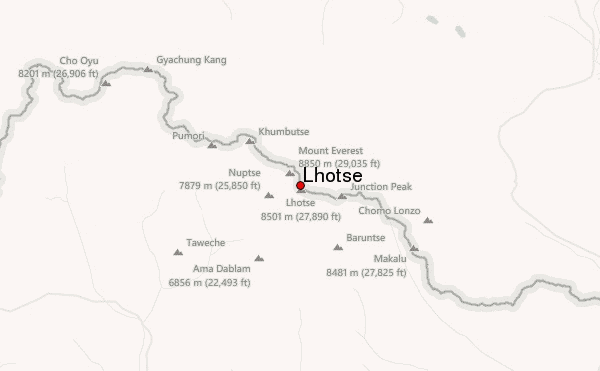
- Mount Lhotse, the fourth highest peak in the world at 8501 metres.
- Cyclonic Storm named ‘ROANU’ developed Over West Central region of Bay of Bengal
- Trikuta hills present in Jammu & Kashmir (News-Forest Fire)
Receive Daily Updates
Recent Posts
Petrol in India is cheaper than in countries like Hong Kong, Germany and the UK but costlier than in China, Brazil, Japan, the US, Russia, Pakistan and Sri Lanka, a Bank of Baroda Economics Research report showed.
Rising fuel prices in India have led to considerable debate on which government, state or central, should be lowering their taxes to keep prices under control.
The rise in fuel prices is mainly due to the global price of crude oil (raw material for making petrol and diesel) going up. Further, a stronger dollar has added to the cost of crude oil.
Amongst comparable countries (per capita wise), prices in India are higher than those in Vietnam, Kenya, Ukraine, Bangladesh, Nepal, Pakistan, Sri Lanka, and Venezuela. Countries that are major oil producers have much lower prices.
In the report, the Philippines has a comparable petrol price but has a per capita income higher than India by over 50 per cent.
Countries which have a lower per capita income like Kenya, Bangladesh, Nepal, Pakistan, and Venezuela have much lower prices of petrol and hence are impacted less than India.
“Therefore there is still a strong case for the government to consider lowering the taxes on fuel to protect the interest of the people,” the report argued.
India is the world’s third-biggest oil consuming and importing nation. It imports 85 per cent of its oil needs and so prices retail fuel at import parity rates.
With the global surge in energy prices, the cost of producing petrol, diesel and other petroleum products also went up for oil companies in India.
They raised petrol and diesel prices by Rs 10 a litre in just over a fortnight beginning March 22 but hit a pause button soon after as the move faced criticism and the opposition parties asked the government to cut taxes instead.
India imports most of its oil from a group of countries called the ‘OPEC +’ (i.e, Iran, Iraq, Saudi Arabia, Venezuela, Kuwait, United Arab Emirates, Russia, etc), which produces 40% of the world’s crude oil.
As they have the power to dictate fuel supply and prices, their decision of limiting the global supply reduces supply in India, thus raising prices
The government charges about 167% tax (excise) on petrol and 129% on diesel as compared to US (20%), UK (62%), Italy and Germany (65%).
The abominable excise duty is 2/3rd of the cost, and the base price, dealer commission and freight form the rest.
Here is an approximate break-up (in Rs):
a)Base Price | 39 |
b)Freight | 0.34 |
c) Price Charged to Dealers = (a+b) | 39.34 |
d) Excise Duty | 40.17 |
e) Dealer Commission | 4.68 |
f) VAT | 25.35 |
g) Retail Selling Price | 109.54 |
Looked closely, much of the cost of petrol and diesel is due to higher tax rate by govt, specifically excise duty.
So the question is why government is not reducing the prices ?
India, being a developing country, it does require gigantic amount of funding for its infrastructure projects as well as welfare schemes.
However, we as a society is yet to be tax-compliant. Many people evade the direct tax and that’s the reason why govt’s hands are tied. Govt. needs the money to fund various programs and at the same time it is not generating enough revenue from direct taxes.
That’s the reason why, govt is bumping up its revenue through higher indirect taxes such as GST or excise duty as in the case of petrol and diesel.
Direct taxes are progressive as it taxes according to an individuals’ income however indirect tax such as excise duty or GST are regressive in the sense that the poorest of the poor and richest of the rich have to pay the same amount.
Does not matter, if you are an auto-driver or owner of a Mercedes, end of the day both pay the same price for petrol/diesel-that’s why it is regressive in nature.
But unlike direct tax where tax evasion is rampant, indirect tax can not be evaded due to their very nature and as long as huge no of Indians keep evading direct taxes, indirect tax such as excise duty will be difficult for the govt to reduce, because it may reduce the revenue and hamper may programs of the govt.