


Indian researchers exploring the Arctic
From metering the precipitation in the Arctic region to drawing up a baseline data on microbial biodiversity in Kongsfjorden sediments and carrying out a biochemical evaluation and biomarker characterisation of Arctic fjord sediments, Indian researchers are into a series of scientific investigations in the icy terrains of Arctic.
Working from Himadri, country’s Arctic research station at Spitsbergen, Norway, the scientists are looking into the various aspects of life that thrives there to gain a better understanding about the climatological factors that influence the Arctic weather and its impact on climate changes elsewhere.
The researchers of the National Centre for Antarctic and Ocean Research, Goa, specializing in atmospheric sciences, will look into the variability of precipitation over Arctic and the precipitation will be measured using Micro Rain Radar. The temperature and humidity profiles of the region will be created using a microwave radiometer profiler.
They hope to “fill the gaps in the observational data on Arctic clouds, especially during the dark winter season, by recording measurements using a ceilometer to measure the vertical profiles of multiple cloud layers,” according to a research document. The long-term monitoring of Kongsfjorden system of Arctic region for climate change studies has also been the mandate of the Centre during the current assignment.
An environmental specialist from the Mahatma Gandhi University, Kerala, will pay attention to the long term environmental monitoring of fjord ecosystems, especially the ecosystem of Kongsfjorden and Krossfjorden. The water and sediment chemistry with respect to climate change in the fjords will be the focus area of research. Different teams will be carrying several studies. For instance, the biochemical evaluation and biomarker characterization from Arctic fjord sediments is the task assigned to the chemical oceanographer from the Kerala University for Fisheries and Ocean Studies.
The zooplankton ecology and planktonic food web dynamics in Kongsfjorden will be studied using in-situ and satellite oceanography techniques by another team. The impact of glacial runoff and associated arctic freshening on microbial community structure will also be assessed. A case study will be carried out in Kongsfjorden.
While trying to understand the macro-benthic faunal composition at selected locations in the Kongsjorden Fjord covering a length of 15 Km from the oceanic end to the glacial end of the Fjord, another scientist from the Cochin University of Science will look into the impact of glacial run-off and associated Arctic freshening of microbial community structure of Kongsfjorden.
Kongsfjorden
Kongsfjorden, an icy archipelago having a length of about 40 km and width ranging from 5 to 10 km, is a glacial fjord(a long, narrow, deep inlet of the sea between high cliffs, as in Norway and Iceland, typically formed by submergence of a glaciated valley) in the Arctic (Svalbard).
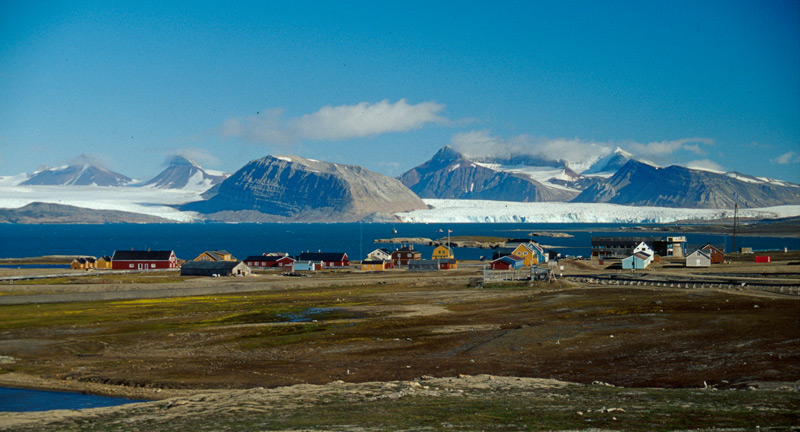
It lies in the northwest coast of Spitsbergen, the main island of Svalbard, and is a site where warmer waters of the Atlantic meet the colder waters of the Arctic.
Ever since India commenced her scientific activities in the Arctic realm, one of the major locales of study has been the Kongsfjorden system. Considering the scope of scientific research the locale afforded and the fact that an integrated study of the fjord has been has been identified as a flagship program of the Svalbard Research Program (SSF), NCAOR in consultation with the Norwegian Polar Institute (NPI) began exploring the feasibility of initiating a major long-term program on the fjord during 2009-10.
Objectives:
The overall objective of the studies planned is to establish a long-term comprehensive physical, chemical, biological and atmospheric measurement programme aimed at understanding:
- The variability in the Arctic/Atlantic climate signal by understanding the interaction between the freshwater from the glacial run-off and Atlantic water from the west Spitsbergen current.
- The effect of interaction between the warm Atlantic water and the cold glacial-melt fresh water on the biological productivity and phytoplankton species composition and diversity within the fjord.
- The winter convection and its role in the biogeochemical cycling.
- The trigger mechanism of spring bloom and its temporal variability and biomass production.
- The production and export of organic carbon in the fjord with a view to quantify the CO2 flux.
Cabinet approves India’s Membership of the International Continental Scientific Drilling Program
The Union Cabinet recently gave its approval for Indian membership of the International Continental Scientific Drilling Program (ICDP) consortium by signing an MoU with the Helmholtz Centre Potsdam GFZ German Research Centre for geosciences. This is a government-funded, Public Law Foundation of the State of Brandenburg, Germany.
Details:
- After signing the MoU on the membership for a period of five years with ICDP, India would enable engaging internationally renowned experts with profound expertise in different aspects of scientific drilling in order to accomplish deep drilling and associated investigations in Koyna region.
- India will get a seat on two ICDP panels – Executive Committee (EC) and Assembly of Governors (AOG). Also, ICDP will provide technical / operational support, facilitate capacity building in terms of manpower training in key scientific areas, sample and data management and support workshops for the Koyna scientific deep drilling project undertaken by Ministry of Earth Sciences.
- As a member of ICDP, scientists/engineers from India would have right to submit proposals, to participate in all ICDP co-funded workshops and drilling projects and have access to all data results from ICDP projects. This will shed new light on the genesis of seismicity and better understanding of earthquake processes.
International Continental Scientific Drilling Program:
It is a multinational program to further and fund geosciences in the field of Continental Scientific Drilling. It was founded in February 1996 in the German Embassy in Tokyo as a result of the German Continental Deep Drilling Program.
Swadesh Darshan Scheme
The Ministry of Tourism has launched the Swadesh Darshan Scheme in 2014-15 with an aim to develop theme based tourist circuits in the country on the principles of high tourist value, competitiveness and sustainability in an integrated manner by synergizing efforts to focus on needs and concerns of all stakeholders to enrich tourist experience and enhance employment opportunities.
Under the Swadesh Darshan scheme, thirteen thematic circuits have been identified, for development namely:
- North-East India Circuit,
- Buddhist Circuit,
- Himalayan Circuit,
- Coastal Circuit,
- Krishna Circuit,
- Desert Circuit,
- Tribal Circuit,
- Eco Circuit,
- Wildlife Circuit,
- Rural Circuit,
- Spiritual Circuit,
- Ramayana Circuit
- Heritage Circuit.
Receive Daily Updates
Recent Posts
Petrol in India is cheaper than in countries like Hong Kong, Germany and the UK but costlier than in China, Brazil, Japan, the US, Russia, Pakistan and Sri Lanka, a Bank of Baroda Economics Research report showed.
Rising fuel prices in India have led to considerable debate on which government, state or central, should be lowering their taxes to keep prices under control.
The rise in fuel prices is mainly due to the global price of crude oil (raw material for making petrol and diesel) going up. Further, a stronger dollar has added to the cost of crude oil.
Amongst comparable countries (per capita wise), prices in India are higher than those in Vietnam, Kenya, Ukraine, Bangladesh, Nepal, Pakistan, Sri Lanka, and Venezuela. Countries that are major oil producers have much lower prices.
In the report, the Philippines has a comparable petrol price but has a per capita income higher than India by over 50 per cent.
Countries which have a lower per capita income like Kenya, Bangladesh, Nepal, Pakistan, and Venezuela have much lower prices of petrol and hence are impacted less than India.
“Therefore there is still a strong case for the government to consider lowering the taxes on fuel to protect the interest of the people,” the report argued.
India is the world’s third-biggest oil consuming and importing nation. It imports 85 per cent of its oil needs and so prices retail fuel at import parity rates.
With the global surge in energy prices, the cost of producing petrol, diesel and other petroleum products also went up for oil companies in India.
They raised petrol and diesel prices by Rs 10 a litre in just over a fortnight beginning March 22 but hit a pause button soon after as the move faced criticism and the opposition parties asked the government to cut taxes instead.
India imports most of its oil from a group of countries called the ‘OPEC +’ (i.e, Iran, Iraq, Saudi Arabia, Venezuela, Kuwait, United Arab Emirates, Russia, etc), which produces 40% of the world’s crude oil.
As they have the power to dictate fuel supply and prices, their decision of limiting the global supply reduces supply in India, thus raising prices
The government charges about 167% tax (excise) on petrol and 129% on diesel as compared to US (20%), UK (62%), Italy and Germany (65%).
The abominable excise duty is 2/3rd of the cost, and the base price, dealer commission and freight form the rest.
Here is an approximate break-up (in Rs):
a)Base Price | 39 |
b)Freight | 0.34 |
c) Price Charged to Dealers = (a+b) | 39.34 |
d) Excise Duty | 40.17 |
e) Dealer Commission | 4.68 |
f) VAT | 25.35 |
g) Retail Selling Price | 109.54 |
Looked closely, much of the cost of petrol and diesel is due to higher tax rate by govt, specifically excise duty.
So the question is why government is not reducing the prices ?
India, being a developing country, it does require gigantic amount of funding for its infrastructure projects as well as welfare schemes.
However, we as a society is yet to be tax-compliant. Many people evade the direct tax and that’s the reason why govt’s hands are tied. Govt. needs the money to fund various programs and at the same time it is not generating enough revenue from direct taxes.
That’s the reason why, govt is bumping up its revenue through higher indirect taxes such as GST or excise duty as in the case of petrol and diesel.
Direct taxes are progressive as it taxes according to an individuals’ income however indirect tax such as excise duty or GST are regressive in the sense that the poorest of the poor and richest of the rich have to pay the same amount.
Does not matter, if you are an auto-driver or owner of a Mercedes, end of the day both pay the same price for petrol/diesel-that’s why it is regressive in nature.
But unlike direct tax where tax evasion is rampant, indirect tax can not be evaded due to their very nature and as long as huge no of Indians keep evading direct taxes, indirect tax such as excise duty will be difficult for the govt to reduce, because it may reduce the revenue and hamper may programs of the govt.