


1)Ice Man of India and Artificial Glacier :-
- Chewang Norphel is an Indian civil engineer from Ladakh, who has built 12 artificial glaciers.He has earned the nickname Ice Man.
- Ladakh is known for its receding glaciers and the people in the region face hardships to obtain water , Norphel came up with an brilliant idea of artificial glacier to store the water longer there by extending the availability of water for longer period .
- Artificial Glaciers:-
- In 1996, Norphel joined the Leh Nutrition Project, a non-governmental organisation, as project manager for watershed development
- Norphel noticed a small stream had frozen solid under the shade of a group of poplar trees, though it flowed freely elsewhere in his yard. He realized the reason for this phenomenon: the flowing water was moving too quickly to freeze, while the sluggish trickle of water beneath the trees was slow enough to freeze. Based on this, he created artificial glaciers by diverting a river into a valley, slowing the stream by constructing checks. The artificial glaciers increase the ground-water recharge, rejuvenating the spring and providing water for irrigation. He constructed them at lower elevations, so that they melt earlier, expanding the growing season.
- The biggest artificial glacier, 1000 ft long and 150 ft wide, with an average depth of 4ft, is situated near the village of Phuktsey. Having cost $2,000, it now provides water for the village of 700 people.Cement water reservoirs of similar capacities typically cost $34,000.

- Documentary :- http://climateheroes.org/portfolio-item/chewang-norphel-ice-mans-dams-himalayas/

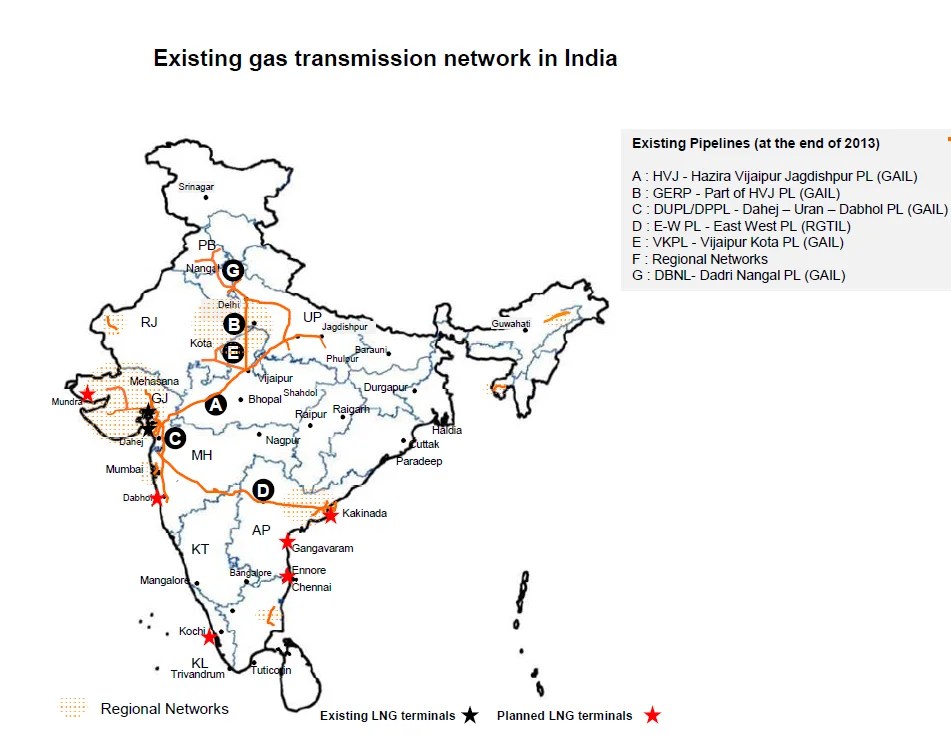
2) National Gas Grid and Expansion of Gas Pipeline Project :-
- At present, the country is having about 15,000 kms of natural gas pipeline infrastructure and an additional 15,000 kms of pipeline is required for completion of National Gas Grid.
- GAIL has been appointed as the “Sponsoring Authority” for development of Ranchi-Talcher-Paradip pipeline as a pilot project under PPP mode with Viability Gap Funding.
- Government has taken several steps which inter alia include the following:–
- Intensification of domestic Exploration & Production (E&P) activities through New Exploration Licensing Policy (NELP) rounds
- Shale Gas Policy framework
- Research and development of Gas Hydrate resources in the country
- Import of Liquefied Natural Gas (LNG) from various countries
- Transnational pipelines viz., Turkmenistan-Afghanistan-Pakistan-India (TAPI) pipeline and Iran-Pakistan-India(IPI) pipeline
- Clearance for exploration and development of some NELP blocks where the same was held up by various agencies
- Exploration in the Mining Lease Area has been allowed with certain conditions
- Acquisition of Overseas Oil and Gas assets is being pursued in order to enhance energy security for the country

3)Bharat Stage Emission Standards :-
News:- Government advances roll out of BS-V and BS-VI norms for 4-wheelers .According to the roadmap earlier laid down by the Auto Fuel Policy, BS-V norms were to be implemented from April 1, 2022 and BS-VI from April 1, 2024.
What is Bharat Stage Emission Standard:-
Bharat stage emission standards are emission standards instituted by the Government of India to regulate the output of air pollutants from internal combustion engine equipment, including motor vehicles. The standards and the timeline for implementation are set by the Central Pollution Control Board under the Ministry of Environment & Forests and climate change.
The standards, based on European regulations were first introduced in 2000. Progressively stringent norms have been rolled out since then. All new vehicles manufactured after the implementation of the norms have to be compliant with the regulations.Since October 2010, Bharat stage III norms have been enforced across the country. In 13 major cities, Bharat stage IV emission norms have been in place since April 2010.
The phasing out of 2 stroke engine for two wheelers, the stoppage of production of Maruti 800 & introduction of electronic controls have been due to the regulations related to vehicular emissions.
While the norms help in bringing down pollution levels, it invariably results in increased vehicle cost due to the improved technology & higher fuel prices. However, this increase in private cost is offset by savings in health costs for the public, as there is lesser amount of disease causing particulate matter and pollution in the air. Exposure to air pollution can lead to respiratory and cardiovascular diseases, which is estimated to be the cause for 620,000 early deaths in 2010, and the health cost of air pollution in India has been assessed at 3 per cent of its GDP.
4)Injectable vaccine to prevent re-emergence of polio launched:
- An injectable vaccine to prevent re-emergence of polio was launched today by the government and it will be administered in addition to polio drops to double the protection from the deadly virus, which has chances of coming back.
- The Inactivated Polio Vaccine (IPV) will be introduced in the routine immunization programme of the government to do away with the risk of re-introduction of the disease.
5) eBird: India lists 20 lakh sightings :-
- Bird enthusiasts of India are scripting a popular science record of sorts. Till last month, over 4,000 dedicated volunteer birders have uploaded over 20 lakh bird sightings from India, which has caught even the seasoned ornithologists pleasantly off guard. Birders of all hues and shades are flocking together with their bird sighting data on an electronic platform eBird (www.ebird.org) in a big way.
- According to the site, anyone taking a stroll or even peering from a window can contribute to the careful documentation of nature. eBird is a “platform for birdwatchers” to upload their data and keep track of their sightings.
6)A generation at Risk : The Diabetic Epidemic:-
The Risk:-
- Chronic conditions or non-communicable diseases are virtually lifelong diseases; they can be managed and controlled, but in most cases not cured fully. Examples are diseases of the heart and blood vessels, diabetes, lungs, chronic kidney disease, cancers and arthritis.
- Diabetes has now become a major public health concern especially in India because of several reasons
- Today, over 300 million people live with diabetes. A similar number is at high risk. India has often been referred to as the “diabetes capital of the world” but has now ceded this position to China. According to the International Diabetes Federation, over 66 million people in India live with this metabolic disease; an almost equal number has pre-diabetes which is an immediate precursor to diabetes. The belief is that diabetes is an urban and rich man’s disease but we now know that the annual increase in the numbers of those with diabetes is much higher in the rural areas, poor individuals and those less educated
- Generally, the rise in numbers has been attributed to chaotic urbanisation, an ageing population, reduced physical activity/deskbound lifestyle and a change in diet patterns which includes consuming junk food. Other factors include genetic susceptibility, under-nutrition during foetal and early life and environmental pollutants
- The rapidly changing lifestyle of children is equally important; they are now more sedentary than earlier generations. Most Indians also have abdominal obesity (“pot-belly”) which has a role in the development of diabetes.
- If this continues unchecked, an already overloaded and inefficient health system will run out of solutions. What is needed are prevention and management strategies
The Solution:-
- Public awareness and promotion of healthy diet and way of living is important
- Non-personal policy interventions also play an important role. These include taxation, enabling urban infrastructure development particularly in the new ‘Smart City’ plan, encouraging right agricultural practices and reducing sugar consumption, an increased and daily intake of fruits, vegetables and whole grain-based food and a promotion of physical activity. These are cost-effective and prventive strategies. For example, a 20 per cent increase in taxation on sweetened beverages helped reduce new cases of diabetes by 1.6 per cent over 2014-2023. This means that 400,000 type-2 cases of diabetes can be prevented during the same decade.
- Strengthening health systems at the primary care level is imperative and involves providing low-cost generic drugs, long-term management of the disease with health counselling and a robust surveillance mechanism to study changing trends and progress.
- Here, innovations include developing a cadre of physician assistants to schedule and manage diabetes care, yoga as a lifestyle [improvement] package, self-care apps and innovative use of gaming technologies to improve physical activity.
Questions of the Day
1)Find the incorrect match among the following:-
- Ice Man of India- Chewang Norphel- Ladakh
- Waterman of India – Rajendra Singh- Rajasthan
- Mountain man of India – Dashrath Manjhi – Bihar
- Forest Man of India – Jadav Payeng- Arunachal Pradesh
2)Check the photo and find out the following :-

- What is this Picture ?
- Which kingdom it was related to ?
- Why was it in the recent news ?
3)Find the wrong statement:-
- India has largest no of Diabetic patient in the world
- Diabetes is a lifestyle disease . It also has hereditary implication
- Type-2 Diabetics is most wide spread
- Healthy diet and regular exercise can prevent this disease.
Answers Given By BodhiSatva in Comment sections are correct.
Receive Daily Updates
Recent Posts
[wptelegram-join-channel link=”https://t.me/s/upsctree” text=”Join @upsctree on Telegram”]2021 WEF Global Gender Gap report, which confirmed its 2016 finding of a decline in worldwide progress towards gender parity.
Over 2.8 billion women are legally restricted from having the same choice of jobs as men. As many as 104 countries still have laws preventing women from working in specific jobs, 59 countries have no laws on sexual harassment in the workplace, and it is astonishing that a handful of countries still allow husbands to legally stop their wives from working.
Globally, women’s participation in the labour force is estimated at 63% (as against 94% of men who participate), but India’s is at a dismal 25% or so currently. Most women are in informal and vulnerable employment—domestic help, agriculture, etc—and are always paid less than men.
Recent reports from Assam suggest that women workers in plantations are paid much less than men and never promoted to supervisory roles. The gender wage gap is about 24% globally, and women have lost far more jobs than men during lockdowns.
The problem of gender disparity is compounded by hurdles put up by governments, society and businesses: unequal access to social security schemes, banking services, education, digital services and so on, even as a glass ceiling has kept leadership roles out of women’s reach.
Yes, many governments and businesses had been working on parity before the pandemic struck. But the global gender gap, defined by differences reflected in the social, political, intellectual, cultural and economic attainments or attitudes of men and women, will not narrow in the near future without all major stakeholders working together on a clear agenda—that of economic growth by inclusion.
The WEF report estimates 135 years to close the gap at our current rate of progress based on four pillars: educational attainment, health, economic participation and political empowerment.
India has slipped from rank 112 to 140 in a single year, confirming how hard women were hit by the pandemic. Pakistan and Afghanistan are the only two Asian countries that fared worse.
Here are a few things we must do:
One, frame policies for equal-opportunity employment. Use technology and artificial intelligence to eliminate biases of gender, caste, etc, and select candidates at all levels on merit. Numerous surveys indicate that women in general have a better chance of landing jobs if their gender is not known to recruiters.
Two, foster a culture of gender sensitivity. Take a review of current policies and move from gender-neutral to gender-sensitive. Encourage and insist on diversity and inclusion at all levels, and promote more women internally to leadership roles. Demolish silos to let women grab potential opportunities in hitherto male-dominant roles. Work-from-home has taught us how efficiently women can manage flex-timings and productivity.
Three, deploy corporate social responsibility (CSR) funds for the education and skilling of women and girls at the bottom of the pyramid. CSR allocations to toilet building, the PM-Cares fund and firms’ own trusts could be re-channelled for this.
Four, get more women into research and development (R&D) roles. A study of over 4,000 companies found that more women in R&D jobs resulted in radical innovation. It appears women score far higher than men in championing change. If you seek growth from affordable products and services for low-income groups, women often have the best ideas.
Five, break barriers to allow progress. Cultural and structural issues must be fixed. Unconscious biases and discrimination are rampant even in highly-esteemed organizations. Establish fair and transparent human resource policies.
Six, get involved in local communities to engage them. As Michael Porter said, it is not possible for businesses to sustain long-term shareholder value without ensuring the welfare of the communities they exist in. It is in the best interest of enterprises to engage with local communities to understand and work towards lowering cultural and other barriers in society. It will also help connect with potential customers, employees and special interest groups driving the gender-equity agenda and achieve better diversity.