


1)India to sell rupee bonds:-
- The Union Government has decided to launch Rupee Bonds “in some countries” to provide long term finance for infrastructure development in the country.
- This will be in addition to the setting up National Investment and Infrastructure Fund and launching of Tax Free Infrastructure Bonds.
- These bonds are also called Masala Bonds.
- It will help as alternate financing and easy the forex pressure on India.
2)Jan Aushadhi:-
- The Government has launched ‘Jan Aushadhi Scheme’ to make available quality generic medicines at affordable prices to all, especially the poor, throughout the country, through outlets known as Jan Aushadhi Stores (JASs)
- Under the Jan Aushadhi Scheme, the State Governments are required to provide space in Government Hospital premises or any other suitable locations for the running of the Jan Aushadhi Stores (JAS)
- Any NGO/Charitable Society/Institution/Self Help Group with experience of minimum 3 years of successful operation in welfare activities, can also open the Jan Aushadhi store outside the hospital premises
Bottlenecks in the scheme:-
- Over dependence on support from State Government.
- Poor Supply Chain management.
- Non-prescription of Generic Medicines by the doctors.
- State Governments launching free supply of drugs
- Lack of awareness among the public
Remedial Measures :-
- Increasing the number of products from 361 to 504 medicines and 161 surgical and consumable items
- Improving the supply chain mechanism through appointing Distributors and C&F agents in different States.
- Increasing the number of functional stores.
- Strengthening the Operating Agency i.e., BPPI(Bureau of Pharma PSUs of India (BPPI)) through augmenting of manpower.
- Relaxation in the eligibility criteria of Operating Agency for JAS.
3) The Man who Knew his Cows – Verghese Kurien
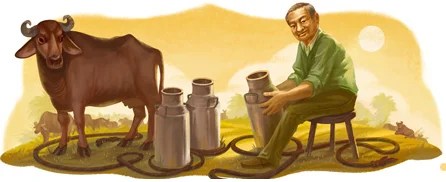
News:- Google has dedicated a doodle on him.
- Verghese Kurien (26 November 1921 – 9 September 2012) was an Indian social entrepreneur known as the “Father of the White Revolution” for his Operation Flood, the world’s largest agricultural development programme. National Milk Day is celebrated on his birth anniversary.
- This transformed India from a milk-deficient nation to the world’s largest milk producer, surpassing the United States of America in 1998,with about 17 percent of global output in 2010–11, which in 30 years doubled milk available to every person.
- He founded around 30 institutions of excellence (like AMUL, GCMMF, IRMA, NDDB) which are owned, managed by farmers and run by professionals. As the founding chairman of the Gujarat Co-operative Milk Marketing Federation (GCMMF), Kurien was responsible for the creation and success of the Amul brand of dairy products. A key achievement at Amul was the invention of milk powder processed from buffalo milk
Operation Flood :-
- Milk is a highly perishable commodity, which is in short supply in summer and in excess supply in winter . The market can not contract and expand according to supply, therefore, you need balancing facilities. And once you have these balancing facilities, which you enable to carry forward the winter production and capture the market, procurement falls into your laps. This was the objective and methodology of Operation Flood.
- Through Operation Flood, milk has been transformed from a commodity into a brand, from insufficient production to sufficient production, from rationing to plentiful availability; from loose unhygienic milk to milk that is pure and sure, from subjugation to as symbol of farmer’s economic independence, to being the consumer’s greatest insurance policy for good health.
- Operation Flood has three major achievements to its credit: making dairying India’s largest self-sustainable rural employment program; bringing India self-sufficiency in milk production; trebling the nation’s milk production within a span of two and half decades to make India the world’s largest milk producer.
His Words:-
- Milk is the only commodity which has to be collected twice a day, every day of the year. Thus, cooperatives are the only logical system for the dairy industry. About 85% of the industry in the US, Denmark and Australia is run by cooperatives. No other system will work for milk
Trivia:- It is well known that who are selected in UPSC , as part of their Bharat Darshan , they get a chance to meet Mr Kurien and most of them who encountered him ,knows his passionate dislike for bureaucracy .(Not bureaucrats as such but the way of working of Bureaucracy)
4) SEBI and BSEC Sign MoU :-
- The Securities and Exchange Board of India (Sebi) on Sunday signed a memorandum of understanding (MoU) with the Bangladesh Securities and Exchange Commission (BSEC) on co-operation and technical assistance.
- The MoU is aimed at promoting economic links, enhancing investor protection, and development of capital markets. Sebi has so far signed MoUs with 21 nations
About :-
The Securities and Exchange Board of India (SEBI) is the regulator for the securities market in India.It was established in the year 1988 and given statutory powers on 12 April 1992 through the SEBI Act, 1992.
Composition:-
- The chairman who is nominated by Union Government of India.
- Two members, i.e., Officers from Union Finance Ministry.
- One member from the Reserve Bank of India.
- The remaining five members are nominated by Union Government of India, out of them at least three shall be whole-time members.
Function:-
- Approve by−laws of stock exchanges.
- Require the stock exchange to amend their by−laws.
- Inspect the books of accounts and call for periodical returns from recognized stock exchanges.
- Inspect the books of accounts of financial intermediaries.
- Compel certain companies to list their shares in one or more stock exchanges.
- Registration of brokers.
Question to think over :-
At the time of Independence , India had a functioning stock market, a fairly developed banking sector and well developed corporate practices , then why it took so long to create a regulator for stock exchange such as SEBI ( created in 1992 when we got independence in 1947 )
Try to find the answer yourself and post it if you like .
Receive Daily Updates
Recent Posts
[wptelegram-join-channel link=”https://t.me/s/upsctree” text=”Join @upsctree on Telegram”]2021 WEF Global Gender Gap report, which confirmed its 2016 finding of a decline in worldwide progress towards gender parity.
Over 2.8 billion women are legally restricted from having the same choice of jobs as men. As many as 104 countries still have laws preventing women from working in specific jobs, 59 countries have no laws on sexual harassment in the workplace, and it is astonishing that a handful of countries still allow husbands to legally stop their wives from working.
Globally, women’s participation in the labour force is estimated at 63% (as against 94% of men who participate), but India’s is at a dismal 25% or so currently. Most women are in informal and vulnerable employment—domestic help, agriculture, etc—and are always paid less than men.
Recent reports from Assam suggest that women workers in plantations are paid much less than men and never promoted to supervisory roles. The gender wage gap is about 24% globally, and women have lost far more jobs than men during lockdowns.
The problem of gender disparity is compounded by hurdles put up by governments, society and businesses: unequal access to social security schemes, banking services, education, digital services and so on, even as a glass ceiling has kept leadership roles out of women’s reach.
Yes, many governments and businesses had been working on parity before the pandemic struck. But the global gender gap, defined by differences reflected in the social, political, intellectual, cultural and economic attainments or attitudes of men and women, will not narrow in the near future without all major stakeholders working together on a clear agenda—that of economic growth by inclusion.
The WEF report estimates 135 years to close the gap at our current rate of progress based on four pillars: educational attainment, health, economic participation and political empowerment.
India has slipped from rank 112 to 140 in a single year, confirming how hard women were hit by the pandemic. Pakistan and Afghanistan are the only two Asian countries that fared worse.
Here are a few things we must do:
One, frame policies for equal-opportunity employment. Use technology and artificial intelligence to eliminate biases of gender, caste, etc, and select candidates at all levels on merit. Numerous surveys indicate that women in general have a better chance of landing jobs if their gender is not known to recruiters.
Two, foster a culture of gender sensitivity. Take a review of current policies and move from gender-neutral to gender-sensitive. Encourage and insist on diversity and inclusion at all levels, and promote more women internally to leadership roles. Demolish silos to let women grab potential opportunities in hitherto male-dominant roles. Work-from-home has taught us how efficiently women can manage flex-timings and productivity.
Three, deploy corporate social responsibility (CSR) funds for the education and skilling of women and girls at the bottom of the pyramid. CSR allocations to toilet building, the PM-Cares fund and firms’ own trusts could be re-channelled for this.
Four, get more women into research and development (R&D) roles. A study of over 4,000 companies found that more women in R&D jobs resulted in radical innovation. It appears women score far higher than men in championing change. If you seek growth from affordable products and services for low-income groups, women often have the best ideas.
Five, break barriers to allow progress. Cultural and structural issues must be fixed. Unconscious biases and discrimination are rampant even in highly-esteemed organizations. Establish fair and transparent human resource policies.
Six, get involved in local communities to engage them. As Michael Porter said, it is not possible for businesses to sustain long-term shareholder value without ensuring the welfare of the communities they exist in. It is in the best interest of enterprises to engage with local communities to understand and work towards lowering cultural and other barriers in society. It will also help connect with potential customers, employees and special interest groups driving the gender-equity agenda and achieve better diversity.