1)Demystifying the Mysterious MYANMAR – Its geography, Its History ,Its Politics and Its India Connection :-

News:- Myanmar Political Transformation.

Introduction :- For larger part Myanmar has remained a Mystery to this generation of Indians. But two generations before (grandparents) , people used to talk about Rangoon as we talk about US or Europe today.One would have heard growing up about the Rangoon Tales.It was the city which provided large-scale employment to their generation.Growing up, few of us knew Burma but almost all of us came across the stories of Rangoon.It is so true for the inhabitants of Eastern coast – from Bengal to Tamilnadu.One is unsure whether it has the same significance in lives of other parts of Indians, but nevertheless stories has traveled far and wide.

Today, Rangoon is officially not even Rangoon, and Burma is not Burma. The military government renamed the country Myanmar and the capital Yangon. But, the country’s most famous citizen, the opposition leader Aung San Suu Kyi, still calls it Rangoon, as do most people. Five years ago, the generals abandoned Rangoon/ Yangon altogether, moving the capital 300 km up-country to a newly built city called Napyidaw.

Geography :-

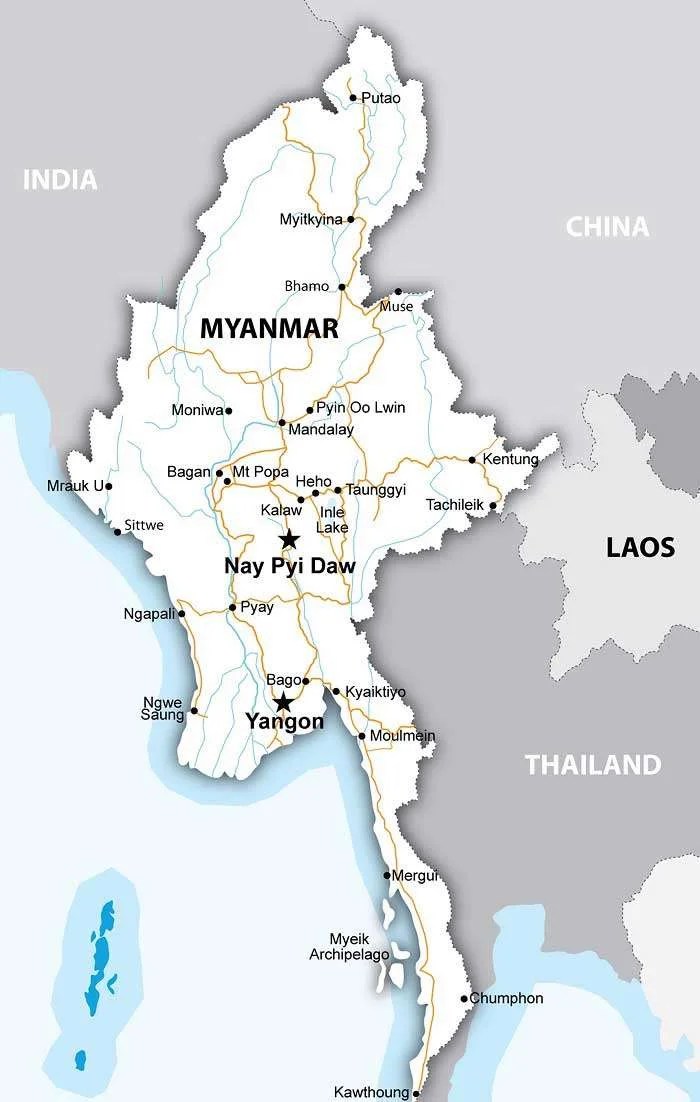
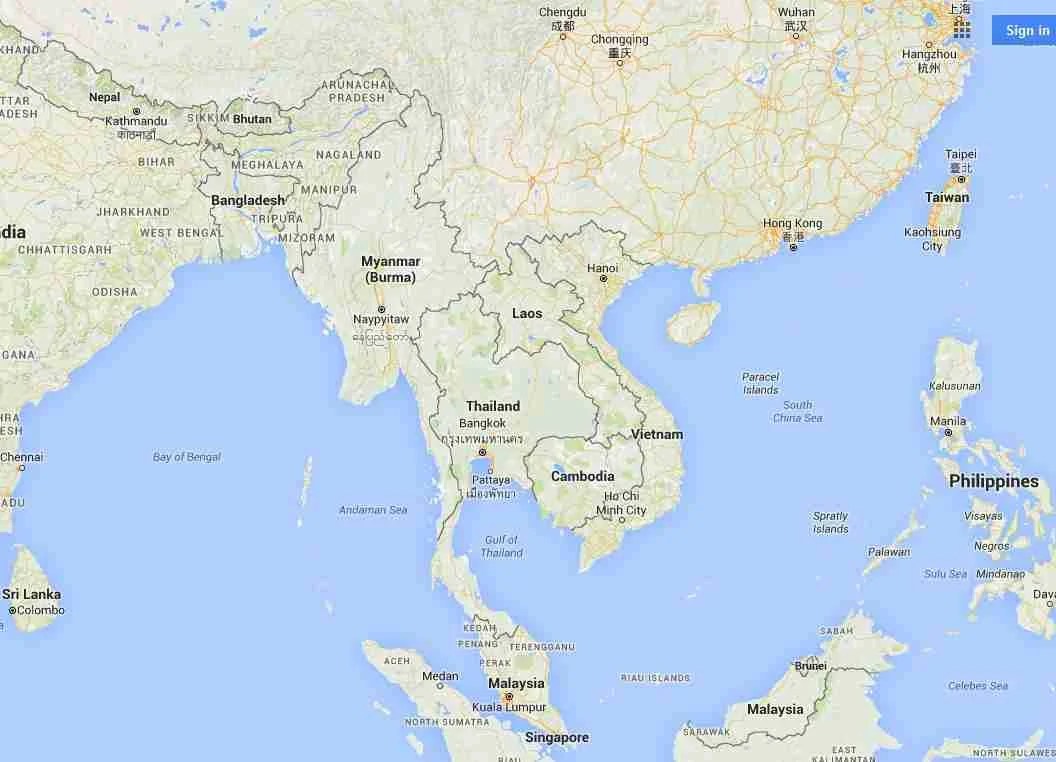
Myanmar, a republic in South-East Asia, bounded on the north by Tibet Autonomous Region of China; on the east by China, Laos, and Thailand; on the south by the Andaman Sea and the Bay of Bengal; and on the west by the Bay of Bengal, Bangladesh, and India. It is officially known as the Union of Myanmar. The coastal region is known as Lower Myanmar, while the interior region is known as Upper Myanmar

A horseshoe-shaped mountain complex and the valley of the Ayarwaddy (Irrawaddy) River system are the dominant topographical features of Myanmar.Irrawaddy Dolphins are usually sighted in the waters of  eastern coast of India
myanmar-compressed

myanmar-map

  • From  India to Myanmar on road:-
    • The road is known as  Tamu-Kalewa-Kalemyo (kale), otherwise known as  Friendship road
    • Tamu-Kalewa-Kalemyo road-compressed

Religion:-

Over 80 percent of Myanmar embraces are Theravada Buddhism. There are Christians, Muslims, Hindus and some animists.

Burma or Myanmar:-

In English, the country is popularly known as either “Burma” or “Myanmar”  . Both these names are derived from the name of the majority Burmese Bamar ethnic group. Myanmar is considered to be the literary form of the name of the group, while Burma is derived from “Bamar”, the colloquial form of the group’s name. Depending on the register used, the pronunciation would be “Bama”  or “Myamah”. The name Burma has been in use in English since the 18th century.

In 1989, the military government officially changed the English translations of many names dating back to Burma’s colonial period or earlier, including that of the country itself: “Burma” became “Myanmar”.

History:-

Myanmar has a long history and its greatness dates back to the early 11th Century when King Anawrahta unified the country and founded the First Myanmar Empire in Bagan more than 20 years before the Norman Conquest of England in 1066.

King Alaungpaya founded the last Myanmar Dynasty in 1752 and it was during the zenith of this Empire that the British moved into Myanmar Wars in 1825. During The Second World War, Myanmar was occupied by the Japanese from 1942 till the return of the Allied Forces in 1945. Myanmar becomes a sovereign independent state in January 1948 after more than 100 years of colonial administration.

Bagan City:-

Bagan City myanmar-compressed

Culture:-

Myanmar lies on the crossroad of two of the world’s great civilizations – China and India – but its culture is neither that of India nor that of China exclusively, but a blend of both interspersed with Myanmar native traits and characteristics. Buddhism has great influence on daily life of the Myanmar. The people have preserved the traditions of close family ties, respect for the elders, reverence for Buddhism and simple native dress.  Myanmar people are contented and cheerful even in the face of adversities and known for their simple hospitality and friendliness.

Currency:-

The local currency is the “Kyat” which is divided into 100 pyas.

Politics :-

  • Historically, Burma was a monarchy ruled by various dynasties prior to the 19th century. The British colonised Burma in the late 19th century, and it was under the jurisdiction of the British Raj until 1937
  • Burma was ruled as a British colony from 1885 until 1948.
  • Burma was granted its independence from Great Britain in 1948. By granting independence to Burma, the British government gave the new ruler, Aung San.
  • From the time of the signing of the Burmese Constitution in 1948, ethnic minorities have been denied Constitutional rights, access to lands that were traditionally controlled by their people and participation in the government. The various minority ethnic groups have been consistently oppressed by the dominant Burman majority, but have also suffered at the hands of warlords and regional ethnic alliances. Religion also plays a role in the ethnic conflicts that have taken place.
  • In 1962, General Ne Win led a coup d’état and established a nominally socialist military government that sought to follow the “Burmese Way to Socialism.” The military expropriated private businesses and followed an economic policy of autarky, or economic isolation.
  • There were sporadic protests against military rule during the Ne Win years and these were almost always violently suppressed.
  • Aung San Suu Kyi :- The light house of democracy in Burma
    • Aung San Suu Kyi is a Burmese opposition politician and chairman of the National League for Democracy (NLD) in Burma. In the 1990 general election, the NLD won 59% of the national votes and 81% (392 of 485) of the seats in Parliament.She had, however, already been detained under house arrest before the elections. She remained under house arrest in Burma for almost 15 of the 21 years from 20 July 1989 until her most recent release on 13 November 2010, becoming one of the world’s most prominent political prisoners.
    • Aung San Suu Kyi was born on 19 June 1945 in Rangoon (now named Yangon).Her father, Aung San, founded the modern Burmese army and negotiated Burma’s independence from the British Empire in 1947; he was assassinated by his rivals in the same year.
    • When Aung San Suu Kyi returned to Burma in 1988, the long-time military leader of Burma and head of the ruling party, General Ne Win, stepped down. Mass demonstrations for democracy followed that event on 8 August 1988 (8–8–88, a day seen as auspicious), which were violently suppressed in what came to be known as the 8888 Uprising.
    • Influenced by both Mahatma Gandhi’s philosophy of non-violence  and more specifically by Buddhist concepts, Aung San Suu Kyi entered politics to work for democratization, helped found the National League for Democracy on 27 September 1988.
    • One of her most famous speeches was Freedom From Fear, which began:    “It is not power that corrupts, but fear. Fear of losing power corrupts those who wield it and fear of the scourge of power corrupts those who are subject to it”
    • In the recently held elections,her party made a historic win. With her win , Myanmar seeks a smooth transition to true democracy.

India Connection :-

  • India had long historical relationship with Myanmar since antiquity, cultural exchanges included Buddhism and the Burmese script, which was based on the Indian Grantha script (somewhat related to Tamil & Malayalam Script)
  • India is the largest market for Burmese exports.
  • Mandalay – Tilak was sent to Mandalay prison by British.
  • India and Myanmar have agreed to a 4-lane, 3200 km triangular highway connecting India, Myanmar and Thailand. The route, which is expected to be completed by sometime during 2016, will run from India’s northeastern states into Myanmar, where over 1,600 km of roads will be built or improved.The route begins from Guwahati in India and connects to Mandalay in Myanmar, route continues to Yangon in Myanmar and then to Mae Sot in Thailand, which then continues to Bangkok.
  • The first phase connecting Guwahati to Mandalay is set to complete by 2016. This will eventually be extended to Cambodia and Vietnam under Mekong-Ganga Cooperation within the wider framework of Asian Highway Network. This is aimed at creating a new economic zone ranging from Kolkata on the Bay of Bengal to Ho Chi Minh City on the South China Sea.
  • India and Myanmar share a long land border of over 1600 km and a maritime boundary in the Bay of Bengal. A large population of Indian origin (according to some estimates about 2.5 million) lives in Myanmar. India and Myanmar signed a Treaty of Friendship in 1951.
  • India and Myanmar signed a border trade agreement in 1994 and have two operational border trade points (Moreh-Tamu and Zowkhatar –Rhi on the 1643 km long border. A third border trade point is proposed to be opened at Avakhung-Pansat/Somrai
  • Myanmar became a member of ASEAN in July 1997. As the only ASEAN country which shares a land border with India, Myanmar is a bridge between India and ASEAN.
  • Myanmar became a member of BIMSTEC in December 1997. Myanmar is a signatory to the BIMSTEC Free Trade Agreement. Myanmar is the lead country for the energy sector. Myanmar trades mostly with Thailand and India in the BIMSTEC region.Myanmar’s major exports to India are agricultural products like beans, pulses and maize and forest products such as teak and hardwoods. Its imports from India include chemical products, pharmaceuticals, electrical appliances and transport equipment.
  • Myanmar is a member of the Mekong Ganga Cooperation (MGC) since its inception in November 2000. MGC is an initiative by six countries – India and five ASEAN countries namely, Cambodia, Laos, Myanmar, Thailand and Vietnam – for cooperation in the fields of tourism, education, culture,transport and communication. The chairmanship of MGC is assumed by member countries in alphabetical order
  • Apart from the regional importance , Myanmar is strategically important to India, given the ,secessionist and insurgency presence of North-East region.Myanmar acts as a base for the insurgent groups and thick jungle becomes their safe haven.Hence Myanmar co-operation in counter-insurgency operation is vital.


Share is Caring, Choose Your Platform!

Receive Daily Updates

Stay updated with current events, tests, material and UPSC related news

Recent Posts

  • Petrol in India is cheaper than in countries like Hong Kong, Germany and the UK but costlier than in China, Brazil, Japan, the US, Russia, Pakistan and Sri Lanka, a Bank of Baroda Economics Research report showed.

    Rising fuel prices in India have led to considerable debate on which government, state or central, should be lowering their taxes to keep prices under control.

    The rise in fuel prices is mainly due to the global price of crude oil (raw material for making petrol and diesel) going up. Further, a stronger dollar has added to the cost of crude oil.

    Amongst comparable countries (per capita wise), prices in India are higher than those in Vietnam, Kenya, Ukraine, Bangladesh, Nepal, Pakistan, Sri Lanka, and Venezuela. Countries that are major oil producers have much lower prices.

    In the report, the Philippines has a comparable petrol price but has a per capita income higher than India by over 50 per cent.

    Countries which have a lower per capita income like Kenya, Bangladesh, Nepal, Pakistan, and Venezuela have much lower prices of petrol and hence are impacted less than India.

    “Therefore there is still a strong case for the government to consider lowering the taxes on fuel to protect the interest of the people,” the report argued.

    India is the world’s third-biggest oil consuming and importing nation. It imports 85 per cent of its oil needs and so prices retail fuel at import parity rates.

    With the global surge in energy prices, the cost of producing petrol, diesel and other petroleum products also went up for oil companies in India.

    They raised petrol and diesel prices by Rs 10 a litre in just over a fortnight beginning March 22 but hit a pause button soon after as the move faced criticism and the opposition parties asked the government to cut taxes instead.

    India imports most of its oil from a group of countries called the ‘OPEC +’ (i.e, Iran, Iraq, Saudi Arabia, Venezuela, Kuwait, United Arab Emirates, Russia, etc), which produces 40% of the world’s crude oil.

    As they have the power to dictate fuel supply and prices, their decision of limiting the global supply reduces supply in India, thus raising prices

    The government charges about 167% tax (excise) on petrol and 129% on diesel as compared to US (20%), UK (62%), Italy and Germany (65%).

    The abominable excise duty is 2/3rd of the cost, and the base price, dealer commission and freight form the rest.

    Here is an approximate break-up (in Rs):

    a)Base Price

    39

    b)Freight

    0.34

    c) Price Charged to Dealers = (a+b)

    39.34

    d) Excise Duty

    40.17

    e) Dealer Commission

    4.68

    f) VAT

    25.35

    g) Retail Selling Price

    109.54


    Looked closely, much of the cost of petrol and diesel is due to higher tax rate by govt, specifically excise duty.

    So the question is why government is not reducing the prices ?

    India, being a developing country, it does require gigantic amount of funding for its infrastructure projects as well as welfare schemes.

    However, we as a society is yet to be tax-compliant. Many people evade the direct tax and that’s the reason why govt’s hands are tied. Govt. needs the money to fund various programs and at the same time it is not generating enough revenue from direct taxes.

    That’s the reason why, govt is bumping up its revenue through higher indirect taxes such as GST or excise duty as in the case of petrol and diesel.

    Direct taxes are progressive as it taxes according to an individuals’ income however indirect tax such as excise duty or GST are regressive in the sense that the poorest of the poor and richest of the rich have to pay the same amount.

    Does not matter, if you are an auto-driver or owner of a Mercedes, end of the day both pay the same price for petrol/diesel-that’s why it is regressive in nature.

    But unlike direct tax where tax evasion is rampant, indirect tax can not be evaded due to their very nature and as long as huge no of Indians keep evading direct taxes, indirect tax such as excise duty will be difficult for the govt to reduce, because it may reduce the revenue and hamper may programs of the govt.

  • Globally, around 80% of wastewater flows back into the ecosystem without being treated or reused, according to the United Nations.

    This can pose a significant environmental and health threat.

    In the absence of cost-effective, sustainable, disruptive water management solutions, about 70% of sewage is discharged untreated into India’s water bodies.

    A staggering 21% of diseases are caused by contaminated water in India, according to the World Bank, and one in five children die before their fifth birthday because of poor sanitation and hygiene conditions, according to Startup India.

    As we confront these public health challenges emerging out of environmental concerns, expanding the scope of public health/environmental engineering science becomes pivotal.

    For India to achieve its sustainable development goals of clean water and sanitation and to address the growing demands for water consumption and preservation of both surface water bodies and groundwater resources, it is essential to find and implement innovative ways of treating wastewater.

    It is in this context why the specialised cadre of public health engineers, also known as sanitation engineers or environmental engineers, is best suited to provide the growing urban and rural water supply and to manage solid waste and wastewater.

    Traditionally, engineering and public health have been understood as different fields.

    Currently in India, civil engineering incorporates a course or two on environmental engineering for students to learn about wastewater management as a part of their pre-service and in-service training.

    Most often, civil engineers do not have adequate skills to address public health problems. And public health professionals do not have adequate engineering skills.


    India aims to supply 55 litres of water per person per day by 2024 under its Jal Jeevan Mission to install functional household tap connections.

    The goal of reaching every rural household with functional tap water can be achieved in a sustainable and resilient manner only if the cadre of public health engineers is expanded and strengthened.

    In India, public health engineering is executed by the Public Works Department or by health officials.

    This differs from international trends. To manage a wastewater treatment plant in Europe, for example, a candidate must specialise in wastewater engineering. 

    Furthermore, public health engineering should be developed as an interdisciplinary field. Engineers can significantly contribute to public health in defining what is possible, identifying limitations, and shaping workable solutions with a problem-solving approach.

    Similarly, public health professionals can contribute to engineering through well-researched understanding of health issues, measured risks and how course correction can be initiated.

    Once both meet, a public health engineer can identify a health risk, work on developing concrete solutions such as new health and safety practices or specialised equipment, in order to correct the safety concern..


    There is no doubt that the majority of diseases are water-related, transmitted through consumption of contaminated water, vectors breeding in stagnated water, or lack of adequate quantity of good quality water for proper personal hygiene.

    Diseases cannot be contained unless we provide good quality and  adequate quantity of water. Most of the world’s diseases can be prevented by considering this.

    Training our young minds towards creating sustainable water management systems would be the first step.

    Currently, institutions like the Indian Institute of Technology, Madras (IIT-M) are considering initiating public health engineering as a separate discipline.

    To leverage this opportunity even further, India needs to scale up in the same direction.

    Consider this hypothetical situation: Rajalakshmi, from a remote Karnataka village spots a business opportunity.

    She knows that flowers, discarded in the thousands by temples can be handcrafted into incense sticks.

    She wants to find a market for the product and hopefully, employ some people to help her. Soon enough though, she discovers that starting a business is a herculean task for a person like her.

    There is a laborious process of rules and regulations to go through, bribes to pay on the way and no actual means to transport her product to its market.

    After making her first batch of agarbathis and taking it to Bengaluru by bus, she decides the venture is not easy and gives up.

    On the flipside of this is a young entrepreneur in Bengaluru. Let’s call him Deepak. He wants to start an internet-based business selling sustainably made agarbathis.

    He has no trouble getting investors and to mobilise supply chains. His paperwork is over in a matter of days and his business is set up quickly and ready to grow.

    Never mind that the business is built on aggregation of small sellers who will not see half the profit .

    Is this scenario really all that hypothetical or emblematic of how we think about entrepreneurship in India?

    Between our national obsession with unicorns on one side and glorifying the person running a pakora stall for survival as an example of viable entrepreneurship on the other, is the middle ground in entrepreneurship—a space that should have seen millions of thriving small and medium businesses, but remains so sparsely occupied that you could almost miss it.

    If we are to achieve meaningful economic growth in our country, we need to incorporate, in our national conversation on entrepreneurship, ways of addressing the missing middle.

    Spread out across India’s small towns and cities, this is a class of entrepreneurs that have been hit by a triple wave over the last five years, buffeted first by the inadvertent fallout of demonetization, being unprepared for GST, and then by the endless pain of the covid-19 pandemic.

    As we finally appear to be reaching some level of normality, now is the opportune time to identify the kind of industries that make up this layer, the opportunities they should be afforded, and the best ways to scale up their functioning in the shortest time frame.

    But, why pay so much attention to these industries when we should be celebrating, as we do, our booming startup space?

    It is indeed true that India has the third largest number of unicorns in the world now, adding 42 in 2021 alone. Braving all the disruptions of the pandemic, it was a year in which Indian startups raised $24.1 billion in equity investments, according to a NASSCOM-Zinnov report last year.

    However, this is a story of lopsided growth.

    The cities of Bengaluru, Delhi/NCR, and Mumbai together claim three-fourths of these startup deals while emerging hubs like Ahmedabad, Coimbatore, and Jaipur account for the rest.

    This leap in the startup space has created 6.6 lakh direct jobs and a few million indirect jobs. Is that good enough for a country that sends 12 million fresh graduates to its workforce every year?

    It doesn’t even make a dent on arguably our biggest unemployment in recent history—in April 2020 when the country shutdown to battle covid-19.

    Technology-intensive start-ups are constrained in their ability to create jobs—and hybrid work models and artificial intelligence (AI) have further accelerated unemployment. 

    What we need to focus on, therefore, is the labour-intensive micro, small and medium enterprise (MSME). Here, we begin to get to a definitional notion of what we called the mundane middle and the problems it currently faces.

    India has an estimated 63 million enterprises. But, out of 100 companies, 95 are micro enterprises—employing less than five people, four are small to medium and barely one is large.

    The questions to ask are: why are Indian MSMEs failing to grow from micro to small and medium and then be spurred on to make the leap into large companies?


    At the Global Alliance for Mass Entrepreneurship (GAME), we have advocated for a National Mission for Mass Entrepreneurship, the need for which is more pronounced now than ever before.

    Whenever India has worked to achieve a significant economic milestone in a limited span of time, it has worked best in mission mode. Think of the Green Revolution or Operation Flood.

    From across various states, there are enough examples of approaches that work to catalyse mass entrepreneurship.

    The introduction of entrepreneurship mindset curriculum (EMC) in schools through alliance mode of working by a number of agencies has shown significant improvement in academic and life outcomes.

    Through creative teaching methods, students are encouraged to inculcate 21st century skills like creativity, problem solving, critical thinking and leadership which are not only foundational for entrepreneurship but essential to thrive in our complex world.

    Udhyam Learning Foundation has been involved with the Government of Delhi since 2018 to help young people across over 1,000 schools to develop an entrepreneurial mindset.

    One pilot programme introduced the concept of ‘seed money’ and saw 41 students turn their ideas into profit-making ventures. Other programmes teach qualities like grit and resourcefulness.

    If you think these are isolated examples, consider some larger data trends.

    The Observer Research Foundation and The World Economic Forum released the Young India and Work: A Survey of Youth Aspirations in 2018.

    When asked which type of work arrangement they prefer, 49% of the youth surveyed said they prefer a job in the public sector.

    However, 38% selected self-employment as an entrepreneur as their ideal type of job. The spirit of entrepreneurship is latent and waiting to be unleashed.

    The same can be said for building networks of successful women entrepreneurs—so crucial when the participation of women in the Indian economy has declined to an abysmal 20%.

    The majority of India’s 63 million firms are informal —fewer than 20% are registered for GST.

    Research shows that companies that start out as formal enterprises become two-three times more productive than a similar informal business.

    So why do firms prefer to be informal? In most cases, it’s because of the sheer cost and difficulty of complying with the different regulations.

    We have academia and non-profits working as ecosystem enablers providing insights and evidence-based models for growth. We have large private corporations and philanthropic and funding agencies ready to invest.

    It should be in the scope of a National Mass Entrepreneurship Mission to bring all of them together to work in mission mode so that the gap between thought leadership and action can finally be bridged.