


News 1: ‘On track to attract $100 bn FDI this year’
Background:
- India is on track to attract $100 billion foreign direct investment (FDI) in the current fiscal on account of economic reforms and ease of doing business, the Centre said on Saturday.
- In 2021-22, India received the “highest ever” foreign inflows of $83.6 billion. “This FDI has come from 101 countries, and invested across 31 Union Territories and States and 57 sectors in the country,” the Commerce and Industry Ministry said in a statement.
Foreign Direct Investment:

- Foreign direct investment (FDI) is when a company takes controlling ownership in a business entity in another country.
- Foreign direct investment (FDI) is a category of cross-border investment in which an investor resident in one economy establishes a lasting interest in and a significant degree of influence over an enterprise resident in another economy.
- Ownership of 10 percent or more of the voting power in an enterprise in one economy by an investor in another economy is evidence of such a relationship.
Benefits of FDI:
- FDI is a key element in international economic integration because it creates stable and long-lasting links between economies.
- FDI is an important channel for the transfer of technology between countries, promotes international trade through access to foreign markets, and can be an important vehicle for economic development.
- Foreign direct investment (FDI) has proved to be resilient during financial crises. For instance, in East Asian countries, such investment was remarkably stable during the global financial crises of 1997-98.
- FDI is a key driver in economic growth and a significant non-debt financial resource of Indian economy.
- FDI allows the transfer of technology—particularly in the form of new varieties of capital inputs—that cannot be achieved through financial investments or trade in goods and services.
- FDI can also promote competition in the domestic input market.
- Recipients of FDI often gain employee training in the course of operating the new businesses, which contributes to human capital development in the host country.
- Profits generated by FDI contribute to corporate tax revenues in the host country.
FDI in India:
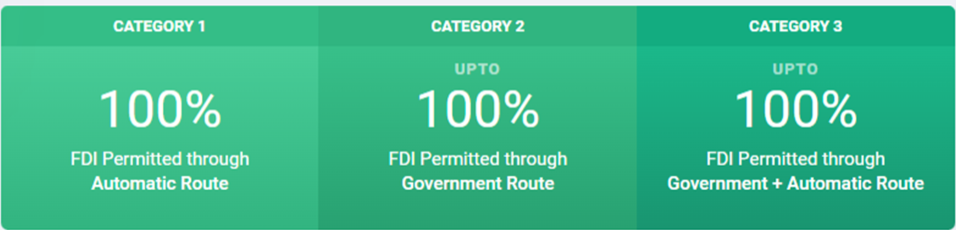
Automatic Route
- Under the Automatic Route, the non-resident investor or the Indian company does not require any approval from Government of India for the investment.
Government Route
- Under the Government Route, prior to investment, approval from the Government of India is required. Proposals for foreign direct investment under Government route, are considered by respective Administrative Ministry/ Department.
Singapore (27.01%), USA (17.94%), Mauritius (15.98%), Netherland (7.86%) and Switzerland (7.31%) emerge as top 5 countries for FDI equity inflows into India FY 2021-22.
Top 5 sectors receiving highest FDI Equity Inflow during FY 2021-22 are Computer Software & Hardware (24.60%), Services Sector (Fin., Banking, Insurance, Non Fin/Business, Outsourcing, R&D, Courier, Tech. Testing and Analysis, Other) (12.13%), Automobile Industry (11.89%), Trading 7.72% and Construction (Infrastructure) Activities (5.52%).
Top 5 States receiving highest FDI Equity Inflow during FY 2021-22 are Karnataka (37.55%), Maharashtra (26.26%), Delhi (13.93%), Tamil Nadu (5.10%) and Haryana (4.76%)
India’s FDI inflows have increased 20 times from 2000-01 to 2021-22. According to the Department for Promotion of Industry and Internal Trade (DPIIT), India’s cumulative FDI inflow stood at US$ 847.40 billion between April 2000-March 2022; this was mainly due to the government’s efforts to improve the ease of doing business and relax FDI norms.
News 2: Operation Megh Chakra
Background:
- The Central Bureau of Investigation (CBI) on Saturday conducted searches at 59 locations across 20 States and one Union Territory, as part of a pan-India drive against the circulation and sharing of child sexual abuse material.
Operation Megh Chakra:
- The CBI has registered two cases alleging that a large number of Indian nationals were involved in the online circulation, downloading and transmission of such material using cloud-based storage.
- The searches were carried out in Himachal Pradesh, Punjab, Haryana, Delhi, Uttar Pradesh, Bihar, Jharkhand, Chhattisgarh, Maharashtra, Gujarat, Goa, Karnataka, Telangana and Tamil Nadu. The agency seized electronic devices belonging to the suspects.
- A preliminary scrutiny of the devices using cyberforensic tools allegedly revealed that a huge quantity of child pornography material was stored in them. “The suspects are being questioned to identify the victims and the abusers,” said an official, adding that the operation was one of the CBI-led global operations in recent times for a prompt response to online child sexual exploitation cases with international linkages.
- The official said the operation sought to collate information from various law enforcement agencies in India, engage with the relevant law enforcement agencies globally and coordinate closely through the Interpol channels on the issue.
Child security in cyberspace:
- Section 67B of the Information Technology (IT) Act, 2000 provides stringent punishment for publishing, transmitting or viewing child sexual abuse material online.
- The Information Technology (Intermediary Guidelines and Digital Media Ethics Code) Rules, 2021 empower the users of Intermediaries and makes the social media platforms accountable for their safety. The Rules also require Significant Social Media Intermediary (SSMI) to endeavor to deploy technology-based measures to proactively identify child sexual abuse material.
- Government periodically blocks the websites containing extreme child sexual abuse material (CSAM) based on INTERPOL’s “worst of list” received through Central Bureau of Investigation (CBI), the national nodal agency for Interpol in India.
- Government has issued an order to concerned Internet Service Providers (ISPs) ordering them to implement Internet Watch Foundation (IWF), UK or Project Arachnid, Canada list of CSAM websites/webpages on a dynamic basis and block access to such child pornography webpages/websites.
- Meity through a program, namely, Information Security Education & Awareness (ISEA), has been creating awareness among users including women and children highlighting the importance of digital safety while using Internet.
- Further, Section-14 of the Protection of Children from Sexual Offence (POCSO) Act provides Punishment for using child for pornographic purposes.
News 3: Odisha offering cash incentive to PVTGs for marrying after 18
Background:
- Keeping the rampant child marriages among the Particularly Vulnerable Tribal Groups (PVTGs) of Odisha in mind, the State government is providing an incentive of ₹20,000 for late marriage.
- Offered by the Odisha PVTG Empowerment and Livelihoods Improvement Programme (OPELIP), a special programme designed to improve living conditions and reduce poverty among the PVTGs, the money is given to the couples marrying after the age of 18 years.
Impact of child marriage:
- It negatively influences children’s rights to education, health and protection. These consequences impact not just the girl directly, but also her family and community.
- A girl who is married as a child is more likely to be out of school and not earn money and contribute to the community. She is more likely to experience domestic violence and become infected with HIV/AIDS. She is more likely to have children when she is still a child. There are more chances of her dying due to complications during pregnancy and childbirth.
- Child marriage violates children’s rights and places them at high risk of violence, exploitation, and abuse. Child marriage affects both girls and boys, but it affects girls disproportionately.
- Asper UNICEF, While the prevalence of girls getting married before age 18 has declined from 47 per cent to 27 per cent between 2005-2006 and 2015-2016 it is still too high.
- Child marriage negatively affects the Indian economy and can lead to an intergenerational cycle of poverty.
- Sustainable Development Goal – child marriage is included in Goal 5 “Achieve gender equality and empower all women and girls” under Target 5.3 “Eliminate all harmful practices, such as child, early and forced marriage and female genital mutilation”
PVTG (Particularly vulnerable tribal Groups):
Government of India follows the following criteria for identification of PVTGs.
- Pre-agricultural level of technology
- Low level of literacy
- Economic backwardness
- A declining or stagnant population.
Accordingly, 75 PTVGs have been identified in the country. Odisha accounts for highest number of PVTGs in India.
In 1973, the Dhebar Commission created Primitive Tribal Groups (PTGs) as a separate category, who are less developed among the tribal groups. In 2006, the Government of India renamed the PTGs as Particularly Vulnerable Tribal Groups (PVTGs).
PVTGs have some basic characteristics -they are mostly homogenous, with a small population, relatively physically isolated, social institutes cast in a simple Mould, absence of written language, relatively simple technology and a slower rate of change etc.
News 4: Election Commission to push for internal democracy in parties
Background:
- After taking action against registered unrecognised political parties (RUPPs) for failing to comply with norms, the Election Commission is likely to take up the issue of internal democracy within parties next, according to EC sources.
- Though the Representation of the People Act does not mandate internal elections, the EC’s guidelines for parties applying for registration under the Act state that the applicant should submit a copy of the party constitution.
Election Commission of India:
Established: 25 January 1950 (Celebrated as National Voters Day)
Type: Autonomous Constitutional body
Responsibilities:
- The Election Commission of India is responsible for administering Union and State election processes in India.
- Article 324 of the Constitution provides that the power of superintendence, direction, and control of elections to parliament, state legislatures, the office of the president of India, and the office of vice-president of India shall be vested in the election commission
Appointment and tenure:
- The President appoints Chief Election Commissioner and Election Commissioners. They have tenure of six years, or up to the age of 65 years, whichever is earlier.
- They enjoy the same status and receive salary and perks as available to Judges of the Supreme Court of India. The Chief Election Commissioner can be removed from office only through impeachment by Parliament.
Voting:
- The democratic system in India is based on the principle of universal adult suffrage; that any citizen over the age of 18 can vote in an election (before 1989 the age limit was 21). The right to vote is irrespective of caste, creed, religion or gender.
- Those who are deemed unsound of mind, and people convicted of certain criminal offences are not allowed to vote. There has been a general increase in the number of people voting in Indian election.
Who can stand for election?
- Any Indian citizen who is registered as a voter is otherwise not disqualified under the Law and is over 25 years of age is allowed to contest elections to the Lok Sabha or State Legislative Assemblies. For the Rajya Sabha the age limit is 30 years. Candidates for Vidhan Sabha should be residents of the same state from which they wish to contest.
- Every candidate has to make deposit of Rs. 25,000/- for Lok Sabha election and Rs. 10,000/- for Rajya Sabha or Vidhan Sabha elections, except for candidates from the Scheduled Castes and Scheduled Tribes who pay half of these amounts. The deposit is returned if the candidate receives more than one-sixth of the total number of valid votes polled in the constituency.
- Nominations must be supported at least by one registered elector of the constituency, in the case of a candidate sponsored by a recognised Party and by ten registered electors from the constituency in case of other candidates.
News 5: ‘Non-oil exports to UAE up 14% after trade deal; surge 3% globally’
Background:
- India’s non-oil exports to the UAE have grown 14% between June and August, the Commerce and Industry Ministry said on Sunday, attributing the uptick to the bilateral deal between the two nations that came into effect this May.
India – UAE relations:
Trading and commerce relations:
- The trade, which was dominated by traditional items such as dates, pearl and fishes, underwent a sharp change after the discovery of oil in UAE (oil exports begun from Abu Dhabi in 1962). With the emergence of UAE as a unified entity in 1971, exports from India started growing gradually over the years.
- Both sides are striving to further strengthen these ties for mutual benefits. India-UAE trade, valued at US$ 180 million per annum in the 1970s, is today US$ 59 billion making UAE, India’s third largest trading partner for the year 2019-20 after China and US.
- Moreover, UAE is the second largest export destination of India (after US) with an amount of nearly US$ 29 billion for the year 2019-20. For UAE, India is the second largest trading partner for the year 2019 with an amount of around US$ 41.43 billion (non-oil trade).
- The sharpest jump in Indian exports to UAE was seen in sugar (up 237%), cereals (161%), vegetables (82%), inorganic chemicals (74%) and electrical machinery and equipment (67%).
- The Ministry said it expects Indian exports to increase further in the coming months with increasing use of the India-UAE Comprehensive Economic Partnership Agreement (CEPA) by exporters and a series of trade promotion events planned in the UAE.
- Gems & Jewellery sector contributes a substantial portion of India’s exports to the UAE and is a sector that is expected to benefit significantly from the tariff concessions obtained for Indian products under the India-UAE CEPA.
- Overall, India will benefit from preferential market access provided by the UAE on over 97 % of its tariff lines which account for 99% of Indian exports to the UAE in value terms particularly from labour-intensive sectors such as Gems and Jewellery, Textiles, leather, footwear, sports goods, plastics, furniture, agricultural and wood products, engineering products, pharmaceuticals, medical devices, and Automobiles.
- As regards trade in services, Indian service providers will have enhanced access to around 111 sub-sectors from the 11 broad service sectors.
- CEPA is expected to increase the total value of bilateral trade in goods to over US$100 billion and trade in services to over US$ 15 billion within five years.
News 6: Flex fuel: Part of plan to cut crude imports, but policy support key
Background:
- India’s first ‘flex fuel’ car, a Toyota sedan that can run on one or multiple fuel types and developed as part of a new pilot aimed at deleveraging the country’s dependence on imported fossil fuels for transportation, is set for an unveiling later this month.
Flex fuel technology:
- A flex fuel, or flexible fuel, vehicle has an internal combustion engine (ICE), but unlike a regular petrol or diesel vehicle, this can run on more than one type of fuel, or even a mixture of fuels. The most common versions use a blend of petrol and ethanol or methanol, but these engines are also equipped to run on 100 per cent petrol or ethanol as well.
- This is made possible by equipping the engine with a fuel mix sensor and an engine control module (ECM) programming that senses and automatically adjusts for any ratio of designated fuels.
- Union Minister of Road Transport and Highways Nitin Gadkari said the push to car makers to adopt flexible engines is part of a broader strategy to cut down on the country’s dependence on imported crude in the medium-to-long run.
Pros and Cons:
Pros:
- The use of ethanol blending sharply lowers harmful pollutants such as carbon monoxide, sulphur, and carbon and nitrogen oxides.
- Blending will help cut back on oil imports for fueling vehicles.
- Many flex fuel vehicles have improved acceleration performance when operating on higher ethanol blends
Cons:
- A flex fuel car typically takes a small hit on fuel efficiency when using ethanol for motive power, ranging from between 4 per cent and 8 per cent.
- A major problem with ethanol blending is that crops such as sugarcane are usually very water-intensive. A NITI Aayog report suggested that in 2019-20, of the total ethanol produced in the country, over 90 per cent came from sugarcane alone.
- Plus, sugarcane is a politically important crop in states such as Maharashtra and Uttar Pradesh, and there is a perceived political angle to the ethanol/methanol blending push.
Ethanol blending in India:
- Currently, around 9.5 per cent ethanol blending with petrol has been achieved in fuel dispensed in pumps in most metros and it is likely that the targeted 10 per cent ethanol blending will be achieved by November 2022.
- But this is slated for a major bump up, with the government’s 2025 target of 20 per cent blending of ethanol in petrol envisaged in its National Biofuel Policy 2018.
National Biofuel Policy 2018:
- The Goal of the Policy is to enable availability of biofuels in the market thereby increasing its blending percentage. Ministry of Petroleum & Natural Gas (MoP&NG) has notified that Oil Companies shall sell Ethanol Blended Petrol (EBP) with percentage of ethanol up to twenty per cent throughout the country from 01st April 2023.
- Blending of ethanol in Petrol will gradually be increased in the coming years. A target of 20% blending of ethanol in petrol is proposed by Ethanol Supply Year (ESY) 2025-26.
- An indicative target of 5% blending of biodiesel in diesel /direct sale of biodiesel is proposed by 2030. This goal is to be achieved by (a) reinforcing ongoing ethanol/biodiesel supplies through increasing domestic production (b) setting up Second Generation (2G) bio refineries (c) development of new feedstock for biofuels (d) development of new technologies for conversion to biofuels (e) creating suitable environment for biofuels and its integration with the main fuels
Salient features:
The Policy categorises biofuels as “Basic Biofuels” viz.
- First Generation (1G) bioethanol & biodiesel
- “Advanced Biofuels” – Second Generation (2G) ethanol,
- Municipal Solid Waste (MSW) to drop-in fuels,
- Third Generation (3G) biofuels, bio-CNG etc. to enable extension of appropriate financial and fiscal incentives under each category.
The Policy expands the scope of raw material for ethanol production by allowing use of Sugarcane Juice, Sugar containing materials like Sugar Beet, Sweet Sorghum, Starch containing materials like Corn, Cassava, Damaged food grains like wheat, broken rice, Rotten Potatoes, unfit for human consumption for ethanol production.
Farmers are at a risk of not getting appropriate price for their produce during the surplus production phase. Taking this into account, the Policy allows use of surplus food grains for production of ethanol for blending with petrol with the approval of National Biofuel Coordination Committee.
With a thrust on Advanced Biofuels, the Policy indicates a viability gap funding scheme for 2G ethanol Bio refineries of Rs.5000 crore in 6 years in addition to additional tax incentives, higher purchase price as compared to 1G biofuels.
The Policy encourages setting up of supply chain mechanisms for biodiesel production from non-edible oilseeds, Used Cooking Oil, short gestation crops.
Roles and responsibilities of all the concerned Ministries/Departments with respect to biofuels has been captured in the Policy document to synergise efforts.
Expected benefits:
- Reduce Import Dependency: One crore lit of E10 saves Rs.28 crore of forex at current rates. The ethanol supply year 2017-18 is likely to see a supply of around 150 crore litres of ethanol which will result in savings of over Rs.4000 crore of forex.
- Cleaner Environment: One crore lit of E-10 saves around 20,000 ton of CO2 emissions. For the ethanol supply year 2017-18, there will be lesser emissions of CO2 to the tune of 30 lakh ton. By reducing crop burning & conversion of agricultural residues/wastes to biofuels there will be further reduction in Green House Gas emissions.
- Health benefits: Prolonged reuse of Cooking Oil for preparing food, particularly in deep-frying is a potential health hazard and can lead to many diseases. Used Cooking Oil is a potential feedstock for biodiesel and its use for making biodiesel will prevent diversion of used cooking oil in the food industry.
- MSW Management: It is estimated that, annually 62 MMT of Municipal Solid Waste gets generated in India. There are technologies available which can convert waste/plastic, MSW to drop in fuels. One ton of such waste has the potential to provide around 20% of drop in fuels.
- Infrastructural Investment in Rural Areas: It is estimated that, one 100klpd bio refinery will require around Rs.800 crore capital investment. At present Oil Marketing Companies are in the process of setting up twelve 2G bio refineries with an investment of around Rs.10,000 crore. Further addition of 2G bio refineries across the Country will spur infrastructural investment in the rural areas.
- Employment Generation: One 100klpd 2G bio refinery can contribute 1200 jobs in Plant Operations, Village Level Entrepreneurs and Supply Chain Management.
- Additional Income to Farmers: By adopting 2G technologies, agricultural residues/waste which otherwise are burnt by the farmers can be converted to ethanol and can fetch a price for these waste if a market is developed for the same. Also, farmers are at a risk of not getting appropriate price for their produce during the surplus production phase. Thus conversion of surplus grains and agricultural biomass can help in price stabilization.
Other important news
Masai tribe:
- The Maasai tribe are an indigenous ethnic group in Africa of semi-nomadic people settled in Kenya and northern Tanzania.
- Cheetahs require large expanses of land that can support prey and suitable cover to thrive. One such habitat is the famed Masai Mara, a large game reserve in Kenya, named in honour of the Masai tribe.

Mars rover Perseverance collects four rock samples:
Since July, NASA’s Perseverance rover has drilled and collected four slim cores of sedimentary rock, formed in what was once a river delta on Mars. They are the first of this type of rock to be gathered on another world — and scientists are excited because at least two of the cores probably contain organic compounds, which, on Earth, are often associated with living things. If all goes well, the samples will be the first-ever returned from Mars.
Perseverance rover:
- Main Job: Seek signs of ancient life and collect samples of rock and regolith (broken rock and soil) for possible return to Earth.
- Mars 2020 is a Mars rover mission forming part of NASA’s Mars Exploration Program that includes the rover Perseverance, the small robotic, coaxial helicopter Ingenuity, and associated delivery vehicles.
Kaziranga National Park:
- Kaziranga National Park is a national park in the Golaghat and Nagaon districts of the state of Assam, India. The park, which hosts two-thirds of the world’s great one-horned rhinoceroses, is a World Heritage Site.
- Kaziranga is a UNESCO world heritage site, a tiger reserve, important bird area as declared by BirdLife International and is located on the edge of Eastern Himalaya biodiversity hotspot.
- It hosts the iconic Greater one-horned rhinoceros, the park is the breeding ground of elephants, wild water buffalo, tiger and swamp deer.
Dal Lake:
- Dal is a lake is in Srinagar (Dal Lake is a misnomer as Dal in Kashmiri means lake), the summer capital of Jammu and Kashmir. The urban lake is integral to tourism and recreation in Kashmir and is named the “Jewel in the crown of Kashmir” or “Srinagar’s Jewel” or “Lake of flowers”.
- The lake is also an important source for commercial operations in fishing and water plant harvesting.
- At present, the Dal and the Mughal gardens on its periphery are undergoing intensive restoration measures to fully address the serious eutrophication problems experienced by the lake.
Receive Daily Updates
Recent Posts
Petrol in India is cheaper than in countries like Hong Kong, Germany and the UK but costlier than in China, Brazil, Japan, the US, Russia, Pakistan and Sri Lanka, a Bank of Baroda Economics Research report showed.
Rising fuel prices in India have led to considerable debate on which government, state or central, should be lowering their taxes to keep prices under control.
The rise in fuel prices is mainly due to the global price of crude oil (raw material for making petrol and diesel) going up. Further, a stronger dollar has added to the cost of crude oil.
Amongst comparable countries (per capita wise), prices in India are higher than those in Vietnam, Kenya, Ukraine, Bangladesh, Nepal, Pakistan, Sri Lanka, and Venezuela. Countries that are major oil producers have much lower prices.
In the report, the Philippines has a comparable petrol price but has a per capita income higher than India by over 50 per cent.
Countries which have a lower per capita income like Kenya, Bangladesh, Nepal, Pakistan, and Venezuela have much lower prices of petrol and hence are impacted less than India.
“Therefore there is still a strong case for the government to consider lowering the taxes on fuel to protect the interest of the people,” the report argued.
India is the world’s third-biggest oil consuming and importing nation. It imports 85 per cent of its oil needs and so prices retail fuel at import parity rates.
With the global surge in energy prices, the cost of producing petrol, diesel and other petroleum products also went up for oil companies in India.
They raised petrol and diesel prices by Rs 10 a litre in just over a fortnight beginning March 22 but hit a pause button soon after as the move faced criticism and the opposition parties asked the government to cut taxes instead.
India imports most of its oil from a group of countries called the ‘OPEC +’ (i.e, Iran, Iraq, Saudi Arabia, Venezuela, Kuwait, United Arab Emirates, Russia, etc), which produces 40% of the world’s crude oil.
As they have the power to dictate fuel supply and prices, their decision of limiting the global supply reduces supply in India, thus raising prices
The government charges about 167% tax (excise) on petrol and 129% on diesel as compared to US (20%), UK (62%), Italy and Germany (65%).
The abominable excise duty is 2/3rd of the cost, and the base price, dealer commission and freight form the rest.
Here is an approximate break-up (in Rs):
a)Base Price | 39 |
b)Freight | 0.34 |
c) Price Charged to Dealers = (a+b) | 39.34 |
d) Excise Duty | 40.17 |
e) Dealer Commission | 4.68 |
f) VAT | 25.35 |
g) Retail Selling Price | 109.54 |
Looked closely, much of the cost of petrol and diesel is due to higher tax rate by govt, specifically excise duty.
So the question is why government is not reducing the prices ?
India, being a developing country, it does require gigantic amount of funding for its infrastructure projects as well as welfare schemes.
However, we as a society is yet to be tax-compliant. Many people evade the direct tax and that’s the reason why govt’s hands are tied. Govt. needs the money to fund various programs and at the same time it is not generating enough revenue from direct taxes.
That’s the reason why, govt is bumping up its revenue through higher indirect taxes such as GST or excise duty as in the case of petrol and diesel.
Direct taxes are progressive as it taxes according to an individuals’ income however indirect tax such as excise duty or GST are regressive in the sense that the poorest of the poor and richest of the rich have to pay the same amount.
Does not matter, if you are an auto-driver or owner of a Mercedes, end of the day both pay the same price for petrol/diesel-that’s why it is regressive in nature.
But unlike direct tax where tax evasion is rampant, indirect tax can not be evaded due to their very nature and as long as huge no of Indians keep evading direct taxes, indirect tax such as excise duty will be difficult for the govt to reduce, because it may reduce the revenue and hamper may programs of the govt.
Globally, around 80% of wastewater flows back into the ecosystem without being treated or reused, according to the United Nations.
This can pose a significant environmental and health threat.
In the absence of cost-effective, sustainable, disruptive water management solutions, about 70% of sewage is discharged untreated into India’s water bodies.
A staggering 21% of diseases are caused by contaminated water in India, according to the World Bank, and one in five children die before their fifth birthday because of poor sanitation and hygiene conditions, according to Startup India.
As we confront these public health challenges emerging out of environmental concerns, expanding the scope of public health/environmental engineering science becomes pivotal.
For India to achieve its sustainable development goals of clean water and sanitation and to address the growing demands for water consumption and preservation of both surface water bodies and groundwater resources, it is essential to find and implement innovative ways of treating wastewater.
It is in this context why the specialised cadre of public health engineers, also known as sanitation engineers or environmental engineers, is best suited to provide the growing urban and rural water supply and to manage solid waste and wastewater.
Traditionally, engineering and public health have been understood as different fields.
Currently in India, civil engineering incorporates a course or two on environmental engineering for students to learn about wastewater management as a part of their pre-service and in-service training.
Most often, civil engineers do not have adequate skills to address public health problems. And public health professionals do not have adequate engineering skills.
India aims to supply 55 litres of water per person per day by 2024 under its Jal Jeevan Mission to install functional household tap connections.
The goal of reaching every rural household with functional tap water can be achieved in a sustainable and resilient manner only if the cadre of public health engineers is expanded and strengthened.
In India, public health engineering is executed by the Public Works Department or by health officials.
This differs from international trends. To manage a wastewater treatment plant in Europe, for example, a candidate must specialise in wastewater engineering.
Furthermore, public health engineering should be developed as an interdisciplinary field. Engineers can significantly contribute to public health in defining what is possible, identifying limitations, and shaping workable solutions with a problem-solving approach.
Similarly, public health professionals can contribute to engineering through well-researched understanding of health issues, measured risks and how course correction can be initiated.
Once both meet, a public health engineer can identify a health risk, work on developing concrete solutions such as new health and safety practices or specialised equipment, in order to correct the safety concern..
There is no doubt that the majority of diseases are water-related, transmitted through consumption of contaminated water, vectors breeding in stagnated water, or lack of adequate quantity of good quality water for proper personal hygiene.
Diseases cannot be contained unless we provide good quality and adequate quantity of water. Most of the world’s diseases can be prevented by considering this.
Training our young minds towards creating sustainable water management systems would be the first step.
Currently, institutions like the Indian Institute of Technology, Madras (IIT-M) are considering initiating public health engineering as a separate discipline.
To leverage this opportunity even further, India needs to scale up in the same direction.
Consider this hypothetical situation: Rajalakshmi, from a remote Karnataka village spots a business opportunity.
She knows that flowers, discarded in the thousands by temples can be handcrafted into incense sticks.
She wants to find a market for the product and hopefully, employ some people to help her. Soon enough though, she discovers that starting a business is a herculean task for a person like her.
There is a laborious process of rules and regulations to go through, bribes to pay on the way and no actual means to transport her product to its market.
After making her first batch of agarbathis and taking it to Bengaluru by bus, she decides the venture is not easy and gives up.
On the flipside of this is a young entrepreneur in Bengaluru. Let’s call him Deepak. He wants to start an internet-based business selling sustainably made agarbathis.
He has no trouble getting investors and to mobilise supply chains. His paperwork is over in a matter of days and his business is set up quickly and ready to grow.
Never mind that the business is built on aggregation of small sellers who will not see half the profit .
Is this scenario really all that hypothetical or emblematic of how we think about entrepreneurship in India?
Between our national obsession with unicorns on one side and glorifying the person running a pakora stall for survival as an example of viable entrepreneurship on the other, is the middle ground in entrepreneurship—a space that should have seen millions of thriving small and medium businesses, but remains so sparsely occupied that you could almost miss it.
If we are to achieve meaningful economic growth in our country, we need to incorporate, in our national conversation on entrepreneurship, ways of addressing the missing middle.
Spread out across India’s small towns and cities, this is a class of entrepreneurs that have been hit by a triple wave over the last five years, buffeted first by the inadvertent fallout of demonetization, being unprepared for GST, and then by the endless pain of the covid-19 pandemic.
As we finally appear to be reaching some level of normality, now is the opportune time to identify the kind of industries that make up this layer, the opportunities they should be afforded, and the best ways to scale up their functioning in the shortest time frame.
But, why pay so much attention to these industries when we should be celebrating, as we do, our booming startup space?
It is indeed true that India has the third largest number of unicorns in the world now, adding 42 in 2021 alone. Braving all the disruptions of the pandemic, it was a year in which Indian startups raised $24.1 billion in equity investments, according to a NASSCOM-Zinnov report last year.
However, this is a story of lopsided growth.
The cities of Bengaluru, Delhi/NCR, and Mumbai together claim three-fourths of these startup deals while emerging hubs like Ahmedabad, Coimbatore, and Jaipur account for the rest.
This leap in the startup space has created 6.6 lakh direct jobs and a few million indirect jobs. Is that good enough for a country that sends 12 million fresh graduates to its workforce every year?
It doesn’t even make a dent on arguably our biggest unemployment in recent history—in April 2020 when the country shutdown to battle covid-19.
Technology-intensive start-ups are constrained in their ability to create jobs—and hybrid work models and artificial intelligence (AI) have further accelerated unemployment.
What we need to focus on, therefore, is the labour-intensive micro, small and medium enterprise (MSME). Here, we begin to get to a definitional notion of what we called the mundane middle and the problems it currently faces.
India has an estimated 63 million enterprises. But, out of 100 companies, 95 are micro enterprises—employing less than five people, four are small to medium and barely one is large.
The questions to ask are: why are Indian MSMEs failing to grow from micro to small and medium and then be spurred on to make the leap into large companies?
At the Global Alliance for Mass Entrepreneurship (GAME), we have advocated for a National Mission for Mass Entrepreneurship, the need for which is more pronounced now than ever before.
Whenever India has worked to achieve a significant economic milestone in a limited span of time, it has worked best in mission mode. Think of the Green Revolution or Operation Flood.
From across various states, there are enough examples of approaches that work to catalyse mass entrepreneurship.
The introduction of entrepreneurship mindset curriculum (EMC) in schools through alliance mode of working by a number of agencies has shown significant improvement in academic and life outcomes.
Through creative teaching methods, students are encouraged to inculcate 21st century skills like creativity, problem solving, critical thinking and leadership which are not only foundational for entrepreneurship but essential to thrive in our complex world.
Udhyam Learning Foundation has been involved with the Government of Delhi since 2018 to help young people across over 1,000 schools to develop an entrepreneurial mindset.
One pilot programme introduced the concept of ‘seed money’ and saw 41 students turn their ideas into profit-making ventures. Other programmes teach qualities like grit and resourcefulness.
If you think these are isolated examples, consider some larger data trends.
The Observer Research Foundation and The World Economic Forum released the Young India and Work: A Survey of Youth Aspirations in 2018.
When asked which type of work arrangement they prefer, 49% of the youth surveyed said they prefer a job in the public sector.
However, 38% selected self-employment as an entrepreneur as their ideal type of job. The spirit of entrepreneurship is latent and waiting to be unleashed.
The same can be said for building networks of successful women entrepreneurs—so crucial when the participation of women in the Indian economy has declined to an abysmal 20%.
The majority of India’s 63 million firms are informal —fewer than 20% are registered for GST.
Research shows that companies that start out as formal enterprises become two-three times more productive than a similar informal business.
So why do firms prefer to be informal? In most cases, it’s because of the sheer cost and difficulty of complying with the different regulations.
We have academia and non-profits working as ecosystem enablers providing insights and evidence-based models for growth. We have large private corporations and philanthropic and funding agencies ready to invest.
It should be in the scope of a National Mass Entrepreneurship Mission to bring all of them together to work in mission mode so that the gap between thought leadership and action can finally be bridged.
Heat wave is a condition of air temperature which becomes fatal to human body when exposed. Often times, it is defined based on the temperature thresholds over a region in terms of actual temperature or its departure from normal.
Heat wave is considered if maximum temperature of a station reaches at least 400C or more for Plains and at least 300C or more for Hilly regions.
a) Based on Departure from Normal
Heat Wave: Departure from normal is 4.50C to 6.40C
Severe Heat Wave: Departure from normal is >6.40C
b) Based on Actual Maximum Temperature
Heat Wave: When actual maximum temperature ≥ 450C
Severe Heat Wave: When actual maximum temperature ≥470C
If above criteria met at least in 2 stations in a Meteorological sub-division for at least two consecutive days and it declared on the second day
It is occurring mainly during March to June and in some rare cases even in July. The peak month of the heat wave over India is May.
Heat wave generally occurs over plains of northwest India, Central, East & north Peninsular India during March to June.
It covers Punjab, Haryana, Delhi, Uttar Pradesh, Bihar, Jharkhand, West Bengal, Odisha, Madhya Pradesh, Rajasthan, Gujarat, parts of Maharashtra & Karnataka, Andhra Pradesh and Telengana.
Sometimes it occurs over Tamilnadu & Kerala also.
Heat waves adversely affect human and animal lives.
However, maximum temperatures more than 45°C observed mainly over Rajasthan and Vidarbha region in month of May.

a. Transportation / Prevalence of hot dry air over a region (There should be a region of warm dry air and appropriate flow pattern for transporting hot air over the region).
b. Absence of moisture in the upper atmosphere (As the presence of moisture restricts the temperature rise).
c. The sky should be practically cloudless (To allow maximum insulation over the region).
d. Large amplitude anti-cyclonic flow over the area.
Heat waves generally develop over Northwest India and spread gradually eastwards & southwards but not westwards (since the prevailing winds during the season are westerly to northwesterly).
The health impacts of Heat Waves typically involve dehydration, heat cramps, heat exhaustion and/or heat stroke. The signs and symptoms are as follows:
1. Heat Cramps: Ederna (swelling) and Syncope (Fainting) generally accompanied by fever below 39*C i.e.102*F.
2. Heat Exhaustion: Fatigue, weakness, dizziness, headache, nausea, vomiting, muscle cramps and sweating.
3. Heat Stoke: Body temperatures of 40*C i.e. 104*F or more along with delirium, seizures or coma. This is a potential fatal condition.