


UPSC/STATE PSC
Curated by Experts For Civil Service Aspirants
The Hindu & Indian Express
News 1: ‘Adopt a TB patient’ drive mitras
Background:
- The Union Health Ministry’s “adopt a TB-patient” (Ni-kshay Mitra) initiative, and it was to fill the critical “community” element into India’s fight towards eliminating TB by 2025 under the Pradhan Mantri TB-Mukt Bharat Abhiyaan.
Burden of TB:
- India has the world’s highest tuberculosis (TB) burden, with 26 lakh people contracting the disease and approximately four lakh people dying from it every year.
- The economic burden of TB in terms of the loss of lives, income and workdays is also substantial.
- TB usually affects the most economically productive age group of society resulting in a significant loss of working days.
Ni-kshay Mitra:
- The support provided to the patient under this initiative is in addition to the free diagnostics, free drugs and the Ni-kshay Poshan Yojana provided by the National TB Elimination Programme (NTEP) to all the patients notified from both the public and the private sector.
Donors:
- Cooperative societies, corporates, elected representatives, individuals, institutions, non-governmental organizations, political parties and partners willing to adopt the health facilities (for individual donor) and urban wards, blocks, districts and States for accelerating the response against TB to complement the government’s efforts.
- Some donors would provide additional support to all the on-treatment TB patients who had given consent for support, in the selected health facilities, blocks, urban wards, districts and States. Others have to choose the entire geographical unit (blocks, urban wards, districts and States). The minimum period of commitment for providing the support to the TB patient will be one year.
News 2: ‘Mastermind’ behind Chinese shell firms held
Background:
- The Serious Fraud Investigation Office (SFIO) late on Saturday arrested a person said to be the mastermind behind a slew of Chinese shell companies operating in the country, from a remote part of Bihar while he was attempting to cross the border through the land route.
Serious Fraud Investigation Office:
- Established: 2003 as per Companies Act, 2013
- Headquarter: New Delhi
- Ministry: Ministry of Corporate Affairs
- Type: Statutory organization
- Objective: It is involved in detecting and prosecuting or recommending for prosecution white-collar crimes/frauds. The SFIO is mandated to conduct Multi-disciplinary investigations of major corporate frauds
Shell companies:
- A shell corporation is a corporation without active business operations or significant assets. These types of corporations are not all necessarily illegal, but they are sometimes used illegitimately, such as to disguise business ownership from law enforcement or the public.
News 3: Project 17A Taragiri
Background:
- Taragiri, the third stealth frigate of the Project 17A, was launched on Sunday by Mazagon Dock Shipbuilders Ltd. (MDL).
Taragiri:
- Indigenously designed Taragiri will have state-of-the-art weapons, sensors, an advanced action information system, an integrated platform management system, world class modular living spaces, a sophisticated power distribution system and a host of other advanced features.
- It will be fitted with a supersonic surface-to-surface missile system and the ship’s air defence capability is designed to counter the threat of the enemy aircraft and the anti-ship cruise missiles would revolve around the vertical launch and long-range surface to air missile system.
Project 17A:
- The programme involves the development of 7 advanced guided missile frigates, of which 4 will be built by Mazagaon Dock Shipbuilders and the remaining three ships by GRSE.
- The Nilgiri-class stealth frigates, are also known as Project 17A frigates and it is a follow-on of the Project 17 Shivalik –class frigates.
- The names of ships are based on the names of hill ranges in India i.e., INS Nilgiri, INS Himgiri, INS Udaygiri, INS Dunagiri, INS Taragiri, INS Vindhyagiri, INS Mahendragiri
Ships of Project 17A:
- It will generate employment opportunities for more than 2000 companies and MSMEs in the country.
- Approximately, 80% of the materials and equipment are being sourced from domestic vendors, thus giving a fillip to domestic manufacturers.
News 4: India stays out of ‘trade pillar’ at Indo-Pacific meet
Background:
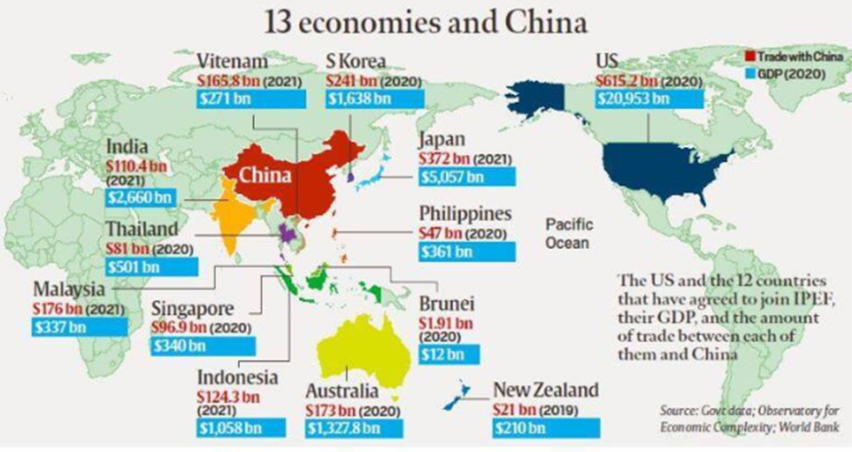
- India stayed out of the joint declaration on the trade pillar of the U.S.-led Indo-Pacific Economic Framework (IPEF) ministerial meet in Los Angeles, with Union Commerce Minister Piyush Goyal citing concerns over possible discrimination against developing economies.
- India was the only one of the 14 IPEF countries, which include Southeast Asian countries, Australia, New Zealand, South Korea and Japan, not to join the declaration on trade.
India’s position on IPEF:
- India was “comfortable” with the outcome statements on the other three pillars: supply chains, clean economy (clean energy) and fair economy (tax and anti-corruption).
- India will be staying out of the trade pillar as the “contours of the framework” had not emerged yet, particularly on the kind of commitment each country would have to make on “environment, labour, digital trade and public procurement.
Indo-Pacific Economic Framework
- The development of an Indo-Pacific economic framework that will define the shared objectives around trade facilitation, standards for the digital economy and technology, supply chain resiliency, decarbonization and clean energy, infrastructure, worker standards, and other areas of shared interest.
- Launched: US President Joe Biden launched it in 2022
- Members: Australia, Brunei, Fiji, India, Indonesia, Japan, South Korea, Malaysia, New Zealand, Philippines, Singapore, Thailand, United States, and Vietnam.
Four pillars:
- Fair and resilient trade
- Supply chain resilience
- Infrastructure, clean energy, and decarbonization
- Tax and anti-corruption
News 5: New adoption rules create confusion

Background:
- Parliament passed the Juvenile Justice (Care and Protection of Children) Amendment Bill, 2021, in July last year, which empowers DMs to give adoption orders. The intent of the amendment was to prevent court-related delays during adoptions because of a large number of pending cases. The amendments came into effect from September 1.
Central Adoption Resource Authority (CARA)
- Type: Statutory
- Ministry: Ministry of Women and Child Development
- Function and Mission: It functions as the nodal body for adoption of Indian children and is mandated to monitor and regulate in-country and inter-country adoptions.
- CARA is designated as the Central Authority to deal with inter-country adoptions in accordance with the provisions of the Hague Convention on Inter-country Adoption, 1993, ratified by Government of India in 2003.
- CARA primarily deals with adoption of orphan, abandoned and surrendered children through its associated /recognized adoption agencies.
News 6: Why Cloudburst forecast still remains elusive in India
Cloudbursts:
- Cloudbursts are violent and voluminous amounts of rain pouring down in a short duration over a small area.
- Cloudburst events are often associated with cumulonimbus clouds that cause thunderstorms and occasionally due to monsoon wind surges and other weather phenomena.
- Cumulonimbus clouds can grow up to 12-15 km in height through the entire troposphere (occasionally up to 21 km) and can hold huge amounts of water.
- According to the India Meteorological Department (IMD), 100 mm of rain in an hour is called a cloudburst.
- Usually, cloudbursts occur over a small geographical region of 20 to 30 sq. km.
Occurrence of Cloudbursts:
- In India, cloudbursts often occur during the monsoon season, when the southwesterly monsoon winds bring in copious amounts of moisture inland.
- The moist air that converges over land gets lifted as they encounter the hills. The moist air reaches an altitude and gets saturated, and the water starts condensing out of the air forming clouds.
- An orographic lifting together with a strong moisture convergence can lead to intense cumulonimbus clouds taking in huge volumes of moisture that is dumped during cloudbursts.
Areas affected by cloudbursts:
- Cloudbursts, hence, occur mostly over the rugged terrains over the Himalayas, the Western Ghats, and northeastern hill States of India.
- The heavy spells of rain on the fragile steep slopes trigger landslides, debris flows, and flash floods, causing large-scale destruction and loss of people and property.
Reasons behind difficult detection of cloudbursts:
- The change in monsoon extremes and cloudbursts we see now are in response to the 1-degree Celsius rise in global surface temperature.
- A 1-degree Celsius rise in temperature may correspond to a 7-10% increase in moisture and rainfall.
- The forecasting of rainfall in hilly regions remains challenging due to the uncertainties in the interaction between the moisture convergence and the hilly terrain, the cloud microphysics, and the heating-cooling mechanisms at different atmospheric levels.
- The resolution of the precipitation radars of the satellites can be much smaller than the area of individual cloudburst events, and hence they go undetected.
- Multiple doppler weather radars can be used to monitor moving cloud droplets and help to provide nowcasts (forecasts for the next three hours).
- As radars are expensive it is not practical to deploy them.
Way forward:
- A long-term measure would be mapping the cloudburst-prone regions using automatic rain gauges.
- People who are located in landslide risk areas and whose condition can be further worsened due to cloudbursts, need to be shifted so as to minimize the impacts of disaster.
- Action and policies to protect lives and property from extreme events are needed as the global temperature change doubles.

News 7: Why is the Kushiyara river treaty important?
Kushiyara agreement:
- The flow of the Barak river has changed in such a way that the bulk of the river’s water flows into Kushiyara while the rest goes into Surma.
- The agreement is aimed at addressing part of the problem that the changing nature of the river has posed before Bangladesh as it unleashes floods during the monsoon and goes dry during the winter when demand of water goes up because of a crop cycle in Sylhet.

Why is Kushiyara river water important for Bangladesh?
- Approximately 10,000 hectares of land and millions of people will benefit from the water that will flow through a network of canals in Sylhet benefiting the farmers involved in cultivation of Boro rice and horticulture crops.
- India initially objected to construction of Rahimpur canal as it interfered with border security but India has now withdrawn this objection.
- The Kushiyara agreement did not require a nod from any of the States like Assam from which the Barak emerges and branches into Kushiyara and Surma.
News 8: India-Saudi ties promise shared growth, security, stability, says Jaishankar
India and Saudi Arabia ties:
- Saudi Arabia is India’s fourth-largest trading partner.
- More than 18 per cent of India’s crude oil imports are sourced from Saudi Arabia.
- The 2.2-million-strong Indian community is the largest expatriate community in Saudi Arabia.
Gulf Cooperation Council:
- It is a regional, intergovernmental, political, and economic union.
- Members: Bahrain, Kuwait, Oman, Qatar, Saudi Arabia, UAE
- Headquarters: Riyadh, Saudi Arabia
News 9: Supreme Court to take up CAA challenge
Background:
- A three-judge Bench of the Supreme Court led by Chief Justice of India (CJI) U U Lalit will hear the challenge to the Citizenship (Amendment) Act on Monday.
Citizenship (Amendment) Act, 2019:
- It seeks to grant citizenship to a class of migrants belonging to Hindu, Sikh, Buddhist, Jain, Parsi or Christian communities from Afghanistan, Bangladesh or Pakistan.
- The legislation applies to those who were “forced or compelled to seek shelter in India due to persecution on the ground of religion”.
- It aims to protect such people from proceedings of illegal migration.
- The cut-off date for citizenship is December 31, 2014 which means the applicant should have entered India on or before that date.
- Indian citizenship, under present law, is given either to those born in India or if they have resided in the country for a minimum of 11 years.
- Exception: The Bill adds that the provisions on citizenship for illegal migrants will not apply to the tribal areas of Assam, Meghalaya, Mizoram, or Tripura, as included in the Sixth Schedule to the Constitution.
- These tribal areas include Karbi Anglong (in Assam), Garo Hills (in Meghalaya), Chakma District (in Mizoram), and Tripura Tribal Areas District.
- It will also not apply to the areas under the Inner Line” under the Bengal Eastern Frontier Regulation, 1873.
Who is an illegal migrant?
- An illegal migrant is a foreigner who: (i) enters the country without valid travel documents, like a passport and visa, or (ii) enters with valid documents, but stays beyond the permitted time period.
- Illegal migrants may be imprisoned or deported under the Foreigners Act, 1946 and the Passport (Entry into India) Act, 1920. The 1946 and the 1920 Acts empower the central government to regulate the entry, exit and residence of foreigners within India.
Criticisms against CAA:
- Some critics are of the view that the act is unconstitutional.
- Others are of the view that it violates Article 14 of the Constitution that guarantees that no person shall be denied the right to equality before law or the equal protection of law in the territory of India.
- Granting citizenship on the grounds of religion is seen to be against the secular nature of the Constitution which has been recognised as part of the basic structure that cannot be altered by Parliament
- Fears have risen in North east states as this will increase the number of illegal migrants which might threaten the linguistic and cultural identity of people.
News 10: ‘Discoms’ outstanding dues towards gencos to be eliminated by 2026
Background:
- Outstanding dues of electricity distribution companies (discoms) towards gencos, which remains over Rs 1 lakh crore at any point of time, eill be eliminated in next four years, Union Power Minister RK Singh said.
Reasons for losses:
- Power tariffs are not keeping in line with price rises
- Aggregate technical and commercial losses
- Pilferage
- Gap between average cost per unit and realised revenue
- Forcing discoms to reduce their power purchases and delay payments to power producers
Ujwal Discom Assurance Yojana:
- Launch: 2015
- Ministry: Ministry of Power
- Objective: UDAY provides for the financial turnaround and revival of Power Distribution companies (DISCOMs), and importantly also ensures a sustainable permanent solution to the financial mess that the power distribution.
- The scheme envisages: financial turnaround, Operational improvement, Reduction of cost of generation of power, Development of Renewable energy, and energy efficiency and conservation.
Benefits to participating states:

Impact of the scheme:

News 11: Switching lanes in EV race
Background:
- India’s first indigenously-developed hydrogen fuel cell (HFC) technology bus was unveiled late August, with the fuel cell — which uses hydrogen and air to generate electricity onboard to power the bus — being developed jointly by the Council of Scientific and Industrial Research (CSIR) and Pune-based automotive software company KPIT Ltd.
- India is finding it difficult to make inroads into the global lithium value chain
Problems of using Lithium batteries:
- Demand for Li-ion batteries from India is projected to grow at CAGR of over 30 per cent by volume up to 2030, translating into over 50,000 tonnes of lithium requirement for the country to manufacture only EV batteries.
- With over 90 per cent of global Lithium production concentrated in Chile, Argentina and Bolivia, alongside Australia and China, and other key inputs such as cobalt and nickel mined in the Congo and Indonesia, India would need to be almost entirely dependent on imports from a small pool of countries to cater to its demand.
India’s early stride towards tapping of hydrogen energy:
- National Hydrogen Mission and a roadmap for using hydrogen as an energy source has been promoted and established in India.
- Proposed end-use sectors include steel and chemicals, the major industry that hydrogen has the potential of transforming is transportation — which contributes a third of all greenhouse gas emissions, and where hydrogen is being viewed as a direct replacement of fossil fuels, with specific advantages over traditional EVs.
Hydrogen:
- The most common element in nature, however, is not found freely.
- Hydrogen exists only when combined with other elements and has to be extracted from naturally occurring compounds like water (which is a combination of two hydrogen atoms and one oxygen atom).
- Although hydrogen is a clean molecule, the process of extracting it is energy intensive. The two most common methods for producing hydrogen are natural gas reforming and electrolysis.
Processes involving production of Hydrogen:
- The thermal processes for hydrogen production typically involve steam reforming, a process in which steam reacts with a hydrocarbon fuel to produce hydrogen and accounts for about 95 per cent of all hydrogen produced. In electrolysis, water is split into oxygen and hydrogen through a process called electrolysis.
- Electrolytic processes take place in an electrolyser, which functions more like a fuel cell in reverse — instead of using the energy of a hydrogen molecule as a fuel cell does, an electrolyser creates hydrogen by splitting water molecules.
How hydrogen fuel cells work:
- Hydrogen fuel must therefore be transformed into electricity by a device called a fuel cell stack before it can be used to power a car or truck. A fuel cell converts chemical energy into electrical energy using oxidising agents through an oxidation-reduction reaction. Fuel cell-based vehicles most commonly combine hydrogen and oxygen to produce electricity to power the electric motor on board.
Benefits of using hydrogen fuel cell:
- Hydrogen fuel cell cars have a near-zero carbon footprint. Hydrogen is about 2-3 times as efficient as burning petrol, because an electric chemical reaction is much more efficient than combustion.
- The new HFC technology bus prototype unveiled in Pune used a fuel cell which is known as, “low temperature proton exchange membrane type fuel cell”, that operates at 65-75°C, which is suitable for vehicular applications. These cells operate at relatively low temperatures and are the best candidates for powering automobiles.
Issues regarding use of hydrogen:
- Lack of fuelling station infrastructure
- Safety issues as hydrogen is stored in a pressurized cryogenic tank.
- Scaling up the technology
News 12: United States Agency for International Development:
- USAID leads international development and humanitarian efforts to save lives, reduce poverty, strengthen democratic governance and help people progress beyond assistance.
- It is an independent agency of the U.S. federal government that is primarily responsible for administering civilian foreign aid and development assistance.
India and USAID
- USAID has partnered with India to alleviate food insecurity, fuel the Green Revolution; eradicate polio and strengthen health systems; promote biodiversity and preserve India’s food crops; develop industry and infrastructure; establish leading research universities; develop its economy; and reduce poverty.
- The US Agency for International Development (USAID) and India’s Ministry of Environment, Forest and Climate Change (MoEF&CC) officially launched Forest-PLUS 2.0 on September 25, 2019.
- It is a five-year programme initiated in December 2018 that focuses on developing tools and techniques to bolster ecosystem management and harnessing ecosystem services in forest landscape management.
- The programme’s first set focused on capacity building to help India participate in Reducing Emissions from Deforestation and forest Degradation (REDD+). It included four pilot projects in Sikkim, Rampur, Shivamogga and Hoshangabad.
About REDD+:
- It means “Reducing Emissions from Deforestation and forest Degradation”, conservation of forest carbon stocks, sustainable management of forests, and enhancement of forest carbon stocks in developing countries.
- REDD+ is a mechanism developed by Parties to the United Nations Framework Convention on Climate Change (UNFCCC).
News 13: M.P. first to draft suicide prevention strategy:
Understanding the sociological factors, suggesting preventive methods, devising ways to raise mass awareness and suggesting newer methods for the training of professionals and individuals. The committee will also look at how the laws can be strengthened or diluted to improve the situation and understand the inter-sectoral linkages in suicide prevention.
According to the National Crime Records Bureau’s Accidental Deaths & Suicides in India 2020, a total of 1,53,052 suicides were reported in the country with 14,578 reported from Madhya Pradesh, the third highest in the country.
News 14: Enforcement Directorate:
- Established: 1956
- Headquarters: New Delhi
- Ministry: Department of Revenue, Ministry of Finance
- Objective: The Directorate of Enforcement is a multi-disciplinary organization mandated with investigation of the offence of money laundering and violations of foreign exchange laws.
- Functions of Enforcement Directorate:
- The Prevention of Money Laundering Act, 2002 (PMLA): It is a criminal law enacted to prevent money laundering and to provide for confiscation of property derived from, or involved in, money-laundering and for matters connected therewith or incidental thereto.
- The Foreign Exchange Management Act, 1999 (FEMA): It is a civil law enacted to consolidate and amend the laws relating to facilitate external trade and payments and to promote the orderly development and maintenance of foreign exchange market in India. ED has been given the responsibility to conduct investigation into suspected contraventions of foreign exchange laws and regulations, to adjudicate and impose penalties on those adjudged to have contravened the law.
- The Fugitive Economic Offenders Act, 2018 (FEOA): This law was enacted to deter economic offenders from evading the process of Indian law by remaining outside the jurisdiction of Indian courts. It is a law whereby the Directorate is mandated to attach the properties of the fugitive economic offenders who have escaped from India warranting arrest and provide for the confiscation of their properties to the Central Government.
News 15: Snake boat race on Pampa

News 16: Red panda

Receive Daily Updates
Recent Posts
- Lowering Emissions by Accelerating Forest Finance (LEAF) Coalition, a collective of the United States, United Kingdom and Norway governments, came up with a $1 billion fund.
- LEAF is supported by transnational corporations (TNCs) like Unilever plc, Amazon.com, Inc, Nestle, Airbnb, Inc as well as Emergent, a US-based non-profit.
- The world lost more than 10 million hectares of primary tropical forest cover last year, an area roughly the size of Switzerland.
- Ending tropical and subtropical forest loss by 2030 is a crucial part of meeting global climate, biodiversity and sustainable development goals. Protecting tropical forests offers one of the biggest opportunities for climate action in the coming decade.
- Tropical forests are massive carbon sinks and by investing in their protection, public and private players are likely to stock up on their carbon credits.
- The LEAF coalition initiative is a step towards concretising the aims and objectives of the Reducing Emissions from Deforestation and Forest Degradation (REDD+) mechanism.
- REDD+ was created by the United Nations Framework Convention on Climate Change (UNFCCC). It monetised the value of carbon locked up in the tropical forests of most developing countries, thereby propelling these countries to help mitigate climate change.
- It is a unique initiative as it seeks to help developing countries in battling the double-edged sword of development versus ecological commitment.
- The initiative comes at a crucial time. The tropics have lost close to 12.2 million hectares (mha) of tree cover last year according to global estimates released by Global Forest Watch.
- Of this, a loss of 4.2 mha occurred within humid tropical primary forests alone. It should come as no surprise that most of these lost forests were located in the developing countries of Latin America, Africa and South Asia.
- Brazil has fared dismally on the parameter of ‘annual primary forest loss’ among all countries. It has lost 1.7 mha of primary forests that are rich storehouse of carbon. India’s estimated loss in 2020 stands at 20.8 kilo hectares.
- Between 2002-2020, Brazil’s total area of humid primary forest reduced by 7.7 per cent while India’s reduced by 3.4 per cent.
- Although the loss in India is not as drastic as in Brazil, its position is nevertheless precarious. For India, this loss is equivalent to 951 metric tonnes worth carbon dioxide emissions released in the atmosphere.
- It is important to draw comparisons between Brazil and India as both countries have adopted a rather lackadaisical attitude towards deforestation-induced climate change. The Brazilian government hardly did anything to control the massive fires that gutted the Amazon rainforest in 2019.
- It is mostly around May that forest fires peak in India. However, this year India, witnessed massive forest fires in early March in states like Odisha, Uttarakhand, Madhya Pradesh and Mizoram among others.
- The European Union’s Copernicus Atmospheric Monitoring Service claimed that 0.2 metric tonnes of carbon was emitted in the Uttarakhand forest fires.
- Implementation of the LEAF Coalition plan will help pump in fresh rigour among developing countries like India, that are reluctant to recognise the contributions of their forest dwelling populations in mitigating climate change.
- With the deadline for proposal submission fast approaching, India needs to act swiftly on a revised strategy.
- Although India has pledged to carry out its REDD+ commitments, it is impossible to do so without seeking knowledge from its forest dwelling population.
- providing Dominion Status to India, i.e., equal partnership of the British Commonwealth of Nations;
- all Provinces (ruled by the British India government) and Indian States (ruled by Indian princes) should constitute one Indian Union by the British Constitution;
- the Constitution of India should be framed by an elected Constituent Assembly of Indian people but if any province (or Indian State) which was not prepared to accept the Constitution was to be free to retain its constitutional position which had existed at that time.
- Such provinces were to be free to enter separate constitutional arrangements.
- there should a Union of India consisting of British India and the States, which would have jurisdiction over subjects of Foreign Affairs, Defense and Communication;
- all residuary powers would belong to the Provinces and the States;
- the Union would have Executive and Legislature consisting of the representatives from the Provinces and the States but for decision relating to a major communal issue in the legislature a majority of representatives of two major communities would be present, and voting along with the majority of all members present and voting would be required;
- the provinces would be free to form Groups with executives and legislatures;
- and each group would be free to determine the Provincial Subjects which would be taken up by the Group organisation.
Context:-
At the recently concluded Leaders’ Summit on Climate in April 2021, Lowering Emissions by Accelerating Forest Finance (LEAF) Coalition, a collective of the United States, United Kingdom and Norway governments, came up with a $1 billion fund plan that shall be offered to countries committed to arrest the decline of their tropical forests by 2030.
[wptelegram-join-channel link=”https://t.me/s/upsctree” text=”Join @upsctree on Telegram”]What is LEAF Coalition?
Why LEAF Coalition?
Brazil & India
According to the UN-REDD programme, after the energy sector, deforestation accounts for massive carbon emissions — close to 11 per cent — in the atmosphere. Rapid urbanisation and commercialisation of forest produce are the main causes behind rampant deforestation across tropical forests.
Tribes, Forests and Government
Disregarding climate change as a valid excuse for the fires, Indian government officials were quick to lay the blame for deforestation on activities of forest dwellers and even labelled them “mischievous elements” and “unwanted elements”.
Policy makers around the world have emphasised the role of indigenous tribes and local communities in checking deforestation. These communities depend on forests for their survival as well as livelihood. Hence, they understand the need to protect forests. However, by posing legitimate environmental concerns as obstacles to real development, governments of developing countries swiftly avoid protection of forests and rights of forest dwellers.
For instance, the Government of India has not been forthcoming in recognising the socio-economic, civil, political or even cultural rights of forest dwellers. According to data from the Union Ministry of Tribal Affairs in December, 2020 over 55 per cent of this population has still not been granted either individual or community ownership of their lands.
To make matters worse, the government has undertaken systematic and sustained measures to render the landmark Scheduled Tribes and Other Traditional Forest Dwellers (Recognition of Forest Rights) Act, 2006 ineffective in its implementation. The Act had sought to legitimise claims of forest dwellers on occupied forest land.
Various government decisions have seriously undermined the position of indigenous people within India. These include proposing amendments to the obsolete Indian Forest Act, 1927 that give forest officials the power to take away forest dwellers’ rights and to even use firearms with impunity.
There is also the Supreme Court’s order of February, 2019 directing state governments to evict illegal encroachers of forest land or millions of forest dwellers inhabiting forests since generations as a measure to conserve wildlife. Finally, there is the lack of data on novel coronavirus disease (COVID-19) deaths among the forest dwelling population;
Tardy administration, insufficient supervision, apathetic attitude and a lack of political intent defeat the cause of forest dwelling populations in India, thereby directly affecting efforts at arresting deforestation.
Way Forward
Tuntiak Katan, a global indigenous leader from Ecuador and general coordinator of the Global Alliance of Territorial Communities, aptly indicated the next steps at the Climate Summit:
“The first step is recognition of land rights. The second step is the recognition of the contributions of local communities and indigenous communities, meaning the contributions of indigenous peoples.We also need recognition of traditional knowledge practices in order to fight climate change”
Perhaps India can begin by taking the first step.
INTRODUCTION:-
The Constitution of India was adopted on 26 November 1949, which means it was finalised by the Constituent Assembly on that day. But it became operative two months after its adoption, i.e., on 26 January 1950, which is also known as the date of its “commencement”.
[wptelegram-join-channel link=”https://t.me/s/upsctree” text=”Join @upsctree on Telegram”]However, some provisions of it, i.e., those relating to citizenship, elections, provisional Parliament, temporary and transitional provisions had become operative on 26 November 1949 itself. The reason for its commencement after two months of its adoption was to signify the January 26 as the original date of achievement of Independence.
It was this day, i.e. 26th January, in 1930 which the Indian National Congress (INC) had first celebrated as the Independence Day of India. It is important to note that the Constitution of India is product of a longdrawn process and deliberations.
EVOLUTION OF THE INDIAN CONSTITUTION 1858-1935
The Constitution of India embodies provisions providing basic democratic rights of human beings including the persons who are not Indian citizens. It also embodies provisions for the availability of institutions for legislation, execution and jurisdiction for the fulfilment these rights.
It presents a vision for social transformation and deepening of democracy in India. The process of evolution of democratic institutions and rights had started much before the Constituent Assembly really made the Constitution of India.
It, however, must be underlined that the features of democratic institutions and values which were introduced during the colonial period were meant to serve the colonial interests in contrast to the purpose of the provisions of the Constitution made by the Constituent Assembly of India.
Although the Indian Constitution was result of the deliberations (from December 9, 1947 to November 26, 1949) of the Constituent Assembly, some of its features had evolved over three quarters of a century through various Acts, i.e., from 1858 to 1935.
The Government of India Act, 1935, and Other Acts
With the transfer of power from the East India Company to the British Crown, the British Parliament got involved in managing affairs of India. For achieving this purpose, from 1858 till 1935, the colonial government introduced certain features of constitution or rules of governance through different Acts. The Government of India Act, 1935 was the most important among these Acts.
First of these other Acts was Government of India Act, 1858. It provided for a combination of centralised and decetralised power structure to govern India. The centralised structure was introduced in the areas which were under the direct control of the Crown. These areas were known as British India provinces or provinces. The decentralized structure was introduced in the areas which were not under the direct control of the Crown. These areas were ruled by the Indian princes, and were known as princely states or states.
Under this system, the princes had freedom to govern in all internal matters of their princely states, but they were subject to the British control. In the centralized structure of power which was introduced in the provinces, all powers to govern India vested in the Secretary of State for India (and through him in the Crown). He acted on behalf of the Crown.
He was assisted by a fifteen-member council of ministers.There did not exist separation of executive, legislative and judicial functions of government; these all were concentrated in the hands of the Secretary of State for India. In British India, the Secretary of State of India was assisted by the Viceroy, who was assisted by an executive council.
At the district level, the viceroy was assisted by a small number of British administrators. The provincial government did not have financial autonomy. In 1870 viceroy Lord Mayo ensured that all parts of provincial administration received due share of revenue to meet their needs.
The scope of political institutions in the provinces was expanded a little further following the introduction of Council of India Act, 1909. This Act introduced for the first time a “representative element” in British India, which included elected non-official members.This Act also introduced separate representation to Muslim community.
The Government of India Act 1919 devolved some authority to the provincial governments, retaining the control of the central government (unitary government) on them.It relaxed the control of the central government in a limited way. It divided the subjects for jurisdiction of administration and sources of revenue between centre and provinces.
Under this arrangement, the provincial government was given control on resources of revenue such as land, irrigation and judicial stamps. The provincial subjects were divided into “transferred’ and “reserved” categories.
The “transferred” subjects were governed by the governor, and “reserved” subjects were governed by the legislature. The governor (executive head) was not accountable to the legislature.
The Government of India Act, 1935 was different from the earlier Government of India Acts. Unlike the earlier Acts, the Government of India Act, 1935 also provided for provincial government enjoying provincial autonomy. It provided “safeguards” for minorities.
Such “safeguards” included provisions for separate representations to Muslims, Sikhs, the Europeans, Indian Christians and Anglo-Indians. This Act also provided for three lists of divisions of power between the federation (central government) and provinces: federal (central), concurrent and provincial.
The Act also provided for establishment of a federal court to adjudicate disputes between federation and provinces. The executive head of the provincial government was Governor, who enjoyed special power. Under the special power the Governor could veto the decisions of the provincial legislature.
He acted on behalf of the Crown, and was not a subordinate of the Governor-General (the changed designation of Viceroy). He enjoyed discretionary powers to exercise his “individual judgments” in certain matters. In such matters, he did not need to work under the advice of ministers: he was to act under the control of the Governor-General, and indeed the Secretary of the State.
He was also not accountable to the legislature but he was required to act on the advice of ministers, who were accountable to the legislature.
Government of India Act, 1935 also had provisions for setting up a central government consisting of representatives from the provinces(areas ruled by the British India government) and the states (the areas covered under princely states).Such government was supposed to be known as federal government because of composition with members both from provinces and the states.
However, the federal government could not be formed because there was no unanimity among the princes to join the federation; consent of all princes was essential for the formation of federation. Thus, only the provincial governments could be formed as per this Act.
And election to the provincial legislature as per the Government of India Act, 1935 was held in 1937. Following the election of 1937, provincial governments headed by the Indian National Congresswere formed in eight provinces. The Indian National Congress government resigned in 1937. Nevertheless, according to M. Govinda Rao and Nirvikar Singh (2005), the Government of India Act, 1935 provided a basis to the Constituent Assembly to make the Constitution.
The Nehru Report(1928): First Indian Initiative to Draft Constitution
As you have read above, attempts to introduce elements of constitution in British India through different Act since 1858 were made by the British rulers. Indians had no role in it.
The first attempt by Indians themselves to prepare a Constitution of India was made in the Nehru Report(1928).Earlier, effort by Indians was made in the name of the swaraj (self-rule) by leaders of Indian national movement during the non-cooperation movement in 1921-22.
The Nehru Report was known as such because it was named after the chairman of its drafting committee, Motilal Nehru. The decision to constitute the drafting committee was taken in the conference of the established All India parties. The principal among these parties included Indian National Congress, Swaraj Party and Muslim League. The Justice Party of Madras and Unionist Party of Punjab did not participate in this meeting.
The Nehru Report demanded universal suffrage for adults and responsible government both in the centre and in the provinces. It, however, supported the Dominion Status, not complete independence for India.
It meant that Indians would have freedom to legislate on certain limited matters under the control of the British India government. For this, the Nehru Report prepared list of central and provincial subjects, and fundamental rights. It also raised demands for universal suffrage for men and women adults.
Indeed, it was in 1934, a few years after the preparation of the Nehru report, that the Indian National Congress officially demanded a constitution of Indian people, without the interference of outsiders.
FORMATION OF THE CONSTITUENT ASSEMBLY
The Cripps Mission
Initially, the colonial authorities resisted the demand for creation of a Constitution of India. But with the change in the circumstances – the outbreak of the World War II and formation of the new Coalition (Labour-led) government in Britain, the British government was forced to acknowledge the urgency to solve the problem related to Constitution of Indians.
In 1942, the British government sent its cabinet member – Sir Stafford Cripps with the draft declaration on proposals (regarding formation of constitution for Indians) to be implemented at the end of the WW II provided both the Muslim League and the Indian National Congress had agreed to accept them.
The draft proposals of the Cripps Mission recommended the following:
Both the Indian National Congress and the Muslim League did not accept the proposals of the Cripps Mission. The Muslim League demanded that India should be divided on the communal lines and some provinces should form an independent state of Pakistan; and, there should be two Constituent Assemblies, one for Pakistan and another for India.
The Cabinet Mission
The British Indian government made several attempts to bridge the differences between the Indian National Congress and the Muslim League. But it was unsuccessful.
The British government sent another delegation of the Cabinet members, known as the Cabinet Delegation, which came to be known as the Cabinet Mission Plan. It consisted of three cabinet members – Lord Pathic Lawrence, Sir Stafford Cripps and Mr. A.V. Alexander.
The Cabinet Delegation also failed to bring the Indian National Congress and the Muslim League to an agreement. It, however, made its own proposal which was announced simultaneously on 16 May, 1946 in England as well as in India.
The Cabinet delegation made the following recommendations:
Election to the Constituent Assembly
Meanwhile, according to the proposals of the Cabinet Mission, the election to the Constituent Assembly was held in which members of both the Indian National Congress and the Muslim League were returned. The members of the Constituent Assembly were elected by the Provincial Legislative Assemblies.
However, differences between the Indian National Congress and the Muslim League arose on interpretation of “Group Clauses” of the Cabinet Mission.
The British government intervened at this stage and explained to the leaders in London that the contention of the Muslim League was correct. And on December 6, 1946, the British Government published a statement, which for the first time acknowledged the possibility of two Constituent Assemblies and two States.
As a result, when the Constituent Assembly first met on December 9, 1946, it was boycotted by the Muslim League, and it functioned without the participation of the Muslim League.
NATURE OF THE CONSTITUENT ASSEMBLY’S REPRESENTATION
It is often argued that the Constituent Assembly of India did not represent the masses of India because its representatives were not elected through the universal adult franchise. Rather they were indirectly elected by the restricted adult franchise confined to the elite sections of society – the educated and tax payers.
According to Granville Austin the reasons for the restricted franchise and indirect election to the Constituent Assembly members were spelled by the Cabinet Mission Plan. These were to avoid the cumbersome and slow progress in the process of Constitution making.
The Cabinet Mission provided for the indirect election to the Constituent Assembly by the elected members of the provincial legislature. The Indian National Congress agreed to this proposal of the Cabinet Mission forsaking the claim of adult franchise to hold election to the Constituent Assembly.
Despite having been elected through the restricted adult franchise, the Constituent Assembly represented different shades of opinions and religious communities of India. Austin observed that though there was a majority of the Indian National Congress in the Constituent Assembly, it had an “unwritten and unquestioned belief” that the Indian National Congress should represent social and ideological diversity.
There was also its “deliberate policy” that the representatives of various minority communities and viewpoints should be represented in the Constituent Assembly. The Constituent Assembly consisted of members with different ideological orientations, and three religious communities -Sikhs, Muslims and General (Hindus and all other communities like the Anglo-Indians, Parsis, etc).
In words of K. Santaram “There was hardly any shade of opinion not represented in the Assembly”. Majority of the Constituent Assembly members belonged to the Indian National Congress. It also included more than a dozen non-Indian National Congress members.
Some of these were A.K. Ayyer, H.N. Kunjru, N.G. Ayyanger, S.P. Mukherjee and Dr. B.R. Ambedkar. S.P. Mookerji represented the Hindu Mahasabha.
The Constituent Assembly included representatives from the Princely States as well. It needs to be underscored that Dr. Ambedkar was initially elected to the Constituent Assembly from Bengal as member of the Scheduled Caste Federation. But he lost this seat due to the partition of Bengal and was re-elected by the Bombay Indian National Congress (as a non-Indian National Congress candidate) at the request of the Indian National Congress High Command.
The Constituent Assembly sought to address concerns of every person irrespective of their social and cultural orientations. Before incorporating a provision in the constitution, it held elaborate deliberations. Thus, the members of the Constituent Assembly could overcome the limitations of having been elected by the restricted franchise.
The Constituent Assembly sought to accommodate universal values of democracy. The Constituent Assembly adopted several provisions from different constitutions of world and adapted them to the needs of India. In fact, Austin argues that while incorporating different provisions in the Constitution including those which were borrowed from other countries the Constituent Assembly adopted “two wholly Indian concepts” of resolving differences among its members, i.e., consensus and accommodation.
Most members of the Constituent Assembly participated in its proceedings. But these were twenty individuals who played the most influential role in the Assembly.
Some of them were Rajendra Prasad, Maulan Azad, Vallabhbhai Patel, Jawaharlal Nehru, Govind Ballabh Pant, P. Sitaramayya, A.K. Ayyar, N.G. Ayyangar, K.M. Munshi, Dr. B.R. Ambedkar and Satyanarayan Sinha. Though the Constituent Assembly was the sole forum where deliberations took place, yet the deliberations took place in coordination of three bodies – the Constituent Assembly, the Indian National Congress Party, and the interim government.
Some members of the Constituent Assembly were also members of other bodies at the same time. Austin said that “an oligarchy” of four – Nehru, Patel, Prasad and Azad had enjoyed unquestioned honour and prestige in the Assembly. They dominated the proceedings of the Constituent Assembly.Some of these were simultaneously in the government, Indian National Congress Party and the Constituent Assembly.
Prasad was President of Indian National Congress before becoming the President of the Constituent Assembly. Patel and Nehru were Prime Minister and Deputy Prime Minister respectively at the same time. They were part of the inner circles of the committees of the Constituent Assembly.
The Constitution Drafting Committee meticulously incorporated in the draft constitution the decisions of the Constituent Assembly. Dr. B.R. Ambedkar, chairman of the Drafting Committee played the leading role in drafting of the Constitution.
Acknowledging the pivotal role of Dr. Ambedkar, T.T. Krishnamachari, a member of the Drafting Committee, said in one of his speeches: “The House is perhaps aware that out of the seven members nominated by you, one had resigned from the house and was replaced. One had died and was not replaced. One was away in America and his place was not filled up, and another person was engaged in State Affairs, and there was a void to that extent. One or two people were far away from Delhi and perhaps reasons of health did not permit them to attend. So it happened ultimately that the burden of drafting this constitution fell upon Dr. Ambedkar and I have no doubt that we are grateful to him for having achieved this task in a manner which is undoubtedly commendable.”
Dr. Ambedkar on his part “gave much of credit” to S.N. Mukerjee – B.N. Rau’s and Ambedkar’s assistant, the Drafting Officer of the Assembly, “for the careful wording of the Constitution”.
THE ROLE OF THE CONSTITUENT ASSEMBLY IN THE MAKING OF INDIAN CONSTITUTION 1946-1949
The inaugural session of the Constituent Assembly was held on 9 December 1946. It was supposed to be attended by all 296 members but only 207 members could attend it because the Muslim League members absented from it.
As stated earlier, they had boycotted the Constituent Assembly. In this meeting, Acharya J.B. Kripalani requested Dr. Sachchidananda Sinha to be the temporary chairman of the House. The members passed a resolution on 10 December 1946 for election of a permanent chairman, and on 11 December 1946, Dr. Rajendra Prasad was elected as the permanent Chairman of the Constituent Assembly.
The Constituent Assembly divided its work among different committees for its smooth functioning. Some of the important committees were:
(a) Union Power Committee. It was chaired by Jawaharlal Nehru and had nine members;
(b) Committee on Fundamental Rights and Minorities. It had 54 members and Sardar Ballabh bhai Patel was its chairman;
(c) Steering Committee and its 3 members which included Dr. K.M. Munshi (chairman), Gopalaswami Iyangar and Bhagwan Das;
(d) Provincial Constitution Committee. It had 25 members with Sardar Patel as its chairman;
(e) Committee on Union Constitution. It had 15 members with Jawahalal Nehru as its chairman.
After discussing the reports of these committees, the Constituent Assembly appointed a Drafting Committee on 29 August 1947 under the chairmanship of Dr. B.R. Ambedakar. The draft was prepared by Sir B.N. Rau, Advisor to the Constituent Assembly.
A 7-member Committee was constituted to examine the draft. Dr. B.R. Ambedkar, who was Law Minister as well as chairman of the Drafting Committee piloted the draft in the Assembly. Dr. Ambedkar presented “Draft Constitution of India”. The “Draft Constitution” was published in February, 1948.
It was discussed by the Constituent Assembly clause by in its several sessions and was completed by October 17, 1949. This discussion was known as the second reading. The Constituent Assembly again met on 14 November 1949 to discuss the draft further or to give it a third reading.
It was finalised on 26 November 1949 after receiving the signature of the President of the Constituent Assembly. But it was January 26, 1950 which became the date of commencement of the Constitution.
SALIENT FEATURES OF THE CONSTITUION
The Indian Constitution has some salient features. These features give Indian Constitution a distinct identity. It is based on the features of different constitutions of the world. In the words of Dr. Ambedkar, The Indian constitution was prepared “after ransacking all the known Constitutions of the world”.
The chapter on Fundamental Rights is based on the American Constitution; the Parliamentary System has been adopted from the British Constitution; the Directive Principles of State Policy have been adopted from the constitution of Ireland; the Emergency provisions are based on the Constitution of Weimar (Germany) and Government of India Act, 1935.
The features which have been borrowed from other Constitutions have been modified in the light of the needs of our country. It is the longest written constitution. At the time of its formation, the constitution of India had 395 Articles and 8 Schedules. It ensures both Justiciable and Non-Justiciable Rights: Fundamental Rights and the Directive Principles of the State Policy.The constituent makers preferred universal adult franchise over the separate electorates.
Universal Adult Suffrage and Abolition of the Separate Electorate
After debating its draft list of Fundamental rights the Sub-Committee on Fundamental Rights did not recommend inclusion of all of them in the section III of the Constitution as the Fundamental Rights. Instead, it suggested that these should be incorporated in other places in the Constitution.
One such example is that of the Universal suffrage, and Secrete and periodic elections. The sub Committee agreed unanimously in favour of the Universal suffrage but suggested that it should not be part of the Fundamental Rights.
Accordingly, it was placed in the Article 326 of the Part XV on election.The word “universal”, however, is missing from the Article 326. But the fact that every adult citizen of the country is entitled to vote makes it practically a universal adult franchise.
In fact, before Indians really got the right to universal adult franchise, the prominent leaders of the Indian National movement strove for the abolition of the separate electorate in favour of the joint electorate.
The British had sought to continue separate electorate in India since the Morley-Minto reforms, 1909 till the Communal Award of 1932 in the Constitution.
The Communal Award aimed to accord separate electorate for Muslims, Europeans, Sikhs, Indian Christians and Anglo-Indians. It also provided for seats for the Depressed Classes which were to be filled in elections from special constituencies. In such constituencies only the depressed classes could vote.
In addition, the depressed classes were also entitled to vote in general constituencies. Gandhi opposed the recommendation of the notion of separate electorate for the depressed classes. In opposition to the proposal for separate electorate, he set on fast unto death in September 1932. Gandhi’s fast evoked opposition from Ambedkar. However, both Gandhi and Ambedkar reached compromise in Poona Pact.
According to the Poona Pact, seats were reserved for the depressed classes in the general constituencies. This resulted in the abolition of the separate electorate.The abolition of separate electorate got reflected in the reservation of seats in the legislative bodies Constitution.
CONCLUSION
The making of Indian Constitution largely consisted of two phases – 1858 to 1935 and 1946 to 1949. With the transfer of power from the East India Company to the British Crown, the British government introduced different elements of governance through different Acts.
These also included the elements of representation of Indians in the institutions of governance. The motive of the British to introduce them was to serve their colonial interests rather than to provide democratic rights to them. The provision for communal representation introduced through the Morley-Minto Reforms in 1909 and through the Communal Award in 1932 was opposed by the leaders of the Indian National Movement.
Gandhi’s fast resulted in the Poona Pact abolishing the separate electorate and in giving the reservation to the depressed classes in the provincial legislature. After the Indian National Congress emphasized the need for making of a Constitution of India by their own Constitient Assembly, the changed political situation following the Second World War and change of government in Britain, the British reluctantly realized the urgency for establishment of the Constituent Assembly of India for Indians.
The Constituent Assembly which was set up following the recommendations of the Cabinet Mission Plan was elected through the restricted adult franchise by the provincial assemblies. Despite having elected by the privileged sections of the society, the Constituent Assembly represented different shades of opinions and ideologies.
It also represented different social groups of India. The Constituent Assembly discussed all issues thoroughly before reaching decision on them. The decision and suggestions of different sub-Committees of the Constituent Assembly were finally incorporated in the Constitution of India.
The Constitution of India is a document which provides a vision for social change. The Constitution is an embodiment of principles of liberal democracy and secularism, with some elements of social democracy. It ensures protection of cultural, linguistic and religious rights of individuals and communities.