


News Snippet
News 1: Panel moots gas pricing freedom from 2026
News 2: New digital lending norms kick in today
News 3: India’s core sector growth braked to 0.1% in October
News 4: 160-200 mn Indians could be exposed to lethal heat waves annually – World Bank Report
News 5: SC seeks Centre’s response on evolving a programme to protect Great Indian Bustard
News 6: India-U.S. exercise near LAC irks China
News 7: Why constitutional validity of J&K Reorganisation Act clause went unchallenged – SC
News 8: Kerala’s man-animal conflict mitigation team selected for Wildlife Trust of India award
News 9: Kerala Cabinet allows Bill to remove Governor as Chancellor
News 10: Are ransomware attacks increasing in India?
News 11: The Assam-Meghalaya border firing
Other important news:
- 100 monuments to be lit up to mark India’s G-20 Presidency
News 1: Panel moots gas pricing freedom from 2026
Background
A government-appointed gas price review panel led by Kirit Parikh on Wednesday, submitted its report to the government, recommending a floor and ceiling price for legacy fields and complete pricing freedom starting January 1, 2026.
Kirit Parikh gas price review panel
Currently, fields in deep sea or in high-temperature, high-pressure zones are governed by a different formula that includes an element of imported LNG cost, but the same is also subject to a ceiling.
“Such producers have marketing and pricing freedom which is constrained by an upper bound fixed by the government. We have suggested continuing with the cap for 3 years and giving total pricing freedom from Jan. 1, 2026, removing the cap,” Kirit Parikh said.
The panel also suggested including natural gas in the one-nation one-tax regime of GST by subsuming excise duty charged by the Centre and varying rates of VAT levied by State governments.
News 2: New digital lending norms kick in today
Background
The Reserve Bank’s modified guidelines on digital lending for customers who had taken loans prior to September 2 will come into force from December 1, 2022. The guidelines seek to protect customers from unethical loan recovery practices.
New digital lending norms
In order to ensure a smooth transition, the Reserve Bank of India (RBI) had given time till November 30 to Regulated Entities (REs) to put in place adequate systems and processes to ensure compliance of the guidelines for digital loans sanctioned before September 2.
As per an RBI circular, the digital loan providers were required to comply with the modified norms for all new loans from September 2.
Under the new norms, all loan disbursals and repayments are required to be executed only between the bank accounts of the borrower and regulated entities (such as banks and NBFCs) without any pass-through / pool account of the Lending Service Providers (LSPs).
“Any fees, charges, etc, payable to LSPs in the credit intermediation process shall be paid directly by RE and not by the borrower”, the RBI said while conveying the regulatory stance.
Guidelines applicable to different types of Regulated Entities
All Commercial Banks
Primary (Urban) Co-operative Banks
State Co-operative Banks
District Central Co-operative Banks
Non-Banking Financial Companies (including Housing Finance Companies)
Digital Lending
A remote and automated lending process, largely by use of seamless digital technologies for customer acquisition, credit assessment, loan approval, disbursement, recovery, and associated customer service.
Digital Lending Apps/Platforms (DLAs)
Mobile and web-based applications with user interface that facilitate digital lending services. DLAs will include apps of the Regulated Entities (REs) as well as those operated by Lending Service Providers (LSPs) engaged by REs for extending any credit facilitation services in conformity with extant outsourcing guidelines issued by the Reserve Bank.
Lending Service Provider (LSP)
An agent of a Regulated Entity who carries out one or more of lender’s functions or part thereof in customer acquisition, underwriting support, pricing support, servicing, monitoring, recovery of specific loan or loan portfolio on behalf of REs in conformity with extant outsourcing guidelines issued by the Reserve Bank.
How new guidelines on digital lending will help stakeholders
With steadily increasing demand, the fintech market was valued at $50 billion in 2021 and is expected to reach around $160 billion by 2025.
One of the major trends in the fintech sector is digital lending, which has increased significantly in the previous two years with the market projected to be worth $350 billion by the financial year 2023 from $150 billion in the financial year 2020.
However, the number of conflicts between lenders and borrowers has also increased with the passage of time due to various technical and ethical issues.
RBI’s recent guidelines on digital lending are not only to safeguard customers’ rights but they are aimed to establish a more fruitful financial landscape in the digital world.
Apart from promoting an innovative culture of digital lending in India, the newly issued guidelines are expected to encourage digital lenders for fierce but fair market competition.
But the most significant or favourable change as per the new guidelines is the direct disbursal of the loan amount, i.e., from the lender’s account to the beneficiary’s account, without any third-party involvement.
The other imperative guidelines issued by RBI mandatorily provide a ‘Key Fact Statement’ or KFS to the borrower, all loans must be reported to the bureaus, Lending Service Providers (LSPs) have to charge customers fees from the regulated entity (REs) only and not directly from customers, and a special emphasis on customers’ data privacy.
News 3: India’s core sector growth braked to 0.1% in October
Background
India’s eight core sectors’ output growth virtually ground to a halt in October, slowing sharply to just 0.1%, from 7.8% in September, with cement and refinery products slipping into contraction and electricity generation rising a mere 0.4%.
Weak performance
Economists reckoned October saw the weakest core sector performance since February 2021, partly driven by base effects.
Index of core Industries
The Index of Core Industries, which constitutes about 40% of the Index of Industrial Production (IIP), was unchanged month-on-month at 138, signalling a flat sequential trend.
While the data signal weakening activity, last October’s high base of 8.7% growth also had a role, said Bank of Baroda chief economist Madan Sabnavis.
News 4: 160-200 million Indians could be exposed to lethal heat waves annually – World Bank Report
Background
From 2030, 160 million to 200 million people can be exposed to lethal heatwaves in India every year, and nearly 34 million Indians will face job losses due to heat stress-related productivity decline.
By 2037, the demand for cooling is likely to be eight times more than the current level, the World Bank has said in a report.
Findings of the Report
According to the report, “Climate investment opportunities in India’s cooling sector”, this could open an investment opportunity of $1.6 trillion by 2040, besides reducing greenhouse gas emissions significantly and creating 3.7 million jobs.
With the demand for cooling shooting up, there will be a demand for a new air-conditioner every 15 seconds, the report said, leading to an expected rise of 435% in annual greenhouse gas emissions over the next two decades.
Thus, there is a need to shift to a more energy-efficient pathway which could lead to a reduction in expected CO2 levels.
The report proposes a road map to support New Delhi’s India Cooling Action Plan (ICAP), 2019, through new investments in three major sectors: building construction, cold chains and refrigerants.
Adopting climate-responsive cooling techniques as a norm in both private and government-funded constructions can ensure that those at the bottom of the economic ladder are not disproportionately affected by rising temperatures.
The report suggests that India’s affordable housing programme for the poor, the Pradhan Mantri Awas Yojana (PMAY), can adopt such changes on scale.
It proposed enacting a policy for “district cooling”, which could lead to the consumption of 20-30% less power than the most efficient conventional cooling solutions.
District cooling technologies generate chilled water in a central plant which is then distributed to buildings via underground insulated pipes. This brings down the cost for providing cooling to individual buildings.
Apart from this, guidelines for implementation of local and city-wide urban cooling measures such as cool-roofs should also be considered. “India’s cooling strategy can help save lives and livelihoods and reduce carbon emissions.
India Cooling Action Plan
Launched: 2019
Ministry: Ministry of Environment, Forest and Climate Change
Cooling requirement is cross sectoral and an essential part for economic growth and is required across different sectors of the economy such as residential and commercial buildings, cold-chain, refrigeration, transport and industries.
The Environment Minister said that the thrust of the India Cooling Action Plan (ICAP) is to look for synergies in actions for securing both environmental and socio-economic benefits.
The India Cooling Action Plan (ICAP) provides an integrated vision towards cooling across sectors encompassing inter alia reduction of cooling demand, refrigerant transition, enhancing energy efficiency and better technology options with a 20 year time horizon.
The India Cooling Action seeks to
(i) reduce cooling demand across sectors by 20% to 25% by 2037-38,
(ii) reduce refrigerant demand by 25% to 30% by 2037-38,
(iii) Reduce cooling energy requirements by 25% to 40% by 2037-38
(iv) Recognize “cooling and related areas” as a thrust area of research under national S&T Programme
(v) Training and certification of 100,000 servicing sector technicians by 2022-23, synergizing with Skill India Mission.
The following benefits would accrue to the society over and above the environmental benefits:
(i) Thermal comfort for all – provision for cooling for EWS and LIG housing,
(ii) Sustainable cooling – low GHG emissions related to cooling
(iii) Doubling Farmers Income – better cold chain infrastructure – better value of produce to farmers, less wastage of produce
(iv) Skilled workforce for better livelihoods and environmental protection
(v) Make in India – domestic manufacturing of air-conditioning and related cooling equipment’s
(vi) Robust R&D on alternative cooling technologies – to provide push to innovation in cooling sector.
Cooling is also linked to human health and productivity. Linkages of cooling with Sustainable Development Goals (SDGs) are well acknowledged. The cross-sectoral nature of cooling and its use in development of the economy makes provision for cooling an important developmental necessity.
News 5: SC seeks Centre’s response on evolving a programme to protect Great Indian Bustard
Background
The Supreme Court on Wednesday sought the government’s response about evolving a “Project Great Indian Bustard” conservation programme like the Project Tiger to bring attention to the peril faced by the critically endangered bird.
Deaths of Great Indian Bustard
The court is hearing a series of petitions highlighting the numerous deaths of Great Indian Bustards due to power transmission lines criss-crossing their habitat in Gujarat and Rajasthan.
Expert panel
In its order, the Special Bench, including Justices A.S. Bopanna and V. Ramasubramanian, directed the Chief Secretaries of Gujarat and Rajasthan to undertake and complete a comprehensive exercise within four weeks to find out the total length of the transmission lines in question and the number of bird diverters required in the priority areas of the birds’ habitats.
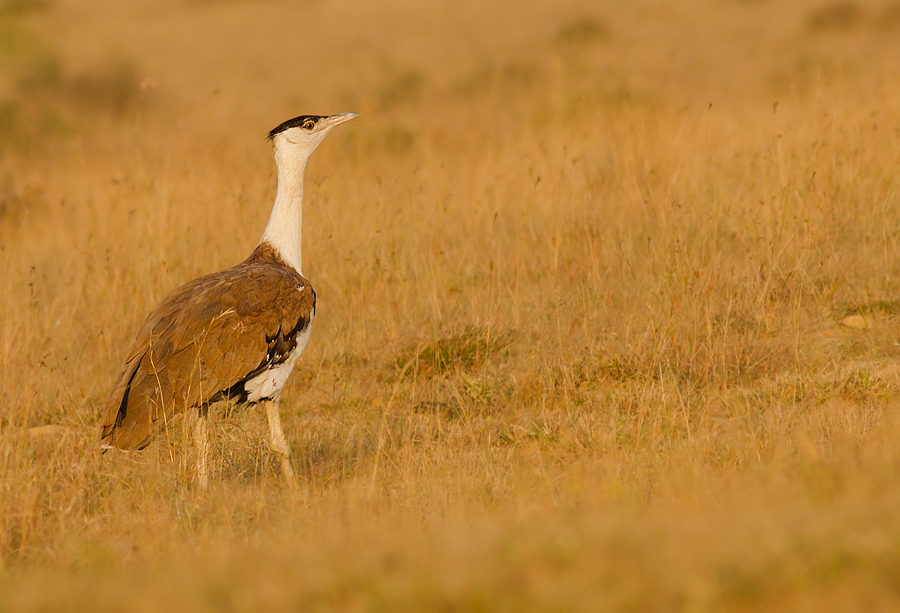
Great Indian Bustard
Conservation and Protection
Schedule I of the Indian Wildlife (Protection)Act, 1972
CMS Convention – Appendix I
CITES – Appendix I
IUCN status – Critically Endangered
National Wildlife Action Plan (2002-2016)
Historically, the great Indian bustard was distributed throughout Western India, spanning 11 states, as well as parts of Pakistan. Its stronghold was once the Thar desert in the north-west and the Deccan plateau of the peninsula. Today, its population is confined mostly to Rajasthan and Gujarat. Small population occur in Maharashtra, Karnataka and Andhra Pradesh.
It has also been identified as one of the species for the recovery programme under the Integrated Development of Wildlife Habitats of the Ministry of Environment and Forests, Government of India.
Threats
Hunting, which is still prevalent in Pakistan.
Occasional poaching outside Protected Areas
Collisions with high tension electric wires, fast moving vehicles and free-ranging dogs in villages
Habitat loss and alteration as a result of widespread agricultural expansion and mechanized farming, infrastructural development such as irrigation, roads, electric poles, as well as mining and industrialization.
While the GIBs’ historic range included much of the Indian sub-continent, it has now shrunk to just 10 per cent of that. Among the heaviest birds with flight, GIBs prefer grasslands as their habitats.
The terrestrial birds spend most of their time on the ground, feeding on insects, lizards, grass seeds, etc. GIBs are considered the flagship bird species of grassland and hence barometers of the health of grassland ecosystems.
News 6: India-U.S. exercise near LAC irks China
Background
China on Wednesday said it had expressed its concern to India over the joint India-U.S. military exercise, Yudh Abhyas, being conducted in Uttarakhand, about 100 km from the Line of Actual Control (LAC).
“The joint military exercise between India and the U.S. close to the LAC at the China-India border violates the spirit of the agreements signed between India and China in 1993 and 1996. It does not serve the mutual trust between India and China,” Chinese Foreign Ministry spokesperson Zhao Lijian told a media briefing in Beijing.
China’s concerns about the Yudh Abhyas exercise
China seeks to “prevent” tensions along the Line of Actual Control (LAC) from pushing India “to partner more closely” with the U.S. and has warned American officials “not to interfere” with its relationship with India, the U.S. Department of Defence said in its latest report.
Interests of China in matters of border instability
“Throughout the stand-off [which began in 2020], PRC [People’s Republic of China] officials sought to downplay the severity of the crisis, emphasising Beijing’s intent to preserve border stability and prevent the stand-off from harming other areas of its bilateral relationship with India,” the China military power report 2022, which was submitted to the U.S. Congress, said.
The report said that over the course of 2021, and as seen in 2022, the Chinese Communist Party (CCP) increasingly turned to the People’s Liberation Army (PLA) as “an instrument of statecraft in support of its national strategy and global ambitions”, while also highlighting that the PLA had “adopted more dangerous, coercive and aggressive actions” in the Indo-Pacific region.
“Differing perceptions of border demarcations along the LAC combined with recent infrastructure construction, led to multiple unarmed clashes, an ongoing stand-off, and military build-ups on both sides of the India-China border,” it said.
Galwan Valley Clash
Further, referring to the violent Galwan Valley clash of June 2020, which resulted in the death of 20 Indian soldiers and at least four Chinese personnel, the report said the Western Theatre Command conducted large-scale mobilisation and deployment of PLA forces.
The report said that each country demanded the withdrawal of the other’s forces and a return to the pre-stand-off conditions, but neither China nor India agreed to the conditions.
News 7: Why constitutional validity of J&K Reorganisation Act clause went unchallenged – SC
Background
The Supreme Court on Wednesday quizzed petitioners about the reason for not challenging the constitutional validity of a specific provision in the Jammu and Kashmir Reorganisation Act which gives the Delimitation Commission the power to “carry out” the readjustment of constituencies in the Union Territory formed after the dilution of Article 370 in the erstwhile State.
Hearings of the matter
Justice Oka said the notifications drew their power specifically from Section 62(2) of the 2019 Act. Section 62(2) provides for the readjustment of constituencies to be carried out by the Delimitation Commission.
The court asked why the petitioners without challenging the source of the government’s notifications, that is Section 62(2), had confined their challenge solely to the notifications.
The petitioners, represented by senior advocate Ravi Shankar Jandhyala and advocates Sriram Parakkat and M.S. Vishnu Shankar, argued that only the Election Commission (EC), under Section 60 of the 2019 Act, was empowered to conduct the delimitation exercise.
They further argued before the Bench that Article 170 of the Constitution barred delimitation exercise on the basis of the 2011 census. It had to either happen on the basis of 2001 census or await “the first census after the year 2026”, they argued.
The petitioners alleged that Sections 60 and 61 of the 2019 Act, which defined the role of the EC in the process of delimitation, were in contradiction to Section 62.
View of the Government
The government has countered that there were two alternative mechanisms to carry out delimitation for J&K. By virtue of Sections 60-61, while the power to determine delimitation was conferred on the EC, Section 62(2) and 62(3) conferred powers to carry out delimitation on the Commission.
News 8: Kerala’s man-animal conflict mitigation team selected for Wildlife Trust of India award
Background
An eight-member team from Chinnakkanal that comes under the Munnar forest division, which has been instrumental in bringing down the incidents of man-animal conflict in the region, has won recognition for its efforts.
Taking note of its contributions in mitigating man-animal conflicts as well as in ensuring the protection of wild elephants over the past eight months, the Wildlife Trust of India has selected the team for its award this year.
Wildlife Trust of India
Established: 1998
Headquarters: Noida, Uttar Pradesh
Type: Charitable trust
WTI was formed, as a response to the rapidly deteriorating condition of wildlife in India.
News 9: Kerala Cabinet allows Bill to remove Governor as Chancellor
Background
The Kerala Cabinet on Wednesday approved the draft Bill removing Governor Arif Mohammed Khan as Chancellor of the State universities after recurrent and politically charged run-ins with Raj Bhavan over matters relating to the administration of centres of higher learning.
Bill to supplant Governor as Chancellor
Instead, the Bill proposes supplanting the Governor with eminent academicians as Chancellors of various universities. The Bill, if passed, will, at a stroke, negate the Governor’s watchdog role in university administration and accord the government more leeway in appointing Chancellors of its choice.
The proposed legislation also aspires to amend the statutes of 14 universities. The Bill caps a season of taut political theatre following the Supreme Court’s invalidation of the KTU Vice-Chancellor’s appointment.
Mr. Khan had sought the resignations of 11 other Vice-Chancellors on the ground that the government had appointed them through the same process deemed unlawful by the apex court.
However, the government took a contrarian view and held it was legally anomalous to apply the Supreme Court ruling in an individual case broadly.
News 10: Are ransomware attacks increasing in India?
Background
On November 23, e-services at the All-India Institute of Medical Sciences (AIIMS) were crippled by what is being suspected to be a ransomware attack.
The Delhi Police’s Intelligence Fusion & Strategic Operations have registered a case and launched investigations to identify the perpetrators, while cyber security experts are employing software tools for data recovery.
What is ransomware?
Ransomware is a type of malicious software, used by cyber criminals, to infect a computer system by blocking access to the stored data by encrypting the files. A ransom is then demanded from the owner in exchange for the decryption key.
While it is not yet clear as to how exactly the AIIMS computer systems were targeted, the malware may usually be injected remotely by tricking the user into downloading it upon clicking an ostensibly safe web link sent via email or other means, including hacking.
It can spread throughout the network by exploiting existing vulnerabilities. Ransomware attacks can also be accompanied by theft of sensitive data for other sinister motives.
How serious are ransomware attacks?
Cybersecurity firm Trellix, in its third-quarter global report, has identified 25 major ransomwares in circulation.
According to the Interpol’s first-ever Global Crime Trend report presented at its 90th General Assembly meeting in Delhi this October, ransomware was the second highest-ranking threat after money laundering, at 66%. It is also expected to increase the most (72%).
Which agencies in India deal with cyber-attacks?
Set up in 2004, the Indian Computer Emergency Response Team (CERT-In) is the national nodal agency that collects, analyses and circulates inputs on cyber-attacks; issues guidelines, advisories for preventive measures, forecasts and issues alerts; and takes measures to handle any significant cyber security event. It also imparts training to computer system managers.
The National Cyber Security Coordinator, under the National Security Council Secretariat, coordinates with different agencies at the national level on cybersecurity issues, while the National Critical Information Infrastructure Protection Centre has been set up for the protection of national critical information infrastructure.
According to the government, the Cyber Swachhta Kendra (Botnet Cleaning and Malware Analysis Centre) has been launched for detection of malicious software programmes and to provide free tools to remove the same, while the National Cyber Coordination Centre works on creating awareness about existing and potential threats.
News 11: The Assam-Meghalaya border firing
Background
A bid by the Assam police and forest personnel to catch alleged timber smugglers from Meghalaya led to the killing of six people at a place claimed by each State to be within its territory.
Apart from heightening tensions along a stretch of the interstate boundary, the incident sparked protests and stray cases of violence in Meghalaya’s capital Shillong and a temporary suspension of vehicular movement between the two States. It also led to a delay in the process of resolving the Assam-Meghalaya boundary dispute.
What was the immediate fallout?
What seemed to be a local incident from far became fodder for pressure groups in poll-bound Meghalaya to rail against the Sangma-led coalition government for failing to protect border residents.
Stray cases of arson, vandalisation of Assam-registered vehicles, and attacks on security personnel and civilians — mostly non-tribals — marked the protests in Shillong. For six days after the incident, Assam police restricted the movement of vehicles to Shillong and other parts of eastern Meghalaya for security reasons.
Tourism in Meghalaya was hit hard in a year it had recorded the highest number of footfalls with many tourists cancelling their trips and some cutting short their stay to get out of uncertainty. The complications arising out of the Mukroh incident also delayed the process of resolving the boundary dispute between the two States in the remaining six of the 12 sectors.
How is the boundary dispute linked to the incident?
Although the Assam government claims to the contrary, the fact that the two governments refer to the place of the incident by two names makes it apparent that the boundary dispute is intertwined.
While Meghalaya says the place is Mukroh in West Jaintia Hills District, Assam claims it is Mukhrow or Moikrang in West Karbi Anglong district. The village is also very close to Block 1, one of the six dispute sectors that remain to be resolved.
Whatsoever may be the dispute between the two States, the NHRC said the police have to use restraint in such situations and examine the standard operating procedure for firing by the armed forces in areas of a border dispute.
How did the boundary dispute start?
Meghalaya, carved out of Assam as an autonomous State in 1970, became a full-fledged State in 1972. The creation of the new State was based on the Assam Reorganisation (Meghalaya) Act of 1969, which the Meghalaya government refused to accept.
This was because the Act followed the recommendations of a 1951 committee to define the boundary of Meghalaya. On that panel’s recommendations, areas of the present-day East Jaintia Hills, Ri-Bhoi and West Khasi Hills districts of Meghalaya were transferred to the Karbi Anglong, Kamrup (metro) and Kamrup districts of Assam.
Meghalaya contested these transfers after statehood, claiming that they belonged to its tribal chieftains. Assam said the Meghalaya government could neither provide documents nor archival materials to prove its claim over these areas.
After claims and counter-claims, the dispute was narrowed down to 12 sectors on the basis of an official claim by Meghalaya in 2011.
Other important news
100 monuments to be lit up to mark India’s G-20 Presidency
One hundred Centrally protected monuments will be illuminated for a week beginning Thursday when India assumes G-20 presidency for a year.
The monuments include Delhi’s Qutub Minar and Purana Qila, Fort Vellore in Tamil Nadu and the Golconda Fort in Hyderabad.
The other monuments on the list include the Sarnath and Dhamek stupas, Fatehpur Sikri and Sikandra in Agra, the Shore Temple in Mahabalipuram and the Charminar in Hyderabad.
The Jageshwar temple in Uttarakhand, the Hazarduari palace in Murshidabad in West Bengal and the Ancient Palace in Leh are also part of the list.
Receive Daily Updates
Recent Posts
- Lowering Emissions by Accelerating Forest Finance (LEAF) Coalition, a collective of the United States, United Kingdom and Norway governments, came up with a $1 billion fund.
- LEAF is supported by transnational corporations (TNCs) like Unilever plc, Amazon.com, Inc, Nestle, Airbnb, Inc as well as Emergent, a US-based non-profit.
- The world lost more than 10 million hectares of primary tropical forest cover last year, an area roughly the size of Switzerland.
- Ending tropical and subtropical forest loss by 2030 is a crucial part of meeting global climate, biodiversity and sustainable development goals. Protecting tropical forests offers one of the biggest opportunities for climate action in the coming decade.
- Tropical forests are massive carbon sinks and by investing in their protection, public and private players are likely to stock up on their carbon credits.
- The LEAF coalition initiative is a step towards concretising the aims and objectives of the Reducing Emissions from Deforestation and Forest Degradation (REDD+) mechanism.
- REDD+ was created by the United Nations Framework Convention on Climate Change (UNFCCC). It monetised the value of carbon locked up in the tropical forests of most developing countries, thereby propelling these countries to help mitigate climate change.
- It is a unique initiative as it seeks to help developing countries in battling the double-edged sword of development versus ecological commitment.
- The initiative comes at a crucial time. The tropics have lost close to 12.2 million hectares (mha) of tree cover last year according to global estimates released by Global Forest Watch.
- Of this, a loss of 4.2 mha occurred within humid tropical primary forests alone. It should come as no surprise that most of these lost forests were located in the developing countries of Latin America, Africa and South Asia.
- Brazil has fared dismally on the parameter of ‘annual primary forest loss’ among all countries. It has lost 1.7 mha of primary forests that are rich storehouse of carbon. India’s estimated loss in 2020 stands at 20.8 kilo hectares.
- Between 2002-2020, Brazil’s total area of humid primary forest reduced by 7.7 per cent while India’s reduced by 3.4 per cent.
- Although the loss in India is not as drastic as in Brazil, its position is nevertheless precarious. For India, this loss is equivalent to 951 metric tonnes worth carbon dioxide emissions released in the atmosphere.
- It is important to draw comparisons between Brazil and India as both countries have adopted a rather lackadaisical attitude towards deforestation-induced climate change. The Brazilian government hardly did anything to control the massive fires that gutted the Amazon rainforest in 2019.
- It is mostly around May that forest fires peak in India. However, this year India, witnessed massive forest fires in early March in states like Odisha, Uttarakhand, Madhya Pradesh and Mizoram among others.
- The European Union’s Copernicus Atmospheric Monitoring Service claimed that 0.2 metric tonnes of carbon was emitted in the Uttarakhand forest fires.
- Implementation of the LEAF Coalition plan will help pump in fresh rigour among developing countries like India, that are reluctant to recognise the contributions of their forest dwelling populations in mitigating climate change.
- With the deadline for proposal submission fast approaching, India needs to act swiftly on a revised strategy.
- Although India has pledged to carry out its REDD+ commitments, it is impossible to do so without seeking knowledge from its forest dwelling population.
Context:-
At the recently concluded Leaders’ Summit on Climate in April 2021, Lowering Emissions by Accelerating Forest Finance (LEAF) Coalition, a collective of the United States, United Kingdom and Norway governments, came up with a $1 billion fund plan that shall be offered to countries committed to arrest the decline of their tropical forests by 2030.
[wptelegram-join-channel link=”https://t.me/s/upsctree” text=”Join @upsctree on Telegram”]What is LEAF Coalition?
Why LEAF Coalition?
Brazil & India
According to the UN-REDD programme, after the energy sector, deforestation accounts for massive carbon emissions — close to 11 per cent — in the atmosphere. Rapid urbanisation and commercialisation of forest produce are the main causes behind rampant deforestation across tropical forests.
Tribes, Forests and Government
Disregarding climate change as a valid excuse for the fires, Indian government officials were quick to lay the blame for deforestation on activities of forest dwellers and even labelled them “mischievous elements” and “unwanted elements”.
Policy makers around the world have emphasised the role of indigenous tribes and local communities in checking deforestation. These communities depend on forests for their survival as well as livelihood. Hence, they understand the need to protect forests. However, by posing legitimate environmental concerns as obstacles to real development, governments of developing countries swiftly avoid protection of forests and rights of forest dwellers.
For instance, the Government of India has not been forthcoming in recognising the socio-economic, civil, political or even cultural rights of forest dwellers. According to data from the Union Ministry of Tribal Affairs in December, 2020 over 55 per cent of this population has still not been granted either individual or community ownership of their lands.
To make matters worse, the government has undertaken systematic and sustained measures to render the landmark Scheduled Tribes and Other Traditional Forest Dwellers (Recognition of Forest Rights) Act, 2006 ineffective in its implementation. The Act had sought to legitimise claims of forest dwellers on occupied forest land.
Various government decisions have seriously undermined the position of indigenous people within India. These include proposing amendments to the obsolete Indian Forest Act, 1927 that give forest officials the power to take away forest dwellers’ rights and to even use firearms with impunity.
There is also the Supreme Court’s order of February, 2019 directing state governments to evict illegal encroachers of forest land or millions of forest dwellers inhabiting forests since generations as a measure to conserve wildlife. Finally, there is the lack of data on novel coronavirus disease (COVID-19) deaths among the forest dwelling population;
Tardy administration, insufficient supervision, apathetic attitude and a lack of political intent defeat the cause of forest dwelling populations in India, thereby directly affecting efforts at arresting deforestation.
Way Forward
Tuntiak Katan, a global indigenous leader from Ecuador and general coordinator of the Global Alliance of Territorial Communities, aptly indicated the next steps at the Climate Summit:
“The first step is recognition of land rights. The second step is the recognition of the contributions of local communities and indigenous communities, meaning the contributions of indigenous peoples.We also need recognition of traditional knowledge practices in order to fight climate change”
Perhaps India can begin by taking the first step.