


The Priority Species and Critical regions of India
Asian Elephants

Habitat and distribution
In India, the Asian elephant was once widely distributed throughout the country, including in states like Punjab and Gujarat. Currently, they are found in four fragmented populations, in south, north, central and north-east India. Extreme habitat generalists, their habitat ranges from wet tropical evergreen forests to semi-arid thorn and scrub forests. However, highest densities of the elephant population are found in tropical deciduous forests. Elephants are ‘mega-herbivores’ that require vast tracts of forests, rich in food and water to survive.
Historically, Indians have through their long association with captive elephants that go back 4,000-5,000 years developed strong cultural and religious links with these mega herbivores. This makes elephants an excellent flagship species in generating public support for their conservation. Owing to their diverse range of habitats and large home ranges, elephants help protect the biodiversity within their range. Even their large dietary requirements enable elephants to have a significant impact on the trees and other vegetation, which results in a modification of their habitat. Thus their conservation could help maintain the biological diversity and ecological integrity of large forest tracts.
Bengal Tigers

At the turn of the 20th century, it is estimated that India probably had many thousands of tigers in the wild.The Wildlife Institute of India (WII) and the National Tiger Conservation Authority (NTCA), Government of India, have been conducting tiger estimation surveys in partnership with NGOs. WWF-India was the key NGO partner of the WII and NTCA in conducting the comprehensive country-wide tiger estimation exercise in 2010-11, which revealed a mean tiger population estimate of 1,706.
Based on a census using the pug mark technique, the number of tigers in 2002 stood at 3,642. As per the 2008 tiger estimation exercise conducted by WII in association with the NTCA using camera traps, there were only 1,411 tigers left in the wild in India.
The tiger is not just a charismatic species or just another wild animal living in some far away forest.
The tiger is a unique animal which plays a pivotal role in the health and diversity of an ecosystem. It is a top predator which is at the apex of the food chain and keeps the population of wild ungulates in check, thereby maintaining the balance between prey herbivores and the vegetation upon which they feed. Therefore, the presence of tigers in the forest is an indicator of the well being of the ecosystem. The extinction of this top predator is an indication that its ecosystem is not sufficiently protected, and neither would it exist for long thereafter.
If the tigers go extinct, the entire system would collapse.
For e.g. when the Dodos went extinct in Mauritius, one species of Acacia tree stopped regenerating completely. So when a species goes extinct, it leaves behind a scar, which affects the entire ecosystem. Another reason why we need to save the tiger is that our forests are water catchment areas.
Therefore, it’s not just about saving a beautiful animal. It is about making sure that we live a little longer as the forests are known to provide ecological services like clean air, water, pollination, temperature regulation etc.
What are white tigers?
A centennial event! Tiger numbers have finally increased!
The number of tigers in the wild is now 3,890! This updated minimum figure, compiled from IUCN data and the latest national tiger surveys, indicates an increase on the 2010 estimate of ‘as few as 3,200’, a first ever in the last 100 years.
With every tiger, we protect around 25,000 acres of forest.
When tigers are protected, we save so much more. As a large predator, the tiger shapes the ecosystem in which it lives.
One Horned Rhino
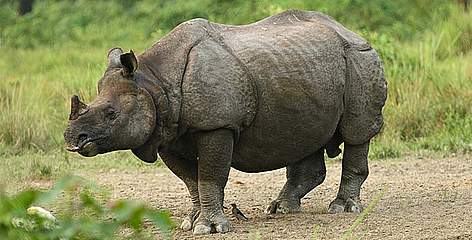
The Indian rhino has a single horn, which is present in both sexes. It is the largest of all the Asian rhinos. Considered to be the most amphibious of all the rhino species, the Indian rhino is an excellent swimmer. It can run at speeds of up to 55km/hr for short periods of time. Though it has an excellent sense of hearing and smell, its eyesight is relatively poor.The animal is solitary as a rule, though several may occupy the same patch of forest or water hole.
Habitat and distribution
The preferred habitat of an Indian rhinoceros is alluvial flood plains and areas containing tall grasslands along the foothills of the Himalayas. Formerly, extensively distributed in the Gangetic plains, today the species is restricted to small habitats in Indo-Nepal terai and northern West Bengal and Assam. In India, rhinos are mainly found in Kaziranga NP, Pobitara WLS, Orang NP, Manas NP in Assam, Jaldapara NP and Garumara NP in West Bengal and Dudhwa TR in Uttar Pradesh.
Indian Rhino Vision 2020
An ambitious plan to expand the distribution of Assam’s state animal, the greater one-horned rhinoceros, took yet another big leap, with the translocation of two rhinos from the Kaziranga National Park to the Burachopari Wildlife Sanctuary on 29 March 2016.
This operation was part of the Indian Rhino Vision 2020 (IRV 2020) programme launched by the Assam Forest Department in partnership with WWF-India, the International Rhino Foundation and US Fish & Wildlife Service in 2005.
The programme aims at increasing the number and range of rhinos in Assam through wild-to-wild translocations from Kaziranga National Park and Pobitora Wildlife Sanctuary to potential Protected Areas including Manas National Park, Burachapori Wildlife Sanctuary, Laokhowa Wildlife Sanctuary, and Dibru-Saikhowa National Park. The vision is to attain a population of 3000 wild rhinos in Assam, distributed over seven of its Protected Areas by 2020.
Snow Leopard

Habitat and distribution
Snow leopards live in the mountainous regions of central and southern Asia. In India, their geographical range encompasses a large part of the western Himalayas including the states of Jammu and Kashmir, Himachal Pradesh, Uttarakhand and Sikkim and Arunachal Pradesh in the eastern Himalayas. The last three states form part of the Eastern Himalayas – a priority global region of WWF and the Living Himalayas Network Initiative
Snow leopards prefer steep, rugged terrains with rocky outcrops and ravines. This type of habitat provides good cover and clear view to help them sneak up on their prey. They are found at elevations of 3,000-5,000 metres or higher in the Himalayas.
Status
The snow leopard is listed as Endangered on the IUCN-World Conservation Union’s Red List of the Threatened Species. In addition, the snow leopard, like all big cats, is listed on Appendix I of the Convention on International Trade of Endangered Species (CITES), which makes trading of animal body parts (i.e., fur, bones and meat) illegal in signatory countries. It is also protected by several national laws in its range countries.
Red Panda

Smooth-coated otter

Habitat and Distribution
Smooth-coated otter is distributed throughout the country from the Himalayas and to the south in India. It is sympatric with other otter species in the Western Ghats and the northeast India.
Smooth-coated otters are found in areas where freshwater is plentiful, preferring shallow and placid waters— wetlands and seasonal swamps, rivers, lakes, and rice paddies. Where they are the only species of otter, they may be found in almost any suitable habitat, but where they are sympatric with other species, they avoid smaller streams and canals in favour of larger bodies of water. Although they are often found in saltwater near the coast, especially on smaller islands, they require a nearby source of freshwater.
Major threats to Asian otter population are loss of wetland habitats due to construction of largescale hydroelectric projects, conversion of wetlands for settlements and agriculture, reduction in prey biomass, poaching and contamination of waterways by pesticides. Poaching for pelt and other body parts that are believed to possess therapeutic properties. Few nomadic hunting tribes eat otter flesh. Reductions in prey biomass (fish stocks) and infrastructural developments have led to disappearance of otters from the many streams and rivers which were once major otter habitats.
Ganges river dolphin

Habitat and Distribution
Ganges river dolphins prefer deep waters, in and around the confluence of rivers. The distribution range of the Ganges river dolphins in India covers seven states namely, Assam, Uttar Pradesh, Madhya Pradesh, Rajasthan, Bihar, Jharkhand and West Bengal. The upper Ganga River (in Uttar Pradesh), Chambal River (Madhya Pradesh and Uttar Pradesh), Ghaghra and Gandak Rivers (Bihar and Uttar Pradesh), Ganga River, from Varanasi to Patna (Uttar Pradesh and Bihar), Son and Kosi rivers (Bihar), Brahmaputra from Sadia (foothills of Arunachal Pradesh) upto Dhubri (on the Bangladesh border) and Kulsi River, a tributary of the Brahmaputra River, form ideal habitats for the Ganges river dolphin.
Once present in tens of thousands of numbers, the Ganges river dolphin has dwindled abysmally to less than 2000 during the last century owing to direct killing, habitat fragmentation by dams and barrages and indiscriminate fishing. It is for these reasons that despite high level of protection, its numbers continue to decline. The absence of a coordinated conservation plan, lack of awareness and continuing anthropogenic pressure, are posing incessant threats to the existing dolphin population.
Nilgiri tahr

Habitat and Distribution
The Nilgiri tahr inhabits the open montane grassland habitats at elevations from 1200 to 2600 m (generally above 2000 m) of the South Western Ghats. Their range extends over 400 km from north to south, and Eravikulam National Park is home to the largest population. The other significant concentration is in the Nilgiri Hills, with smaller populations in the Anamalai Hills, Periyar National Park, Palani Hills and other pockets in the Western Ghats south of Eravikulam, almost to India’s southern tip.
Nilgiri tahrs exist only in small, isolated populations due to extreme habitat fragmentation and illegal hunting. They are, as a result, vulnerable to local extinction. The reasons for the decline of tahr populations have not been fully understood. Despite several studies over the years, there are only rough estimations of Nilgiri tahr populations. The species has always been under severe stress on account of the construction of numerous hydroelectric projects, timber felling and monoculture plantation of eucalyptus and wattles. All these development activities, especially the plantation activities affect the heart of the tahr habitat, which are the grasslands – sholas.
Sarus Crane

The Sarus crane is the tallest flying bird in the world standing 152-156 cm tall with a wingspan of 240cm
Habitat and distribution
The Sarus crane has three disjunct populations in the Indian sub-continent, south-east Asia and northern Australia with an estimated global population of 25,000-37,000 individuals. In the Indian subcontinent, it is found in northern and central India, Terai Nepal and Pakistan. It was once a common site in the paddy fields of Uttar Pradesh, Bihar, Rajasthan, West Bengal, Gujarat, Madhya Pradesh and Assam. Their population is now on the decline with only 15,000-20,000 found in India, a majority of which are in Uttar Pradesh. The Sarus crane is known for its ability to live in association with humans, inhabiting open, cultivated, well watered plains, marshlands and jheels. These areas suit them well for foraging, roosting and nesting.
The main threat to the Sarus crane in India is habitat loss and degradation due to draining the wetland and conversion of land for agriculture. The landscape of its historic range is rapidly changing due to construction of highways, housing colonies, roads, and railway lines. More recently, many deaths have been recorded due to collision with power lines. Also, due to the increase in agricultural land, Sarus cranes are left with no choice but to forage in these fields, and as a result ingest pesticides, which lead to poisoning.
Black Necked Crane

Habitat and Distribution
The high altitude wetlands in the Tibetan plateau are the main breeding ground of the species. These wetlands with small mounds provide an excellent habitat to the birds for breeding. These birds winter at lower altitudes where they feed mainly on the leftovers in rice and potato fields. This species is found in India, China and Bhutan and breeds in high altitude wetlands in the Tibetan plateau at elevations of 2950-4900 m above mean sea level. High altitude marshes and lakes of Tibetan Plateau (Tibet, Qinghai, Xinjiang, Gansu), Sichuan (China), and eastern Ladakh (India) are the known breeding grounds of black-necked crane. The major wintering flocks are in Tibet, Yunnan and Guizhou (China) and Bhutan (Phobjika and Bomdaling Valleys). A small wintering population is also found in Sangti and Zimithang valleys of Arunachal Pradesh in India.
The major threat to the successful breeding of black-necked crane is the damage to the eggs and chicks, caused by feral dogs. These dogs are owned both by armed forces as well as by the local nomads. Another threat to the bird is the loss of habitat. The human pressure on the wetlands, the primary habitat of cranes, has increased tremendously over the last decade. The increased grazing pressure on the limited pastures near the wetlands is also leading to the degradation of the wetland habitat.
Sundarbans

Satpura Maikal landscape

Satpuda Maikal Landscape (SML) sprawls across 19 districts in the states of Madhya Pradesh, Maharashtra and Chhattisgarh covering a total area of 1,43,551km2. Of this, roughly 40,837km2 is under forest cover, with some of the country’s most famous tiger reserves and Protected Areas. This landscape supports 30 per cent of the world’s tiger population and 17 per cent of India’s tiger population with some of the largest contiguous forested tracks connected through wildlife corridors. Some of the tiger reserves critical from a conservation standpoint in this landscape are Kanha, Satpuda, Pench, Melghat, Tadoba and Achanakmar.
Terai Arc Landscape

Western Ghats


Nilgiris Eastern Ghats Landscape
The Nilgiris Eastern Ghats Landscape (NEG) is the foremost elephant country of the subcontinent. It has the single largest contiguous population of Asiatic elephants in its range and holds the key to the long term survival of the species. Over 6,000 elephants live in the Nilgiri and Eastern Ghats Landscape which spreads over an area of about 12,000km2. Other large mammals found in the area are the gaur, sambar and tiger. The terrain of the landscape is mostly undulating with low hills. The area extends from the south of the Brahmagiri hills in Karnataka through the Wayanad plateau into the northern Nilgiri hill slopes and the Mysore plateau which links up to the Sigur plateau and the Moyar river valley.
The Moyar valley rises up the slopes of the Eastern Ghats leading into the Thalamalai plateau going up to the east of the Biligirirangan range into Bargur, Sathyamangalam and Madeshwaramalai up to the Cauvery River.
Southern Western Ghats Landscape
The Southern Western Ghats (SWG) cover an area of 7000km2 through the states of Kerala and Tamil Nadu and harbour a very rich floral and faunal biodiversity. It forms one of the largest contiguous blocks of ‘good’ forest cover in the Southern Western Ghats. This region harbours high levels of endemism and over 15 per cent is under the Protected Area network. Some of the important and unique habitat types found here include wet evergreen forests and sholas in the higher elevations. The Southern Western Ghats is also a priority terrestrial and freshwater ecoregion of the world.
North Bank landscape

Kaziranga-Karbi Anglong landscape

The Kaziranga-Karbi Anglong Landscape (KKL) is a vital site situated within the Indo-Burma biodiversity hotspot. KKL is spread over 25,000 km2 south of the Brahmaputra River in Assam, touching the neighbouring states of Meghalaya and Nagaland in north-eastern India. The vision for this biodiversity-rich and culturally-diverselandscape is to ensure that large mammals, especially tigers, elephants and rhinos persist in connected ranges with minimal wildlife-human conflict.
Kaziranga National Park, the biggest protected area (PA) in this landscape is connected with the rest of the landscape through four corridors, namely Panbari, Haldhibari, Amguri and Kanchanjhuri, which are facing anthropogenic pressures. This landscape has a population of about 2500 elephants – about half of Assam’s elephant population and more than 70 per cent of Assam’s tigers. In addition, this landscape boasts of more than 2,000 rhinos, comprising close to 90 per cent of the rhino population of India. This makes the area critical for protection and conservation of wildlife and their habitats.
The region is also endowed with rich ethnic diversity. The diverse cultural and traditional practices among the ethnic tribes and other communities contribute to a complex demographic structure throughout the landscape.
Khangchendzonga landscape

Khangchendzonga Landscape lies at the heart of the eastern Himalayas. It includes the state of Sikkim as well as northern West Bengal. The area lies in the shadow of the towering 8,585-metre Khangchendzonga peak – the third highest mountain in the world. ‘Khangchendzonga’ literally means five repositories of God’s treasure, namely gold, silver, gems, grains and Holy Scriptures.
This landscape is nestled in the Himalayan biodiversity hotspot. A wide variety of endemic and threatened species thrive here because of the variations in elevation, climate, vegetation and habitat type. It is listed among the world’s ten most critical centres for biodiversity and endemism, with a vast array of floral and faunal species. Over 220 water bodies are found in Sikkim, fed mostly with glacial melt water, which also are the main sources for rivers in the state
The northern part of this landscape is comprised of the mountainous state of Sikkim, which has about 82 per cent of its geographical area under forest jurisdiction. Darjeeling district and parts of Jalpaiguri in northern West Bengal constitute the southern part of this landscape. The total area of this landscape is less than 10,000 km2. Due to a wide range of altitudes here, between 150 metres and 8500 metres, this landscape boasts of a great variety of plants that range from tropical and temperate to alpine and tundra. This is one of the few regions in the world to exhibit such diversity in a small area. A great variety of wild animals found in this area include the Bengal tiger, Asian elephant, clouded leopard and gaur in the lowland areas and the red panda – Sikkim’s state animal, Asiatic black bear, goral, serow, snow leopard, Himalayan tahr, Tibetan gazelle, Tibetan argali, and musk deer are found in the higher reaches. Sikkim is also renowned for orchids. It is home to an impressive 695 species of butterflies of the 1438 butterfly species found in India.
Western Arunachal landscape

Western Indian tiger landscape
The Western Indian Tiger Landscape (WITL) is spread over an area of 30,000km2 across the states of Rajasthan and Madhya Pradesh at the intersection of the Aravalli and Vindhya mountain ranges, the oldest hill ranges of India. It comprises two tiger reserves, two national parks and nine wildlife sanctuaries, all connected to each other through wildlife corridors in the form of territorial forests, reserve forests and tributaries of the river Chambal.This landscape supports the westernmost population of the Bengal tigers in India, and the world
The famous Ranthambore Tiger Reserve holds the source population of tigers, which disperse into adjoining national parks and wildlife sanctuaries through the wildlife corridors, in search of new territory, food and mate\
The landscape is a mix of dense forests comprising mostly dhak trees, a species known to withstand long periods of drought and heat, and grasslands on plateaus. Old ruins, palaces and forts form the backdrop of these forests, which were once the private hunting grounds of the Maharajas of Jaipur. While the tiger is the top predator here, other endangered wildlife include, the leopard, striped hyena, caracal, jungle cat and the black buck. The forests and wildlife here are threatened by habitat degradation, habitat fragmentation, encroachment, poaching of tigers and prey species and human-wildlife conflict.
Bharatpur

One of the most important waterfowl refuges of the world, a Ramsar site and a World Heritage site, Keoladeo National Park (KNP) is known for its rich biological diversity.
It is a man-made and managed wetland and was notified as a bird sanctuary in 1956 and elevated to the status of a national park in 1982. The reserve, primarily used as a waterfowl hunting reserve while protecting Bharatpur from frequent floods also provided grazing grounds for village cattle.
This 29 km2 reserve, locally known as Ghana, is a mosaic of dry grasslands, woodlands, woodland swamps, and wetlands. These diverse habitats are home to over 366 bird species, 379 floral species, 50 species of fish, 13 species of snakes, five species of lizards, seven amphibian species, seven turtle species and a variety of other invertebrates. Every year thousands of migratory waterfowl visit the park for wintering and breeding. By virtue of being one of the best bird areas of Asia, KNP attracts over 100,000 visitors every year.
Receive Daily Updates
Recent Posts
- Lowering Emissions by Accelerating Forest Finance (LEAF) Coalition, a collective of the United States, United Kingdom and Norway governments, came up with a $1 billion fund.
- LEAF is supported by transnational corporations (TNCs) like Unilever plc, Amazon.com, Inc, Nestle, Airbnb, Inc as well as Emergent, a US-based non-profit.
- The world lost more than 10 million hectares of primary tropical forest cover last year, an area roughly the size of Switzerland.
- Ending tropical and subtropical forest loss by 2030 is a crucial part of meeting global climate, biodiversity and sustainable development goals. Protecting tropical forests offers one of the biggest opportunities for climate action in the coming decade.
- Tropical forests are massive carbon sinks and by investing in their protection, public and private players are likely to stock up on their carbon credits.
- The LEAF coalition initiative is a step towards concretising the aims and objectives of the Reducing Emissions from Deforestation and Forest Degradation (REDD+) mechanism.
- REDD+ was created by the United Nations Framework Convention on Climate Change (UNFCCC). It monetised the value of carbon locked up in the tropical forests of most developing countries, thereby propelling these countries to help mitigate climate change.
- It is a unique initiative as it seeks to help developing countries in battling the double-edged sword of development versus ecological commitment.
- The initiative comes at a crucial time. The tropics have lost close to 12.2 million hectares (mha) of tree cover last year according to global estimates released by Global Forest Watch.
- Of this, a loss of 4.2 mha occurred within humid tropical primary forests alone. It should come as no surprise that most of these lost forests were located in the developing countries of Latin America, Africa and South Asia.
- Brazil has fared dismally on the parameter of ‘annual primary forest loss’ among all countries. It has lost 1.7 mha of primary forests that are rich storehouse of carbon. India’s estimated loss in 2020 stands at 20.8 kilo hectares.
- Between 2002-2020, Brazil’s total area of humid primary forest reduced by 7.7 per cent while India’s reduced by 3.4 per cent.
- Although the loss in India is not as drastic as in Brazil, its position is nevertheless precarious. For India, this loss is equivalent to 951 metric tonnes worth carbon dioxide emissions released in the atmosphere.
- It is important to draw comparisons between Brazil and India as both countries have adopted a rather lackadaisical attitude towards deforestation-induced climate change. The Brazilian government hardly did anything to control the massive fires that gutted the Amazon rainforest in 2019.
- It is mostly around May that forest fires peak in India. However, this year India, witnessed massive forest fires in early March in states like Odisha, Uttarakhand, Madhya Pradesh and Mizoram among others.
- The European Union’s Copernicus Atmospheric Monitoring Service claimed that 0.2 metric tonnes of carbon was emitted in the Uttarakhand forest fires.
- Implementation of the LEAF Coalition plan will help pump in fresh rigour among developing countries like India, that are reluctant to recognise the contributions of their forest dwelling populations in mitigating climate change.
- With the deadline for proposal submission fast approaching, India needs to act swiftly on a revised strategy.
- Although India has pledged to carry out its REDD+ commitments, it is impossible to do so without seeking knowledge from its forest dwelling population.
- providing Dominion Status to India, i.e., equal partnership of the British Commonwealth of Nations;
- all Provinces (ruled by the British India government) and Indian States (ruled by Indian princes) should constitute one Indian Union by the British Constitution;
- the Constitution of India should be framed by an elected Constituent Assembly of Indian people but if any province (or Indian State) which was not prepared to accept the Constitution was to be free to retain its constitutional position which had existed at that time.
- Such provinces were to be free to enter separate constitutional arrangements.
- there should a Union of India consisting of British India and the States, which would have jurisdiction over subjects of Foreign Affairs, Defense and Communication;
- all residuary powers would belong to the Provinces and the States;
- the Union would have Executive and Legislature consisting of the representatives from the Provinces and the States but for decision relating to a major communal issue in the legislature a majority of representatives of two major communities would be present, and voting along with the majority of all members present and voting would be required;
- the provinces would be free to form Groups with executives and legislatures;
- and each group would be free to determine the Provincial Subjects which would be taken up by the Group organisation.
Context:-
At the recently concluded Leaders’ Summit on Climate in April 2021, Lowering Emissions by Accelerating Forest Finance (LEAF) Coalition, a collective of the United States, United Kingdom and Norway governments, came up with a $1 billion fund plan that shall be offered to countries committed to arrest the decline of their tropical forests by 2030.
[wptelegram-join-channel link=”https://t.me/s/upsctree” text=”Join @upsctree on Telegram”]What is LEAF Coalition?
Why LEAF Coalition?
Brazil & India
According to the UN-REDD programme, after the energy sector, deforestation accounts for massive carbon emissions — close to 11 per cent — in the atmosphere. Rapid urbanisation and commercialisation of forest produce are the main causes behind rampant deforestation across tropical forests.
Tribes, Forests and Government
Disregarding climate change as a valid excuse for the fires, Indian government officials were quick to lay the blame for deforestation on activities of forest dwellers and even labelled them “mischievous elements” and “unwanted elements”.
Policy makers around the world have emphasised the role of indigenous tribes and local communities in checking deforestation. These communities depend on forests for their survival as well as livelihood. Hence, they understand the need to protect forests. However, by posing legitimate environmental concerns as obstacles to real development, governments of developing countries swiftly avoid protection of forests and rights of forest dwellers.
For instance, the Government of India has not been forthcoming in recognising the socio-economic, civil, political or even cultural rights of forest dwellers. According to data from the Union Ministry of Tribal Affairs in December, 2020 over 55 per cent of this population has still not been granted either individual or community ownership of their lands.
To make matters worse, the government has undertaken systematic and sustained measures to render the landmark Scheduled Tribes and Other Traditional Forest Dwellers (Recognition of Forest Rights) Act, 2006 ineffective in its implementation. The Act had sought to legitimise claims of forest dwellers on occupied forest land.
Various government decisions have seriously undermined the position of indigenous people within India. These include proposing amendments to the obsolete Indian Forest Act, 1927 that give forest officials the power to take away forest dwellers’ rights and to even use firearms with impunity.
There is also the Supreme Court’s order of February, 2019 directing state governments to evict illegal encroachers of forest land or millions of forest dwellers inhabiting forests since generations as a measure to conserve wildlife. Finally, there is the lack of data on novel coronavirus disease (COVID-19) deaths among the forest dwelling population;
Tardy administration, insufficient supervision, apathetic attitude and a lack of political intent defeat the cause of forest dwelling populations in India, thereby directly affecting efforts at arresting deforestation.
Way Forward
Tuntiak Katan, a global indigenous leader from Ecuador and general coordinator of the Global Alliance of Territorial Communities, aptly indicated the next steps at the Climate Summit:
“The first step is recognition of land rights. The second step is the recognition of the contributions of local communities and indigenous communities, meaning the contributions of indigenous peoples.We also need recognition of traditional knowledge practices in order to fight climate change”
Perhaps India can begin by taking the first step.
INTRODUCTION:-
The Constitution of India was adopted on 26 November 1949, which means it was finalised by the Constituent Assembly on that day. But it became operative two months after its adoption, i.e., on 26 January 1950, which is also known as the date of its “commencement”.
[wptelegram-join-channel link=”https://t.me/s/upsctree” text=”Join @upsctree on Telegram”]However, some provisions of it, i.e., those relating to citizenship, elections, provisional Parliament, temporary and transitional provisions had become operative on 26 November 1949 itself. The reason for its commencement after two months of its adoption was to signify the January 26 as the original date of achievement of Independence.
It was this day, i.e. 26th January, in 1930 which the Indian National Congress (INC) had first celebrated as the Independence Day of India. It is important to note that the Constitution of India is product of a longdrawn process and deliberations.
EVOLUTION OF THE INDIAN CONSTITUTION 1858-1935
The Constitution of India embodies provisions providing basic democratic rights of human beings including the persons who are not Indian citizens. It also embodies provisions for the availability of institutions for legislation, execution and jurisdiction for the fulfilment these rights.
It presents a vision for social transformation and deepening of democracy in India. The process of evolution of democratic institutions and rights had started much before the Constituent Assembly really made the Constitution of India.
It, however, must be underlined that the features of democratic institutions and values which were introduced during the colonial period were meant to serve the colonial interests in contrast to the purpose of the provisions of the Constitution made by the Constituent Assembly of India.
Although the Indian Constitution was result of the deliberations (from December 9, 1947 to November 26, 1949) of the Constituent Assembly, some of its features had evolved over three quarters of a century through various Acts, i.e., from 1858 to 1935.
The Government of India Act, 1935, and Other Acts
With the transfer of power from the East India Company to the British Crown, the British Parliament got involved in managing affairs of India. For achieving this purpose, from 1858 till 1935, the colonial government introduced certain features of constitution or rules of governance through different Acts. The Government of India Act, 1935 was the most important among these Acts.
First of these other Acts was Government of India Act, 1858. It provided for a combination of centralised and decetralised power structure to govern India. The centralised structure was introduced in the areas which were under the direct control of the Crown. These areas were known as British India provinces or provinces. The decentralized structure was introduced in the areas which were not under the direct control of the Crown. These areas were ruled by the Indian princes, and were known as princely states or states.
Under this system, the princes had freedom to govern in all internal matters of their princely states, but they were subject to the British control. In the centralized structure of power which was introduced in the provinces, all powers to govern India vested in the Secretary of State for India (and through him in the Crown). He acted on behalf of the Crown.
He was assisted by a fifteen-member council of ministers.There did not exist separation of executive, legislative and judicial functions of government; these all were concentrated in the hands of the Secretary of State for India. In British India, the Secretary of State of India was assisted by the Viceroy, who was assisted by an executive council.
At the district level, the viceroy was assisted by a small number of British administrators. The provincial government did not have financial autonomy. In 1870 viceroy Lord Mayo ensured that all parts of provincial administration received due share of revenue to meet their needs.
The scope of political institutions in the provinces was expanded a little further following the introduction of Council of India Act, 1909. This Act introduced for the first time a “representative element” in British India, which included elected non-official members.This Act also introduced separate representation to Muslim community.
The Government of India Act 1919 devolved some authority to the provincial governments, retaining the control of the central government (unitary government) on them.It relaxed the control of the central government in a limited way. It divided the subjects for jurisdiction of administration and sources of revenue between centre and provinces.
Under this arrangement, the provincial government was given control on resources of revenue such as land, irrigation and judicial stamps. The provincial subjects were divided into “transferred’ and “reserved” categories.
The “transferred” subjects were governed by the governor, and “reserved” subjects were governed by the legislature. The governor (executive head) was not accountable to the legislature.
The Government of India Act, 1935 was different from the earlier Government of India Acts. Unlike the earlier Acts, the Government of India Act, 1935 also provided for provincial government enjoying provincial autonomy. It provided “safeguards” for minorities.
Such “safeguards” included provisions for separate representations to Muslims, Sikhs, the Europeans, Indian Christians and Anglo-Indians. This Act also provided for three lists of divisions of power between the federation (central government) and provinces: federal (central), concurrent and provincial.
The Act also provided for establishment of a federal court to adjudicate disputes between federation and provinces. The executive head of the provincial government was Governor, who enjoyed special power. Under the special power the Governor could veto the decisions of the provincial legislature.
He acted on behalf of the Crown, and was not a subordinate of the Governor-General (the changed designation of Viceroy). He enjoyed discretionary powers to exercise his “individual judgments” in certain matters. In such matters, he did not need to work under the advice of ministers: he was to act under the control of the Governor-General, and indeed the Secretary of the State.
He was also not accountable to the legislature but he was required to act on the advice of ministers, who were accountable to the legislature.
Government of India Act, 1935 also had provisions for setting up a central government consisting of representatives from the provinces(areas ruled by the British India government) and the states (the areas covered under princely states).Such government was supposed to be known as federal government because of composition with members both from provinces and the states.
However, the federal government could not be formed because there was no unanimity among the princes to join the federation; consent of all princes was essential for the formation of federation. Thus, only the provincial governments could be formed as per this Act.
And election to the provincial legislature as per the Government of India Act, 1935 was held in 1937. Following the election of 1937, provincial governments headed by the Indian National Congresswere formed in eight provinces. The Indian National Congress government resigned in 1937. Nevertheless, according to M. Govinda Rao and Nirvikar Singh (2005), the Government of India Act, 1935 provided a basis to the Constituent Assembly to make the Constitution.
The Nehru Report(1928): First Indian Initiative to Draft Constitution
As you have read above, attempts to introduce elements of constitution in British India through different Act since 1858 were made by the British rulers. Indians had no role in it.
The first attempt by Indians themselves to prepare a Constitution of India was made in the Nehru Report(1928).Earlier, effort by Indians was made in the name of the swaraj (self-rule) by leaders of Indian national movement during the non-cooperation movement in 1921-22.
The Nehru Report was known as such because it was named after the chairman of its drafting committee, Motilal Nehru. The decision to constitute the drafting committee was taken in the conference of the established All India parties. The principal among these parties included Indian National Congress, Swaraj Party and Muslim League. The Justice Party of Madras and Unionist Party of Punjab did not participate in this meeting.
The Nehru Report demanded universal suffrage for adults and responsible government both in the centre and in the provinces. It, however, supported the Dominion Status, not complete independence for India.
It meant that Indians would have freedom to legislate on certain limited matters under the control of the British India government. For this, the Nehru Report prepared list of central and provincial subjects, and fundamental rights. It also raised demands for universal suffrage for men and women adults.
Indeed, it was in 1934, a few years after the preparation of the Nehru report, that the Indian National Congress officially demanded a constitution of Indian people, without the interference of outsiders.
FORMATION OF THE CONSTITUENT ASSEMBLY
The Cripps Mission
Initially, the colonial authorities resisted the demand for creation of a Constitution of India. But with the change in the circumstances – the outbreak of the World War II and formation of the new Coalition (Labour-led) government in Britain, the British government was forced to acknowledge the urgency to solve the problem related to Constitution of Indians.
In 1942, the British government sent its cabinet member – Sir Stafford Cripps with the draft declaration on proposals (regarding formation of constitution for Indians) to be implemented at the end of the WW II provided both the Muslim League and the Indian National Congress had agreed to accept them.
The draft proposals of the Cripps Mission recommended the following:
Both the Indian National Congress and the Muslim League did not accept the proposals of the Cripps Mission. The Muslim League demanded that India should be divided on the communal lines and some provinces should form an independent state of Pakistan; and, there should be two Constituent Assemblies, one for Pakistan and another for India.
The Cabinet Mission
The British Indian government made several attempts to bridge the differences between the Indian National Congress and the Muslim League. But it was unsuccessful.
The British government sent another delegation of the Cabinet members, known as the Cabinet Delegation, which came to be known as the Cabinet Mission Plan. It consisted of three cabinet members – Lord Pathic Lawrence, Sir Stafford Cripps and Mr. A.V. Alexander.
The Cabinet Delegation also failed to bring the Indian National Congress and the Muslim League to an agreement. It, however, made its own proposal which was announced simultaneously on 16 May, 1946 in England as well as in India.
The Cabinet delegation made the following recommendations:
Election to the Constituent Assembly
Meanwhile, according to the proposals of the Cabinet Mission, the election to the Constituent Assembly was held in which members of both the Indian National Congress and the Muslim League were returned. The members of the Constituent Assembly were elected by the Provincial Legislative Assemblies.
However, differences between the Indian National Congress and the Muslim League arose on interpretation of “Group Clauses” of the Cabinet Mission.
The British government intervened at this stage and explained to the leaders in London that the contention of the Muslim League was correct. And on December 6, 1946, the British Government published a statement, which for the first time acknowledged the possibility of two Constituent Assemblies and two States.
As a result, when the Constituent Assembly first met on December 9, 1946, it was boycotted by the Muslim League, and it functioned without the participation of the Muslim League.
NATURE OF THE CONSTITUENT ASSEMBLY’S REPRESENTATION
It is often argued that the Constituent Assembly of India did not represent the masses of India because its representatives were not elected through the universal adult franchise. Rather they were indirectly elected by the restricted adult franchise confined to the elite sections of society – the educated and tax payers.
According to Granville Austin the reasons for the restricted franchise and indirect election to the Constituent Assembly members were spelled by the Cabinet Mission Plan. These were to avoid the cumbersome and slow progress in the process of Constitution making.
The Cabinet Mission provided for the indirect election to the Constituent Assembly by the elected members of the provincial legislature. The Indian National Congress agreed to this proposal of the Cabinet Mission forsaking the claim of adult franchise to hold election to the Constituent Assembly.
Despite having been elected through the restricted adult franchise, the Constituent Assembly represented different shades of opinions and religious communities of India. Austin observed that though there was a majority of the Indian National Congress in the Constituent Assembly, it had an “unwritten and unquestioned belief” that the Indian National Congress should represent social and ideological diversity.
There was also its “deliberate policy” that the representatives of various minority communities and viewpoints should be represented in the Constituent Assembly. The Constituent Assembly consisted of members with different ideological orientations, and three religious communities -Sikhs, Muslims and General (Hindus and all other communities like the Anglo-Indians, Parsis, etc).
In words of K. Santaram “There was hardly any shade of opinion not represented in the Assembly”. Majority of the Constituent Assembly members belonged to the Indian National Congress. It also included more than a dozen non-Indian National Congress members.
Some of these were A.K. Ayyer, H.N. Kunjru, N.G. Ayyanger, S.P. Mukherjee and Dr. B.R. Ambedkar. S.P. Mookerji represented the Hindu Mahasabha.
The Constituent Assembly included representatives from the Princely States as well. It needs to be underscored that Dr. Ambedkar was initially elected to the Constituent Assembly from Bengal as member of the Scheduled Caste Federation. But he lost this seat due to the partition of Bengal and was re-elected by the Bombay Indian National Congress (as a non-Indian National Congress candidate) at the request of the Indian National Congress High Command.
The Constituent Assembly sought to address concerns of every person irrespective of their social and cultural orientations. Before incorporating a provision in the constitution, it held elaborate deliberations. Thus, the members of the Constituent Assembly could overcome the limitations of having been elected by the restricted franchise.
The Constituent Assembly sought to accommodate universal values of democracy. The Constituent Assembly adopted several provisions from different constitutions of world and adapted them to the needs of India. In fact, Austin argues that while incorporating different provisions in the Constitution including those which were borrowed from other countries the Constituent Assembly adopted “two wholly Indian concepts” of resolving differences among its members, i.e., consensus and accommodation.
Most members of the Constituent Assembly participated in its proceedings. But these were twenty individuals who played the most influential role in the Assembly.
Some of them were Rajendra Prasad, Maulan Azad, Vallabhbhai Patel, Jawaharlal Nehru, Govind Ballabh Pant, P. Sitaramayya, A.K. Ayyar, N.G. Ayyangar, K.M. Munshi, Dr. B.R. Ambedkar and Satyanarayan Sinha. Though the Constituent Assembly was the sole forum where deliberations took place, yet the deliberations took place in coordination of three bodies – the Constituent Assembly, the Indian National Congress Party, and the interim government.
Some members of the Constituent Assembly were also members of other bodies at the same time. Austin said that “an oligarchy” of four – Nehru, Patel, Prasad and Azad had enjoyed unquestioned honour and prestige in the Assembly. They dominated the proceedings of the Constituent Assembly.Some of these were simultaneously in the government, Indian National Congress Party and the Constituent Assembly.
Prasad was President of Indian National Congress before becoming the President of the Constituent Assembly. Patel and Nehru were Prime Minister and Deputy Prime Minister respectively at the same time. They were part of the inner circles of the committees of the Constituent Assembly.
The Constitution Drafting Committee meticulously incorporated in the draft constitution the decisions of the Constituent Assembly. Dr. B.R. Ambedkar, chairman of the Drafting Committee played the leading role in drafting of the Constitution.
Acknowledging the pivotal role of Dr. Ambedkar, T.T. Krishnamachari, a member of the Drafting Committee, said in one of his speeches: “The House is perhaps aware that out of the seven members nominated by you, one had resigned from the house and was replaced. One had died and was not replaced. One was away in America and his place was not filled up, and another person was engaged in State Affairs, and there was a void to that extent. One or two people were far away from Delhi and perhaps reasons of health did not permit them to attend. So it happened ultimately that the burden of drafting this constitution fell upon Dr. Ambedkar and I have no doubt that we are grateful to him for having achieved this task in a manner which is undoubtedly commendable.”
Dr. Ambedkar on his part “gave much of credit” to S.N. Mukerjee – B.N. Rau’s and Ambedkar’s assistant, the Drafting Officer of the Assembly, “for the careful wording of the Constitution”.
THE ROLE OF THE CONSTITUENT ASSEMBLY IN THE MAKING OF INDIAN CONSTITUTION 1946-1949
The inaugural session of the Constituent Assembly was held on 9 December 1946. It was supposed to be attended by all 296 members but only 207 members could attend it because the Muslim League members absented from it.
As stated earlier, they had boycotted the Constituent Assembly. In this meeting, Acharya J.B. Kripalani requested Dr. Sachchidananda Sinha to be the temporary chairman of the House. The members passed a resolution on 10 December 1946 for election of a permanent chairman, and on 11 December 1946, Dr. Rajendra Prasad was elected as the permanent Chairman of the Constituent Assembly.
The Constituent Assembly divided its work among different committees for its smooth functioning. Some of the important committees were:
(a) Union Power Committee. It was chaired by Jawaharlal Nehru and had nine members;
(b) Committee on Fundamental Rights and Minorities. It had 54 members and Sardar Ballabh bhai Patel was its chairman;
(c) Steering Committee and its 3 members which included Dr. K.M. Munshi (chairman), Gopalaswami Iyangar and Bhagwan Das;
(d) Provincial Constitution Committee. It had 25 members with Sardar Patel as its chairman;
(e) Committee on Union Constitution. It had 15 members with Jawahalal Nehru as its chairman.
After discussing the reports of these committees, the Constituent Assembly appointed a Drafting Committee on 29 August 1947 under the chairmanship of Dr. B.R. Ambedakar. The draft was prepared by Sir B.N. Rau, Advisor to the Constituent Assembly.
A 7-member Committee was constituted to examine the draft. Dr. B.R. Ambedkar, who was Law Minister as well as chairman of the Drafting Committee piloted the draft in the Assembly. Dr. Ambedkar presented “Draft Constitution of India”. The “Draft Constitution” was published in February, 1948.
It was discussed by the Constituent Assembly clause by in its several sessions and was completed by October 17, 1949. This discussion was known as the second reading. The Constituent Assembly again met on 14 November 1949 to discuss the draft further or to give it a third reading.
It was finalised on 26 November 1949 after receiving the signature of the President of the Constituent Assembly. But it was January 26, 1950 which became the date of commencement of the Constitution.
SALIENT FEATURES OF THE CONSTITUION
The Indian Constitution has some salient features. These features give Indian Constitution a distinct identity. It is based on the features of different constitutions of the world. In the words of Dr. Ambedkar, The Indian constitution was prepared “after ransacking all the known Constitutions of the world”.
The chapter on Fundamental Rights is based on the American Constitution; the Parliamentary System has been adopted from the British Constitution; the Directive Principles of State Policy have been adopted from the constitution of Ireland; the Emergency provisions are based on the Constitution of Weimar (Germany) and Government of India Act, 1935.
The features which have been borrowed from other Constitutions have been modified in the light of the needs of our country. It is the longest written constitution. At the time of its formation, the constitution of India had 395 Articles and 8 Schedules. It ensures both Justiciable and Non-Justiciable Rights: Fundamental Rights and the Directive Principles of the State Policy.The constituent makers preferred universal adult franchise over the separate electorates.
Universal Adult Suffrage and Abolition of the Separate Electorate
After debating its draft list of Fundamental rights the Sub-Committee on Fundamental Rights did not recommend inclusion of all of them in the section III of the Constitution as the Fundamental Rights. Instead, it suggested that these should be incorporated in other places in the Constitution.
One such example is that of the Universal suffrage, and Secrete and periodic elections. The sub Committee agreed unanimously in favour of the Universal suffrage but suggested that it should not be part of the Fundamental Rights.
Accordingly, it was placed in the Article 326 of the Part XV on election.The word “universal”, however, is missing from the Article 326. But the fact that every adult citizen of the country is entitled to vote makes it practically a universal adult franchise.
In fact, before Indians really got the right to universal adult franchise, the prominent leaders of the Indian National movement strove for the abolition of the separate electorate in favour of the joint electorate.
The British had sought to continue separate electorate in India since the Morley-Minto reforms, 1909 till the Communal Award of 1932 in the Constitution.
The Communal Award aimed to accord separate electorate for Muslims, Europeans, Sikhs, Indian Christians and Anglo-Indians. It also provided for seats for the Depressed Classes which were to be filled in elections from special constituencies. In such constituencies only the depressed classes could vote.
In addition, the depressed classes were also entitled to vote in general constituencies. Gandhi opposed the recommendation of the notion of separate electorate for the depressed classes. In opposition to the proposal for separate electorate, he set on fast unto death in September 1932. Gandhi’s fast evoked opposition from Ambedkar. However, both Gandhi and Ambedkar reached compromise in Poona Pact.
According to the Poona Pact, seats were reserved for the depressed classes in the general constituencies. This resulted in the abolition of the separate electorate.The abolition of separate electorate got reflected in the reservation of seats in the legislative bodies Constitution.
CONCLUSION
The making of Indian Constitution largely consisted of two phases – 1858 to 1935 and 1946 to 1949. With the transfer of power from the East India Company to the British Crown, the British government introduced different elements of governance through different Acts.
These also included the elements of representation of Indians in the institutions of governance. The motive of the British to introduce them was to serve their colonial interests rather than to provide democratic rights to them. The provision for communal representation introduced through the Morley-Minto Reforms in 1909 and through the Communal Award in 1932 was opposed by the leaders of the Indian National Movement.
Gandhi’s fast resulted in the Poona Pact abolishing the separate electorate and in giving the reservation to the depressed classes in the provincial legislature. After the Indian National Congress emphasized the need for making of a Constitution of India by their own Constitient Assembly, the changed political situation following the Second World War and change of government in Britain, the British reluctantly realized the urgency for establishment of the Constituent Assembly of India for Indians.
The Constituent Assembly which was set up following the recommendations of the Cabinet Mission Plan was elected through the restricted adult franchise by the provincial assemblies. Despite having elected by the privileged sections of the society, the Constituent Assembly represented different shades of opinions and ideologies.
It also represented different social groups of India. The Constituent Assembly discussed all issues thoroughly before reaching decision on them. The decision and suggestions of different sub-Committees of the Constituent Assembly were finally incorporated in the Constitution of India.
The Constitution of India is a document which provides a vision for social change. The Constitution is an embodiment of principles of liberal democracy and secularism, with some elements of social democracy. It ensures protection of cultural, linguistic and religious rights of individuals and communities.