Budget Simplified :-
1. Government spending simplified
The Indian government has proposed to spend Rs.19,78,060 crore in the fiscal year 2016-17, which is 10.8% higher than Rs. 17,65,436 crore, revised estimates for previous year. Here is how the allocation is proposed to be distributed across ministries:
(The size of circles is proportional to the proposed amount)

2. Which ministry gained the most?
Proposed allocation to Ministry of Women and Child Development has increased by 313 per cent, from Rs. 747 crores in 2015-16 to Rs. 3,094 crores in 2016-17.
Ministry of Land Resources has been allocated Rs. 230.51, a 437 per cent increase from Rs. 43.71 crore last year.
A 13 per cent increase in Higher Education allocation, from Rs. 25,344 crore to Rs.28,765 crore.
Ministry of Civil Aviation has been allocated Rs. 2,590.68 crore, a 38 per cent decrease from Rs. 4,198 crore.
(All comparisons are between revised estimates for 2015-16 to budget estimates for 2016-17)
3. Comparison of BRICS Nations
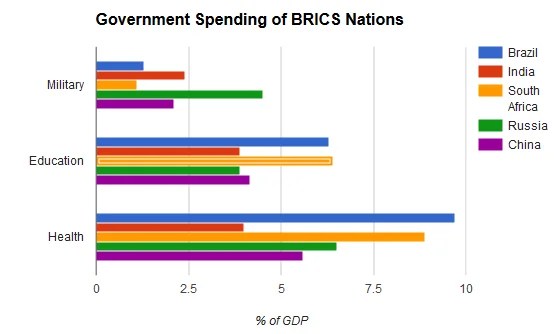
How does government spending vary across BRICS nations? BRICS is the acronym for the association of five major emerging economies – Brazil, Russia, India, China and South Africa. As the total government revenue varies widely among the BRICS nations, budgetary allocation to a sector as percentage of GDP is good indicator to compare government spending. Russia has the highest military allocation in percentage terms, followed by India and China. For education and health, India has the lowest allocation in percentage terms.
4. Subsidy subsides

Share of subsidies as proportion of total expenditure has decreased from 2012 onwards, when it reached a peak value of 18.23 per cent. In 2016-17, 12.66 per cent of spending — Rs. 2,50,432.93 crore — has been proposed for various subsidies.
5. Food eats up bulk of subsidy

A closer look at how subsidies are distributed across various sectors reveals that share of food subsidies has been the highest since 2013. Now, half of the total subsidy goes to food. Subsidy of petroleum has varied over time, perhaps due to fluctuating oil prices. Share of fertilisers in total subsidy has gone down from 43% in 2009 to 28% in 2016-17 budget estimates.
6. How does the government earn money?

Corporation tax and income tax together constitute one-third of the total government earnings.
7. How has the share of taxes changed?

Of the total tax — Rs. 16,30,887.81 crore — collected by the central government, corporation tax has the major share, though it has declined from 39 per cent in 2009-10 to estimated 30.2 per cent in 2016-17. On the other hand, the share of service tax has gradually increased, now contributing 14 per cent of total tax collected by the government.
8. More revenue forgone

From 2006-07, the government has released a statement of revenue that is forgone, which analyses the impact on government revenue due to the tax incentives available under the Central Tax system. For 2016-17, this amount is projected to be Rs. 6,11,128.31 crores — approximately a third of the total government revenue — higher than last year, when the impact on revenue was Rs. 5,54,349.04 crores.
In contrast, subsidies on various sectors amount to Rs. 2,50,432.93 crores in this year’s allocation.
Festival of Innovations:-
Background:-The three day Global Roundtable on Inclusive Innovation held as part of the ongoing ‘Festival of Innovations’ concluded at Rashtrapati Bhavan
The Gandhian Young Technological Innovation (GYTI) awards-2016 were conferred as part of the ‘Festival of Innovations’. The GYTI Awards is an initiative to foster youth driven innovations across India and were organised by the Society for Research and Initiatives for Sustainable Technologies and Institutions (SRISTI) with support from the Biotechnology Industry Research Assistance Council (BIRAC).
Scheme for new Entrepreneurs:-
a. Simplification and Handholding
· Simple Compliance Regime for startups based on Self-certification
· Launch of Mobile app and Portal for compliance and information exchange
· Startup India Hub to handhold startups during various phases of their development
· Legal support and fast-tracking patent examination at reduced costs
· Relaxed norms of public procurement for startups
· Faster exit for startups
b. Funding support and Incentives
· Providing funding support through a Fund of Funds with a corpus of Rupees 10,000 crore
· Credit guarantee fund for startups
· Tax exemption on capital gains invested in Fund of Funds
· Tax exemption to startups for 3 years
c. Industry-Academia Partnership and Incubation
· Organizing Startup Fests to showcase innovations and providing collaboration platforms
· Launch of Atal Innovation Mission (AIM) with Self –Employment and Talent Utilization (SETU) Program of NITI Aayog
· Harnessing private sector expertise for setting up incubators
· Setting up of 7 new research parks modeled on the Research Park at IIT Madras
· Launching of innovation focused programs for students.
· Annual Incubator Grand Challenge to promote good practices among incubators.
World Heritage Sites and Policy:-
Background :-
UNESCO, with the help of 21 member World Heritage Committee and advisory bodies such as International Council on Monuments and Sites (ICOMOS) and International Union for Conservation of Nature (IUCN), within the framework of its Operational Guidelines, decides about the cultural and natural sites to be included on the World Heritage list. Such cultural and natural sites must display the necessary Outstanding Universal Value (OUV), fulfill one or more out of 10 prescribed criteria (as given below), maintain the condition of authenticity and integrity and should be in a good state of conservation.
Criteria for the assessment of Outstanding Universal Value (OUV) as per UNESCO’s Operational Guidelines:-
- to represent a masterpiece of human creative genius;
- to exhibit an important interchange of human values, over a span of time or within a cultural area of the world, on developments in architecture or technology, monumental arts, town-planning or landscape design;
- to bear a unique or at least exceptional testimony to a cultural tradition or to a civilization which is living or which has disappeared;
- to be an outstanding example of a type of building, architectural or technological ensemble or landscape which illustrates (a) significant stage(s) in human history;
- to be an outstanding example of a traditional human settlement, land-use, or sea-use which is representative of a culture (or cultures), or human interaction with the environment especially when it has become vulnerable under the impact of irreversible change;
- to be directly or tangibly associated with events or living traditions, with ideas, or with beliefs, with artistic and literary works of outstanding universal significance. (The Committee considers that this criterion should preferably be used in conjunction with other criteria.
- to contain superlative natural phenomena or areas of exceptional natural beauty and aesthetic importance;
- to be outstanding examples representing major stages of earth’s history, including the record of life, significant ongoing geological processes in the development of landforms, or significant geomorphic or physiographic features;
- to be outstanding examples representing significant ongoing ecological and biological processes in the evolution and development of terrestrial, fresh water, coastal and marine ecosystems and communities of plants and animals;
- to contain the most important and significant natural habitats for in-situ conservation of biological diversity, including those containing threatened species of outstanding universal value from the point of view of science or conservation.
There are 32 sites from India declared as World Heritage properties as follows:-
CULTURAL SITES
(Under Protection of Archaeological Survey of India)
| S.No | Name of Site | State |
| 1. | Ajanta Caves (1983) | Maharashtra |
| 2. | Ellora Caves (1983) | Maharashtra |
| 3. | Agra Fort (1983) | Uttar Pradesh |
| 4. | Taj Mahal (1983) | Uttar Pradesh |
| 5. | Sun Temple, Konarak (1984) | Odisha |
| 6. | Group of Monuments at Mahabalipuram (1984) | Tamil Nadu |
| 7. | Churches and Convents of Goa (1986) | Goa |
| 8. | Group of Temples, Khajuraho (1986) | Madhya Pradesh |
| 9. | Group of Monuments at Hampi (1986) | Karnataka |
| 10. | Group of Monuments, FatehpurSikri (1986) | Uttar Pradesh |
| 11. | Group of Temples, Pattadakal (1987) | Karnataka |
| 12. | Elephanta Caves ( 1987) | Maharashtra |
| 13. | Great Living Chola temples at Thanjavur, Gangaikondacholapuram and Darasuram (1987 & 2004) | Tamil Nadu |
| 14. | Buddhist Monuments at Sanchi (1989) | Madhya Pradesh |
| 15. | Humayun’s Tomb, Delhi (1993) | Delhi |
| 16. | Qutb Minar Complex, Delhi (1993) | Delhi |
| 17. | Prehistoric Rock Shelters of Bhimbetka (2003) | Madhya Pradesh |
| 18. | Champaner-Pavagarh Archaeological Park (2004) | Gujarat |
| 19. | Red Fort Complex, Delhi (2007) | Delhi |
| 20. | Hill Forts of Rajasthan
(Chittaurgarh, Kumbhalgarh, Jaisalmer and Ranthambhore, Amber and Gagron Forts) (2013) (Amber and Gagron Forts are under protection of Rajasthan State Archaeology and Museums) |
Rajasthan |
| 21. | Rani ki Vav (2014) | Gujarat |
Under Protection of Ministry of Railways
| 22. | Mountain Railway of India ( Darjeeling,1999), Nilgiri (2005), Kalka-Shimla(2008) | West Bengal, Tamil Nadu, Himachal Pradesh |
| 23. | Chhatrapati Shivaji Terminus (formerly Victoria Terminus) (2004) | Maharashtra |
Under Protection of Bodhgaya Temple Management Committee
| 24. | Mahabodhi Temple, Bodhgaya (2002) | Bihar |
Under Protection of Rajasthan State Archaeology and Museums Department
| 25. | Jantar Mantar, Jaipur (2010) | Rajasthan |
NATURAL SITES
Under Protection of Ministry of Environment & Forest
| 26. | Kaziranga National Park (1985) | Assam |
| 27. | Manas Wild Life Sanctuary (1985) | Assam |
| 28. | Keoladeo National Park (1985) | Rajasthan |
| 29. | Sunderban National Park (1987) | West Bengal |
| 30. | Nanda Devi and Valley of Flowers National Parks (1988, 2005) | Uttarakhand |
| 31. | Western Ghats (2012) | Karnataka, Kerala, Maharashtra,Tamil Nadu |
| 32. | Great Himalayan National Park (2014) | Himachal Pradesh |
Garuda Shakti IV:-
Its a INDO- Indonesia Joint Training Exercise of Army.
Snapshot of Schemes related to Higher Education:-
1)National Institutional Ranking Framework (NIRF) :-
Under the NIRF, Educational Institutions will be ranked by an independent ranking Agency for which objective criteria has been developed. They shall be ranked separately in fields such as Engineering, Management, Pharma, Architecture etc
2)Impacting Research, Innovation & Technology (IMPRINT):-
Under the IMPRINT initiative, the Government has taken the initiative to address major engineering challenges through the collaborative efforts of the Indian Institutes of Technology (IITs) and Indian Institute of Science (IISc). Under this, a roadmap is finalised to pursue engineering challenges in ten technology domains that have large social impact.
3)Uchchtar Avishkar Yojna (UAY):-
The objectives of UAY scheme are to promote innovation in IITs addressing issues of manufacturing industries; to spur innovative mindset; to co-ordinate action between academia & industry and to strengthen labs & research facilities
4)Global Initiative of Academic Networks (GIAN):-
GIAN scheme is for facilitating partnership between Higher Educational Institutions of the country and other countries. The scheme is aimed at tapping international talent pool of scientists and entrepreneurs.
5)Rashtriya Uchchatar Shiksha Abhiyan (RUSA):-
For strategic funding and reforms in the State Higher Education sector.
Note :- Few News of importance are not yet published and will be published in the upcoming posts. The intention was not to make the post bulky or cumbersome, hence judicious distribution of News over the month/week is important.This has been considered after giving heed to the feedbacks from many of you.Thank you.
Receive Daily Updates
Recent Posts
Petrol in India is cheaper than in countries like Hong Kong, Germany and the UK but costlier than in China, Brazil, Japan, the US, Russia, Pakistan and Sri Lanka, a Bank of Baroda Economics Research report showed.
Rising fuel prices in India have led to considerable debate on which government, state or central, should be lowering their taxes to keep prices under control.
The rise in fuel prices is mainly due to the global price of crude oil (raw material for making petrol and diesel) going up. Further, a stronger dollar has added to the cost of crude oil.
Amongst comparable countries (per capita wise), prices in India are higher than those in Vietnam, Kenya, Ukraine, Bangladesh, Nepal, Pakistan, Sri Lanka, and Venezuela. Countries that are major oil producers have much lower prices.
In the report, the Philippines has a comparable petrol price but has a per capita income higher than India by over 50 per cent.
Countries which have a lower per capita income like Kenya, Bangladesh, Nepal, Pakistan, and Venezuela have much lower prices of petrol and hence are impacted less than India.
“Therefore there is still a strong case for the government to consider lowering the taxes on fuel to protect the interest of the people,” the report argued.
India is the world’s third-biggest oil consuming and importing nation. It imports 85 per cent of its oil needs and so prices retail fuel at import parity rates.
With the global surge in energy prices, the cost of producing petrol, diesel and other petroleum products also went up for oil companies in India.
They raised petrol and diesel prices by Rs 10 a litre in just over a fortnight beginning March 22 but hit a pause button soon after as the move faced criticism and the opposition parties asked the government to cut taxes instead.
India imports most of its oil from a group of countries called the ‘OPEC +’ (i.e, Iran, Iraq, Saudi Arabia, Venezuela, Kuwait, United Arab Emirates, Russia, etc), which produces 40% of the world’s crude oil.
As they have the power to dictate fuel supply and prices, their decision of limiting the global supply reduces supply in India, thus raising prices
The government charges about 167% tax (excise) on petrol and 129% on diesel as compared to US (20%), UK (62%), Italy and Germany (65%).
The abominable excise duty is 2/3rd of the cost, and the base price, dealer commission and freight form the rest.
Here is an approximate break-up (in Rs):
a)Base Price | 39 |
b)Freight | 0.34 |
c) Price Charged to Dealers = (a+b) | 39.34 |
d) Excise Duty | 40.17 |
e) Dealer Commission | 4.68 |
f) VAT | 25.35 |
g) Retail Selling Price | 109.54 |
Looked closely, much of the cost of petrol and diesel is due to higher tax rate by govt, specifically excise duty.
So the question is why government is not reducing the prices ?
India, being a developing country, it does require gigantic amount of funding for its infrastructure projects as well as welfare schemes.
However, we as a society is yet to be tax-compliant. Many people evade the direct tax and that’s the reason why govt’s hands are tied. Govt. needs the money to fund various programs and at the same time it is not generating enough revenue from direct taxes.
That’s the reason why, govt is bumping up its revenue through higher indirect taxes such as GST or excise duty as in the case of petrol and diesel.
Direct taxes are progressive as it taxes according to an individuals’ income however indirect tax such as excise duty or GST are regressive in the sense that the poorest of the poor and richest of the rich have to pay the same amount.
Does not matter, if you are an auto-driver or owner of a Mercedes, end of the day both pay the same price for petrol/diesel-that’s why it is regressive in nature.
But unlike direct tax where tax evasion is rampant, indirect tax can not be evaded due to their very nature and as long as huge no of Indians keep evading direct taxes, indirect tax such as excise duty will be difficult for the govt to reduce, because it may reduce the revenue and hamper may programs of the govt.
Globally, around 80% of wastewater flows back into the ecosystem without being treated or reused, according to the United Nations.
This can pose a significant environmental and health threat.
In the absence of cost-effective, sustainable, disruptive water management solutions, about 70% of sewage is discharged untreated into India’s water bodies.
A staggering 21% of diseases are caused by contaminated water in India, according to the World Bank, and one in five children die before their fifth birthday because of poor sanitation and hygiene conditions, according to Startup India.
As we confront these public health challenges emerging out of environmental concerns, expanding the scope of public health/environmental engineering science becomes pivotal.
For India to achieve its sustainable development goals of clean water and sanitation and to address the growing demands for water consumption and preservation of both surface water bodies and groundwater resources, it is essential to find and implement innovative ways of treating wastewater.
It is in this context why the specialised cadre of public health engineers, also known as sanitation engineers or environmental engineers, is best suited to provide the growing urban and rural water supply and to manage solid waste and wastewater.
Traditionally, engineering and public health have been understood as different fields.
Currently in India, civil engineering incorporates a course or two on environmental engineering for students to learn about wastewater management as a part of their pre-service and in-service training.
Most often, civil engineers do not have adequate skills to address public health problems. And public health professionals do not have adequate engineering skills.
India aims to supply 55 litres of water per person per day by 2024 under its Jal Jeevan Mission to install functional household tap connections.
The goal of reaching every rural household with functional tap water can be achieved in a sustainable and resilient manner only if the cadre of public health engineers is expanded and strengthened.
In India, public health engineering is executed by the Public Works Department or by health officials.
This differs from international trends. To manage a wastewater treatment plant in Europe, for example, a candidate must specialise in wastewater engineering.
Furthermore, public health engineering should be developed as an interdisciplinary field. Engineers can significantly contribute to public health in defining what is possible, identifying limitations, and shaping workable solutions with a problem-solving approach.
Similarly, public health professionals can contribute to engineering through well-researched understanding of health issues, measured risks and how course correction can be initiated.
Once both meet, a public health engineer can identify a health risk, work on developing concrete solutions such as new health and safety practices or specialised equipment, in order to correct the safety concern..
There is no doubt that the majority of diseases are water-related, transmitted through consumption of contaminated water, vectors breeding in stagnated water, or lack of adequate quantity of good quality water for proper personal hygiene.
Diseases cannot be contained unless we provide good quality and adequate quantity of water. Most of the world’s diseases can be prevented by considering this.
Training our young minds towards creating sustainable water management systems would be the first step.
Currently, institutions like the Indian Institute of Technology, Madras (IIT-M) are considering initiating public health engineering as a separate discipline.
To leverage this opportunity even further, India needs to scale up in the same direction.
Consider this hypothetical situation: Rajalakshmi, from a remote Karnataka village spots a business opportunity.
She knows that flowers, discarded in the thousands by temples can be handcrafted into incense sticks.
She wants to find a market for the product and hopefully, employ some people to help her. Soon enough though, she discovers that starting a business is a herculean task for a person like her.
There is a laborious process of rules and regulations to go through, bribes to pay on the way and no actual means to transport her product to its market.
After making her first batch of agarbathis and taking it to Bengaluru by bus, she decides the venture is not easy and gives up.
On the flipside of this is a young entrepreneur in Bengaluru. Let’s call him Deepak. He wants to start an internet-based business selling sustainably made agarbathis.
He has no trouble getting investors and to mobilise supply chains. His paperwork is over in a matter of days and his business is set up quickly and ready to grow.
Never mind that the business is built on aggregation of small sellers who will not see half the profit .
Is this scenario really all that hypothetical or emblematic of how we think about entrepreneurship in India?
Between our national obsession with unicorns on one side and glorifying the person running a pakora stall for survival as an example of viable entrepreneurship on the other, is the middle ground in entrepreneurship—a space that should have seen millions of thriving small and medium businesses, but remains so sparsely occupied that you could almost miss it.
If we are to achieve meaningful economic growth in our country, we need to incorporate, in our national conversation on entrepreneurship, ways of addressing the missing middle.
Spread out across India’s small towns and cities, this is a class of entrepreneurs that have been hit by a triple wave over the last five years, buffeted first by the inadvertent fallout of demonetization, being unprepared for GST, and then by the endless pain of the covid-19 pandemic.
As we finally appear to be reaching some level of normality, now is the opportune time to identify the kind of industries that make up this layer, the opportunities they should be afforded, and the best ways to scale up their functioning in the shortest time frame.
But, why pay so much attention to these industries when we should be celebrating, as we do, our booming startup space?
It is indeed true that India has the third largest number of unicorns in the world now, adding 42 in 2021 alone. Braving all the disruptions of the pandemic, it was a year in which Indian startups raised $24.1 billion in equity investments, according to a NASSCOM-Zinnov report last year.
However, this is a story of lopsided growth.
The cities of Bengaluru, Delhi/NCR, and Mumbai together claim three-fourths of these startup deals while emerging hubs like Ahmedabad, Coimbatore, and Jaipur account for the rest.
This leap in the startup space has created 6.6 lakh direct jobs and a few million indirect jobs. Is that good enough for a country that sends 12 million fresh graduates to its workforce every year?
It doesn’t even make a dent on arguably our biggest unemployment in recent history—in April 2020 when the country shutdown to battle covid-19.
Technology-intensive start-ups are constrained in their ability to create jobs—and hybrid work models and artificial intelligence (AI) have further accelerated unemployment.
What we need to focus on, therefore, is the labour-intensive micro, small and medium enterprise (MSME). Here, we begin to get to a definitional notion of what we called the mundane middle and the problems it currently faces.
India has an estimated 63 million enterprises. But, out of 100 companies, 95 are micro enterprises—employing less than five people, four are small to medium and barely one is large.
The questions to ask are: why are Indian MSMEs failing to grow from micro to small and medium and then be spurred on to make the leap into large companies?
At the Global Alliance for Mass Entrepreneurship (GAME), we have advocated for a National Mission for Mass Entrepreneurship, the need for which is more pronounced now than ever before.
Whenever India has worked to achieve a significant economic milestone in a limited span of time, it has worked best in mission mode. Think of the Green Revolution or Operation Flood.
From across various states, there are enough examples of approaches that work to catalyse mass entrepreneurship.
The introduction of entrepreneurship mindset curriculum (EMC) in schools through alliance mode of working by a number of agencies has shown significant improvement in academic and life outcomes.
Through creative teaching methods, students are encouraged to inculcate 21st century skills like creativity, problem solving, critical thinking and leadership which are not only foundational for entrepreneurship but essential to thrive in our complex world.
Udhyam Learning Foundation has been involved with the Government of Delhi since 2018 to help young people across over 1,000 schools to develop an entrepreneurial mindset.
One pilot programme introduced the concept of ‘seed money’ and saw 41 students turn their ideas into profit-making ventures. Other programmes teach qualities like grit and resourcefulness.
If you think these are isolated examples, consider some larger data trends.
The Observer Research Foundation and The World Economic Forum released the Young India and Work: A Survey of Youth Aspirations in 2018.
When asked which type of work arrangement they prefer, 49% of the youth surveyed said they prefer a job in the public sector.
However, 38% selected self-employment as an entrepreneur as their ideal type of job. The spirit of entrepreneurship is latent and waiting to be unleashed.
The same can be said for building networks of successful women entrepreneurs—so crucial when the participation of women in the Indian economy has declined to an abysmal 20%.
The majority of India’s 63 million firms are informal —fewer than 20% are registered for GST.
Research shows that companies that start out as formal enterprises become two-three times more productive than a similar informal business.
So why do firms prefer to be informal? In most cases, it’s because of the sheer cost and difficulty of complying with the different regulations.
We have academia and non-profits working as ecosystem enablers providing insights and evidence-based models for growth. We have large private corporations and philanthropic and funding agencies ready to invest.
It should be in the scope of a National Mass Entrepreneurship Mission to bring all of them together to work in mission mode so that the gap between thought leadership and action can finally be bridged.